
Is my foam hiding rot?
It can. Foam sprayed over a leak or a damp slope traps moisture against the rafters, so we check the timber before anyone talks about removal.
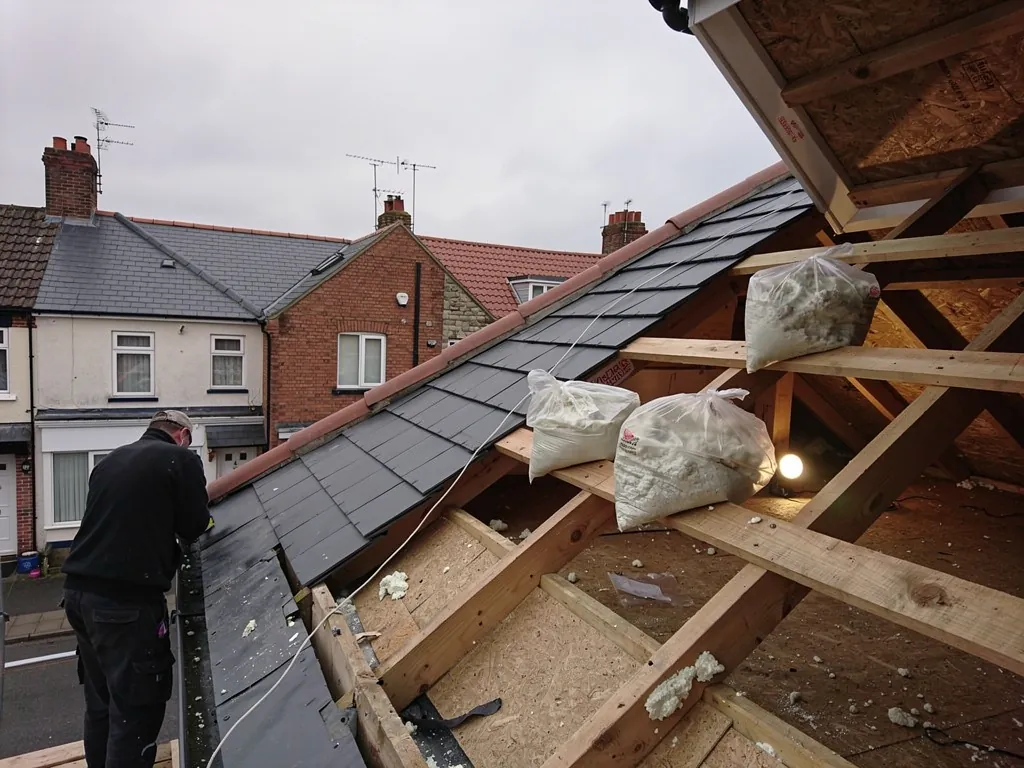
Foam under the roof that a surveyor, lender or leak has put in question, on a house anywhere in Swindon or north Wiltshire. We look at the timbers and the covering first, then plan the removal and the repairs, with photographs and a written quote.
It can. Foam sprayed over a leak or a damp slope traps moisture against the rafters, so we check the timber before anyone talks about removal.
That is the lender's decision, and positions differ. Ask yours in writing, and bring the roof assessment with you when you do.
Yes. Most of the first look happens from the loft, with moisture readings and photographs, before any covering is lifted.
| Job | Typical cost |
|---|---|
| Assessment of the foam and the roof | £100 to £200 |
| Removal of the foam | £20 to £50 per m² |
| Disposal of the waste foam | £150 to £400 |
| Roof repairs and new insulation afterwards | £500 to £3,000 |
| Scaffolding, where the roof work needs it | £500 to £1,500 |
These come from a published national guide and are not a price list of ours. Foam area, plus how sound the timber turns out to be, decide the total, and the figure that binds is the one in your written quote after the roof assessment.
MyBuilder spray foam insulation removal cost guide (updated August 2026).
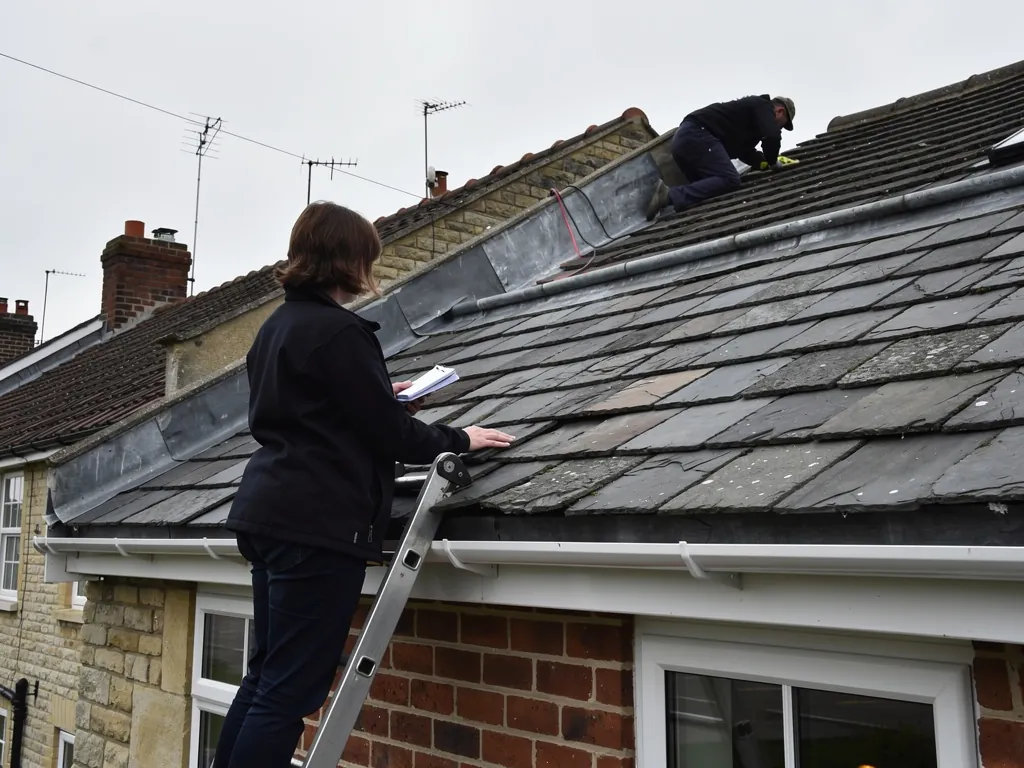
See all costs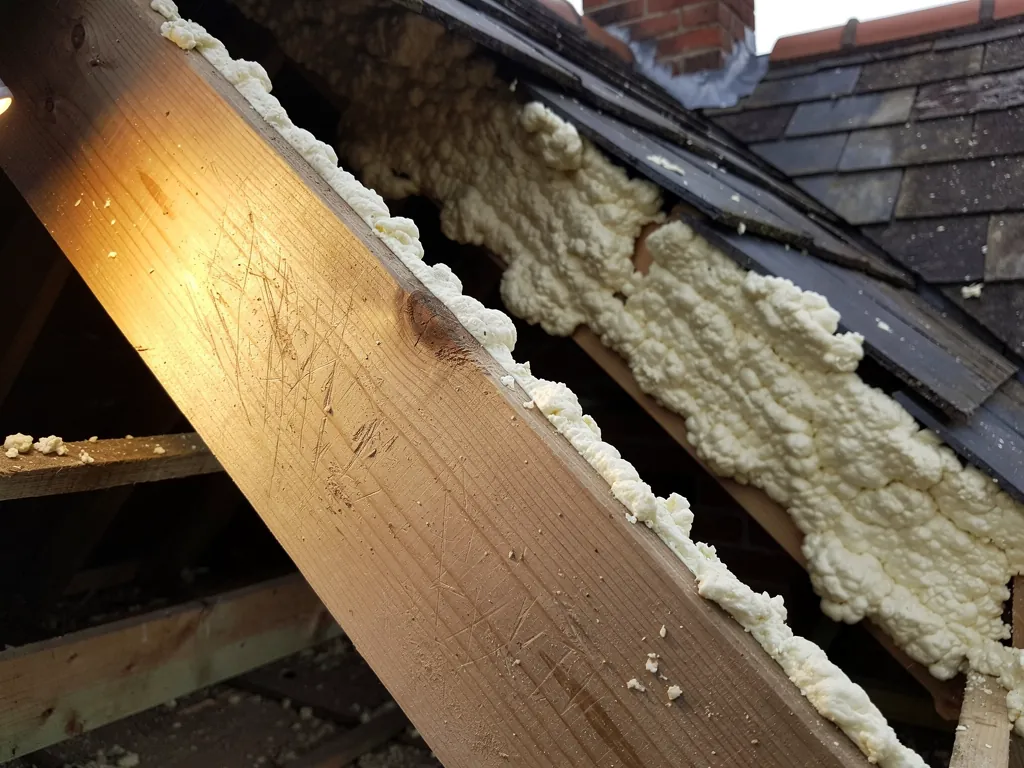 Roof assessmentA look at the foam, the rafters, the underlay and the covering from the loft and the roof, with moisture readings and photographs of anything doubtful.
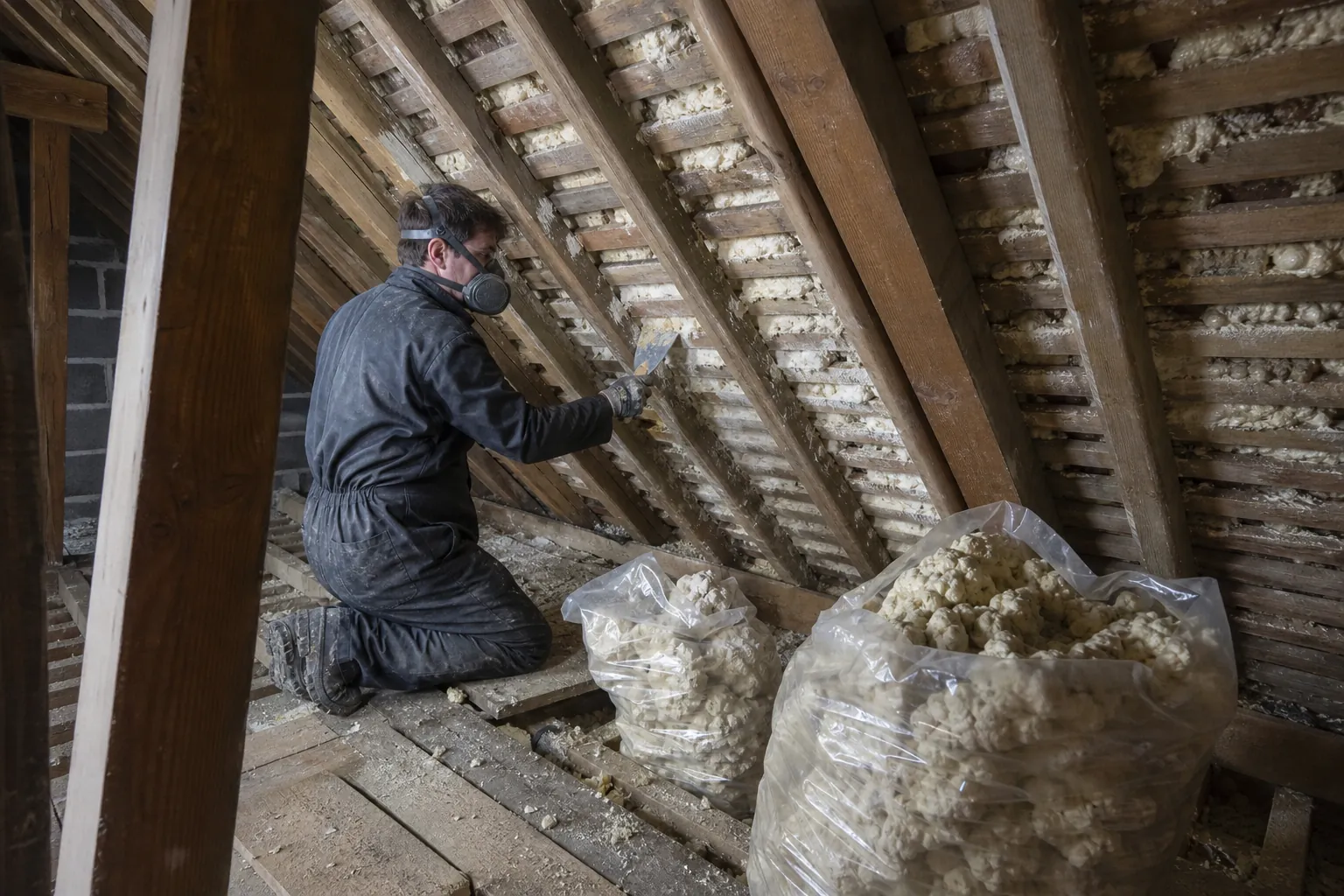
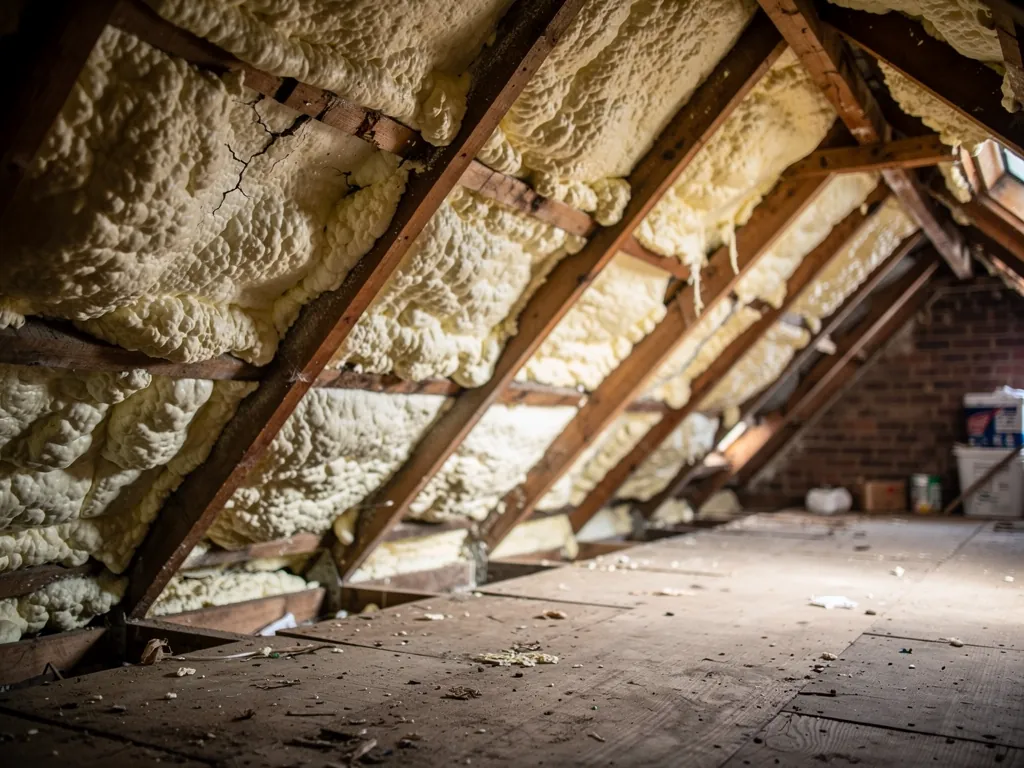 Foam removalThe foam is cut, scraped and extracted from the rafters and the underside of the covering, working so the slates, tiles and timber are not damaged.
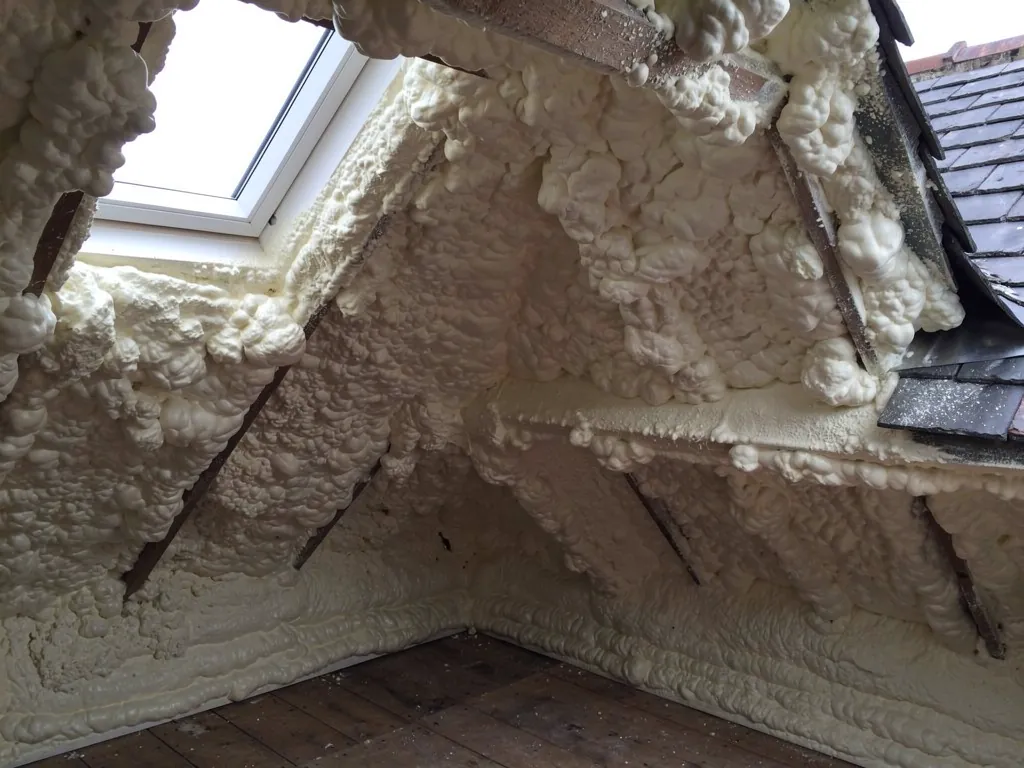 Waste and cleaningFoam waste is bagged, taken away and disposed of properly, and the roof space is cleaned so the timbers can be checked bare.
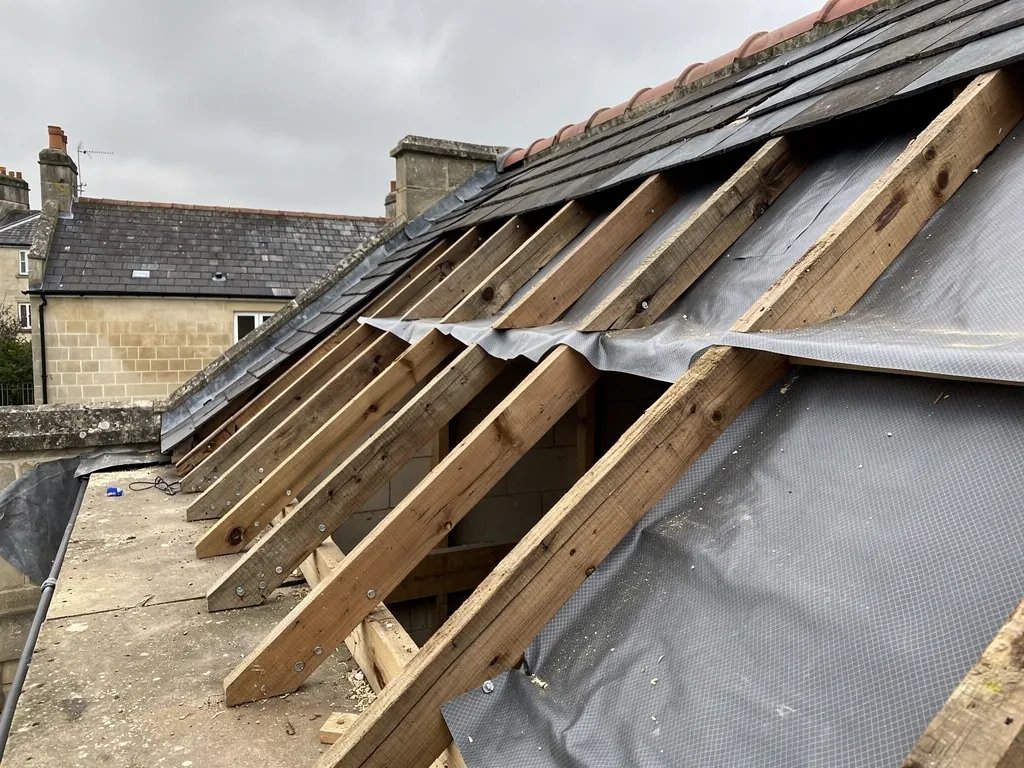 Timber inspectionOnce the foam is off, each rafter and batten is tested for soft spots, staining and fungal growth, and we photograph what we find for your records.
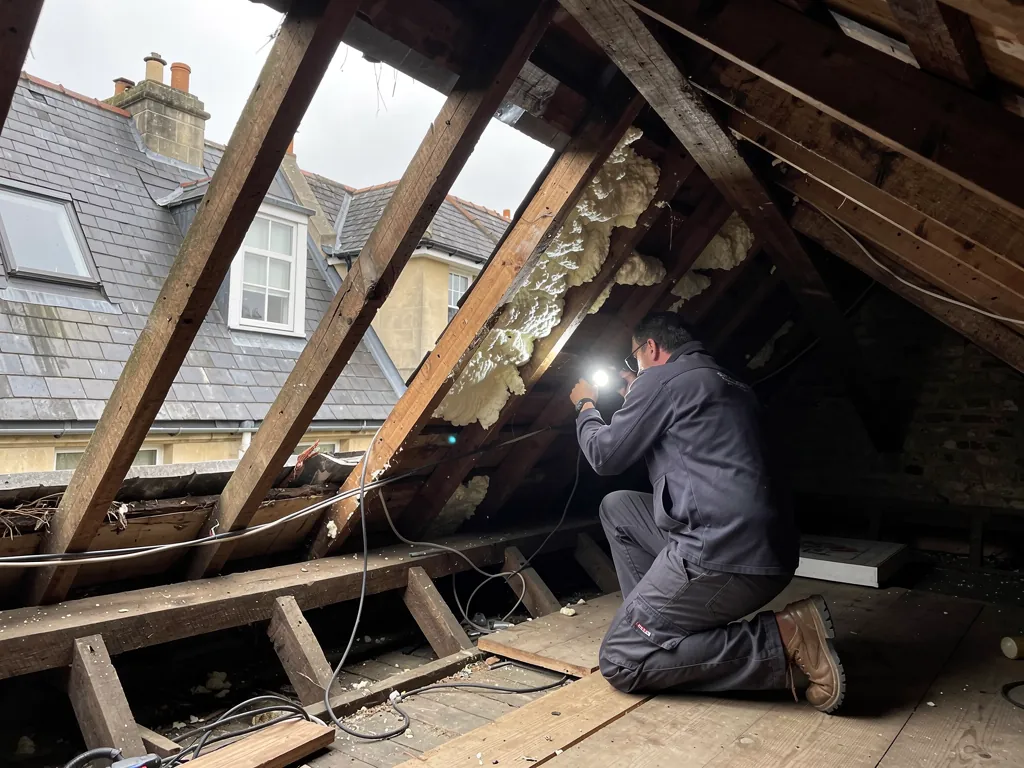 Roof repairsSlipped slates, split underlay, failed flashings or rotten battens that the foam was hiding are repaired, or the roof is re-covered if it has reached that point.
 Reinsulation and ventilationA ventilated insulation build-up goes back in, so the loft is warm again and the roof structure can dry out as it should.
Foam under the roof, in six chapters
From whether removal is needed at all to what the roof looks like once the foam has gone, in the order most owners meet them.
The short answer
Not automatically. Whether foam should come out depends on what it is, what lies behind it and who has to be satisfied. Open-cell foam on a dry, sound roof is a different case from closed-cell foam sprayed over a leaking slope, and an assessment of the roof, not a rule of thumb, tells you which one you have.
People usually reach us after a surveyor's note, a refused mortgage or a worry about the rafters, and they assume the answer is removal. Sometimes it is. Sometimes it is not, and part of our job is to say which, and to show you the evidence either way.
Spray foam is a liquid that expands and sets against whatever it touches. Under a pitched roof it is sprayed onto the underside of the slates or tiles, onto the underlay, or over and between the rafters. That is the root of the difficulty: the foam is stuck to the very parts of the roof that you would want to inspect, repair or ventilate.
The two types behave differently. Open-cell foam is softer and lets some moisture vapour pass through it. Closed-cell foam is dense, rigid and a good deal harder to take off. The Energy Saving Trust says that the risk of roof timbers rotting, which can follow a leak or condensation, should be much lower with an open-cell foam. So the first thing we establish is which type is on your roof and how thick it is.
Removal makes sense where the foam was sprayed over a roof that already leaked, where it covers slipped slates or damaged underlay, where the timbers cannot be inspected at all, or where a buyer, lender or surveyor will not proceed with it in place. The Energy Saving Trust does not recommend spraying foam onto the underside of a damaged or leaking roof without fixing the problem first, because the water has nowhere to go and the rafters stay wet.
If the foam is open-cell, the roof above it is sound, the timber readings are normal and nobody needs a clean bill of health for a sale or a loan, leaving it can be a reasonable decision. That decision is yours, and it should rest on photographs and readings, not on a worry. Our answer on whether spray foam has to be removed sets out the reasoning in more detail.
Swindon has plenty of both. On a Victorian terrace with no modern underlay, foam sprayed onto the back of the slates glues them to the structure and to each other. On a 1980s estate house with concrete tiles on felt, it usually sits on the felt instead. The roof's age changes what removal involves, so we ask when it was last re-covered.
Either can take the foam off. Many of the firms homeowners find first are insulation specialists, whose focus is the foam and whatever replaces it. A roofer adds the other half: the slates, nails, battens, underlay and valleys the foam was hiding are checked and put right before the loft is closed up again. Whoever you choose, ask for a professional roof assessment before removal starts, a written total price and a guarantee on paper. For advice first, send us a photo of the loft and we will say what we can see.
If the foam has to stay for now, keep the assessment photographs and readings. They show the condition of the roof on the day, and they are what a surveyor or lender will ask to see if the question comes up again.
MythSpray foam in a loft always has to be ripped out.
FactRemoval depends on the foam type, the condition of the roof under it and what a lender or buyer requires, which is why the roof is assessed first.
The short answer
RICS advises owners to check with their mortgage provider and insurer, and warns that its presence can influence how a surveyor values the home. As of November 2024 some lenders said they would not lend on homes with spray foam, and others assess case by case. Positions change, so ask yours in writing.
Most of the pressure to remove foam comes from outside the roof. A buyer's surveyor flags it, the conveyancer passes the comment on, and a sale that looked simple stops. It helps to know who is actually saying what.
The RICS consumer guide on spray foam insulation, published in March 2023, says that incorrectly installed insulation can lead to dampness such as uncontrolled condensation, and that the presence of foam is a factor that could affect a surveyor's professional opinion of value. It tells owners to check with their mortgage provider and their insurer whether their policies allow such products. It also says foam must not be installed in a listed building or other protected structure without prior consent, and that removing it could potentially damage the existing structure.
A report in Today's Conveyancer on 20 November 2024, drawing on a BBC investigation, named several lenders that said they would not lend on properties with spray foam, including an equity release lender, and others that said they would take applications case by case. That is a dated snapshot, not a standing rule. Lenders update their criteria, and a lender's answer for one property can differ from its answer for another. Our guide to spray foam and mortgages keeps the dated detail in one place.
Yes, a house with foam can be sold, but expect the buyer's surveyor to question it and be ready for some lenders to decline the loan. We do not advise on mortgages or insurance, and we will not tell you that a lender will accept a roof once the foam has gone. What we can give you is evidence. A written roof assessment with photographs and timber readings, and later a record of what was removed and what was repaired, is the kind of paperwork a surveyor can read and a lender's valuer can weigh. Ask your lender or insurer, in writing, exactly what they need to see, then we plan the work to produce it.
A buyer's surveyor wants to know what is behind the foam and whether it has caused harm. A lender's valuer wants to know whether the property is still good security. An insurer wants to know whether the policy allows it. Each reads the same roof with a different question, so one well-organised file of photographs, readings and repair records usually does more than three separate conversations.
If you are selling, tell your conveyancer early: an assessment done before the house is listed turns a late surprise into a documented position.
Nothing here is legal or financial advice. If your lender or insurer has put a requirement in writing, send it to us with your enquiry and we will build the assessment and the quote around it.
Our view
Ask the lender and the insurer what they need in writing, then let a roof assessment supply the evidence.
The answer
We identify the foam type and thickness, take moisture readings from the rafters and battens, look for staining, softness and fungal growth, and check the underlay and covering for leaks that the foam may be hiding. Everything doubtful is photographed, and the findings are written up for your quote.
An assessment is the smallest cost in a foam job and the part that decides everything after it. It answers the questions the removal cost depends on: how much foam, what type, and what condition the roof is in under it. Our guide to what a spray foam assessment checks goes through the written report; this is how the visit runs.
We start where most of the evidence is. The foam is identified by touch and by looking at how it was applied: sprayed thick between rafters, sprayed thin over everything, or applied to the underside of the underlay. We note where it stops and starts, where pipes, cables and the chimney breast pass through it, and where it has pulled away from timber. Moisture readings are taken through the foam surface where the meter allows it, and at any exposed timber, such as the ends of rafters, wall plates and the area around the loft hatch.
Then we go outside and look at the covering. Foam hides a leak by taking away the stained ceiling that would normally announce it, so the roof itself has to be read: slipped or cracked slates and tiles, failed lead flashings, split valleys, ridge tiles that have lost their bedding. We also check whether the roof is ventilated at the eaves and ridge, because an unventilated slope with foam under it has nowhere for moisture to go. Where a roof is difficult to read from the ground, a camera survey, or a closer look from a ladder or tower, fills in the gaps.
The write-up names the foam type and extent, records the readings, and separates three things: what is sound, what is damaged, and what cannot be judged until the foam is off. That last category matters. Nobody, however expert, can fully read a rafter under thick closed-cell foam until it is off, and the report states that instead of guessing. Our wider roof inspections and surveys page explains how our photographic reports are put together.
A dormer cheek, a tight hipped eaves or a flat-roofed extension can leave foam out of reach. We then say which areas we have judged and which we have not, so the quote allows a second look once the foam is off.
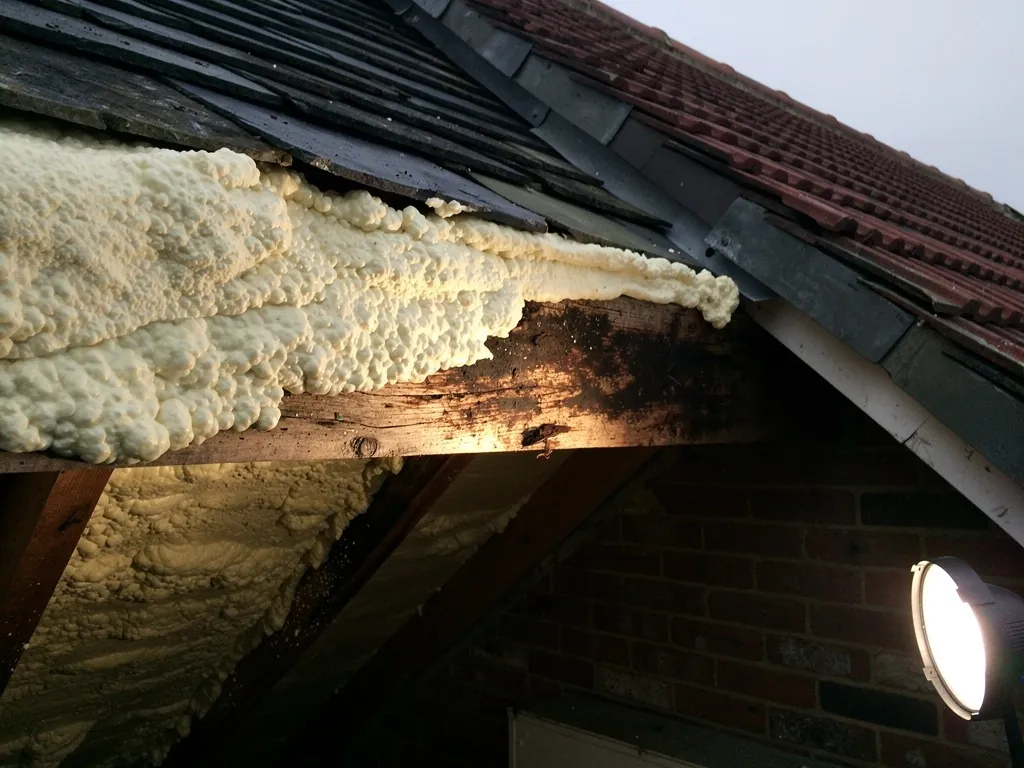
Please do not pull foam away from rafters yourself to see underneath. Disturbed foam throws off dust, and a patch opened up in the wrong place can let moisture or draughts into a roof that was otherwise holding.
Foam takes away the ceiling stain that would normally tell you the roof is leaking.
The short answer
The roof space is protected and sealed, the foam is cut, scraped or shaved away from the rafters and the covering with minimal force, and the waste is bagged and removed. Closed-cell foam takes longer than open-cell. Afterwards the bare timber is cleaned and checked before anything goes back.
There is no single method, because foam is applied in different thicknesses and different places. What stays the same is the order of work and the aim: take the foam off the roof without taking the roof with it. The detail is in our guide to how spray foam is removed; here is the outline.
Yes, with the right precautions, and the health and safety side is planned before anyone climbs into the loft. Foam dust and offcuts travel, so containment comes first. Floors, the loft hatch route and the landing below are covered, the hatch is sealed as far as it can be, and anything stored in the loft has to be cleared beforehand. Those working in the roof space wear protective clothing and respiratory protection, cables are traced before any cutting, and no heat or harsh solvent goes near the slates or timber. The area is cleaned as the work goes on.
Open-cell foam is relatively soft and can be cut and scraped off in sections. Closed-cell foam grips harder and may need shaving or cutting back in thin layers, working with the grain of the timber. The risk in either case is the same: tearing the underlay, chipping the back of slates or gouging a rafter. We work slowly where the foam is stuck to the underlay or directly to the underside of slates and tiles, because that is where damage is easiest to do and hardest to see afterwards.
Once the bulk has gone, the rafters and battens are cleaned back and checked bare. This is when the timber can be properly read, and it is why any extra timber repair is agreed with you in writing once it is seen: nobody can price a rotten batten they have not yet seen.
Offcuts and dust are bagged and carried out through the house or via the scaffold, not dropped down the stairs in loose sacks. The waste is taken away from site and disposed of properly, and the roof space is vacuumed before the next stage starts.
Harder than it looks. Closed-cell foam bonds to the felt and the backs of the slates, so it is cut back by hand. Time goes on the slow parts: shaving foam from around the chimney breast, working it off narrow timbers where rafters meet the wall plate, and freeing it from the underlay without tearing the membrane. A deep, hard layer in a low roof space takes far longer than a thin coat in a loft you can stand up in, which is one more reason the assessment comes first. We give you a realistic programme in the written quote, and tell you early if the bare roof changes it.
Removal is dusty, slow work, and we will tell you before we start how long each stage is likely to take on your roof. The tidiest jobs are the ones where the loft has been emptied and a path to the hatch cleared beforehand.
| Stage | What happens | What we watch for |
|---|---|---|
| Protect | Floors and hatch covered, loft cleared | Dust reaching the rooms below |
| Remove | Foam cut or scraped from rafters and covering | Torn underlay, damaged slates, gouged timber |
| Clean | Residue taken off, space vacuumed | Foam left stuck in the joints |
| Inspect | Bare timber and underlay checked and photographed | Softness, staining, fungal growth |
| Dispose | Bagged waste taken from site | Loose sacks carried through the house |
The short answer
National guides put foam removal at £20 to £50 per m², with an average job around £1,500, plus assessment, disposal and whatever repairs and reinsulation follow. The roof assessment fixes the real figure, because the quantity of foam and the condition of the timber underneath move the total more than anything else.
A foam removal quote has more moving parts than most roofing quotes, because it covers work you can see (the foam coming off) and work nobody can see until it is off (what the foam was covering). Our spray foam removal cost guide works through the national figures; this is the shape of it.
MyBuilder, in a guide updated in August 2026, puts removal at £20 to £50 per m², with an average job around £1,500. It lists an assessment at £100 to £200, disposal at £150 to £400, and repairs and new insulation afterwards at £500 to £3,000. Scaffolding, where the roof work needs it, is given as £500 to £1,500. These are national figures and your roof will set its own.
Area comes first, because removal is priced per square metre. Then thickness: a thin coat over the underside of the slates comes off differently from a deep layer of closed-cell foam packed between rafters. Access matters too. A loft you can stand up in is quicker to work than a low cut-roof space where every cut is made lying down. Then comes the bit nobody can quote exactly in advance, the condition of the timber and the covering once the foam is off.
The written quote covers removal, waste, timber work, roof repairs and reinsulation as one total price. If the rafters turn out sound, the timber work shrinks. If a run of battens is rotten, we stop, photograph it, show you and agree the extra in writing before going further. That is fairer to you than padding the price with a hidden margin for the unknown.
Rotten timber and failed underlay were there before the work began, so they fall to whoever owns the roof. If the foam came with an installer's guarantee or warranty, read it before work starts. A complaint to the original installer may be possible, and our photographs and readings can support it, though nobody can promise how the installer will respond.
Compare quotes like for like. Ask whether each one includes waste disposal, the timber inspection, repairs to the covering and reinsulation, and whether VAT is included. A figure that leaves those out is describing a smaller job than the one you have.
What it typically costs
The answer
The bare roof is checked, any damaged slates, underlay, flashings or battens are repaired, and the loft is reinsulated with a build-up that lets the roof breathe. Ventilation is restored at the eaves and, where needed, the ridge, and building control is told if the work is notifiable.
Taking the foam off is the middle of the job, not the end. A roof that has been sealed in foam for years has often not had its timbers looked at, its underlay inspected or its ventilation working in that time, and the work afterwards is what turns a clean loft into a sound roof.
With the roof bare, we repair what the assessment could not reach. That can mean refixing slipped slates with the right clips, replacing a split underlay, renewing lead flashings, or cutting out and replacing rotten battens. Where several things are wrong at once, or the slates and tiles are tired all over, we tell you plainly and price a re-roof as an option beside the repair, so the choice stays with you. Our roof replacement page explains how that decision is made.
A loft without insulation is cold and costly to heat, so insulation goes back, but in a breathable form that lets the roof dry. For a cold roof, BS 5250 as summarised by Marley asks for 10 mm of ventilation along the eaves on pitches over 15 degrees, with an extra 5 mm at high level on steeper roofs, and 25 mm at the eaves on lower pitches. Our guide to reinsulating the loft after spray foam explains the usual options, such as mineral wool laid between and across the joists with the eaves kept clear. If you plan to sell, an updated EPC afterwards will describe the new insulation instead of the foam.
Reinsulating can count as renovating a thermal element, and Approved Document L can then call for the roof to meet an improved U-value. Whether it does turns on the share of the roof that is renovated and the way it is done. We explain consent and handle the Building Regulations notification where the job is notifiable, and if you would rather check first, Swindon Borough Council runs its own building control team and will say.
You finish with photographs of the bare timber, a written record of what was removed and repaired, and our 10-year workmanship guarantee on the work, in writing. Rubbish leaves with us and the house is left tidy. Anything you sign in your own home carries a 14-day cancellation period. Work begins within it only on a written request from you, whether on paper or by email.
Keep the whole file together: the assessment, the photographs, the quote, the completion record and the guarantee. If you sell, the next buyer's surveyor will want to see them.
More on lenders, surveys, timbers, listed buildings, selling, buying and what to do when a surveyor has flagged foam.
Yes. The loft is where we identify the foam, take timber readings and photograph the rafters. A clear path to the hatch makes the visit quicker and the photographs better.
Yes, and it is common to find it only when a survey or a leak prompts a look. Any records from the installer help, but we assess the roof as it is, not as the paperwork says.
It can if it is rushed, which is why we work slowly where foam is stuck to the underlay or the back of the covering. Anything damaged is shown to you and repaired.
Yes, in materials that match. RICS says foam should not go into a listed building without prior consent, and removal can touch protected fabric, so we check with the council's conservation team before proposing anything beyond like-for-like.
Sometimes. If the problem is confined to one area, the assessment can show that. A lender or buyer may still want the whole roof dealt with, so check what they require.
Not usually. The work is in the roof space and the rooms below are protected. Anyone with breathing difficulties should talk to us first so we can plan the dustiest stages around them.
Yes. Foam assessments and removal run across Swindon and the towns nearby, including Old Town, Stratton St Margaret, Haydon Wick, Wroughton, Royal Wootton Bassett, Highworth, Purton, Cricklade, Shrivenham and Marlborough. The roof assessment is the same wherever the house is.
Send us the surveyor's note, the lender's letter or the installer's records, together with a photograph of the foam taken from the loft hatch without disturbing it. Tell us whether you are selling, buying or staying put, and we will arrange the roof assessment anywhere around Swindon, starting with the rafters and the underlay.
Tell us what’s happening and we’ll call you back.
Or call 01793 626096
Message us on WhatsApp