
Equity release is a different animal from an ordinary mortgage. The money is secured on your home, often for the rest of your life, and the provider wants to be sure the property will still be good security when the loan is eventually repaid. A roof is a large part of that picture, and spray foam on its underside has become a point of friction over the last few years, as the surveyors' body published its consumer guide and the press picked the subject up.
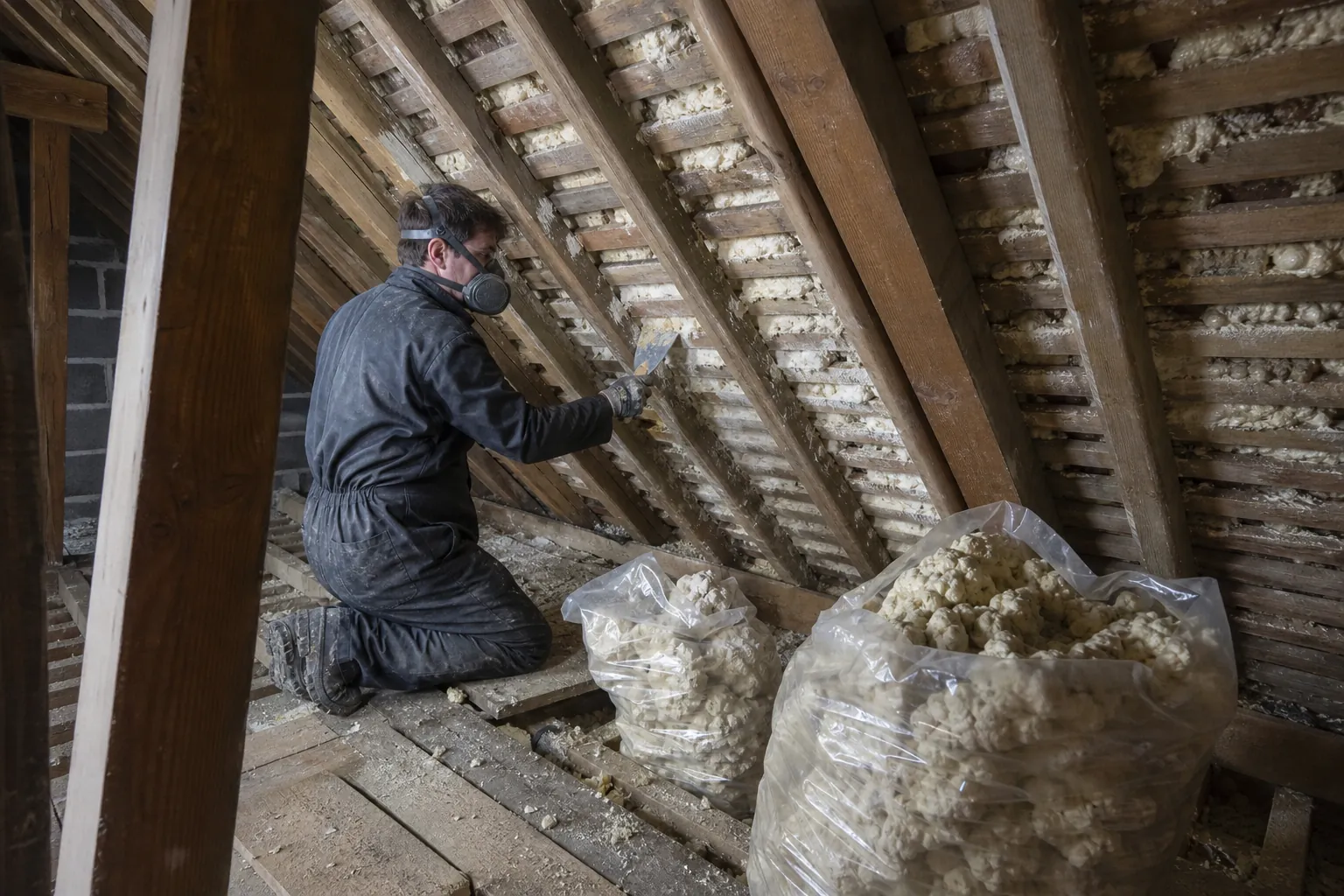
This guide sets out what was reported about lenders in November 2024, why you should treat any dated position as a starting point and not a rule, what a valuer is likely to notice in your loft and how to prepare. It does not give financial advice. For that you need a regulated equity release adviser. What we can do is tell you what the roof looks like, what removal or repair involves and what it tends to cost, as part of our spray foam insulation removal service.
Why equity release providers look hard at a roof
With a lifetime mortgage, interest usually rolls up over the years, so the debt grows while the value of the house may rise, fall or stay put. The provider's comfort depends on the home holding its value, and a defect that makes a house harder to sell or mortgage in future is exactly the sort of thing a valuer is asked to report on.
Spray foam on a roof timber is awkward in that light because a later buyer, and the later buyer's lender, may question it. If the next buyer cannot get a mortgage on the house, the pool of people who can buy it shrinks, and the equity release provider is left holding security that is harder to sell. That chain of reasoning, more than any single technical fault, is why some providers have taken a cautious line.
Is the roof the only thing a valuer checks?
No. The valuer looks at the whole property: construction, condition, location, extensions and obvious defects. Foam is one item among many, but it is one that has had a lot of press attention, and valuers are more likely to ask about it than they were a few years ago. If the loft is accessible and the foam can be seen from the hatch, expect it to be noted.
Many owners who are now thinking about equity release had their loft insulated years ago, when foam was offered as a tidy, modern answer to heat loss, and nobody mentioned lenders. Having it done was not foolish. The rules of the market moved after the work, and the sensible response is to find out where your own roof stands, calmly, before the application rather than during it.
Two practical habits help. Keep every document from the original job, however thin, because a dated invoice and a product name are more useful to an adviser than they look. And note anything you have noticed since, such as a damp smell in the loft or stains on a ceiling, because honest answers early are better than awkward ones after the valuation.
What was reported in November 2024
On 20 November 2024, the trade site Today's Conveyancer reported the findings of a BBC investigation into lenders and spray foam. In it, Aviva, which lends in the equity release market, was among the names said to refuse homes with foam installed, alongside a handful of banks and building societies. A separate group of large banks was described as judging each application individually.
For anyone looking at equity release, the lines that matter name two providers. As of November 2024, Aviva was reported to be declining homes with foam, and More 2 Life to lend only on documented, authorised new builds. What you have is a dated report on two providers, carried by one publication, and it says nothing reliable about how the wider equity release market treats foam today.
Treat the November 2024 report as a snapshot. Positions change, and the only answer that counts is the one your chosen provider gives you in writing today.
We do not hold lender policies and we cannot tell you what any provider will decide. Please do not rely on this page for that. Ask your adviser to put the question about foam to each provider they are considering, before a valuation is paid for.
Why a dated position is only a starting point
Lending criteria are rewritten from time to time. A provider that declined foam in 2024 might add conditions, ask for a specialist report or change its stance entirely. Another that took each case on its merits might tighten up. A page like this one, written on 14 October 2026, cannot know which way any individual lender has moved since the report.
It also helps to know that an equity release adviser is paid to compare providers. Telling them up front that the house has foam, and which type, lets them rule out providers that will not proceed and approach those that might. Hiding it does nobody any good. The valuer will probably find it, and a refusal after you have paid for a valuation and legal work costs more than a refusal at the start.
Should I get the foam looked at before I speak to an adviser?
It is a sensible order of events, and the reason is evidence. An adviser who can say that the foam is open-cell, installed by a named firm in a named year, with a condensation risk check and a recent report showing dry timbers, is in a far better position than one who can say only that there is foam. Our guide to the spray foam assessment shows what that report covers.
What the RICS guidance means for your valuation
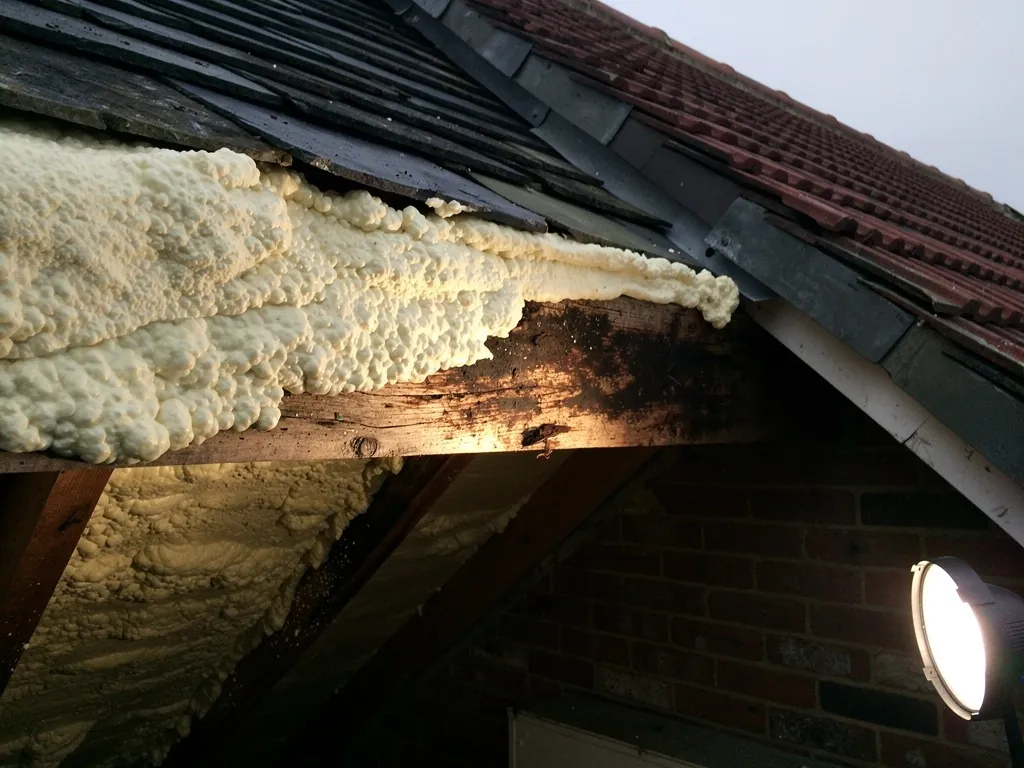
The RICS consumer guide on spray foam insulation, dated March 2023, makes three points that bear directly on equity release. Owners are advised to ask their mortgage provider whether its policy permits foam, and to put the same question to their insurer. The guide also warns that foam in the roof may sway a surveyor's judgement of value.
That last point is the one that can change the numbers. A valuer who thinks foam makes a home harder to sell may reduce the valuation or attach a condition. Because equity release amounts are usually set as a proportion of the property's value, a lower valuation means a smaller sum available to you.
Our page on the RICS spray foam guidance goes through the guide point by point. If you are planning to sell instead, the picture is similar and is covered in our guide to selling a house with spray foam.
Does the insurance side matter too?
It can. Some owners find that a home insurer asks about foam or adds a condition. Check your own policy wording and ask your insurer directly, because only they can say how their policy treats it.
Fixing the roof before you apply
If you are early in the process, there are three broad routes, and the right one depends on what is in your loft. The first is to leave the foam as it is and gather evidence that it is sound: installer paperwork, a moisture check, photographs and a note from a surveyor. That might satisfy a provider that assesses cases individually.
The second is partial work. Where there is a defect in one area, such as a leak at a valley or a wet section above a bathroom, we can deal with the cause and the affected stretch while leaving sound foam elsewhere. The third is full removal, timber repair where needed and new insulation of a type that lenders and valuers are comfortable with. That is the biggest job and it only makes sense when the evidence points to it or when a provider you want to use will not proceed otherwise.
One question owners raise is whether a membrane or covering over the foam changes the position. It is a fair question, and our page on spray foam and roof membranes sets out what that approach can and cannot do.
How long does it take to prepare a roof?
That depends on the size of the roof, the foam thickness and the weather. The written quote after our survey sets out the work, and we explain the likely order of events so you can fit it around your application dates.
What removal and re-insulation can cost
National guide figures give a rough sense of scale. MyBuilder's spray foam removal guide, updated on 21 August 2026, puts removal at £20 to £50 per square metre, averaging roughly £1,500 a job. It lists an assessment at £100 to £200, disposal at £150 to £400, repairs and new insulation at £500 to £3,000 and scaffold at £500 to £1,500. Those are national yardsticks from a third-party guide, not a price for your roof.
What moves a real figure up or down is access, the foam's thickness and type, whether it has been sprayed onto timber that now needs repair, how many roof slopes are involved and whether scaffold is required to reach them. Our spray foam removal cost page goes through each of those.
When a quote lands on your mat, check whether it covers VAT and scaffolding. A total that leaves them out is a different number from one that includes them, and the gap can be large.
For your own house, the survey comes first and a single written total follows, illustrated with pictures of the loft and the slopes outside. Where the survey shows the foam can stay, that is what we tell you, and the visit is the only cost. Some owners are relieved to hear it, and a few are surprised, because they had braced for a large job. Advice should follow what the roof needs.
Questions to put to your adviser and provider
A short list written before the first call saves time and avoids surprises. These are the ones we would take along.
- Does this provider currently lend on a home with spray foam, and can that be confirmed in writing?
- If foam is accepted, what evidence does the provider want: an installer certificate, a surveyor's report, a moisture reading or all three?
- Would a valuation be arranged before or after the foam question is settled?
- If the valuer reduces the figure because of the foam, what happens to the offer?
- Are there providers who would accept the house once the foam is removed, and what proof of removal would they want?
Keep copies of every answer. If the work does go ahead, we can give you photographs taken during it and a written account of what was done, which gives the next valuer something concrete to read. If we do any work, a ten-year workmanship guarantee goes to you on paper, and we take our waste away.
To talk through your loft, ring 01793 626096, use WhatsApp, or send the form below with your loft pictures attached. Pictures of the loft and any paperwork you hold are the best starting point.