
Is a loose ridge tile urgent?
Treat it as one. A tile that rocks can be lifted by wind and land on the path, and the gap lets rain reach the underlay.
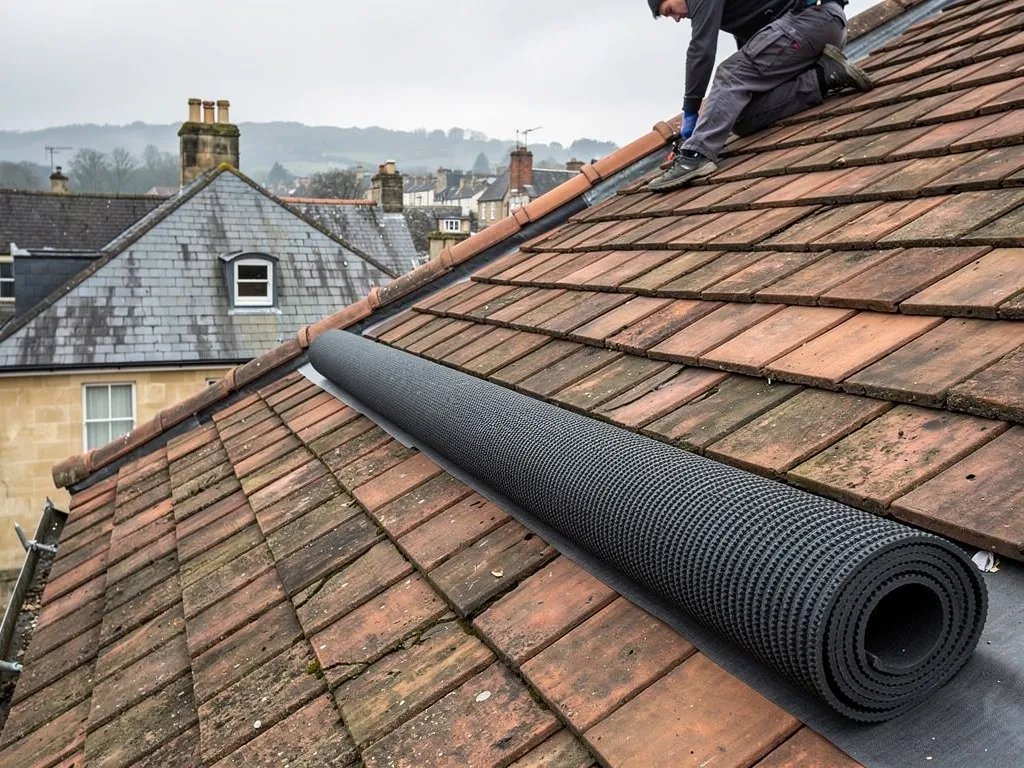
Loose ridge tiles, crumbling verge mortar and failing hips, rebedded with proper fixings, or replaced by a dry ridge system (often called dry-fix) tested as a set. You get photographs of the ridge line and a written quote.
Treat it as one. A tile that rocks can be lifted by wind and land on the path, and the gap lets rain reach the underlay.
Yes, provided the tiles are also fixed mechanically. Since BS 5534:2014 the mortar is no longer left to do the job on its own.
Not every one. It suits most concrete and clay tiled roofs, but we check the tile profile, the pitch and the building before suggesting it.
| Job | Typical cost |
|---|---|
| Repointing ridge or hip tiles | £200 to £400 |
| Ridge tiles rebedded or replaced | £300 to £600 |
| Dry ridge, typical whole job | £500 to £1,000 |
| Dry hip, per linear metre (ex VAT) | £70 to £100 |
| Verge repointing or dry verge | priced on survey |
Guide ranges like these come from national surveys of the trade and are not our prices. Your own figure is the one on the written quote that follows a look at your ridge line.
MyBuilder slate roof and dry ridge cost guides (updated August 2026); Checkatrade roof repair guide (October 2026, ex VAT).
See all costs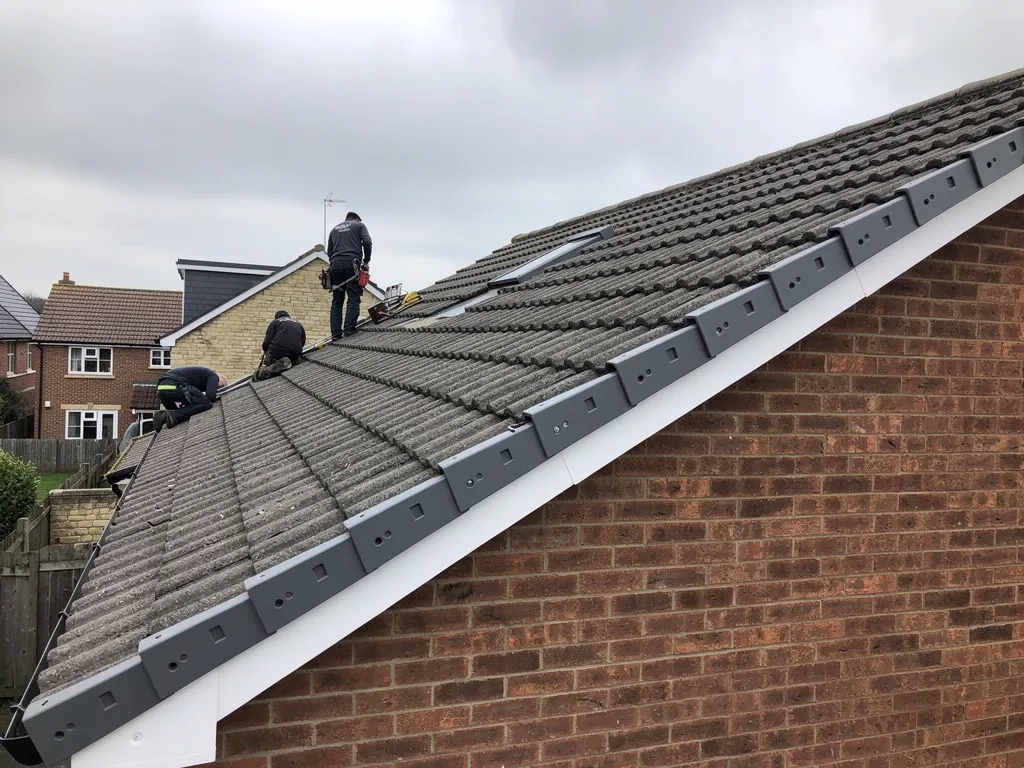 Ridge rebeddingOld mortar and loose tiles lifted off, then the ridge relaid on a fresh bed and fixed mechanically as well, so it no longer depends on the mortar alone.
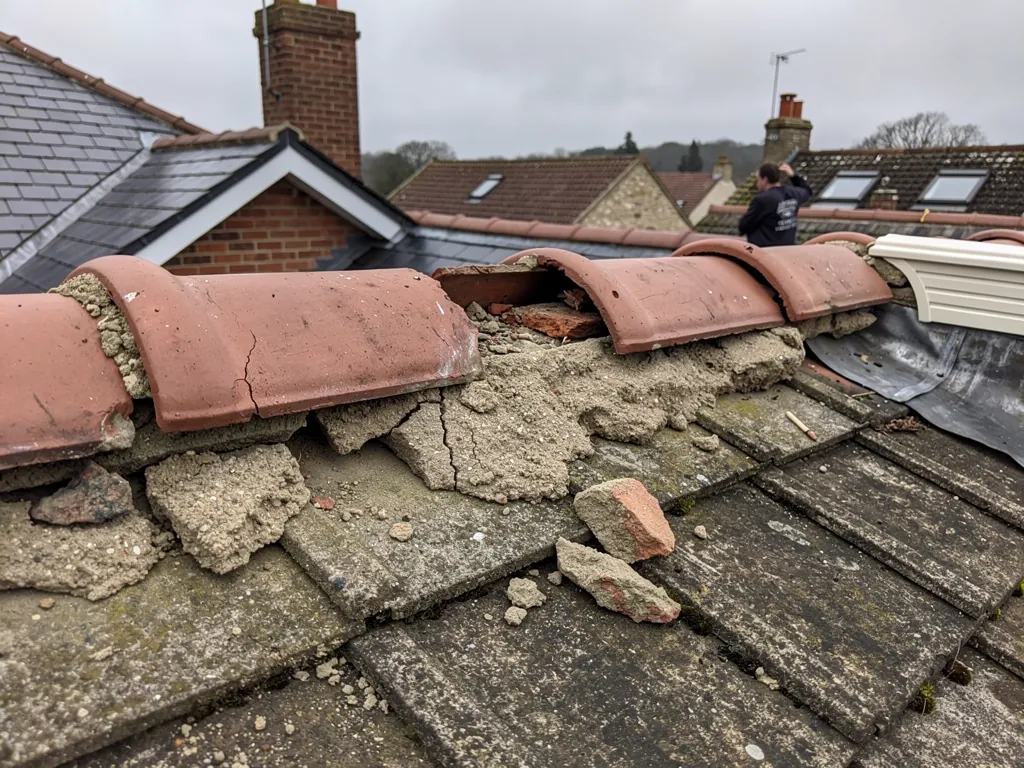 Ridge and hip repointingWhere the bed is sound and only the pointing has failed, we rake out and repoint the joints rather than strip a ridge that does not need it.
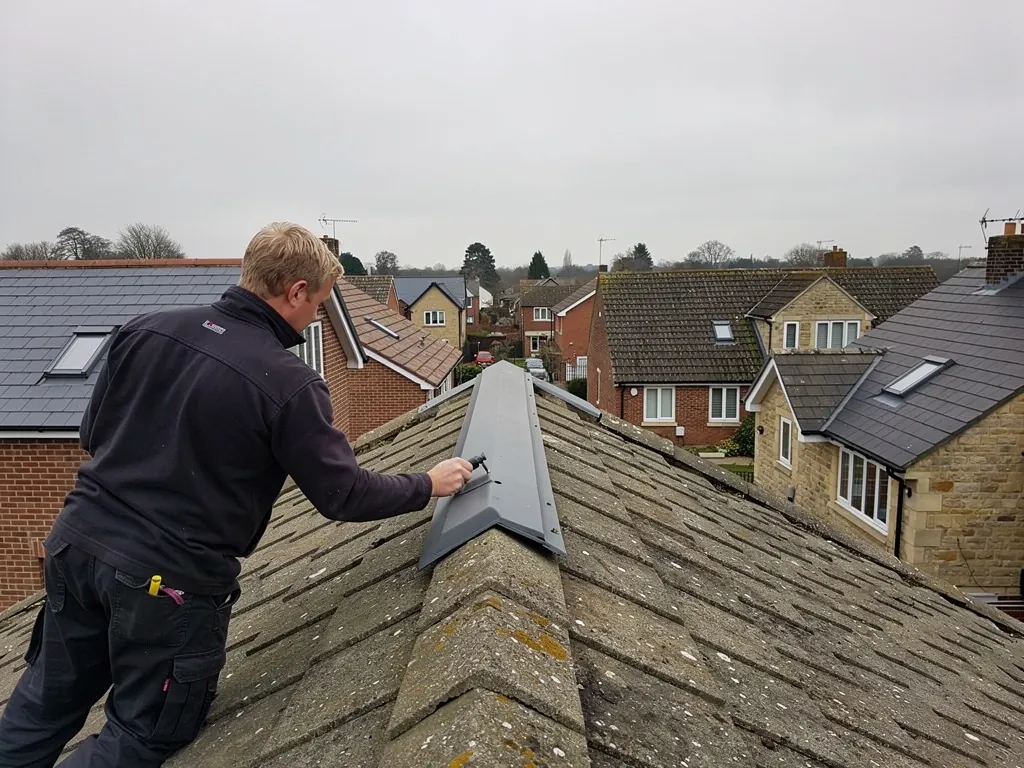 Dry ridge conversionA batten, clipped or screwed tiles and a flexible union strip replace the mortar bed, using a system tested to BS 8612.
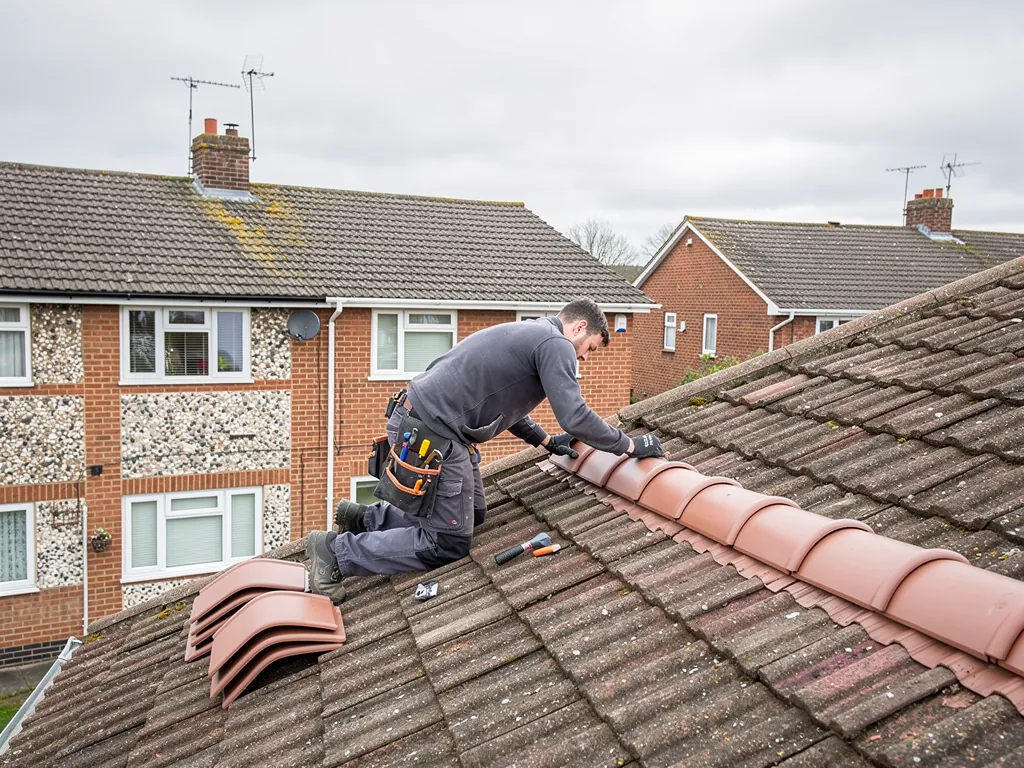 Hip tiles and hip ironsLoose hip tiles refixed and the bracket at the foot of each hip checked, because that small iron stops the whole run from creeping downhill.
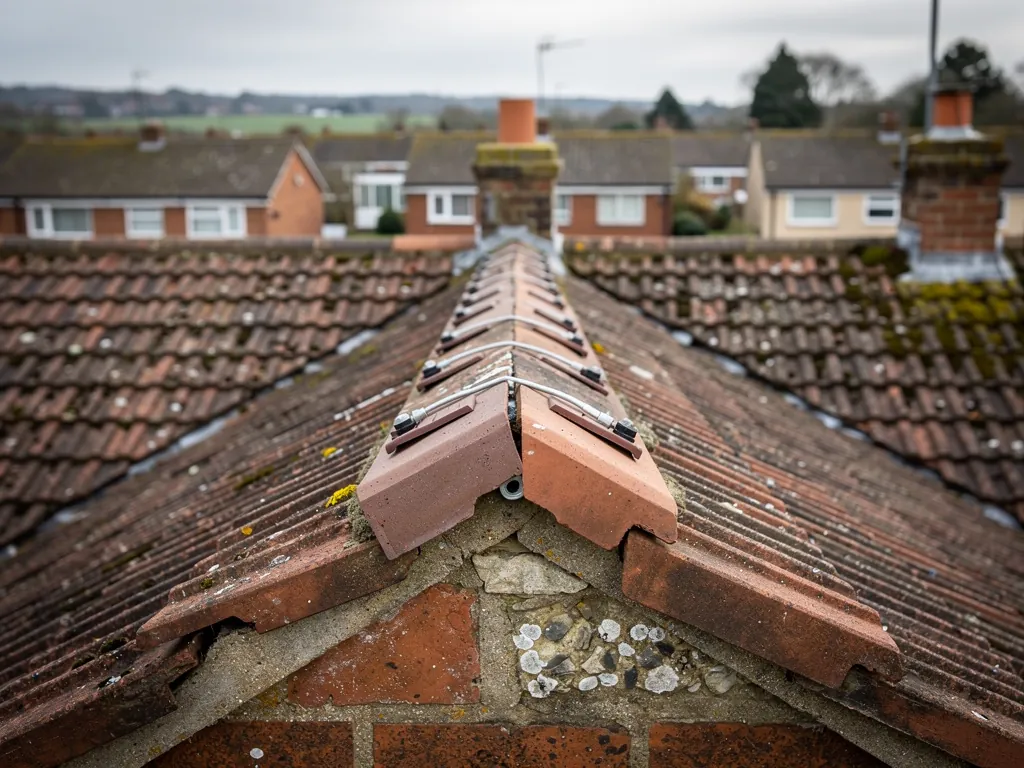 Verge repair and dry vergeCrumbling mortar along a gable edge repointed, or replaced with dry verge units clipped to the tiles and battens beneath.
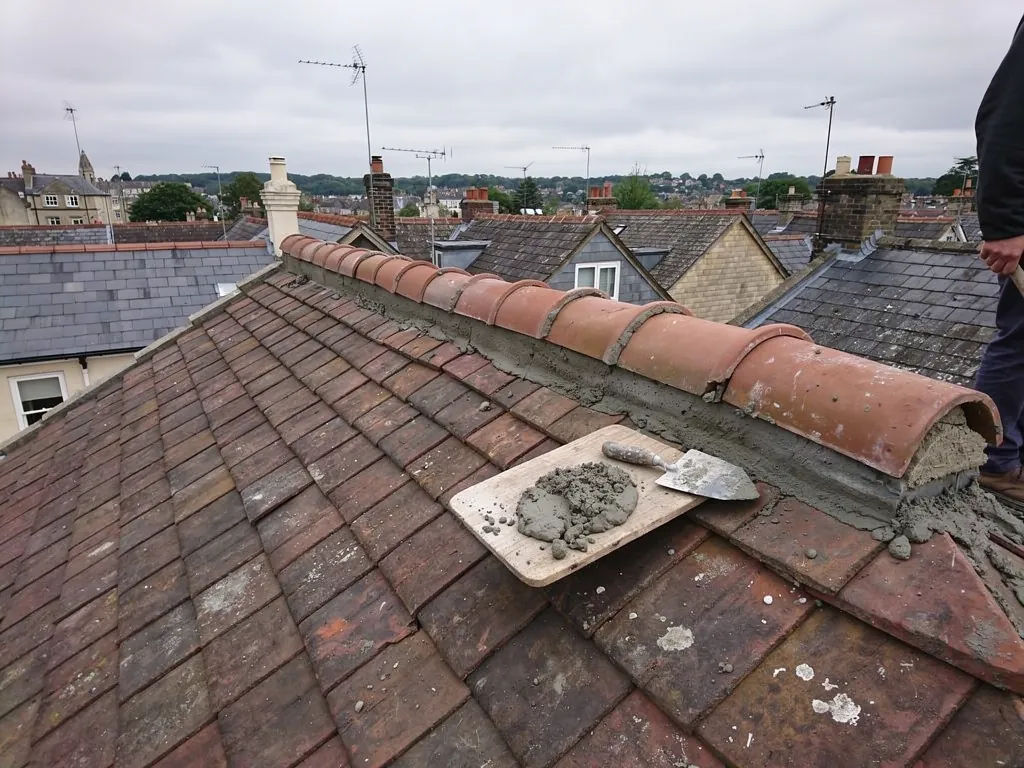 Storm-loosened ridgesTiles blown off or shifted by wind made safe first, then the ridge line refixed or rebuilt once we can see how far the damage runs.
Ridges, hips and verges explained
Why ridges loosen, what mortar and a dry ridge each do, what the standards ask for and what the work costs on Swindon's tiled roofs.

The short answer
Most ridges are bedded on mortar, and mortar slowly cracks and shrinks as the roof moves, soaks up water and freezes. Once the bed stops gripping, the tile rocks, wind finds the gap and a tile can lift or drop. The fix is a new fixing, not more filler.
Along the crest of the roof, where the two slopes meet, sits the ridge. Hips are the sloping lines at outward corners, where slopes also meet, and they carry tiles of their own. The verge is the roof's edge up the side of a gable wall, where the covering finishes short of the brickwork. All three sit at the most exposed points of the house.
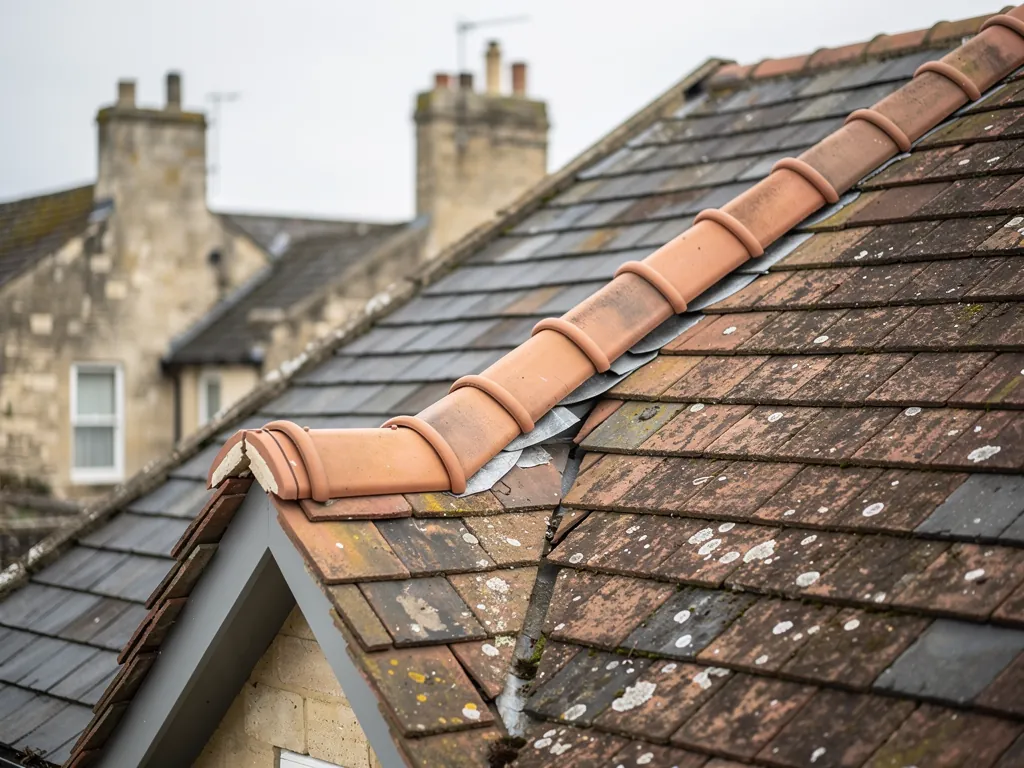
On a traditional roof each ridge tile sits in a bed of sand and cement mortar laid across the tiles below. Mortar is good at being squeezed and poor at being pulled or twisted. Timbers shift and gusts push at the tiles all winter. Hairline cracks open, rain gets into them, and frost widens them a little each cold spell. In time the bed shrinks away from the tile, which then sits loose on a crumbling cushion.
You do not need to climb up to spot trouble. A ridge line that is no longer straight, a tile at a different angle from its neighbours, grit and mortar crumbs in the gutter or on a lower flat roof, and pale streaks of sandy debris on the slope below are all signs. A gap beneath the ridge where daylight shows from the loft is another.
A loose tile can sit quietly for years until one strong gust lifts it. Then it falls into the garden or onto the pavement, and the exposed tiles beside it are the next to go. If one has already dropped, our answer on what to do when a ridge tile has fallen off sets out what to do safely, and the page on whether a ridge can leak explains how rain gets in along the top of the roof.
Smearing fresh mortar over old, or filling a gap with sealant, covers the symptom. The new material bonds to dust and loose crumbs and breaks away again. We take off whatever is no longer attached, look at the tiles and battens beneath, and rebuild the fixing so the ridge holds because of how it is fixed, not because of how much material is piled around it.
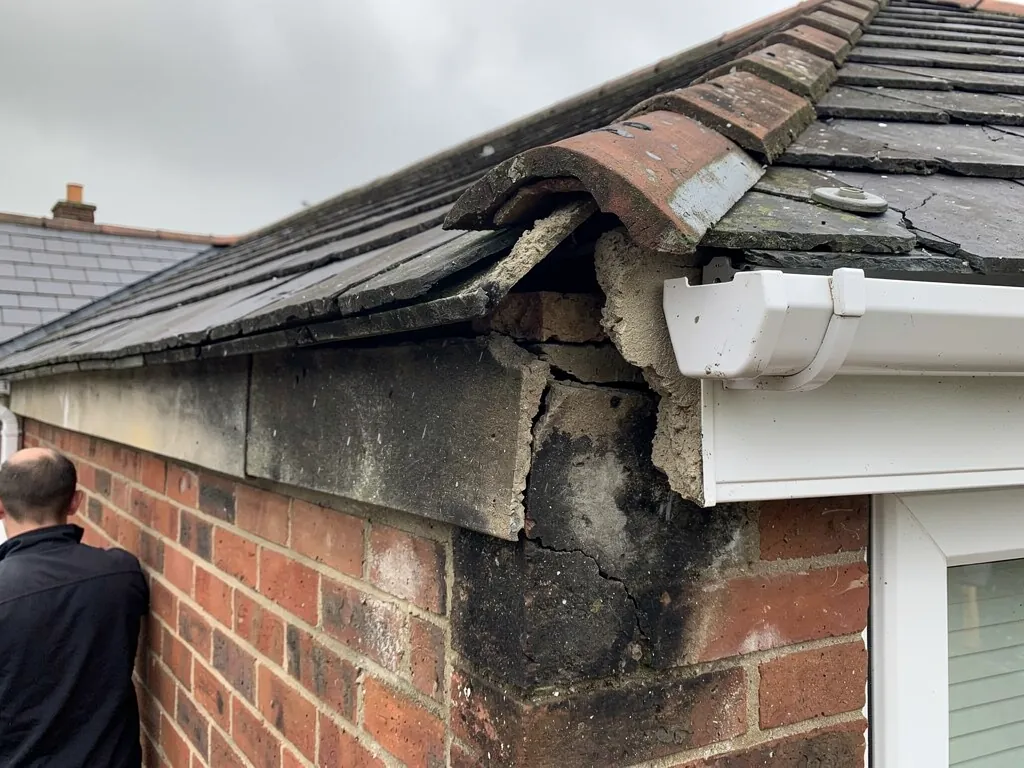
Do not climb up to test a ridge yourself. A tile that rocks in your hand can come away with you. A photograph taken from the ground, with the ridge line in view, tells us most of what we need before we visit.
The short answer
Either can be done well. A mortar ridge with mechanical fixings keeps the traditional look and suits older or protected roofs. A dry ridge system, also called dry-fix, uses a batten, clips and a flexible strip, so there is no mortar to crack, and it suits most modern tiled roofs. The tile, pitch and building decide.
Each method solves a different set of problems, and the roof in front of us decides which is right.
A mortar ridge is still a perfectly acceptable way to finish a roof, provided the ridge and hip tiles are also held down with mechanical fixings. Since BS 5534:2014, the standard no longer treats mortar by itself as enough to hold them down. It keeps the traditional line that suits older houses, and it is the usual answer where the surrounding roof is historic, or where a conservation officer expects the original look. The cost of that look is upkeep, because the pointing will need attention again some years on.
A dry ridge system replaces the mortar bed with a ridge batten along the top of the roof, fixing clips or screws that hold each tile, and a flexible, ventilated union strip that closes the gap beneath. It moves a little with the roof instead of cracking, and there is no mortar left to wash out. Many systems also let air escape at the top of the loft, which can help with condensation. Dry ridge, hip and verge systems are tested to BS 8612, so the product we install is one tested as a complete system.
The main benefit is a secure, durable ridge: every tile is mechanically fixed, so it does not depend on a mortar bed that cracks with age. Marley, the tile maker, says dry-fix components need minimal maintenance once installed, and there is no pointing to redo. Installation is less tied to the weather, because nothing has to cure. The drawbacks are a higher material cost, a slightly different line from the street, and plastic union strips and caps that sit in the sun and wind for their whole life, so they are worth a look from the garden after storms.
Not every roof takes it. Unusual or obsolete ridge tile profiles may have no matching dry component. Very low pitches and some roof shapes need care. Slate roofs often have their own ridge details, and a listed building may need consent before the look changes. For slate, see the answer on fitting a dry ridge to a slate roof.
On a modern estate house with concrete interlocking tiles, where the mortar has failed before, a dry ridge is usually worth it. On a period roof in clay or slate, a mortar bed with hidden mechanical fixings normally keeps the look better. On a listed or conservation-area property, ask the council before any change of method. Our guide to dry ridge versus mortar weighs appearance, upkeep and cost in more depth, and we explain both routes when both would work.
Whichever method is chosen, the tiles themselves should be sound. Fixing a cracked ridge tile with clips just fixes a cracked tile in place, so any damaged tile is replaced first.
| Question | Mortar with fixings | Dry-fix |
|---|---|---|
| How are tiles held? | Mortar bed plus mechanical fixings | Batten, clips or screws and a union strip |
| Look from the street | Traditional pointed line | Cleaner line, with a strip beneath |
| Upkeep | Pointing needs attention in time | No mortar to crack or wash out |
| Loft air | Closed bed | Some systems allow ventilation |
| Best suited to | Older, protected or unusual roofs | Most modern tiled roofs |
The answer
A mortar verge is a pointed edge of mortar sealing the gap between the end tiles and the gable wall. A dry verge replaces it with clipped units, either single pieces or a continuous strip, fixed to the tiles and battens. It cannot crack away, but the system must match the tiles.
Verges climb the side of a gable wall. Water arriving at that edge needs somewhere to go, and the end tiles need holding down against wind that blows up and over the gable. Mortar has traditionally done both jobs, and it is also the part most likely to fail.
The tiles at the edge overhang a narrow strip called an undercloak, usually fibre cement, plain tile or slate, laid on the gable wall. Mortar is then pointed between the tile ends and the wall, sealing the gap and holding the end tiles in place. Over the years the mortar cracks away from the undercloak, falls out in pieces and leaves the end tiles loose. Rain and wind then work at the exposed edge. The answer on what a verge undercloak is explains that hidden strip, and our page on verge repairs covers repointing in detail.
A dry verge replaces the pointed mortar with a cap or unit that clips or screws to the end tiles and battens. Some are made as separate units for each tile; others run as a continuous length. The end cap finishes the line. There is no mortar to crack, and the tile ends are held mechanically. The guide to dry verge systems describes how unit and continuous types differ in how they fix.
A dry verge is only as good as its fit. Colour mismatch, a profile that does not suit the tiles, or fixings that miss the batten all cause trouble. Loose units rattle on windy days, and caps that were not secured can come off. We cover the usual causes in why a dry verge rattles, and the replacement of a blown cap in what to do when dry verge caps blow off.
Usually, provided the edge tiles and battens are sound. A dry verge system comes as unit caps, one per course, or as a continuous interlocking length, and each is fixed with the screws, clips or nails its maker specifies; ask whether they are stainless steel or coated. Some plain tile ranges use cloaked verge tiles instead, with a moulded edge that turns down over the gable. Whichever is chosen, it has to suit the tile profile on the existing roof. The page on retrofitting dry verge sets out what we look at first.
Gable ends next to a chimney, a neighbour's wall or a lean-to extension have their own junctions. We deal with those on the day, because the right detail depends on what the roof meets, and our chimney repairs page covers the stack side of it.
A verge is where a roof meets the wind head on, so whatever holds it must not rely on mortar alone.
MythA dry verge is a quick fix you can clip on over rotten mortar.
FactDry verge only holds if the tile edges and battens beneath are sound, so old mortar and any damage come off first.
The short answer
National guides put repointing ridge or hip tiles at £200 to £400, and rebuilding or swapping ridge tiles at £300 to £600. A whole dry ridge job is typically £500 to £1,000. Your own figure depends on the length of the ridge, the tile and the access.
Ridge work is a small job by roofing standards, yet its price spreads widely. A short bungalow ridge is quick, while a tall house with hips and a verge takes far longer.
MyBuilder, updated in August 2026, gives £300 to £600 for a rebed or replacement of ridge tiles, and £200 to £400 to repoint ridge or hip tiles. Its dry ridge guide puts the system at £40 to £60 per linear metre, with a typical job between £500 and £1,000. Checkatrade's October 2026 roof repair guide gives dry ridge at £50 to £70 a metre and dry hip at £70 to £100 a metre, before VAT. These are national ranges, not our prices.
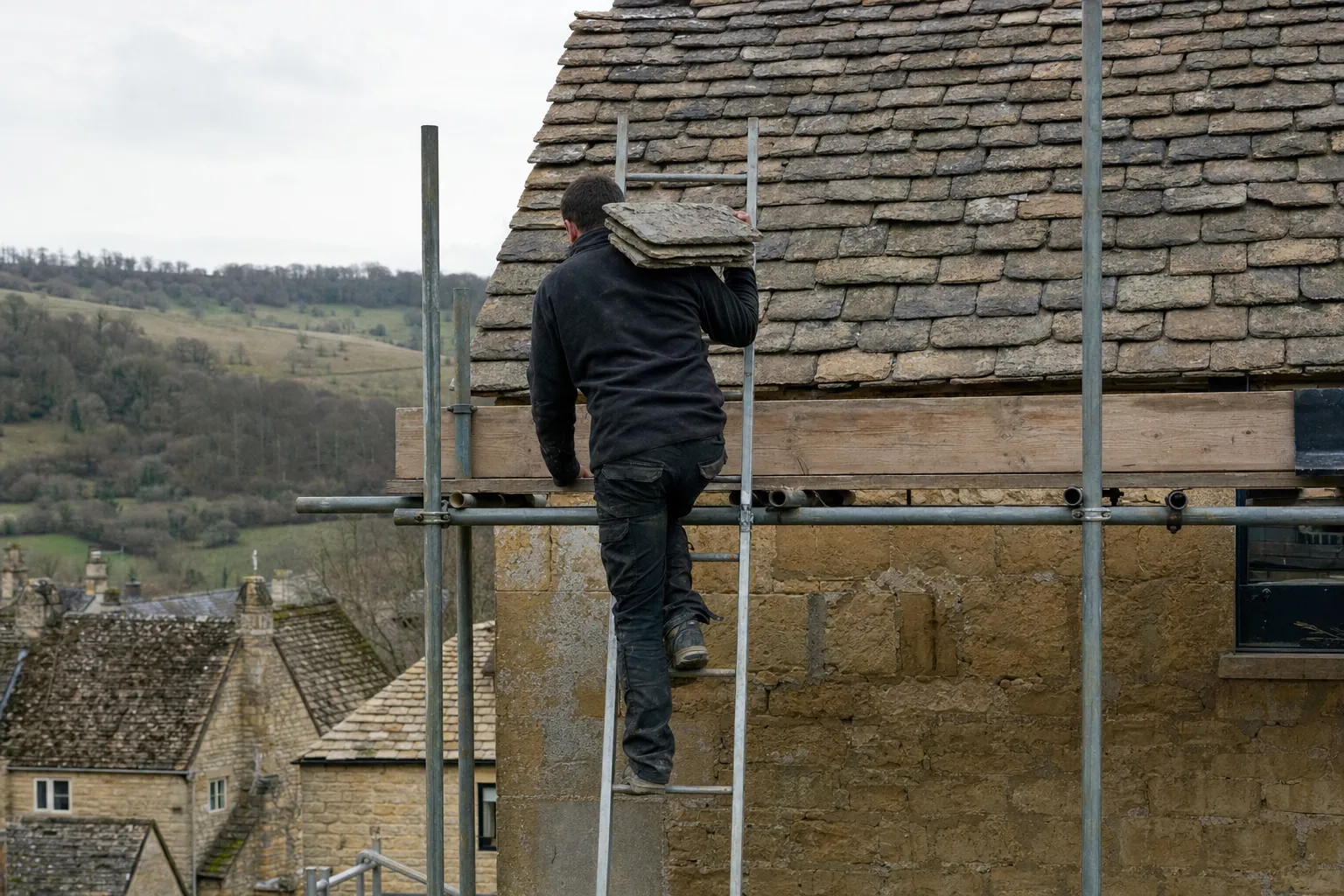
Length is the first driver, since most ridge pricing is per metre. The roof shape comes next: hips and valleys add joints and cuts. Then the tile: a standard concrete ridge tile is easy to replace, while an obsolete clay or hand-made profile can need sourcing. Access matters most of all. On a standard two-storey set-up, MyBuilder says scaffolding runs to roughly £850 to £1,200, which can exceed the ridge work itself, so we use a roof ladder or tower where that is safe and tell you when it is not.
The lowest price is not always the lowest cost. If the bed is sound and only the pointing has failed, repointing is enough. If tiles have shifted or the bed has gone, repointing will not hold and a rebed is the sensible repair. Converting to a dry ridge costs more in materials but removes the mortar for good. Our guide to ridge tile repair costs and the page on dry ridge and dry hip cost per metre go further into the ranges.
On the guide figures above, a rebed costs less up front than a whole dry ridge job. Across the years the gap narrows: mortar needs repointing again in time, whereas the mechanically fixed ridge only needs its caps and strip checked. Which comes out cheaper on your roof depends on the ridge length, the tile and how often the mortar has failed.
Once we have surveyed the roof, you are sent pictures of every defect we found along the ridge line, plus one written total for the work. When the work is done you get photographs of the finished ridge and a 10-year workmanship guarantee in writing, covering our own work.
When comparing quotes, check each says how the ridge will be fixed, and whether scaffold and waste are included.
What it typically costs
The short answer
BS 5534 covers the design and fixing of slating and tiling, and the 2014 revision stopped treating mortar by itself as enough for ridge and hip tiles, so they are fixed mechanically too. BS 8612:2018 is the specification against which systems that fix the ridge, hips and verges without mortar are tested.
Standards sound dull, but they decide how your ridge is fixed. Two of them matter here, and they are easily muddled. One tells roofers how tiles and fittings should be fixed. The other tells makers how a dry-fix system is tested.
BS 5534 is the code of practice for slating and tiling. Marley, the tile maker, explains that after the 2014 revision the tensile strength of mortar alone could no longer be relied upon to fix ridge tiles and hip tiles, and that bedded roof tiles and fittings should include mechanical fixings. Before that, mortar on its own was commonly accepted. So a ridge bedded in the old way is not unlawful, and it is not wrong to leave a sound one in place. But when we rebed, the new work gets a fixing as well as a bed.
BSI published BS 8612:2018 in January 2018. It covers dry-fixed systems for ridges, hips and verges on slated and tiled roofs. It is the test specification for dry verge, hip and ridge systems. The practical point is that a product which has been properly tested can be used to show compliance, while a loose collection of clips and strips from different makers cannot. We fit a system as the maker intends, not a mix of parts.
It is worth being clear, because the claim is repeated often. Neither standard bans mortar. BS 5534 asks for mechanical fixing alongside it. The guide to BS 5534 and BS 8612 goes through both in more detail, and the answer on whether mortar bedding is still allowed deals with the question directly.
If you are only repairing a small area, a sound ridge elsewhere is not suddenly out of date. If the work involves taking a ridge off and rebuilding it, then the rebuilt ridge follows current practice. On the Planning Portal's test, repairs or re-covering that touch less than 25 per cent of the building envelope and less than 50 per cent of the roof do not normally call for a building control application. If you are unsure, your building control body can confirm.
Many dry ridge systems include a ventilated union strip that lets moist air out at the top of the loft. BS 5250, the code of practice on moisture in buildings, as summarised by Marley, wants a continuous 5 mm gap for air near the ridge once a roof is pitched above 35 degrees, and on any roof spanning more than 10 m. Whether your loft needs it depends on the underlay and the ceiling below, so we check both before saying a ridge will cure damp; a leak or steam from a bathroom has its own cause.
Ask for the name of the dry ridge system and the maker's fixing instructions on any quote. A roofer who cannot say which system is going on your roof has not chosen one.
Our view
Mortar can stay, but the ridge should also be mechanically fixed, and dry-fix should be a tested system.
The answer
Often, but not always. A like-for-like ridge repair on an older roof is usually straightforward. Changing from mortar to a dry ridge alters the look of the ridge, so on a listed building it can need consent, and in a conservation area it is worth asking the council first.
Swindon has plenty of older roofs: railway terraces, Victorian villas, village cottages and farm buildings. For these, the way the ridge looks matters as much as how well it holds, and the right answer is often to repair in kind.
On an older tiled or slated roof we usually keep to the original method: matching ridge tiles, a mortar bed made up to suit the roof and a mechanical fixing hidden beneath or beside each tile. That keeps the profile that the neighbours see and the way the roof has aged. Like-for-like work rarely needs planning permission, though Article 4 areas and listed buildings are exceptions. The guide to ridge tiles on listed and conservation-area homes covers what we do on those roofs.
A listed building needs consent before works go ahead that would change what makes it special. Changing a pointed mortar ridge for a dry system can alter that character, so it is for the council to say, not us. Swindon's Railway Village, for example, is a conservation area covered by an Article 4 direction adopted in 1980, and most of its cottages are listed. If your house is in a conservation area or listed, speak to Swindon Borough Council's planning team before agreeing any change in method.
A 1960s or 1970s estate house with concrete interlocking tiles is a different case, and the ridge is not a heritage feature. A dry ridge is often a sensible choice there, particularly where the mortar has failed more than once. The same goes for most extensions and garages with tiled roofs. For slate roofs, our page on slate roofing covers the covering itself, and ridge detail on slate is dealt with case by case.
Ridge tiles come in half-round, angled and segmental shapes, and the wrong one leaves gaps that wind can use. Our answer on types of ridge tiles shows how they differ. Colour matters too, and dry ridge components come in a range of finishes so the strip beneath does not stand out against the tiles.
We are a local roofing contractor working across Swindon and the towns and villages around it, including Old Town, Stratton St Margaret, Wroughton, Highworth and Royal Wootton Bassett. Homeowners, landlords and business customers can ring or send a photo of the ridge on WhatsApp for advice before booking a survey.
If the roof is protected, send us the address and tell us whether you know it is listed. We can survey and describe the options in writing, and you can show that to the council before anything is agreed.
Costs, systems, standards and fixes for ridges, hips and verges, from rebedding and repointing to dry ridge and dry verge systems, loose tiles and noisy caps.
It depends on the length of the ridge, whether hips are involved and the access. Repointing a short ridge is quick; stripping and rebuilding a long ridge with two hips takes longer. The survey tells us which you have.
Not always. Short ridges on low roofs can be reached with a roof ladder or tower. A tall house, a long ridge or a lengthy job may need scaffolding. The quote covers it, and we explain the reason.
If the bed is sound and only the pointing has failed, yes. If the tiles rock or the mortar beneath has gone, repointing will not hold and a rebed is the proper repair.
With no mortar to crack, its lifespan rests on the plastic union strip, the caps and the fixings. Each maker sets its own warranty for its system, so ask which system is proposed and keep its paperwork. A cracked or lifted cap spotted from the ground is a small repair.
Loose mortar, cracked tiles and debris come down in bags and leave site with us. Gutters near the ridge are checked and cleared of any mortar that has dropped into them.
Ice, rain and strong winds stop work on a ridge. Mortar needs mild, dry conditions to set, which is one reason a dry ridge is a useful option for a cold-weather repair, and we make the roof safe if the weather turns.
Send a photo of the ridge, hip or gable edge from ground level, and say where tiles look loose or have dropped. If any are missing, tell us, and we deal with making the roof safe ahead of everything else. We then arrange a survey, photograph each defect and send a written quote.
Tell us what’s happening and we’ll call you back.
Or call 01793 626096
Message us on WhatsApp