
A hipped roof falls away in every direction, and the hips are the sloping lines where two neighbouring slopes meet at an outward corner. Each hip is capped with a run of hip tiles, bedded along the angle and finished at the top where the hips meet the ridge. Because a hip runs downhill, gravity pulls on every one of those tiles all the time. A ridge has to resist the wind. A hip has to resist the wind and a steady slide towards the eaves.
That extra load explains why hips tend to give trouble in a particular order: the lowest tile moves first, the joints open next and the junction at the top gets damp after that. Spotting the stage tells you whether you need a quick refix or a proper rebuild of the hip. Catching it early matters because a hip that is refixed while the bed is still mostly intact is a small job, while one left through another winter can lose a long run of tiles and let water into the timbers beneath. The sections below cover how a hip is built, what failure looks like from the ground, the repair choices and what moves the price. For the neighbouring detail at the gable end, see our guide to verge repairs.
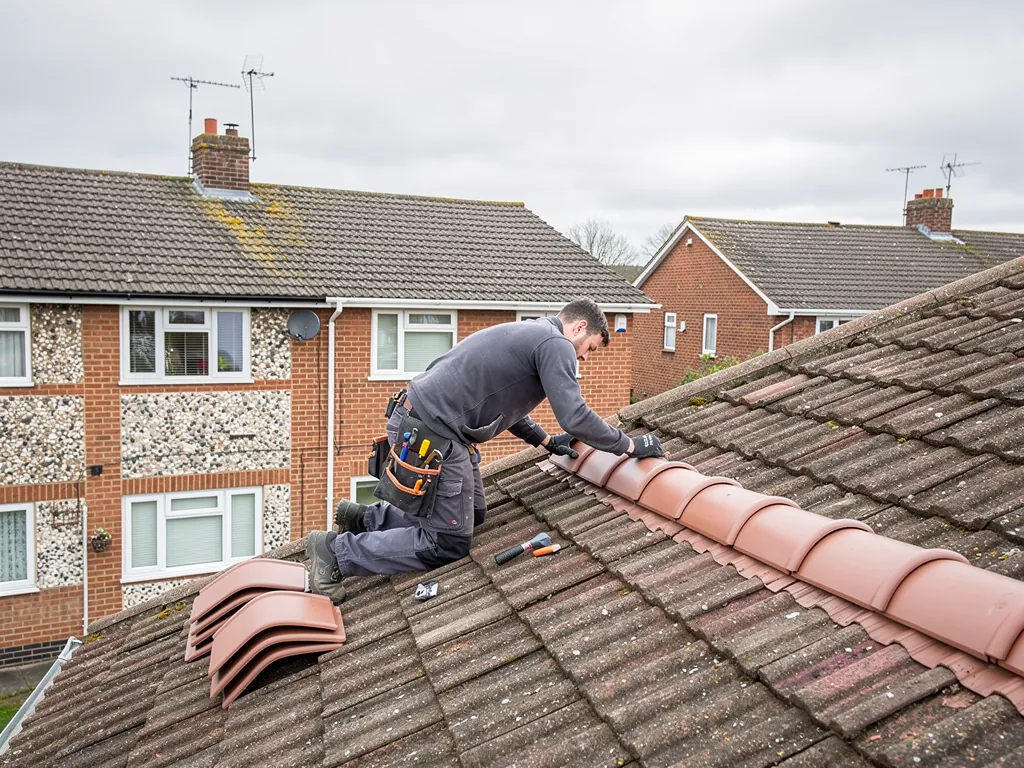
How a hip is built and what holds it
Where two slopes meet at an external corner, the roof tiles or slates from each side are cut to follow the angle. That cut line is covered by hip tiles, which are usually the same half-round or angled shape as the ridge, laid in a row from the eaves up to the ridge. Underneath, a timber hip rafter runs the full length of the corner, and on many roofs a hip batten is fixed along it to give the tiles something to be secured to.
The traditional method beds every hip tile on mortar and points the joints. At the foot of the hip a metal bracket called a hip iron is screwed to the hip rafter, and its upturned end supports the lowest tile so that the whole line cannot slide. The iron is a small part with a big job: if it rusts through or is missing, the hip is held up by mortar alone, and mortar is exactly what the standard says not to rely on. We cover the bracket in our short guide to the hip iron.
Under BS 5534:2014 a hip tile gets a mechanical fixing in addition to its bed. That can mean a fixing screwed through the tile into a batten, or a clip system, and it applies to repairs as well as new roofs wherever tiles are being relaid.
Do all hips have a hip iron?
No. Older roofs often have none, because the mortar bed was trusted to do everything, and some modern dry-fix systems use a different end stop. If a hip has no iron and the bottom tile is creeping, adding one is a cheap and useful repair.
What failure looks like from the garden
You can read a lot from the ground, with a pair of binoculars if the roof is high. The first sign is usually the bottom hip tile sitting a little lower than it did, or standing at an odd angle to its neighbours. A gap opens between that tile and the next, and daylight or a dark line shows where mortar used to be.
Further up the hip, look at the joints. Mortar that is cracked, crumbling or missing leaves open channels for rain. A band of pale grit on the roof below, or on the ground near the downpipe, is mortar that has already fallen. Moss growing along a hip joint holds moisture against the bed and speeds the damage, and lichen on the tiles themselves is a cue to look closer at the joints beneath it.
At the top, where the hips meet the ridge, three lines of tiles come together at an awkward angle, and this junction often has the most complicated mortar work on the whole roof. It is the spot most likely to let water into the loft, and it is also where a brown stain on the ceiling inside the house often traces back to.
Is a cracked hip tile urgent?
It depends on where the crack sits and how the tile is bedded.
A single hairline crack is not an emergency, though it should be dealt with before the next winter. A tile that has broken in two can slide, and a tile that falls lands in a garden or on a path. We put an active leak or storm damage ahead of routine bookings. A loose hip tile is something we ask you to keep people clear of until we have looked.
Why hip tiles slip, crack and open up
The causes are mostly mechanical. Mortar shrinks as it cures, and over years it is shaken by wind, flexed by temperature swings and attacked by frost when water gets into small cracks. A sand and cement bed is brittle, and once it cracks it loosens its hold on the clay or concrete.
The load on a hip makes everything worse. The weight of the tiles and the bed pushes down the slope, so the lowest tile carries the greatest push. If the hip iron has corroded, or was never fitted, the only thing resisting that push is the grip of the mortar on the rafter batten, and when that grip goes the row moves as one.
Cut tiles beneath the hip add to the trouble. The roof tiles on either side are cut at an angle to meet the hip, so their cut edges sit close to the bed. If they were cut badly or are cracked, water finds its way past the hip line even when the hip tiles themselves are sound. A repair that looks only at the cap and ignores the cuts underneath can leave the leak where it was.
Can foot traffic crack hip tiles?
Yes. Aerial and satellite fitters, chimney sweeps and well-meaning neighbours step on hips because they look like a ridge you can walk along. They are not, and a hip tile is a brittle shape standing on a slope. If a tile broke soon after somebody was on the roof, that is a likely cause.
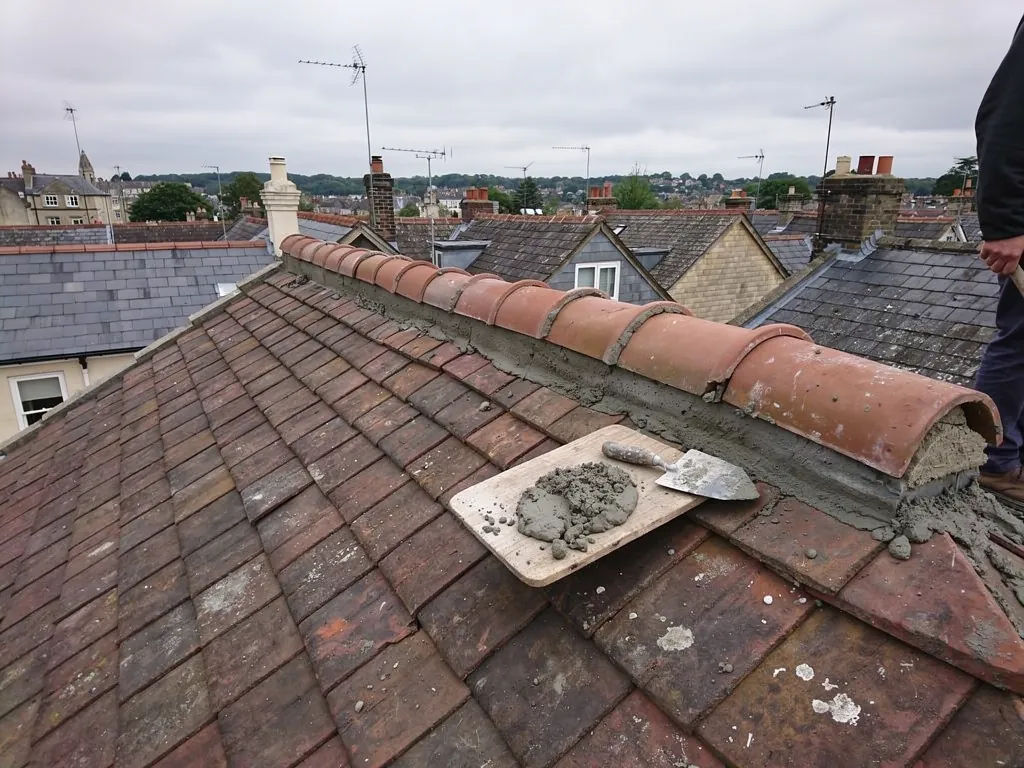
The repair options, from refixing to a dry hip
The right repair depends on how far the failure has spread. We usually look at the options in this order, because it keeps the repair in proportion to the fault, never bigger than it needs to be.
- Refix the bottom tile and renew the hip iron. Suitable where the rest of the hip is sound and only the foot has moved.
- Repoint the joints. Where the tiles are firm but the mortar is cracked or lost, raking out and repointing seals the joints. This is a tidy-up and not a structural repair, and it works only when the tiles are mechanically held already.
- Lift, rebed and fix the hip. Where the mortar bed has gone along a stretch, the tiles are lifted, the old bed is cleared, and the hip is relaid on fresh mortar with mechanical fixings added. Our guide to ridge rebedding explains the sequence, which is the same for hips.
- Replace damaged tiles. Cracked tiles are swapped for matching ones during a rebed. A cracked ridge tile follows the same logic, as our short answer on a cracked ridge tile explains.
- Fit a dry-fix hip system. Mortar is replaced by clips, a fixing tray and cap pieces tested to BS 8612:2018.
A repair that skips the mechanical fixing leaves the hip relying on mortar, and the standard moved away from that for good reason.
Mortar or dry hip: choosing for your roof
A mortar-bedded hip suits a roof where appearance matters, on a house in a conservation area, or with clay tiles of an older pattern. Properly finished it looks right from the road and can last many years, though the pointing is a maintenance item that will need attention eventually.
A dry hip suits modern concrete-tiled roofs, and it avoids the shrink and crack cycle of mortar altogether. It also copes with the movement a long hip experiences. The drawbacks are that the caps are visible and may not match an older roof, and the system must match the tile profile in use. The choice is explained in full in mortar against dry-fix.
The decision can be made hip by hip. A house may have mortar on a front hip that matters to the street and a dry system on the rear ones. Mixed methods are normal, and a roofer should be able to explain why each hip got the method it did. What we avoid is leaving a mortar-only hip behind because it looks fine, when we already know the fixing has gone.
Whichever method you choose, the hip should end up held by something other than mortar alone, and the written quote should say what that something is.
Access, safety and what drives the cost
A hip is a long diagonal on a steep roof, and reaching it safely often decides how the job is run. A short repair near the eaves may be reached from a ladder, provided the footing is solid and the ladder can be tied at the top. A repair along the full length of a hip, or at the top junction with the ridge, normally needs a scaffold with a working platform, because a person cannot safely stand on a pitched roof while handling tiles and wet mortar.
For cost context only, MyBuilder's guide to slate roof costs, updated 21 August 2026, gives roughly £200 to £400 for repointing ridge or hip tiles, and £300 to £600 for the dearer job of lifting and relaying ridge tiles. Checkatrade's roof repair guide, last updated June 2026, lists dry ridge at £50 to £70 a metre and dry hip at £70 to £100 a metre, both before VAT. These are national figures and not our prices. What actually sets your total is the length of the hips, how many there are, the access needed, the tile type and whether the bedding is sound or has to be stripped.
Why does the survey matter on a hip job?
Because the cause is often hidden. We photograph the hips, the junction at the top and the cut tiles below, and the quote that follows in writing rests on what the pictures show. If a small refix will solve the fault, the quote is for that refix. If the whole hip needs relaying we say that, with the reasons. Ten years of workmanship cover is given on paper, and the old mortar, broken tiles and other waste go with us at the end of the job.
To arrange a survey, ring 01793 626096, drop a WhatsApp message to the same number or send the enquiry form. For the wider group of fixes, the ridge, verge and dry-fix page is the place to start.