
Why does water pour over my gutter?
A blockage is the usual cause, but a wrong fall, a sagging run or an undersized outlet will do it too. We check all four before replacing anything.
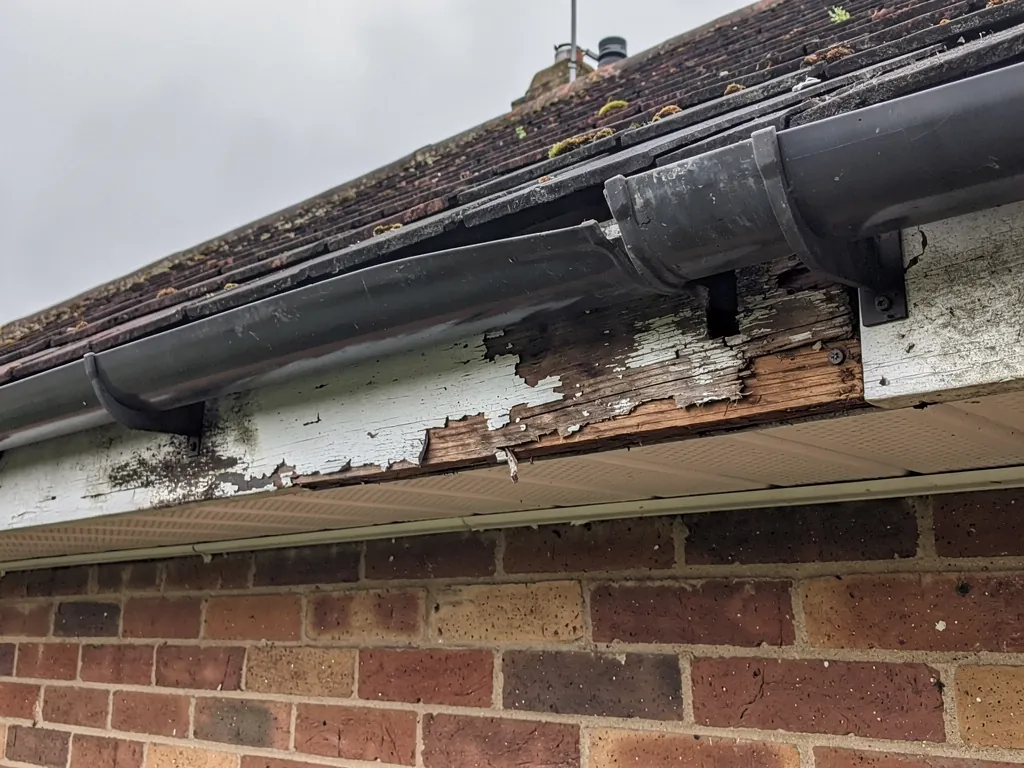
Overflowing gutters, sagging runs, rotten fascia boards and soffits gone green, put right at the roofline where they start, or a whole new roofline installed. You get photographs of every fault and a quote in writing.
A blockage is the usual cause, but a wrong fall, a sagging run or an undersized outlet will do it too. We check all four before replacing anything.
Sound boards can stay and be capped or repainted. Boards that are soft, split or crumbling at the bottom edge cannot hold a gutter and need to come off.
Often, yes. The soffit is where fresh air usually enters the loft, so a vented strip or disc can stop condensation. We check the loft before choosing a plain board.
| Job | Typical cost |
|---|---|
| Guttering replacement | £30 to £70 per metre |
| Fascia boards | £80 to £150 per metre |
| Soffit boards | £100 to £180 per metre |
| Removal and disposal of old boards | £150 to £300 |
| Scaffolding, standard two-storey house | £850 to £1,200 |
Typical national figures, not our prices. Run length, house height and the material you choose move them, so your own number is fixed on paper after the survey.
MyBuilder gutter, fascia and soffit replacement cost guide and scaffolding cost guide (updated August 2026).
See all costs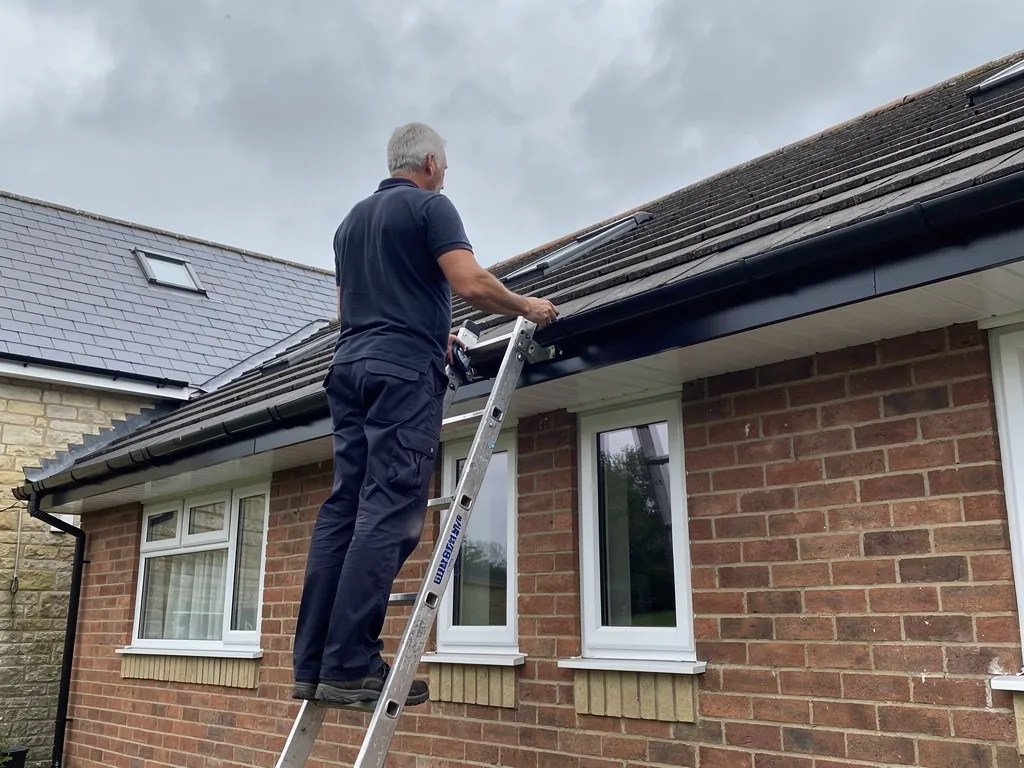 Gutter replacementWhole runs replaced in uPVC, aluminium or cast iron, set to a fall and fixed on brackets spaced for the system, so the water reaches the outlet.Gutter repair and realignmentFailed joints resealed, sagging runs re-hung, split sections swapped out and cracked brackets renewed, where that cures the fault without a full replacement.
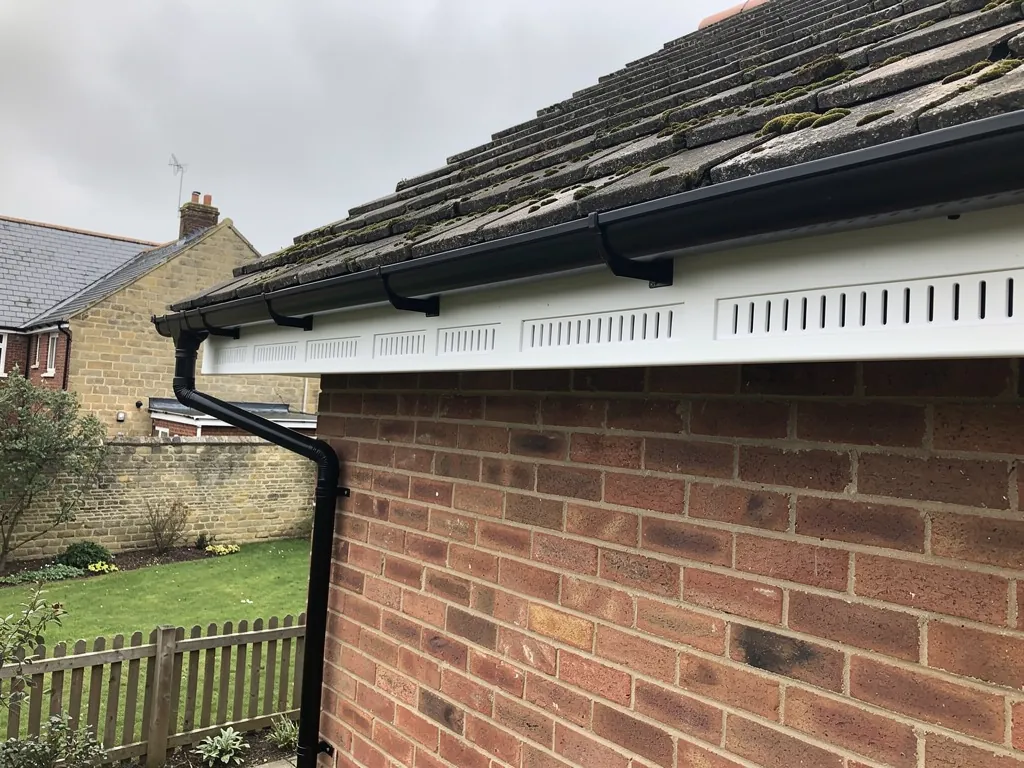 Downpipes and drain connectionsNew pipes, offsets, clips and shoes, joined to the hopper or gully so the water ends up in the drain and not against your wall.
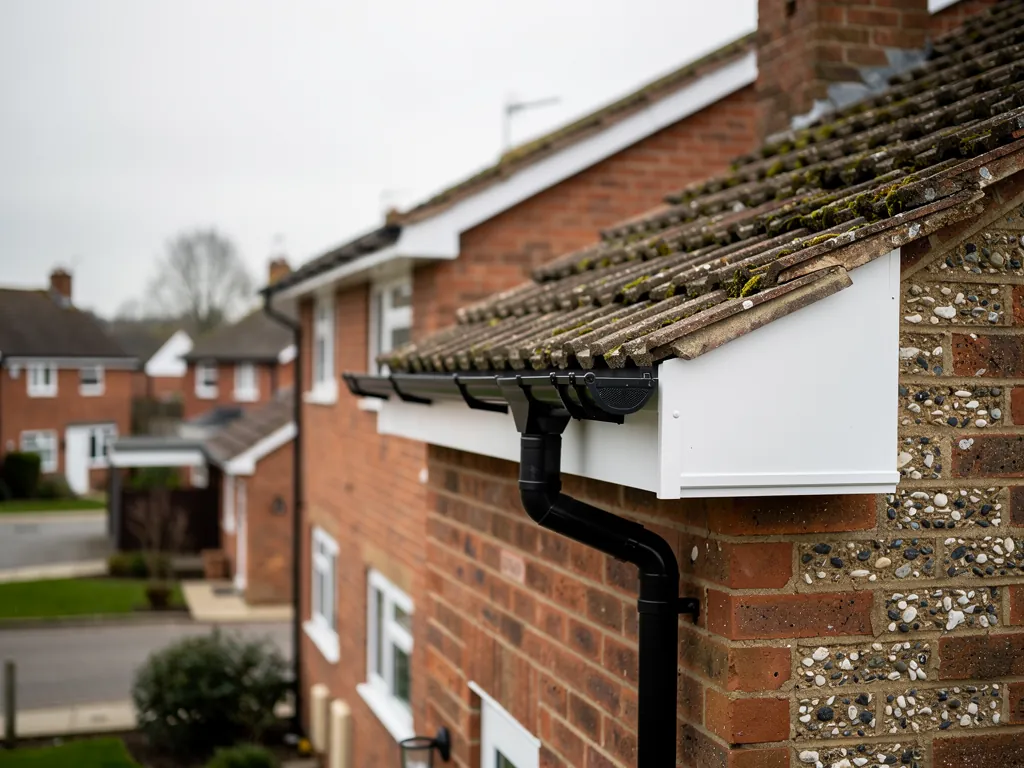 Fascia boardsRotten timber cut out, or boards replaced in uPVC, aluminium or timber, with the gutter refitted to a board that can carry its weight.
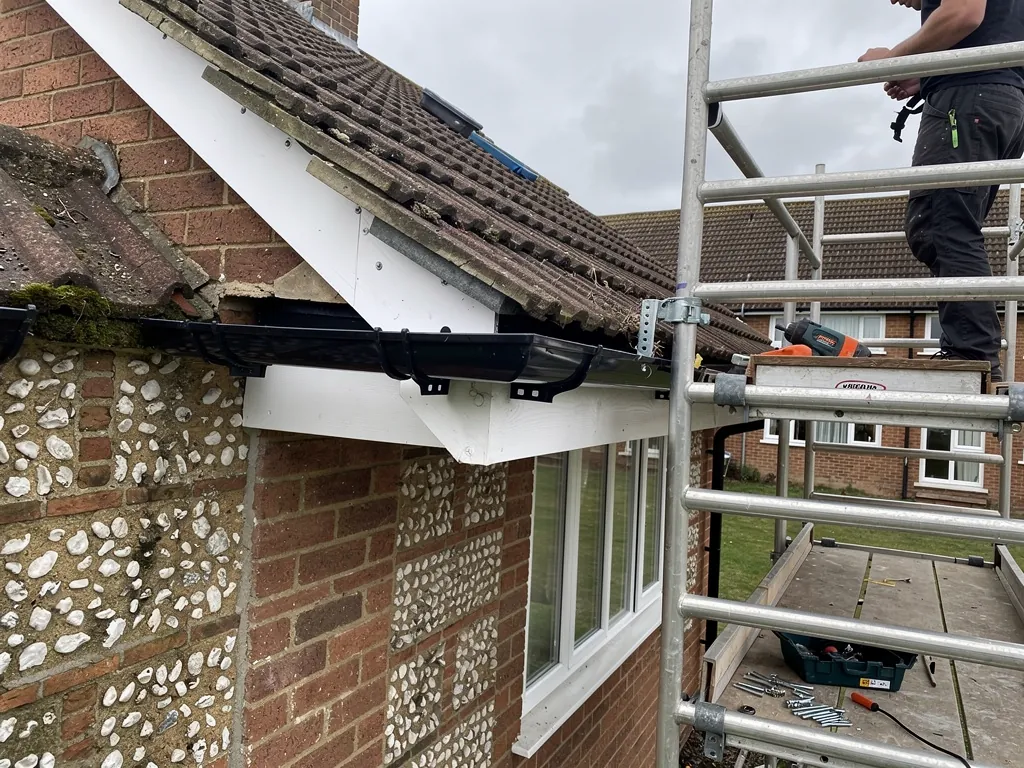 Soffits and eaves ventilationPlain or vented soffit boards fitted under the overhang, with the loft checked so the air path from the eaves is left open.
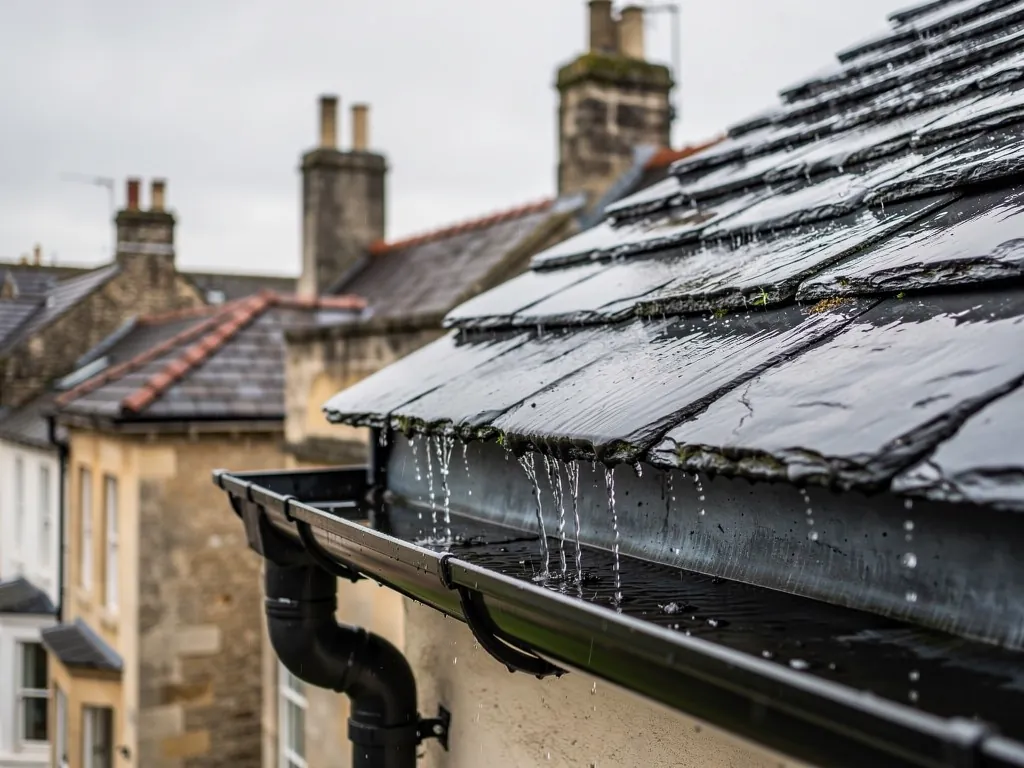 Bargeboards and cleaningGable-end boards renewed or repainted, plus gutter clearing and a roofline check, with photographs of anything that needs attention.
Roofline work, explained by question
From what each board does to whether an old soffit might hold asbestos, the questions that come up when a roofline starts to fail.
The short answer
The fascia is the board at the rafter ends that carries the gutter. The soffit is the board under the overhang that closes the gap to the wall. The gutter and downpipe collect rainwater and take it to the drain. Each one protects the others, which is why they tend to fail together.
The roofline is the strip where the roof stops and the walls begin. It looks like trim, but every part of it is working. When one part gives up, the damage spreads to its neighbours, usually into the timber behind the paint and plastic.
The fascia is the board fixed across the ends of the rafters, facing outwards. It does two jobs: it finishes the edge of the roof, and it carries the guttering. Plastic gutter brackets are screwed into it, or sometimes into the rafter feet behind it, so a fascia that has gone soft is a gutter waiting to drop. On some houses the board is also what the bottom row of roof tiles sits against, so it helps hold the covering at the edge.
The soffit is the flat board on the underside of the overhang, running from the back of the fascia to the wall. It keeps birds, wasps and weather out of the eaves cavity. On many houses it is also where air enters the roof space, either through a vented strip, a row of round discs or a gap left along the board. The soffit is out of sight from the garden, so it is easy to forget until it sags or goes green.
The gutter catches the water running off the roof and moves it along a gentle fall to an outlet. The downpipe carries it down the wall to a gully or soakaway. If the gutter overflows or leaks, the water runs down the wall face or into the eaves, which is where fascia and soffit rot begins. Our guide to how fascias, soffits and gutters work together goes through each part in more detail.
A blocked gutter spills over the fascia. A wet fascia rots at the bottom edge. A rotten fascia lets the gutter sag. A sagging gutter holds water that spills again. Starting at any point in that loop is possible, but the repair only lasts if the cause is found, which is why we look at the whole run before deciding what needs replacing and what can simply be put right.
Bargeboards sit on the sloping edges of a gable end and finish the roof there. They carry no gutter, but they take the same weather as the fascia and rot the same way, so they are checked on the same visit.
| Part | Where it sits | What it does |
|---|---|---|
| Fascia | Across the rafter ends, facing out | Carries the gutter and finishes the roof edge |
| Soffit | Underside of the overhang | Closes the eaves and often admits loft air |
| Gutter | Fixed to the fascia | Collects roof water and moves it to an outlet |
| Downpipe | Down the wall | Takes the water to the drain or gully |
| Bargeboard | Along the gable slope | Finishes the roof edge at the gable end |

The short answer
MyBuilder puts guttering replacement at £30 to £70 per metre, fascia boards at £80 to £150 per metre and soffit boards at £100 to £180 per metre. Scaffolding and the disposal of old boards come on top, and the length of run decides most of the total.
Roofline work is priced per metre, so the first thing to settle is how many metres you have. A mid-terrace house has a short front and back run. A detached house with a garage and a rear extension may have three or four times as much, and the quote grows with it.
MyBuilder, updated in August 2026, gives £30 to £70 per metre for guttering replacement. The same guide puts soffits at £100 to £180 per metre and fascia boards at £80 to £150 per metre, and says a combined fascia and soffit job typically comes to around £150 per metre. A bargeboard is listed at £195. Removal and disposal of the old boards is shown as £150 to £300. These are national averages from a third party. They help you judge whether a quote is in a sensible region, not what yours will be.
Boards and gutters are fixed at eaves height, and eaves height on a two-storey house is not somewhere to work from a ladder for hours. MyBuilder puts scaffolding for an ordinary two-storey home at around £850 to £1,200, and on roofline work the scaffold often takes the biggest share of the bill. That is why gutters and fascias are best done in one visit: the scaffold is paid for once, and if a re-roof is coming, doing the roofline alongside it saves a second set of scaffolding. Our roof replacement page covers how that is planned.
Material comes next: plastic costs least, while aluminium and cast iron cost more, and iron is slower to fit because of its weight. Then there is what sits behind the old boards. Soft rafter ends must be cut back and repaired before a new fascia goes on, which nobody can see until the old board is off.
MyBuilder's gutter cleaning guide, updated in August 2026, puts a standard clean at £50 to £150 and cleaning fascias and soffits at £40 to £100, with larger or harder-to-reach houses costing more. Height, run length and how blocked the channel is set the figure. We clear gutters as a job in its own right, and a roofline check comes with it. Our quote is one written price after we have seen the house, covering the gutter metres, board metres, downpipes, access and waste. Our guides on the cost of replacing gutters and on fascia and soffit costs take the national figures apart further.
When you compare quotes, check that each names the material and colour, includes VAT and scaffolding, and says whether the old boards go away with the team.
What it typically costs
The answer
uPVC suits most modern houses and is the lowest-maintenance choice. Aluminium is lighter than iron, holds its shape and comes in a range of colours. Cast iron belongs on period buildings where the original system is part of the look. The house, not the catalogue, should decide.
Choosing a gutter material is partly about money, partly about appearance and partly about what the building can carry. A heavy iron gutter on a thin fascia is a mistake, and a thin plastic one on a Victorian bay looks wrong from the pavement.
Plastic guttering is light, easy to cut and does not rust, which is why it is on most houses built from the 1960s onward, including the estate houses on the edges of Swindon. It is low maintenance and durable in our weather, needing little beyond clearing. Its weak points are the rubber seals at joints, which harden over time, and brackets, which can crack when the plastic has been baked and chilled for years. White uPVC dulls and picks up algae, and black or grey holds its colour better in the shade.
Aluminium is stronger than plastic at the same thickness, stays straight along a long run and takes a factory-applied colour. It can also be formed on site into one continuous length with no joints between the corners, which is what people mean by seamless guttering. Our answer on seamless aluminium gutters explains where they suit and where they do not.
Cast iron is heavy, durable when painted and maintained, and the right match for a house that had it originally. On a listed building or in a conservation area it is often the system the council expects to see kept or restored. Our page on cast iron guttering sets out when to repair a section, when to replace it and when to restore the lot.
Sources differ. MyBuilder, updated in August 2026, advises looking over fascias and soffits every 5 years and says they are typically replaced every 10 to 20 years, depending on the material and the local weather. A plastics retailer puts uPVC boards at 20 to 40 years. What shortens the life is usually the fitting, not the product: thin boards, too few fixings, and joints left with no room to move as the plastic warms and cools. Painted timber lasts well only while the paint is kept up. Our answer on how long uPVC fascias last goes further.
White is still the common choice, with black, anthracite grey, brown and woodgrain foils widely made, so roofline products can match the windows, the doors or the existing gutters on the rest of the home. Steel, zinc and copper suit design-led work, and copper and zinc weather to a natural colour. Whatever you pick, decide early: a factory colour cannot be changed once it is up, and we fit one maker's system end to end so the parts join neatly.
Half-round is the common domestic shape. Square sections give a crisper line and a little more capacity, and ogee copies the moulded profile of older cast iron. Our guide to gutter materials compared sets the options side by side.
Ask what the gutter will be fixed to. A heavy system needs a firm fascia or fixing direct to the rafters, and a board that cannot take the weight turns a good material choice into a failure within a few winters.
On an old building, the right gutter is often the one it was built with.
MythPlastic guttering never needs any attention once it is up.
FactIt does not rust, but its seals harden, its brackets crack and its channel fills with leaf litter, so it still needs clearing and the odd check.
The short answer
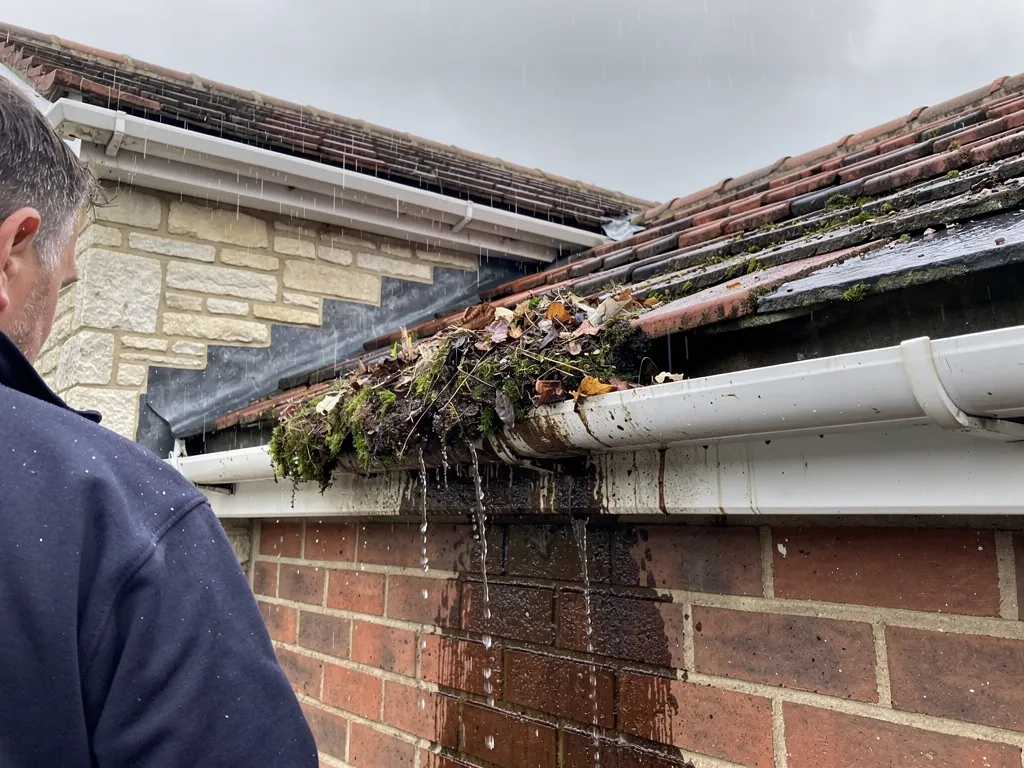
Blockages cause most overflows, but a wrong fall, loose brackets or a downpipe that cannot clear the flow will do the same. Drips at joints usually mean a perished seal or a bracket gap. We trace which one it is first, because the fix for each is different.
A gutter that spills in heavy rain is not always a gutter that needs replacing. The right repair depends on why the water leaves the channel, and the quickest way to find out is to watch it and look closely from above.
Leaves, moss washed off the roof, nesting material and the grit shed by older concrete tiles all settle in the channel and at the outlet. A blocked outlet fills the gutter from the downpipe end, and the water spills over the front edge, usually in the middle of the run rather than at the end. Clearing is a short job, and our guide to gutter cleaning covers how often it is worth doing. Houses with overhanging trees want it more often. A blocked downpipe, which is a different fault, is covered in clearing a blocked downpipe.
A gutter has to run downhill to its outlet. Manufacturers typically recommend a gentle fall, roughly 1:600 to 1:350 depending on the system. Too little and water stands in the channel, goes stagnant and spills at the first heavy shower. Too much and the water rushes past the outlet. The fall is lost when brackets sag, when a fascia bows or when a run was set up level to look neat from the garden. Our answer on the fall a gutter should have explains what to look for.
Brackets hold the gutter at the right height and position, and manufacturers set a maximum spacing between them. One plastic system's guide says no more than 500mm apart on straight runs, and another maker says supports should be no more than 900mm apart, so we follow the maker's data for the system on your house. Missing or cracked brackets leave the channel to bend under water, snow and a ladder leant against it.
Where two lengths of plastic gutter meet there is a union with a rubber seal. When that hardens or the gutter moves, it drips. A reseal is a repair; a split section or a corner that has warped needs swapping. Our guide to leaking gutter joints explains the fixes in order.
Sometimes the gutter is simply too small for the roof above it, or the outlet is too far from the roof valley that dumps water onto one corner. That is a design fault, and the fix is a larger section or an extra downpipe rather than a bigger brush.
If water is running down the inside of a wall or staining a ceiling, do not assume it is the gutter. Roof leaks and gutter overflow can look alike from inside, and our roof repairs page explains how a leak is traced.
The short answer
Capping puts a new plastic or aluminium cover over a sound timber board and is quicker and neater. It is the wrong choice when the timber behind is soft, because the rot carries on out of sight. Boards that fail the probe test come off; sound ones can be covered.
Capping is popular because it gives a clean new finish without removing the old timber. Done on sound boards, it works well. Done on rotten ones, it hides a problem and lets it grow, so the first question is always what the board is like underneath.
We probe the lower edge and the ends of each board with a bradawl or screwdriver. Sound timber resists; rotten timber lets the point in easily and crumbles. The bottom edge and the joints between lengths fail first, because water sits there. Any gap where paint has split gives a sign to look at, and a fascia that rings hollow, or that has dropped away from the rafters, is a sign to look behind. Our answer on how to tell if a fascia needs replacing lists what to look for from the ground.
If the timber is sound but the paint is tired, a capping system saves repainting and gives a maintenance-free face. It also keeps the original board in place, which can matter where the rafter ends are awkward to reach. Our guide on capping old fascias with uPVC covers the trade-offs.
Rot that has reached the rafter ends, boards that have split along the grain and sections that have pulled away from the wall plate all need replacement. Fitting a cap over them gives the gutter a smooth surface to fix to, but the screws bite into mush, and the gutter comes down at the next storm. Where rafter ends are damaged, they are cut back to sound wood and repaired first. Rotten bargeboards follow the same rule, and bargeboards have their own guide.
It is when the timber is rotting, the gutter has started to sag, birds or wasps are getting into the eaves, or you are repainting high boards every few years. New uPVC protects the rafter ends, ends the painting and lifts the look of the property from the street. It is not worth it when sound timber only needs a coat of paint, and we tell customers that plainly.
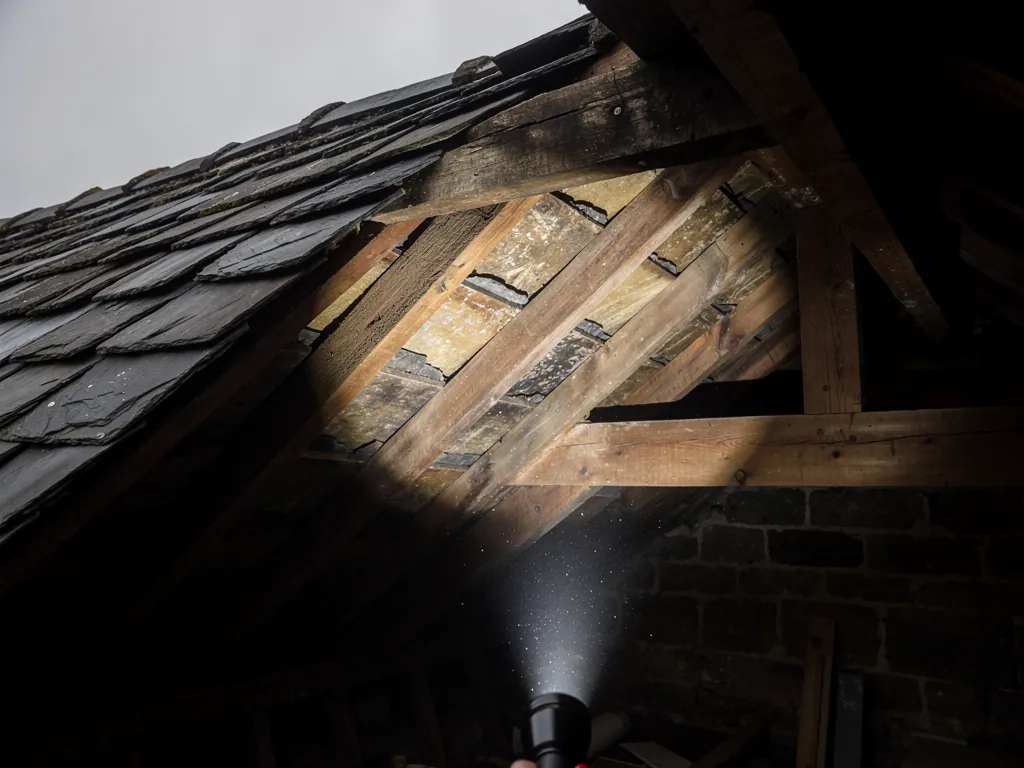
The scaffold goes up, the old gutters and boards come down, and we check every rafter foot before anything new goes on. Fascias are fixed to sound timber, soffits go in with vents where the loft needs air (our guide to soffit vents and loft ventilation covers sizing), and the gutters are hung to the maker's fall with downpipes into the drain. We install roofline on homes, flats, shops and commercial units, local to Swindon and across Wiltshire, from Old Town and Stratton St Margaret to Highworth and the surrounding villages. The work carries our 10-year workmanship guarantee, in writing.
On older houses, the soffit board may not be what it looks like. HSE lists external soffits among the places asbestos insulating board has been used, and says it is difficult to tell it from non-asbestos boards by eye. If the building was built or refurbished before 2000, HSE says to assume asbestos may be present. A board we suspect is left untouched until it has been checked, and our page on asbestos in soffits explains why sampling and specialist removal come first.
Capping adds a layer rather than taking one away, so it also adds a little thickness at the edge. On a tight eaves detail we check that the tile overhang and the gutter still line up before agreeing to it.
Our view
Cap a board only when a probe finds sound timber right to the bottom edge; any softness means it comes off.
The answer
Repairs that copy what is there seldom need permission, but changing the material, profile or colour of a roofline on a listed building or in a conservation area can. The Railway Village also has an Article 4 direction. Check with Swindon Borough Council's planning team before agreeing a change.
Swindon has plenty of roofline that nobody would want changed. The council's conservation areas page lists 27 areas, among them Swindon Old Town, Highworth, Wroughton and Swindon's Railway Conservation Area. The rules differ by building, so the first step is to find out which category yours is in.
Maintenance work falls outside the definition of development in planning law, provided the outside of the building looks much as it did before. So replacing a cracked cast iron section with the same pattern, or a rotten timber fascia with timber of the same profile, does not usually need planning permission. That is the broad position, and the caveats are listed building status and Article 4 directions.
On a listed building, a change from timber to plastic, or from iron to a different profile, may need listed building consent. We ask the council before proposing a change, not after, and our listed roof repairs page explains the consent side. The council makes that call, and we work to its answer.
The Railway Village became a conservation area in 1975 and became part of the wider Swindon's Railway Conservation Area when the council merged areas in 2020 to 2021. The council's appraisal says the cottages were listed in 1970, and an Article 4 direction adopted in 1980 applies to Church Place and the residential streets around it. Under it, painting the exterior and making alterations both need permission, so even a change of colour on a roofline there is a question for the council.
The council's page also notes an Article 4 direction for Bishopstone. Villages from Wroughton to Hannington have their own conservation areas, and being inside one can change what you may alter on a front elevation. Our guide on guttering and roofline in a conservation area goes through the matching and consent points. On an older street we photograph the existing profile first, and if a planning question is open, the quote waits for the council's answer.
Ask Swindon Borough Council's planning team about the status of the house first; a quote signed before that answer arrives may be for the wrong material.
More detail on costs, materials, leaks, ventilation and the particular parts of the roofline, from downpipes to bargeboards.
Yes, when the boards are sound. We probe them first, and if they pass, new gutters go straight on. Soft boards need to come off or the new gutter will sag again.
Yes. Old guttering, boards and offcuts are carted off by us, and the site is cleared before we go.
A closed soffit with tight joints removes the gaps birds and wasps use. We leave the ventilation path open through a vented strip, so the eaves are blocked to animals, not to air.
They can reduce leaf build-up on houses under trees, but they are not a cure for neglect and some types clog with moss. Our gutter guards answer sets out the types and the catches.
Yes, with a diverter kit fitted into the pipe. It needs an overflow route back to the drain so a full butt does not send water against the wall.
A hard jet can drive water behind the boards and scuff a foiled finish, so a soft wash with a mild cleaner and a brush is the safer route. Green streaks usually come back where water keeps running, so we check the gutter above too.
It depends on the deeds and who the gutter serves, so the paperwork comes first. Where terraces or semis share a run, we suggest agreeing the work with the neighbour in writing before it starts.
Send us a photo of the stained wall, the spilling gutter or the board that looks soft, taken from the ground, and tell us roughly which side of the house it is on. We will measure the runs, probe the boards and look up into the soffit, then send one written price covering everything.
Tell us what’s happening and we’ll call you back.
Or call 01793 626096
Message us on WhatsApp