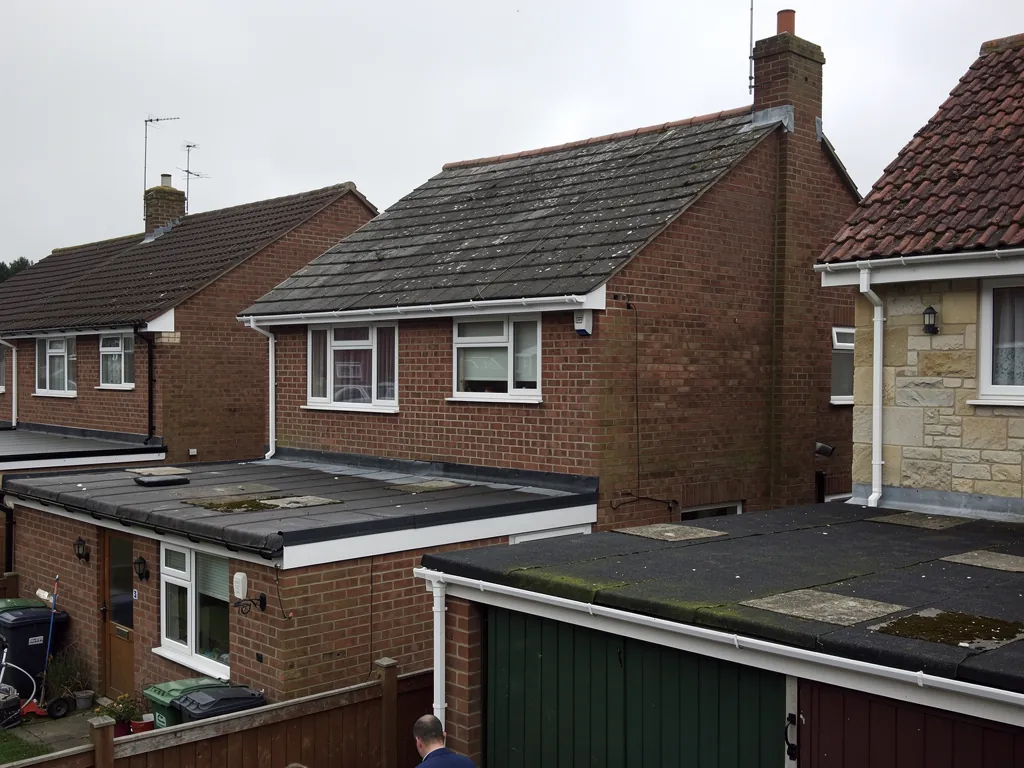
Flat-roofed garages behind brick semi-detached houses

Roofers in Royal Wootton Bassett

Pitched and flat roofs, chimneys and leadwork across Royal Wootton Bassett, from the stone-roofed houses of the High Street and the Town Hall on its columns to the estates built as the town grew.

Royal Wootton Bassett's roofs, from High Street to estate

Brick terrace with a stone-tiled roof
The High Street and the Town Hall

The Victoria County History describes the High Street as largely lined with red brick houses of the eighteenth and early nineteenth centuries, built from local brickyards and topped with stone roofs, with a few timber-framed houses surviving at the west end. The Town Hall is the landmark: a small half-timbered building raised on fifteen stone columns, credited by tradition to 1700 and restored in 1889. Stone roofs are heavy, and the stones shrink in size as the courses climb, so the biggest ones sit low along the gutter line and the smallest are up by the ridge. They suit a repair made stone by stone, because dismantling a whole slope risks breaking the very pieces that give the street its character. Where a stone has slipped, it can often be refixed on a new peg without disturbing the courses beside it.

Victorian terrace with shared chimney stacks
Railway-age streets

The London to Bristol railway was built through the parish in 1841, and the population climbed from 1,244 in 1801 to 2,990 in 1841, swollen by about 800 railway labourers. Streets of terraces and pairs from the railway years and after share chimney stacks and party walls, and many are now covered in slate or clay tile. Their faults cluster at the joins: lead flashings that have split where a roof meets a stack, ridges bedded on tired mortar, and valleys where two slopes meet and the lead lining has crept or cracked. A leak in a terrace often shows in the neighbour's ceiling first.

Postwar semi-detached houses with tiled roofs
The dormitory town

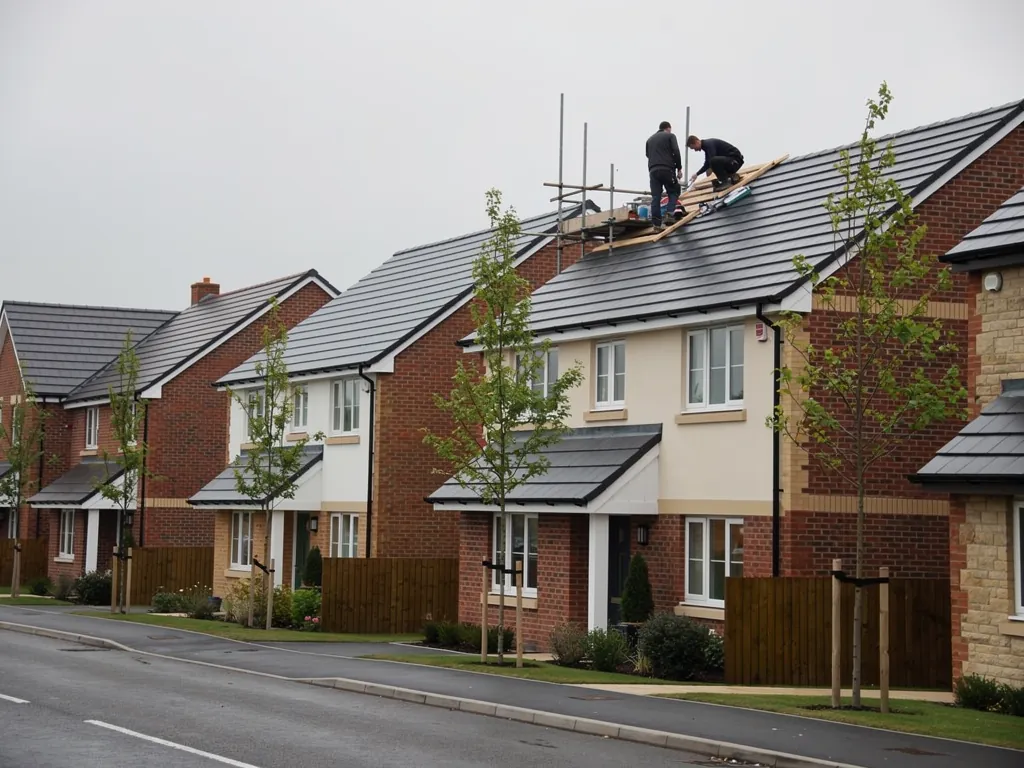
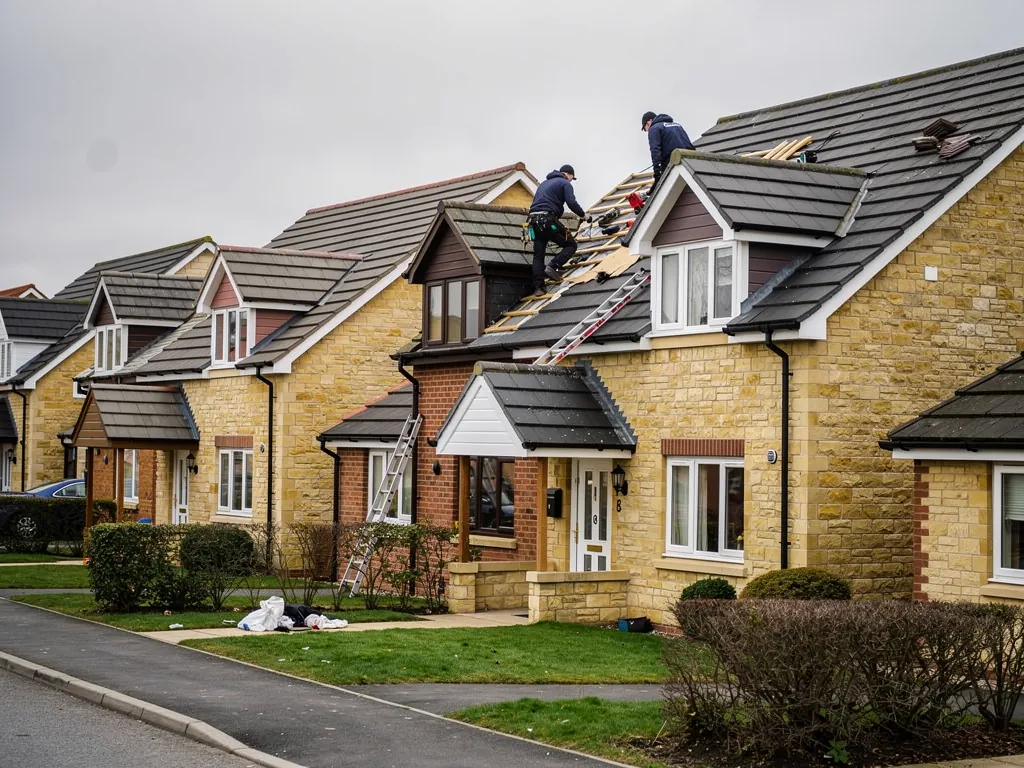
The largest growth came after the early 1950s, when Royal Wootton Bassett became a dormitory for Swindon and RAF Lyneham. That means rows of houses and bungalows from the postwar decades, then later estates, with concrete interlocking tiles on pitched roofs and flat or shallow coverings over garages, porches and rear extensions. The usual faults are cracked or slipped tiles, loose ridge bedding, rotting fascias and felt that has blistered. Garages and outbuildings built or refurbished before 2000 may also carry cement sheet roofing, and HSE guidance is to assume asbestos in buildings of that age, so we check before anything is touched.

From Swindon along the ridge to Royal Wootton Bassett

Map showing Royal Wootton Bassett and central Swindon. 7 road miles west-south-west of central Swindon.

Distance
7 road miles west-south-west of central Swindon
Council
Wiltshire Council
Council
Wiltshire Council, not Swindon Borough
Conservation area
Wootton Bassett, covering the historic core
Setting
A ridge crest about 400 ft above sea level, on the Corallian ridge

Before you book work in Royal Wootton Bassett

Is my High Street house listed or in the conservation area?

Royal Wootton Bassett has a conservation area and a number of listed buildings in the centre. Wiltshire Council can confirm which applies to your address before any work is priced.

Can you repair the stone roofs on the old brick High Street houses?

Yes. Stone roofs are repaired in place where we can, with new stones matched for size and thickness, rather than stripped for one fault.

What does the town's ridge-top position do to a roof?

It leaves roofs more open to the wind than houses on the clay land either side. Ridges, hips and verges are the parts we check first.

Q1

What kind of roof sits on a High Street house?

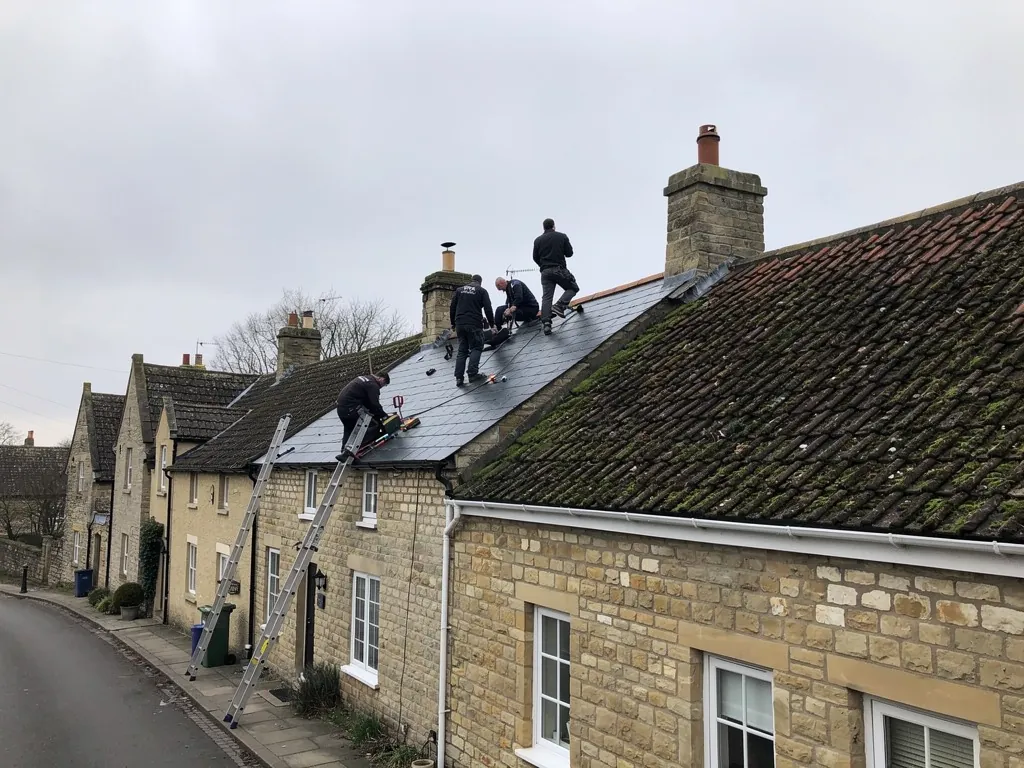
Roofers on a slate roof along a limestone village street
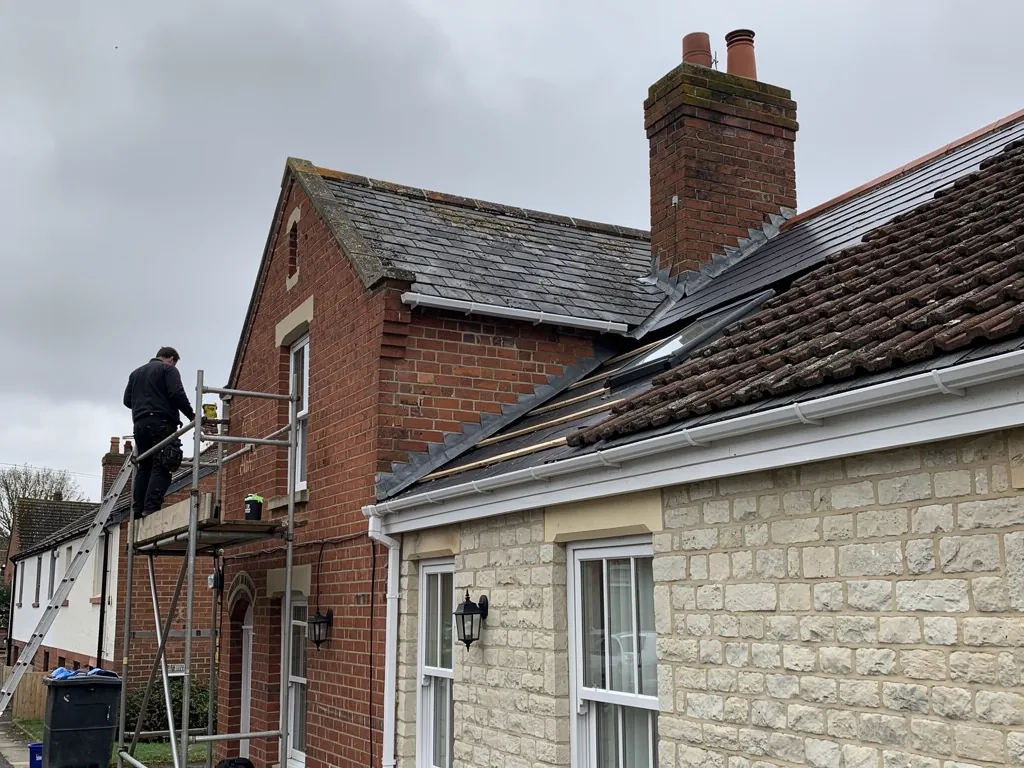
Brick end-of-terrace gable beside a limestone house, slate roofs

The short answer

On the older High Street houses, the Victoria County History records red brick walls with stone roofs, plus a few timber-framed buildings at the west end. The Town Hall is half-timbered on stone columns. These roofs are heavy and settled, and they repair best in place.

Royal Wootton Bassett stands on a ridge, and the stone under the town shaped what was built on it. The Victoria County History notes frequent exposures of Coral Rag, a hard Corallian limestone that was quarried locally for roads and buildings. It also records that most High Street houses of the eighteenth and early nineteenth centuries are red brick from local brickyards with stone roofs.

How does a stone roof behave on old brick walls?

A stone roof is a weight resting on old walls and old timbers. Give it enough decades and the rafters sag a little, the rows of stone wander, and the slope picks up a gentle wave that belongs to the building. We do not try to flatten it. A repaired patch has to sit in line with its neighbours, not proud of them. The faults are rarely the stones themselves: the pegs, battens and fixings that hold them give out first, and so does the bedding at the ridge.

Do timber-framed buildings need a different approach?

The Town Hall, half-timbered on its fifteen stone columns, is a reminder that this was a market town long before the railway. Timber-framed buildings move seasonally, so a rigid or cement-heavy repair at the roof edge can crack as the frame shifts. Lime-based mortar and flexible lead detailing suit them better. Wherever a roof meets a timber wall, we look at how water is shed before we look at anything else.

What does St Bartholomew's tell you about the roofs nearby?

St Bartholomew and All Saints is built of stone, mostly of the fifteenth century, and G. E. Street restored it in 1870 and 1871. Church roofs are looked after through the church's own channels, but the houses around it share its weather, and the same stone and brick tell you a good deal about what the older roofs nearby were built to carry. Our roof repairs page explains how we trace a fault on an older roof before quoting.

Our view

Treat a stone roof as heavy and settled, and repair it in place before anyone talks of stripping it.

Q2

Which Royal Wootton Bassett roofs date from the railway?

The answer

Those on the terraces and pairs put up from 1841 onward, when the London to Bristol line came through. They are typically slate or clay-tiled, share stacks and party walls, and fail at the joins: flashings, valleys and ridge bedding. A good many leaks start beside a chimney rather than across an open slope.

The railway changed the town quickly. Its population stood at 1,244 in 1801 and 2,990 in 1841, inflated by around 800 railway labourers. Streets built in those years and soon after share a recognisable pattern, and so do their roof faults.

Why do slates creep down a terrace roof?

A slate is nailed through two holes near its head and hangs from a batten. Once a nail corrodes, the slate creeps downhill, normally a little at a time, and water then gets through to the underlay. Swapping in a handful of slates is a quick job if the neighbouring ones are sound, but when slides keep appearing across a whole slope it is a sign the nails have failed generally and the slope needs re-fixing. Clay tiles fail differently, by laminating or cracking after frost, and they can be replaced one at a time.

Why does the leak show up next door?

Terraces share chimney stacks, and every stack is a junction of brick, lead and slate. Flashing means the lead that seals that junction against rain, and a soaker is a small lead sheet worked into the slates beside the stack. When lead ages it splits along its folds. Water then runs down the stack into the party wall and shows up in a neighbour's ceiling. If a stack is disused, taking it down below the roofline is sometimes the cleanest answer, though taking out the chimney breast below always needs Building Regulations approval, and a breast on a shared wall brings in the Party Wall etc. Act.

Could the valley be the real culprit?

Where two slopes meet at an inside corner, the valley carries a large share of the roof's water. A lead-lined valley that has split, or a valley clogged with moss, causes more ceiling stains than a missing slate. It is also the most overlooked part of the roof from the pavement.

Q3

What should a postwar Wootton Bassett roof check?

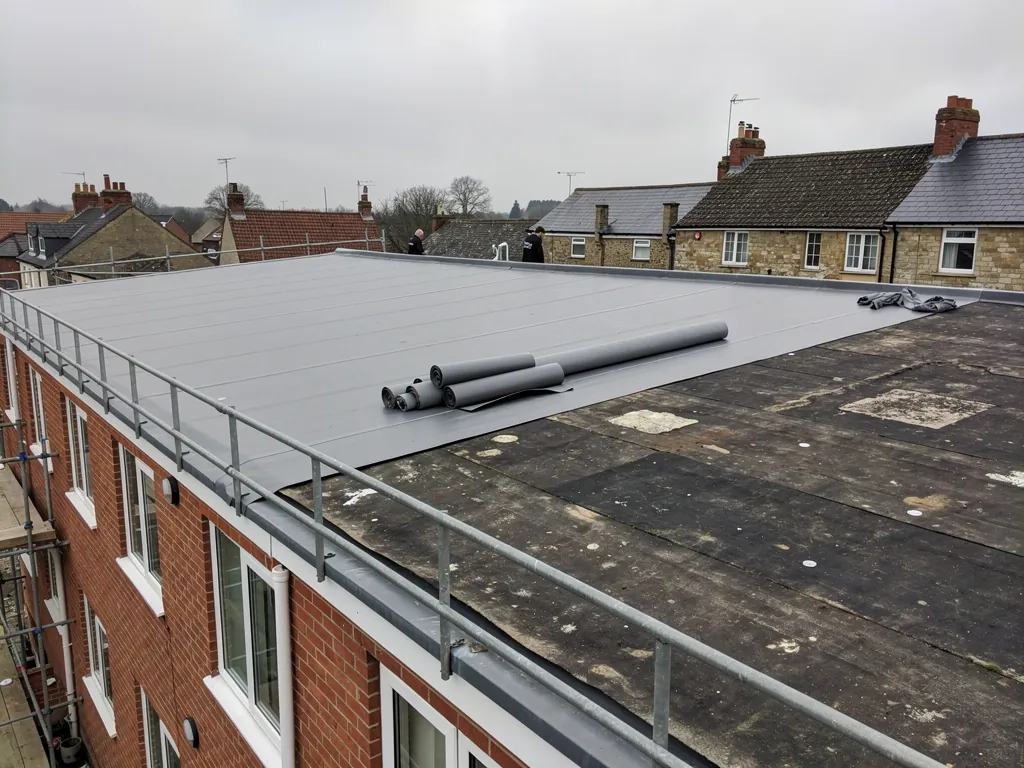
Long flat roof on a 1960s brick building being re-covered
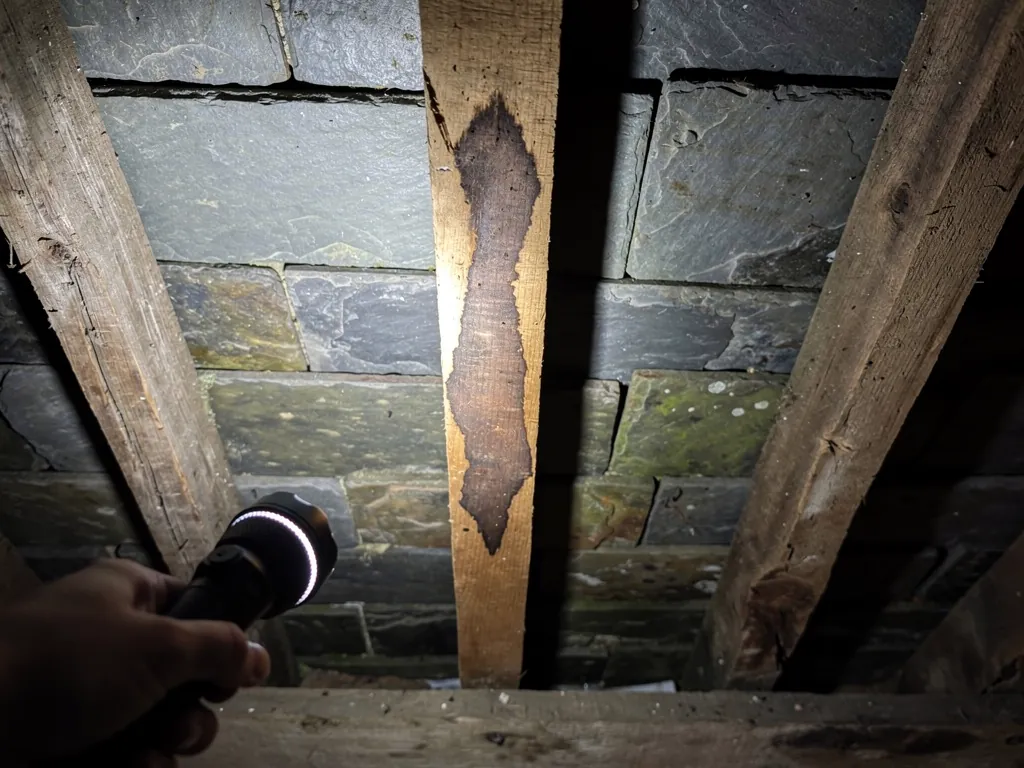
Torch showing a water-stained rafter beneath slates in a loft

The short answer

The ridge and hip bedding, any cracked or slipped tiles, the felt under them, the fascias, and the flat roofs over garages and extensions. Roofs from the dormitory-town years tend to age in small, local ways, and a survey with photographs shows which parts still have years left.

After the early 1950s the town grew to serve Swindon and RAF Lyneham. Houses and bungalows from those decades, and the estates after them, are very different from the High Street, and their roofs ask for a different kind of attention.

How long do the concrete tiles and felt last?

Interlocking concrete tiles often last for several decades, and a figure of around 30 to 60 years is a fair range. They are not maintenance-free. Tiles crack where a ladder has leaned or a dish has been fixed, and the underlay beneath them, which is the membrane that catches wind-blown rain, can tear at the eaves. New tiles plus a patch of fresh underlay make a modest job, and a far cheaper one than waiting for a ceiling to stain.

Why is the garage roof usually the first to leak?

Flat-roofed garages and rear extensions from these decades are often the first roofs to leak. Felt blisters, joints open, and water ponds in the middle of the roof. Whether to patch or re-cover depends on how much of the covering is sound, and we show you photographs so the decision is yours. Garages built or refurbished before 2000 may have asbestos cement sheets, and HSE guidance separates two cases: careful handling of whole sheets is non-licensed work, while substantially damaged or broken sheets make it notifiable non-licensed work. We identify what you have before a single sheet is moved.

Who approves a bigger re-roof in the town?

For a re-roof that goes beyond a repair, the route is Wiltshire Council's building control team or a registered building control approver, and we explain what is needed before work starts. Our flat roofing page covers garage and extension roofs in more detail, and our roof replacement page sets out the point at which a full re-cover beats another patch.

MythA concrete tile roof needs no attention for its whole life.

FactThe tiles last for decades, but ridge bedding, felt, fascias and flat extension roofs wear out first.

Roofing services in Royal Wootton Bassett

Questions from the High Street and the Town Hall

Why do the older High Street roofs have stone when the walls are brick?

Because stone was quarried close by and brick came from local brickyards, so builders used both. The Victoria County History records frequent exposures of Coral Rag around the town, and it describes the eighteenth and early nineteenth century High Street houses as red brick with stone roofs. The result is a heavy covering on brick walls, which is why we look at the roof timbers before any quote.

Do you work on roofs close to the Town Hall and St Bartholomew's?

Yes, on the houses and shops around them. The Town Hall and the church roof have their own owners and routes. Beside a listed neighbour we choose materials to suit it, and if the plan altered how the roof looks, the next call would be to Wiltshire Council.

Do you cover the estates and lanes beyond Royal Wootton Bassett?

Yes. Hook, Purton and the villages around are all inside the area we cover, which is every place within 30 road miles of Swindon. A new estate or a farm lane makes no difference to the survey, and the quote that follows is in writing.

My garage roof in Royal Wootton Bassett is old cement sheet: can it be repaired?

Sometimes, but we check the material first. HSE's advice is to assume asbestos is present if the structure was built or refurbished before 2000, and it classes the careful removal of unbroken asbestos cement as non-licensed work. We tell you what we find on survey and what the options are before you decide.

Ask us about your roof

Tell us what’s happening and we’ll call you back.

  • Photos of what we find
  • A written quote
  • 10-year workmanship guarantee

Or call 01793 626096

Call Get a quote