
Should I go up and look at the damage?
No. Look from the ground or the loft hatch, photograph what you can see, and leave the slope to someone with the right access equipment.
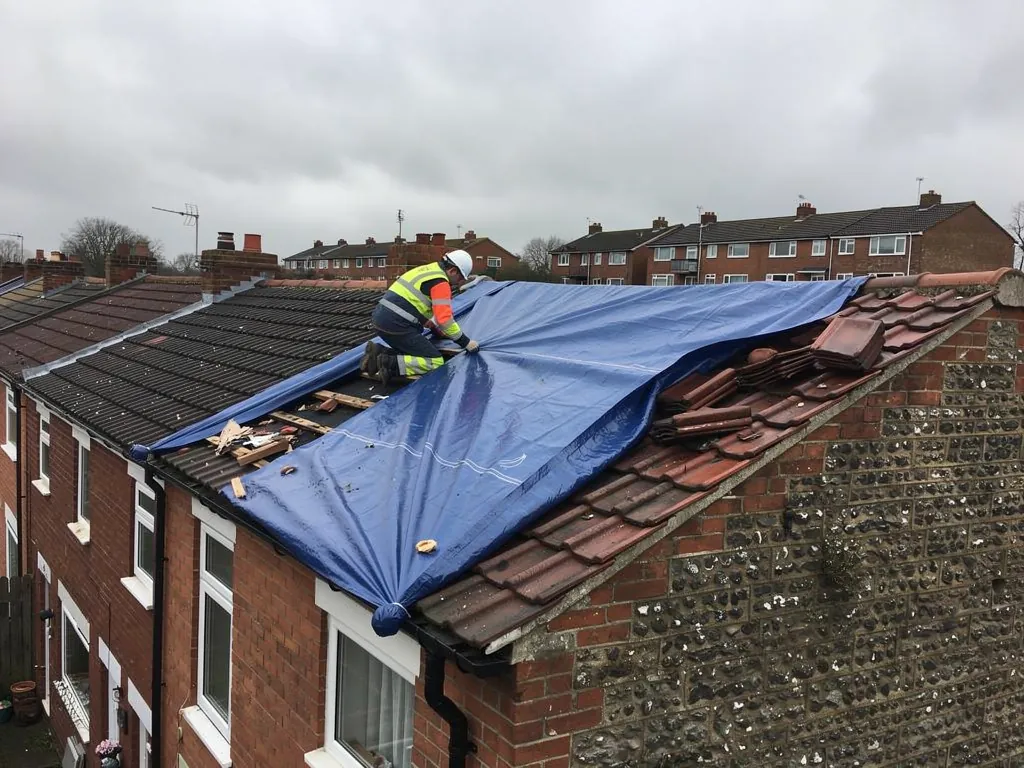
Water coming through the ceiling, a tree on the slope or tiles torn off overnight. We make the roof safe first, photograph the damage for you, then quote the lasting repair in writing.
No. Look from the ground or the loft hatch, photograph what you can see, and leave the slope to someone with the right access equipment.
Fitted over battens and fixed down properly, it holds the weather off for a while. It is a holding measure, never the repair.
Ring your insurer early, because many policies want to hear before repairs begin, then arrange temporary cover so the damage does not spread.
| Job | Typical cost |
|---|---|
| Minor repair, such as a few displaced tiles | £100 to £300 |
| Storm damage repair | £500 to £1,500 |
| Scaffold for a typical two-storey house | £850 to £1,200 |
| Temporary cover over damaged tiles or a fallen branch | priced on survey |
Typical figures from published cost guides, not Skyline's own. A leak that cannot wait is made safe first, and the lasting repair is quoted in writing after the damage has been photographed.
MyBuilder guides to roof repair and scaffolding costs (updated August 2026).
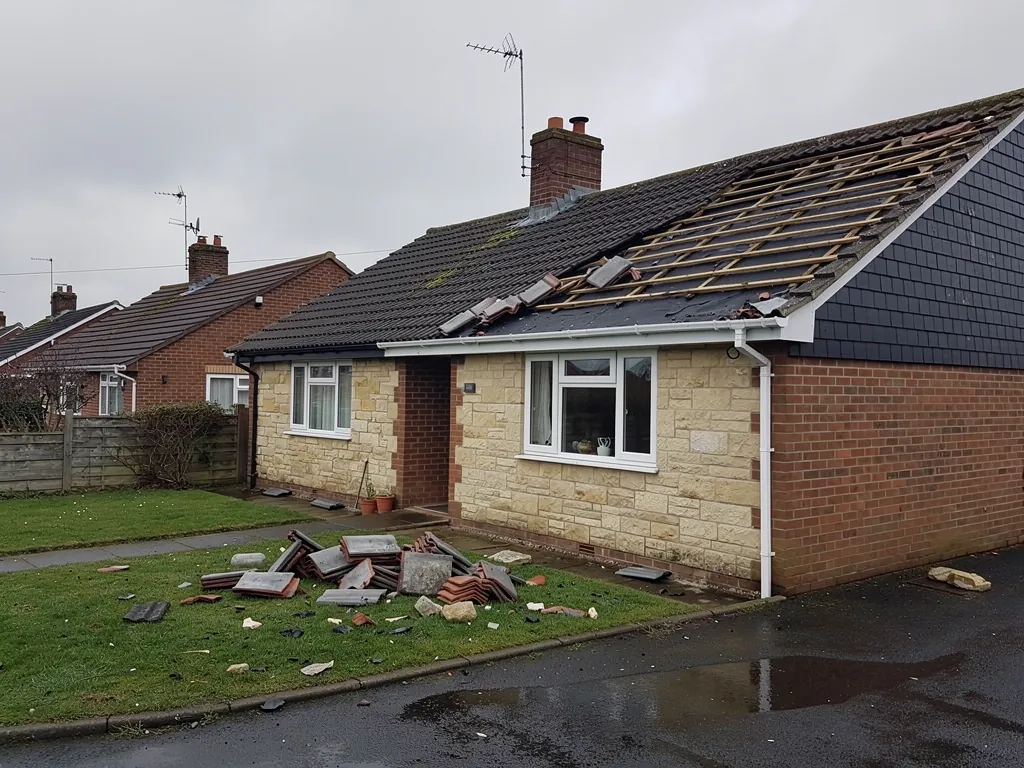
See all costsActive leaksWater coming through a ceiling or down a wall. We find where it enters, stop it, and protect what sits below before anything else.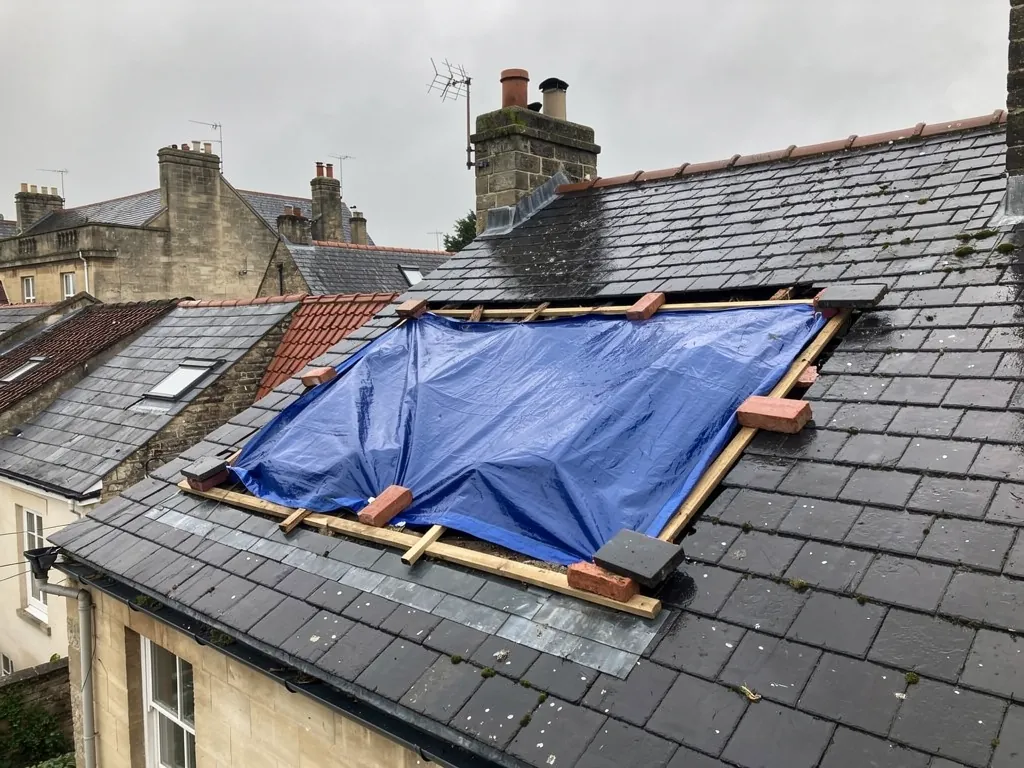 Storm damageTiles, slates, ridges and verges torn loose by wind, with the surrounding roof checked for damage you cannot see from the ground.
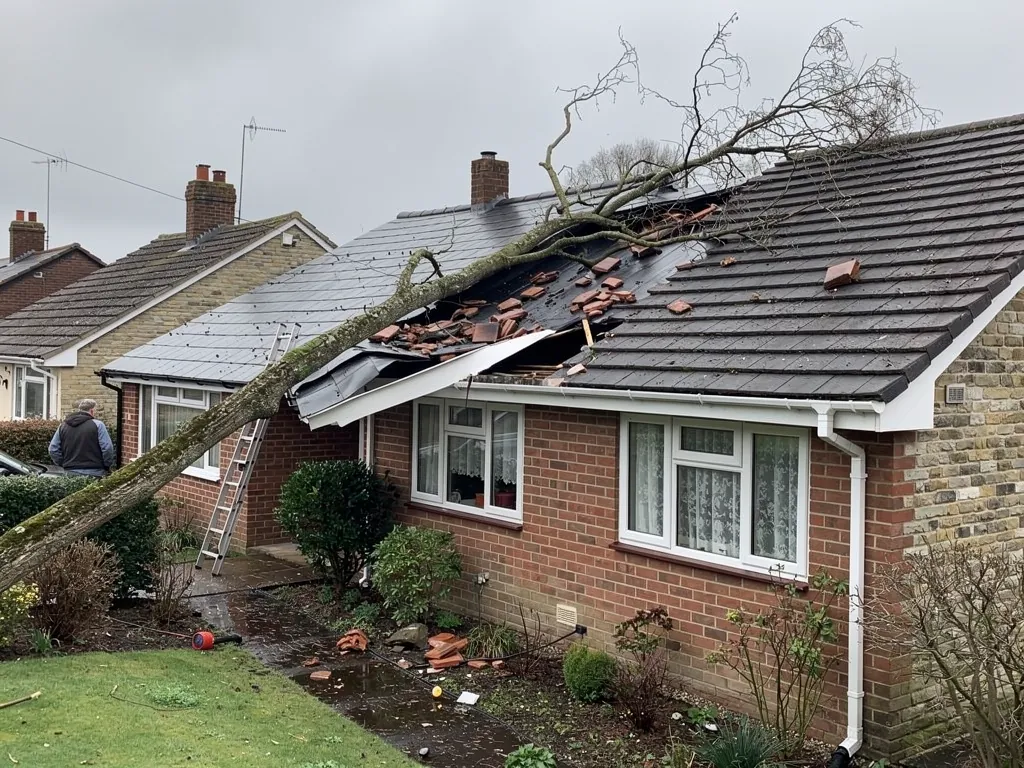
 Fallen trees and branchesImpact damage to rafters, battens and coverings, made safe so the weight is controlled and the opening is sealed against rain.
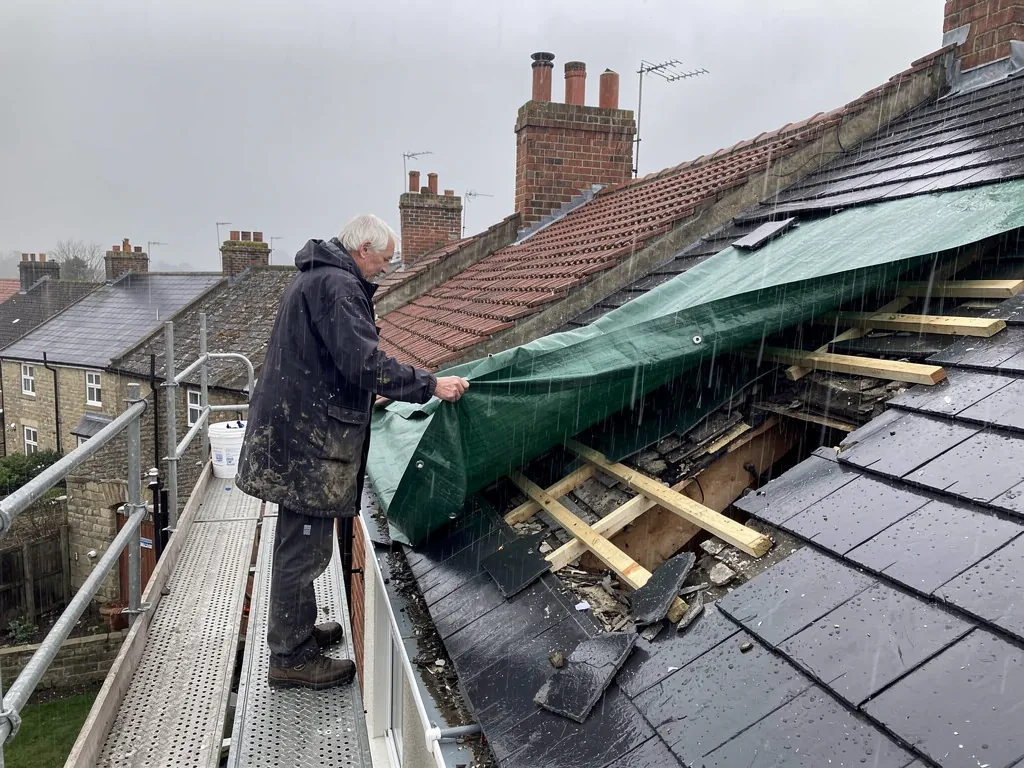
 Temporary coverTarpaulin, sheeting or boarding fixed to battens so the wind cannot lift it, left in place to protect the roof until the proper repair.
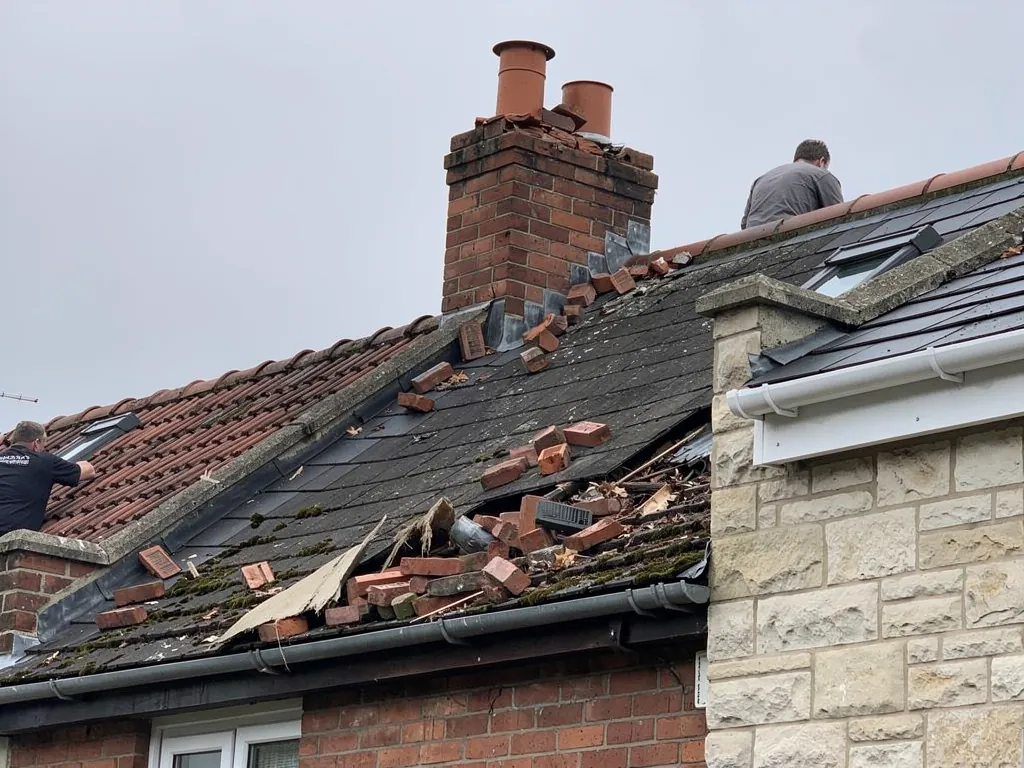
 Chimneys and flashingsLoose pots, cracked stacks and lifted lead that are letting water in or threatening to fall, secured or sealed to buy safe time.
 Flat roof failuresSplit membranes, blown felt and ponding that has finally broken through, covered or patched to stop water reaching the rooms below.
Emergency roof repairs, one question at a time
From the first bucket to the last invoice: what to do while it is leaking, what a make-safe involves, how storm cover works and how to keep out of trouble.
The short answer
Protect people first, then belongings. Move valuables away, catch the drips, and keep everyone out of any room where the ceiling is sagging. If water is reaching a light fitting or socket, stay clear and switch off at the consumer unit only if you can reach it without standing in water.
A leaking roof feels like an emergency because the damage grows while you watch. Most of the first hour's work happens indoors and needs no ladder, and nothing in this chapter is worth a fall.
Water and electricity are the real danger. If water is dripping through a light fitting, a ceiling rose or along a cable, do not touch the fitting. Isolate that circuit at the consumer unit only if you can reach it without standing on a wet floor; if you cannot, leave the room, keep others out and ring an electrician too. A ceiling that has darkened, sags or bulges is holding water and wet plaster, and it can come down without warning, so keep everyone from standing beneath it. Our answer on a ceiling bulging with water explains when a bulge is worth releasing and how to do it from a safe position.
Set a wide, shallow bowl under each drip, with a towel round it to stop splashing, and move furniture, rugs and electronics clear. If the loft hatch is within easy reach, shift stored boxes and put a container under the wettest spot. Stay off the roof: wet slates and tiles are slick, a ladder resting on a wet gutter can slide, and a storm is the worst time to be on any slope. Our page on what to do if your roof is leaking right now sets these steps out as a short list.
Who you need depends on where the water starts. Water that turns up while it rains, on a ceiling directly under the roof, round a chimney breast or below a valley points to the roof: a slipped tile, lifted lead flashing or a blocked valley on a pitched roof. Water that appears in dry weather, near the cold water tank, the hot water cylinder or a pipe run is usually plumbing, so turn the supply off at the stopcock and ring a plumber. Overflowing guttering can also push water into the top of a wall and pass for a roof leak; our answer on whether it is the gutter or the roof helps you tell them apart. If you are still unsure, an experienced roofer can usually say from your photographs which trade to call first.
Treat it as urgent when water is coming in, a ceiling is sagging, tiles or slates are missing so the felt or battens show, a chimney stack leans or has cracked, or anything loose could fall onto a path or a car. Those need a make-safe before further damage follows. A single slipped tile with dry felt beneath it, moss along the courses or a dripping gutter joint can wait for a booked visit. Either way, ring 01793 626096 for advice or send photographs on WhatsApp, taken from the ground with the date showing, saying where the water is, how heavy it is and whether anyone is at risk. Leaks and storm damage take priority on our rota, and those details mean the right ladders, sheeting and materials come on the van.

When the rain stops the urgency does not. Water that has soaked into insulation and plasterboard keeps spreading, and our guide to drying out after a roof leak explains how to ventilate and what to leave alone until the roof is sound.

The short answer
A make-safe stops water entering and removes danger from overhead, without trying to finish the repair in poor conditions. That can mean sheeting fixed to battens, tiles refixed or replaced, a loose pot or stack secured, or a split flat roof covered, with the lasting repair following once the weather allows.
People often expect the roofer to arrive and put everything right in one visit. In an emergency the order is different: wind, rain and failing light are poor conditions for dressing lead or bedding a ridge, so the first visit stops further harm and the second does the job properly.
That depends on things nobody controls from the phone: whether water is coming in now, whether the wind lets anyone onto the slope safely, how awkward the access is, and how many other properties the same storm has hit. The quickest route is to ring or send photographs taken from the ground, because they let us judge how urgent your roof is against the others waiting. Where water is entering, the property is made safe first and the lasting repair is quoted later.
Emergency call-outs reach every part of Swindon and the places around it, from Old Town, Rodbourne and Haydon Wick to Stratton St Margaret, Wroughton, Highworth, Royal Wootton Bassett, Purton and Cricklade, and on out to 30 road miles. We make safe family homes, rented property and commercial roofs over shops, offices and small industrial units, for landlords and business customers as well as householders.
Where a few tiles or slates are missing, sound matching ones can sometimes be refixed with clips or nails. Where the damage is wider, we lay heavy-duty sheeting over the area and fix it to battens, the narrow timber strips that tiles hang from, so the wind cannot get under the edge and lift it. A sheet merely weighed down will flap and tear. Our explanation of how a tarpaulin is fitted to a roof goes through the method, and temporary roof repairs covers the other options.
Some damage is a hazard before it is a leak. A loose chimney pot, a ridge tile hanging by its mortar or a flashing flapping in the wind can fall onto a path or a car. We secure or remove what is dangerous first, and we photograph it as we go so there is a record of the original damage. Where a tree or large branch has landed on the roof, the load is controlled before it is moved, because lifting it carelessly can bring structural timbers and ceilings down with it. Our page on what happens when a tree falls on your roof explains the sequence.
Access is decided on the day by what is safe, not what is quickest. A low roof can be reached with a tied ladder and a roof ladder fixed over the ridge; a tall one, or a slope made slippery by rain, may call for a tower or a scaffold. If the only safe way is to wait for conditions to ease, we make the room below safe from inside and come back, because a professional who takes a risk on a wet slope helps nobody.
Temporary cover protects the building; it does not restore the roof. Sheeting wears, battens loosen and the original cause, whether a lifted flashing, a split valley or a broken ridge, is still there underneath. The make-safe buys time to quote the lasting repair, order matching materials and wait for weather in which lead, mortar and sealants can be worked. A split flat roof can be patched to keep water out, but one that has failed across its width needs a new covering, which our flat roofing page covers.
Ask how long the temporary measure is meant to last. Our answer on how long a tarp can stay on a roof explains why the lasting repair should be booked while the cover is still sound.
| What has happened | First response | What follows |
|---|---|---|
| Tiles blown off | Refix sound tiles or fit sheeting on battens | Matching tiles and a check of the neighbours |
| Ridge or hip displaced | Secure loose pieces, cover the open joint | Rebedded and mechanically fixed ridge |
| Flashing lifted by wind | Fix it down and seal the gap temporarily | New lead dressed into the wall or stack |
| Tree through the slope | Control the load, board and sheet the hole | Structural check, then rafters and covering |
| Flat roof split | Dry and cover the split | Patch or new membrane, depending on the deck |
The answer
It might, but it depends on your policy and on whether the weather was the real culprit. Insurers look at whether there really was a storm, whether the damage fits storm damage, and whether wear and tear explains it. Speak to your insurer before repairs start, and keep every receipt.
Your insurer decides a claim under the terms of your policy, and nobody outside it can promise a result. Knowing how storm claims are judged helps you gather the right evidence while the damage is fresh.
The Financial Ombudsman Service, which settles disputes between customers and insurers, sets out three tests for a storm claim. Can anyone show that a storm hit around the time the damage appeared? Does the damage look like the kind a storm causes? And did the weather do the real harm, or would the roof have failed anyway? Its guidance is on its storm damage page. Which?, writing in November 2025, notes that insurers often lean on a storm definition built around gusts of 55mph or more, so a blustery night may not meet it.
Many policies leave out damage that builds up slowly, along with wear and tear. One example Which? offers is rain getting in through a roof that has been left to deteriorate. It also reports that only 32% of storm-related claims made in 2024 ended in a payout, using figures from the Financial Conduct Authority. Its article is why your home insurance could leave you out in the cold. Our answers on wear and tear and refused claims and what counts as a storm go through both in detail.
Fresh storm damage looks different from old neglect. Sound tiles lifted or snapped, a branch across the slope and debris in the garden point to the weather. Dark, mossy edges where a slate has slid, flashing that has been lifting for years or a ceiling stain older than the gale point somewhere else. We record what we see accurately, without arguing the case for you, and an accurate record is the most useful thing a customer can hand an insurer.
During Storm Eunice in 2022 the Association of British Insurers, the insurers' trade body, urged householders to contact their insurer promptly, to check with it before booking temporary repairs to stop things worsening, and to keep the receipts as evidence. Our page on repairing before the insurer visits explains how that works in practice, and the evidence a claim needs lists what to photograph.
We photograph the damage before we cover it and give you a written account of the work, which you are free to pass to your insurer. If a loss adjuster visits, what to expect from a loss adjuster is worth reading first.
A storm that exposes an old fault is a harder claim than one that damages a sound roof.
MythIf the leak started during a storm, the insurer has to pay for the new roof.
FactInsurers and the Financial Ombudsman Service ask whether the weather was the real culprit, and a roof that was already worn is treated differently.
The short answer
Published guides put storm damage repairs at £500 to £1,500, with minor repairs at £100 to £300. Scaffolding, if the repair needs it, adds a separate figure. Temporary cover is priced on survey, because the area and the access decide it, and the lasting repair is quoted in writing afterwards.
Emergency work is hard to price over the phone for the same reason it is urgent: nobody knows how far the damage goes until someone has looked. The national guides give a sensible frame, and your roof decides where within it you land.
MyBuilder, in a guide updated in August 2026, puts storm damage repairs at £500 to £1,500, minor repairs at £100 to £300 and moderate repairs at £500 to £1,000. Checkatrade's October 2026 guide gives roofers' day rates of £280 to £360, before VAT. These are national figures for repair, not our prices; a storm that leaves a re-cover as the sensible answer moves into a different bracket.
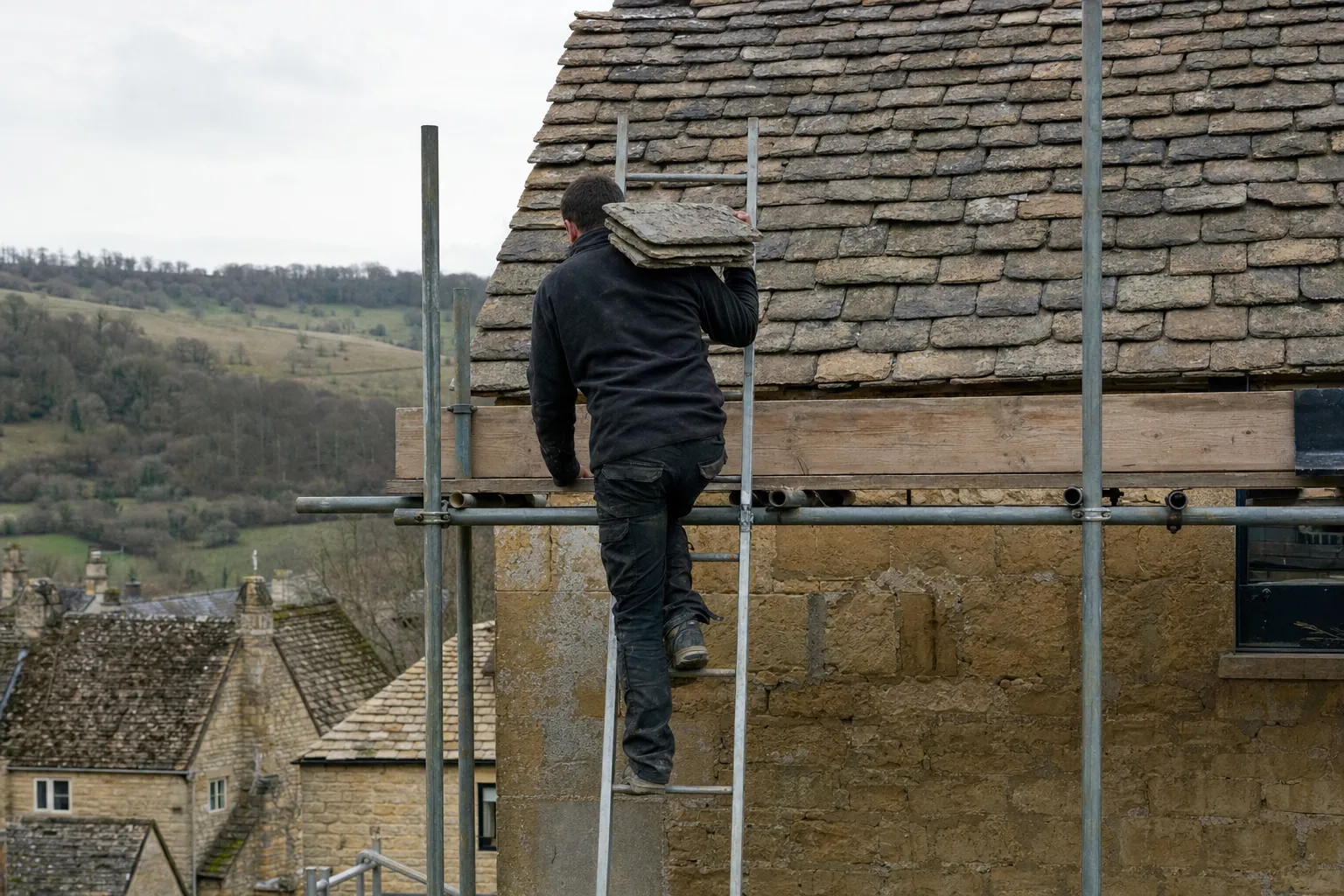
Access is usually the largest variable. MyBuilder puts a scaffold for a typical two-storey house at £850 to £1,200, and high-level scaffolding for a chimney at £400 to £900, with a scaffold licence adding £50 to £200 where the scaffold stands on the public footway. A make-safe can often be managed with a tied ladder, a hooked roof ladder or a low tower, but a damaged stack or a hole high on a three-storey house may leave no safe alternative. Our emergency roof repair cost guide breaks the national figures down further.
Some roofers add a call-out premium for evenings and weekends, so check whether a figure includes it, and whether it includes VAT, scaffolding and waste. Our answer on whether an out-of-hours roofer costs more covers the questions to ask. Hidden damage is the other variable. A fallen branch can crack a rafter that nobody can see from outside, and wet insulation or battens may need replacing. We photograph anything we find and show you before it is added to the job, and nothing goes on the bill without your agreement.
A fair emergency quote gives a single written figure covering the stopgap and the permanent repair together. It reaches you once the roof is safe, with survey pictures of your roof alongside.
If an insurer is involved, ask them before you commit to the permanent stage, and keep the invoice for the temporary one. Both are part of the record.
What it typically costs

The short answer
Storm chasers knock on doors after bad weather, press for an immediate decision, ask for cash up front and offer nothing in writing. A genuine roofer will put the price in writing and show you the damage on camera and will not mind you taking time to compare it or to speak to your insurer.
After a bad storm, the same few days that fill local roofers' diaries also bring people to the door who are not from the area and will not be there when the work fails. The pattern is recognisable once you know it, and a few sensible habits protect you from it.
The classic approach is an unsolicited knock, a claim that they spotted damage from the road and an offer to start straight away. The pressure comes next: the damage is worse than it looks, the price is only good today, a deposit in cash will secure the materials. Some ask you to climb a ladder to see for yourself, which you should never do. There is often no address, no written quote and a van with no name on it. Our guide to avoiding storm chaser roofers covers the full pattern.
Storm damage is usually local: a patch of tiles, a section of ridge, a flashing. A claim from the road that the whole roof must come off is a reason to ask for evidence and a second opinion.
A genuine roofer gives you one written total price, a postal address and a written guarantee, and shows you the damage in pictures of your own roof. They do not insist on cash only, and they accept that you want time to think or to ring your insurer. Nothing about a real repair needs deciding on the doorstep; if a cover must go on tonight, that is a make-safe with a modest scope, not a licence to agree to a new roof. Should anything go wrong, the Citizens Advice consumer helpline can advise and refer the case to Trading Standards.
Any contract agreed at your home carries a 14-day cancellation period, and the trader may not begin inside it unless you have expressly asked, by letter or email. Anyone who says urgency cancels those rights is a warning sign. Our own practice matches: work begins inside those 14 days only at your written request.
If you are unsure whether a caller is genuine, you can always shut the door, ring us on 01793 626096 and let us look at the roof and quote in writing.
Our view
Any roofer who needs your decision at the door and your money before the paperwork is asking you to take the risk.
The answer
Once the roof is holding, the next step is the lasting repair: a written quote with photographs, matching materials, and a date when conditions allow lead, mortar and sealants to be worked. Larger repairs may also trigger Building Regulations checks, and listed homes need extra care.
The make-safe is the start of the job, not the end of it. What follows depends on what the storm or the leak has done, and the sooner the lasting stage is planned, the less the temporary cover has to hold.
We go back over the photographs from the first visit, then examine the roof properly: the loft, the battens, the underlay and the roof around the damage. A lifted flashing may be sitting on perished mortar, or a run of ridge tiles may have been loose for years before the wind finished the job. We write the repair up, quote it on paper and agree a date. Our wider roof repairs page covers planned repair work, and our guide to checking your roof after a storm shows what to look for once the weather settles.
After a storm or a single leak, a repair is usually the answer, and it is what we quote whenever it properly fixes the fault. Replacement comes into it only when the survey finds the same failure across the whole roof: rotten battens, perished underlay, nails rusted through on a slate roof, or tiles so worn that new ones will not sit beside them. We show you the photographs behind the recommendation, and our roof replacement page explains what a new roof involves.
A like-for-like repair does not usually need planning permission. On a listed building, a change of roof material can need listed building consent, so we repair in kind. The Planning Portal sets a two-part test for repairs and re-covering: under 25 per cent of the total building envelope affected, and under 50 per cent of the roof. Inside both limits no building control application is normally needed. If a storm has taken more of the roof than that, we explain what follows and deal with the Building Regulations notification when the work calls for one.
The permanent repair uses matching tiles or slates, proper fixings and the right lead, and we sweep the drive and garden and take the old materials away before leaving. You receive photographs of the finished work, a written note of what was done and a 10-year workmanship guarantee in writing, which covers our own work rather than the rest of the roof. If you would like to see who we are before you ring, you can find us on Google.
If the storm exposed a weak spot, such as old ridge mortar or a tired flashing, it is cheaper to fix it in calm weather than in the next gale. Our guide to getting your roof ready for storm season lists the places we look first, and a loose chimney is covered on our chimney repairs page.
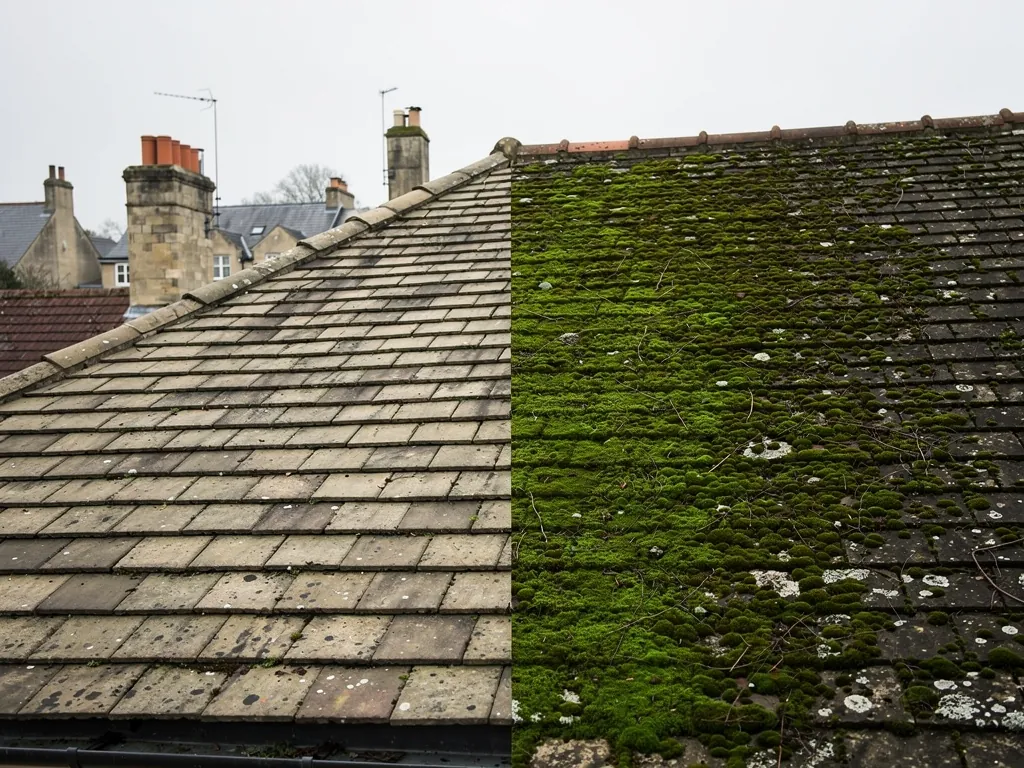
Keep the photographs, the quote and the invoice together. If you claimed on insurance, they are your evidence, and if you did not, they are the history of the roof for whoever owns it next.
More on leaks, tarpaulins, fallen trees, storm checks and insurance, from the moment the water appears to the claim afterwards.
Yes. We control the load, board the opening, fix sheeting over it on battens and photograph the damage. The rafters are checked before any lasting repair is quoted.
No. Many make-safes are managed with ladders or a low tower. Chimney work and damage high on a tall house sometimes need scaffolding, and we tell you why.
Sometimes. A few slipped tiles refixed with sound matching ones can be the whole repair. Wider damage, or lead and mortar work in wet weather, waits for the written quote and better conditions.
It can spread further than you expect, so contain it and call us. We prioritise leaks, and a small entry point is easier to close before the damp travels.
Yes. Bag sound ones, because they may be reused, and keep broken pieces as evidence for your insurer. Pick them up only where it is safe to do so.
Possibly, but speak to your insurer first, and keep the invoice and photographs. Whether they reimburse you depends on your policy and is their decision.
Ring 01793 626096 or message us on WhatsApp with where the water is coming in, and send a few photographs of the ceiling, the loft and any damage you can see from the ground, taken safely. We will tell you what to do while we arrange the make-safe, and what we will check first once the roof is covered.
Tell us what’s happening and we’ll call you back.
Or call 01793 626096
Message us on WhatsApp