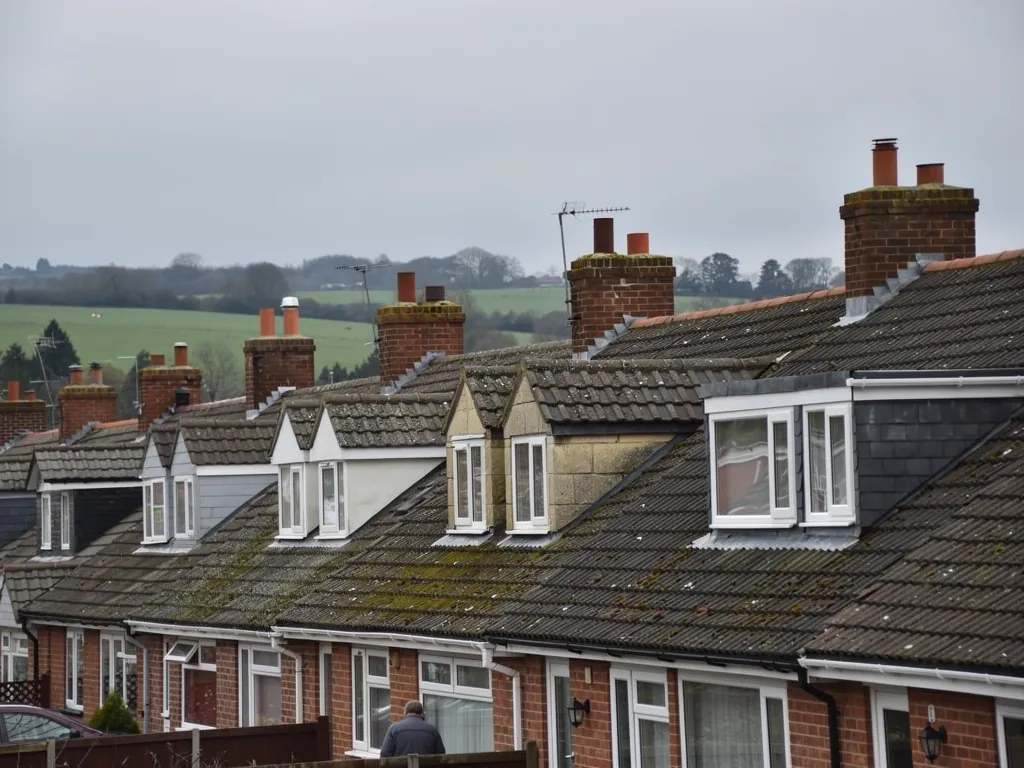
Rear tiled roof of a brick semi seen from the garden

Roofers in Purton

Repairs, re-covering, chimney work and flat roofing along Purton's long hilltop street, from the stone houses around St Mary's church to the newer homes of the Ridgeway Farm estate.

Purton's roofs, from St Mary's to Ridgeway Farm

Old stone farmhouse beside a village church
Around St Mary's and the old farmhouses

Purton's oldest buildings gather near St Mary's, a Grade I listed church with work from the thirteenth century and an unusual pair of towers, one of them carrying a spire. William Butterfield restored it in 1872. The parish also holds four Grade II* houses, every one built in limestone rubble, and the nearest, College Farmhouse in the centre of the village, dates from the early seventeenth century. Walls like these are thick, uneven and often soft with age, and the roofs on top have been mended by many hands over the centuries. The faults we meet on them are small and delicate: slipped coverings above a gable, lead gone brittle where a roof meets a chimney, and valleys choked with leaves. Our first job is working out which parts are original and which are later repairs.

Mixed village cottages along a main road
Cottages and houses along the road

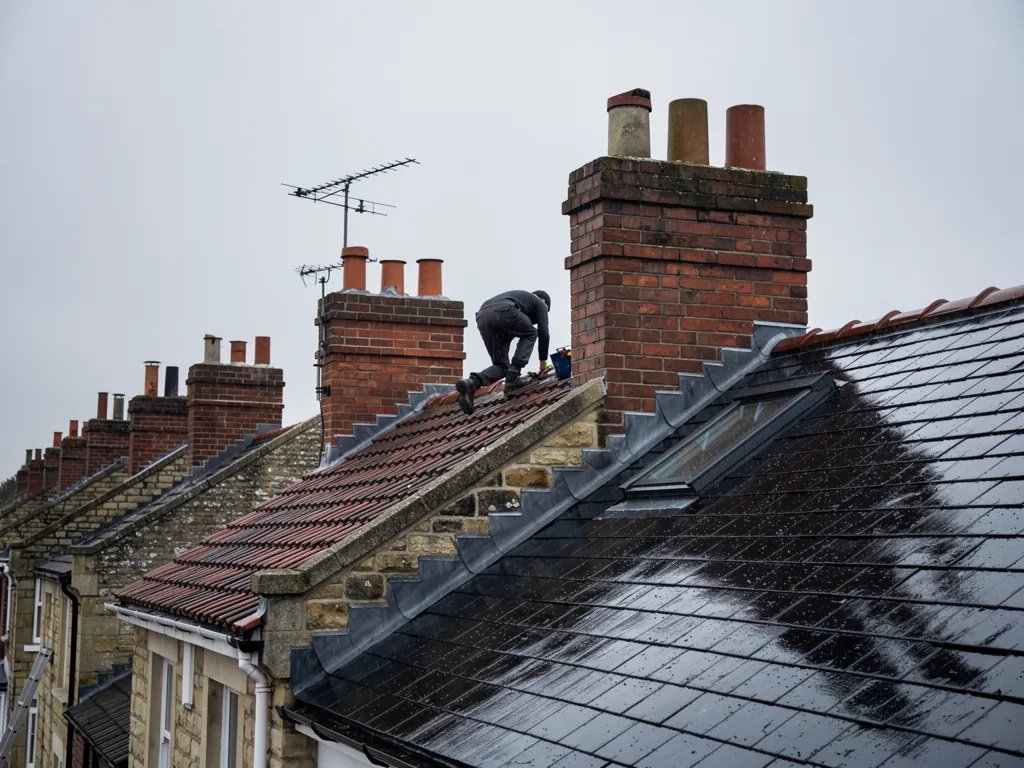
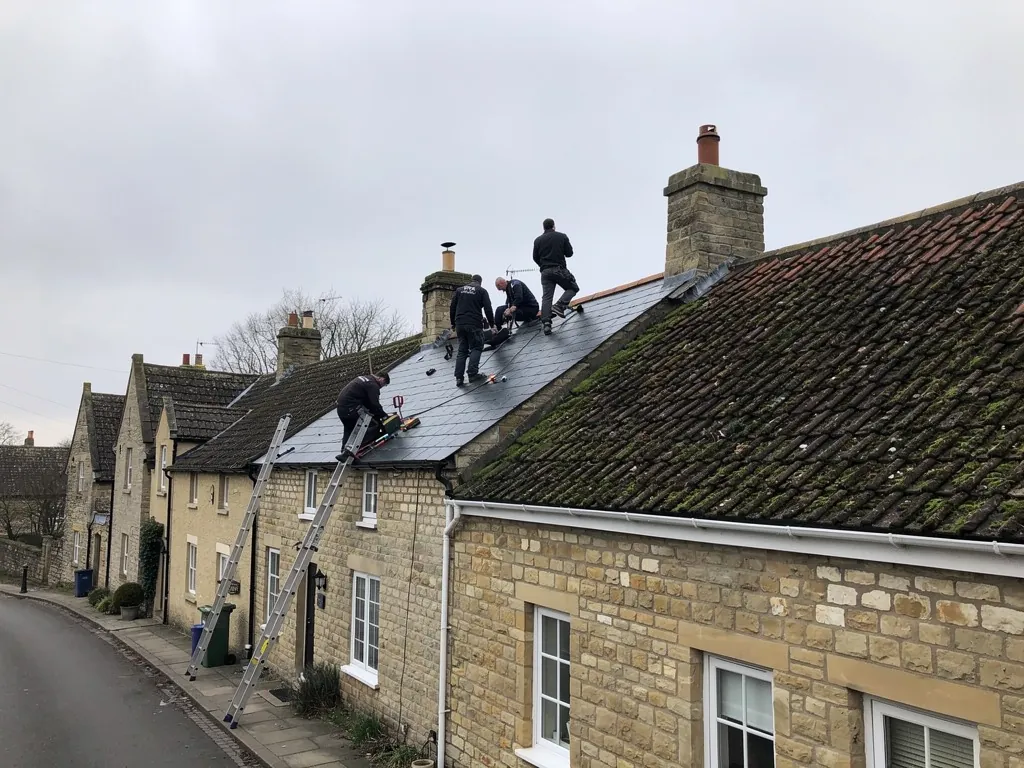
A linear village grows house by house, so the main road holds many ages side by side: farm buildings, cottages, villas and later infill, each with its own roof. Neighbouring roofs of different ages meet at party walls and abutments, and those junctions are the weak points for rain. A stepped flashing is the strip of lead that follows a roof slope up against a wall, and when it fails the damp often shows on the inside of the next-door room first. Along a road on the brow of a hill, the verges (the sloping edges of a roof at a gable) and the ridge also take the wind from several directions, so they are among the first places we look.

Modern estate houses with concrete tiles
Ridgeway Farm and the newer estates

Modern development has added a large share of Purton's homes, among them the Ridgeway Farm estate of around 700 houses. Estate houses of recent decades often carry interlocking concrete tiles, and the problems are different from those on old stone: hip and ridge tiles with loose bedding, cracked tiles, tired felt at the eaves, and fascias that give up years before the roof covering does. Many of these houses also have a porch, a garage or a rear extension under a shallow or flat roof, and those coverings reach the end of their life sooner than the tiles above them. The work is usually repair, because a repair is often all the fault needs.

From Swindon along the hilltop road to Purton

Map showing Purton and central Swindon. 6 road miles west-north-west of central Swindon.

Distance
6 road miles west-north-west of central Swindon
Council
Wiltshire Council
Council
Wiltshire Council, not Swindon Borough
Conservation area
Purton Conservation Area
Setting
A hilltop village above the Thames floodplain

Purton roof questions

Is my Purton house inside the conservation area?

Purton has a conservation area, but the street alone will not tell you where its boundary runs. Ask Wiltshire Council to check the address against its map; for a like-for-like repair, that is usually the end of it.

Do you work on houses beside St Mary's church?

Yes, on neighbouring houses and farm buildings, using matching materials and the narrowest repair that works. The church roof itself belongs to the church's own process.

Which parts of a Purton roof does the open hilltop test first?

Ridges, verges and loose tiles at gable ends. A house on the brow of a hill takes the wind from more directions than one in a dip, so those fixings get checked first.

Q1

What do Purton's older stone roofs need?

Roofer repointing a stone chimney stack above lead flashing
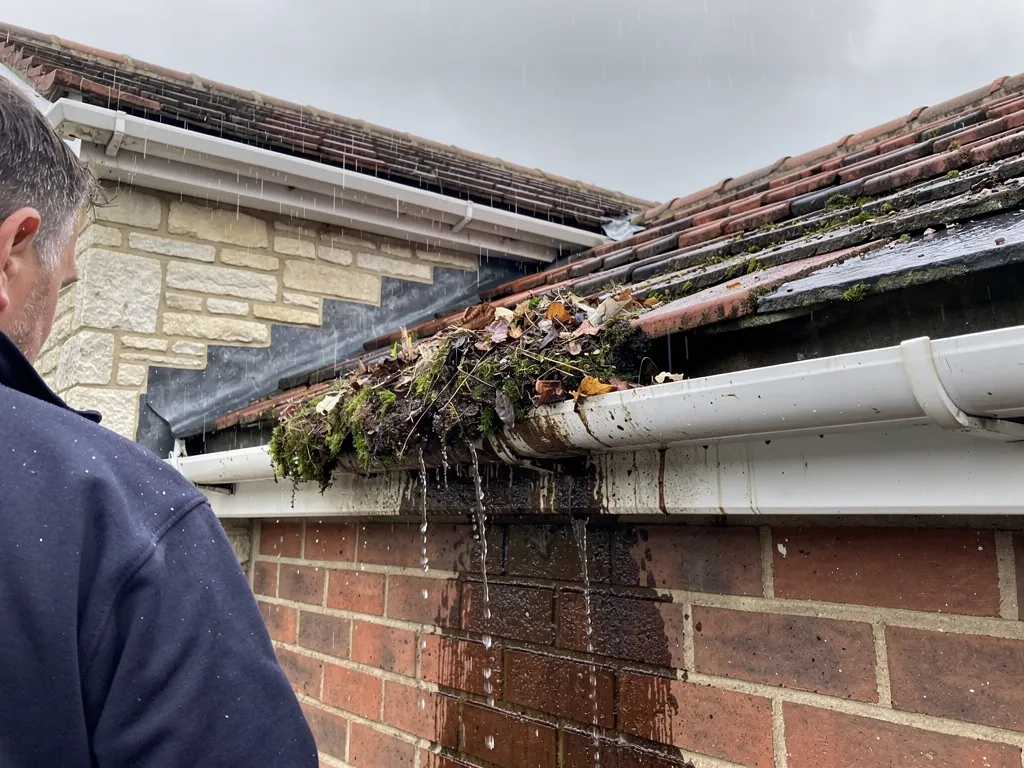
Blocked gutter full of leaves overflowing down a brick wall

The short answer

Careful, narrow repairs. Old limestone rubble houses and farm buildings carry roofs that have been mended many times, so the aim is to find the actual fault, fix it with matching material, and leave sound covering alone rather than stripping a whole slope for one leak.

Walk the length of Purton's main road and the buildings change age every few doors. Near St Mary's the houses are the oldest in the village, with walls recorded as limestone rubble, and roofs that have been repaired by many different hands over the centuries.

How do you tell the original roof from later repairs?

On a house like College Farmhouse, built in the early seventeenth century, a roof is a record of repairs. A patch of newer tiles here, a lead flashing there, a ridge bedded in a different mortar from the one beside it. Before we quote anything, we photograph each slope and work out what belongs to the original roof, what is a later repair and what is simply failing. That tells us whether the right job is a handful of refixed pieces or a larger section rebuilt.

Why do the verges and gable tops give trouble?

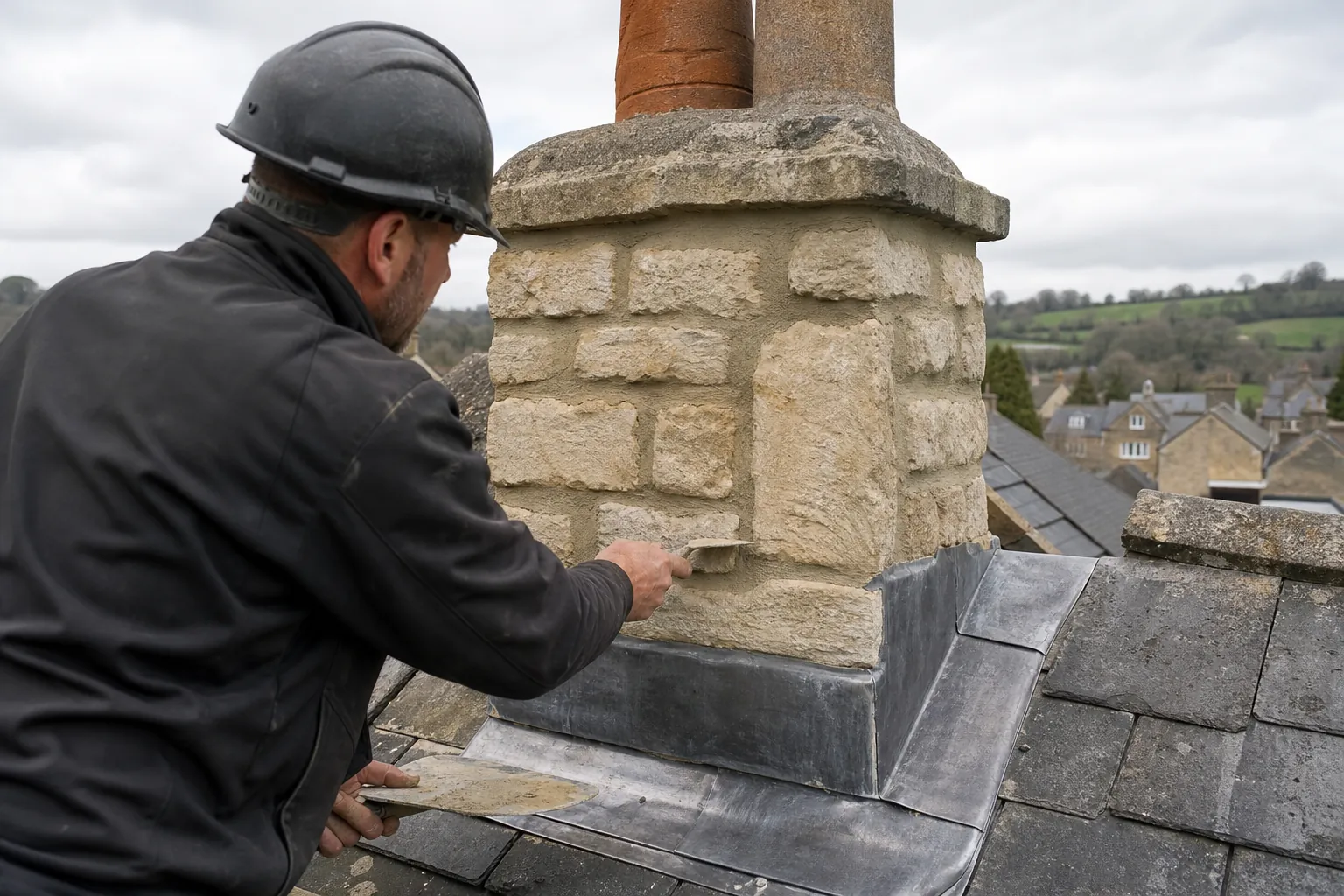
Rubble walls are thick and uneven, and the roof edge on top of them is rarely straight. Verges are often bedded on mortar that has cracked, and gable tops catch rain and let it into the wall head. A cement-rich repair on soft old stone can trap damp and harm the wall, so the mortar for these buildings is chosen to be weaker than the stone around it. Chimney stacks on old houses are another regular source of trouble: lead flashings, the metal strips that seal where a roof meets a stack or wall, tire with age, and the pointing of the stack opens up.

Could a blocked valley be behind the leak?

Many old farmhouses have valleys where two roof slopes meet, and these fill with leaves and moss. A blocked valley sends water sideways under the covering instead of down it. Clearing and relining a valley can be all it takes to end a leak, and we would suggest that well before any talk of replacement. Our roof repairs page sets out how we approach a leak, from the first photographs to the written quote.

Q2

Does Purton's conservation area change a re-roof?

The answer

Often not, if the new covering matches the old. Purton has a conservation area, and Grade I and Grade II* buildings stand in the village. Like-for-like work rarely goes near the planning department, but a different material, or anything done to a listed house, is best raised with Wiltshire Council first.

Roof work in Purton falls into three groups, and which one yours belongs to decides who you need to talk to.

Does a matching repair need anything from the council?

Replacing broken tiles, refixing slipped ones or re-covering a slope in the same material and pattern is upkeep, and a like-for-like re-roof is not generally something that calls for a planning application. Purton has a conservation area, but a matching repair leaves the street looking as it did, which is what the designation exists to protect. There are two exceptions, a listed building and any Article 4 direction that withdraws permitted development rights. Wiltshire Council can say whether either applies to your house, and that answer belongs at the start, before any pricing.

What if I want a different material or a roof window?

Swapping clay for concrete, or a natural covering for a manufactured one, changes how a house sits in the street. So do new roof windows on a slope that faces the road. In a conservation area the council is likely to have a view on both. Raise them early. Better to hear the council's view while plans are still on paper than once the scaffold is up.

Where do Building Regulations and listing come in?

Planning is one question and the Building Regulations are another. The Planning Portal's test is that you normally avoid a building control application while the work affects under 25 per cent of the total building envelope and under 50 per cent of the roof. Cross either figure and the job needs approval, often with an insulation upgrade to the roof as part of it. The same goes for any new covering at least 15 per cent heavier than the old. For a Purton house, the route is Wiltshire Council's building control team or a registered building control approver, and we deal with the paperwork when the job requires it.

St Mary's, used as a Church of England church, falls under the church's own faculty system. A listed farmhouse or cottage is different: changes that alter its special character, roofing material included, need listed building consent.

MythEvery roof job in a conservation area needs an application to the council.

FactA repair in matching material seldom does; it is changes to the look of the roof that the council examines.

Q3

How do Ridgeway Farm roofs age?

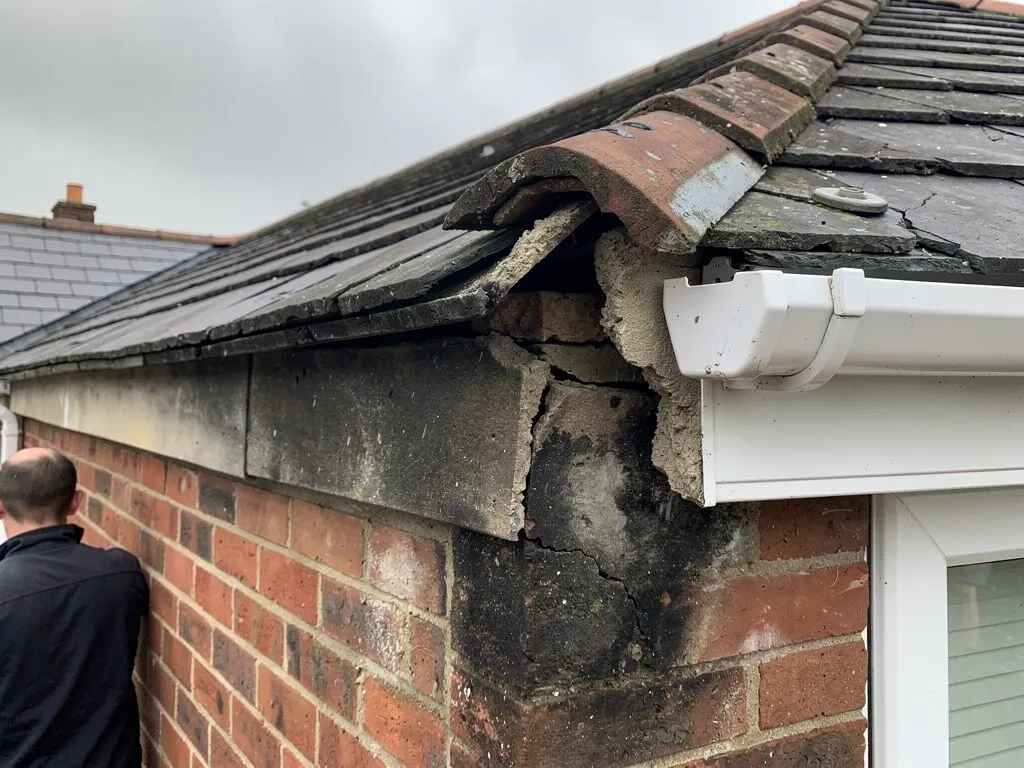
Crumbling mortar and cracked brickwork at a tiled roof eaves corner
Concrete tile roof with moss, lifted tiles and a cracked ridge

The short answer

In small, predictable places rather than all at once: loose bedding under the ridge, cracked or slipped tiles, tired felt at the eaves, and flat porch or garage roofs. These are usually repair jobs, not replacements, and a survey shows which slopes are still sound.

Purton has grown well beyond its old street, and the Ridgeway Farm estate of around 700 houses, built this century in the east of the parish on Swindon's western edge, is a big part of that growth. Roofs on estates of this age tend to fail in a small number of ways, which makes them quick to diagnose once someone is up there with a camera.

What goes wrong along the ridge and hips?

The ridge runs along the top of a roof where two slopes meet, and a hip is the sloping line formed where two slopes meet at an outside corner. On older estate roofs the tiles along both are often held by mortar bedding. Since BS 5534:2014, that bedding no longer counts as enough by itself, and the tiles are clipped or screwed down too. Each time we re-bed a ridge we put those fixings in, or choose a tested dry-fix kit, because a tile that drops in a gale can damage a car or a fence below.

What happens when a concrete tile cracks or slips?

Interlocking concrete tiles can crack where a ladder has leaned on them or where a satellite dish has been fixed, and a slipped tile lets rain onto the underlay (the membrane under the tiles). Underlay at the eaves tends to tire first, because that is where water sits. Replacing a few tiles and a strip of underlay is a small job, and a slipped tile is among the cheaper faults to fix, which is why a spring look from the ground is worth the five minutes.

Is the porch or extension roof a separate job?

The porch, garage or kitchen extension is often a different roof from the main house, with a different covering and a different age. Our ridge, verge and dry-fix page explains the fixings, and our pitched roofing page covers re-covering the slopes themselves.

Questions from along Purton's hilltop street

Why do the roofs near St Mary's church look so different from one another?

Because the buildings are from different centuries and have been repaired separately ever since. A seventeenth century farmhouse, a Victorian addition and a later infill house each carry a covering chosen for its own time, and patches from different decades sit side by side. We read each roof as its own history, then match the repair to what is already there rather than to the house next door.

Can you work on a Grade II* farmhouse in Purton?

Yes, in matching materials and with methods suited to old walls. Repairs that match seldom need consent, yet anything altering a listed building's special character does, roofing material included. You will know our plan before the scaffold goes up, and we would send you to Wiltshire Council if that plan changed.

Do you reach the farms and lanes off Purton's main road?

Yes. Purton, Hook, Royal Wootton Bassett and Cricklade all sit within the area we cover, which is every place within 30 road miles of Swindon. A farm track or a long drive makes no difference to the survey, though it helps if you tell us where the scaffold and the skip can go.

Do roofs on a hilltop village street need their ridge tiles fixed differently?

Not differently, but the fixing counts for more. Mortar bedding was the usual method until BS 5534:2014 changed the standard, and tiles now need clips or screws as well. Along the brow of a hill, where wind reaches a roof from several sides, a tested dry-fix kit tops the list of upgrades we would suggest.

Ask us about your roof

Tell us what’s happening and we’ll call you back.

  • Photos of what we find
  • A written quote
  • 10-year workmanship guarantee

Or call 01793 626096

Call Get a quote