
Can one slipped slate be fixed?
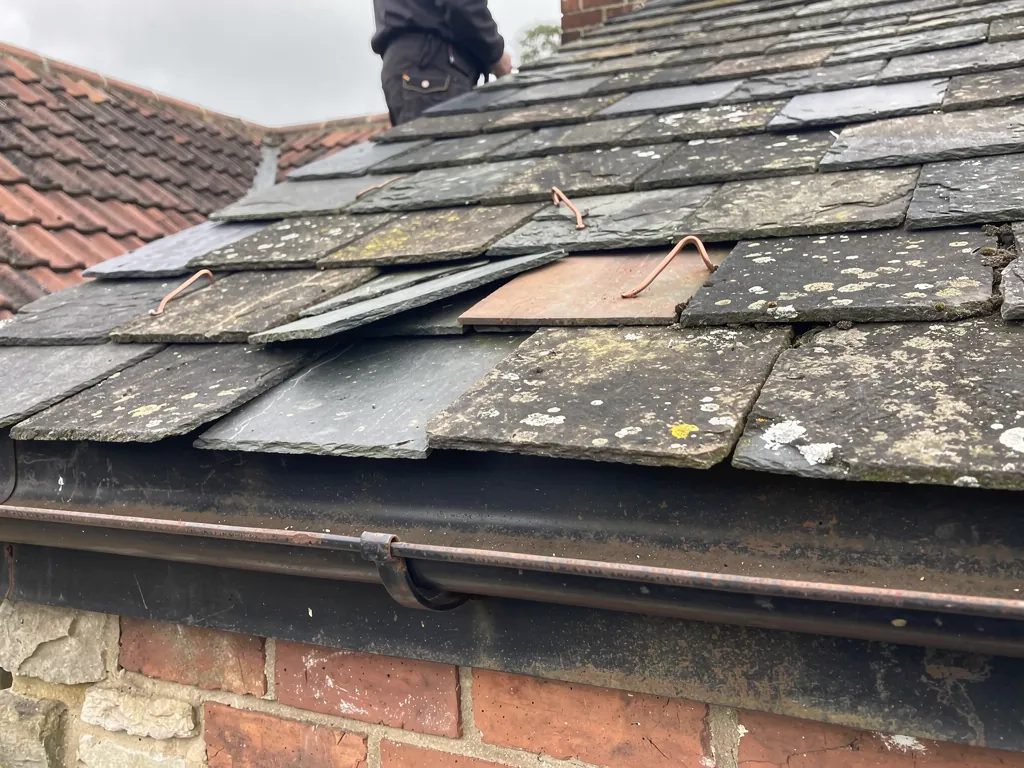
Yes. It is refixed with a copper or stainless hook, called a tingle or a clip, not stuck back with sealant.
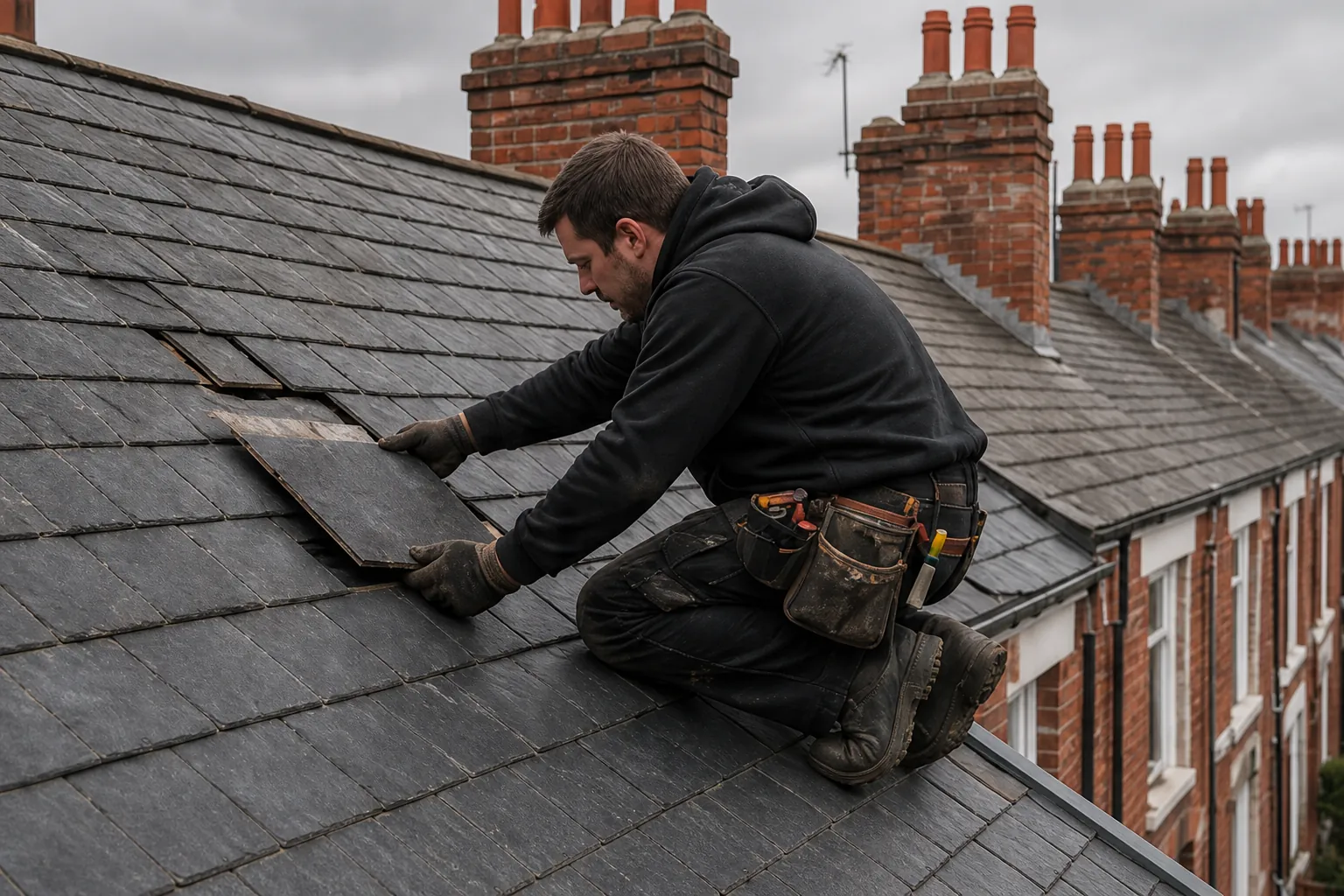
Slipped slates, leaks, lifted flashing and storm damage, traced to the cause and fixed properly. Photographs of the problem, then a written quote.
Yes. It is refixed with a copper or stainless hook, called a tingle or a clip, not stuck back with sealant.
Often the flashing, a valley or the chimney, not the spot above the stain. We trace it before we touch anything.
Not always. Plenty of repairs are done from a ladder, roof ladder or tower; we tell you which, and why.
| Job | Typical cost |
|---|---|
| Minor repair, such as a few slipped tiles | £100 to £300 |
| Moderate repair | £500 to £1,000 |
| Re-bedding or replacing ridge tiles | £300 to £600 |
| Stepped lead flashing | £80 to £120 per metre |
| Storm damage repair | £500 to £1,500 |
National ranges, not our prices. Once we have seen the roof, your figure arrives on paper.
MyBuilder roof repair and slate roof guides (updated August 2026); Checkatrade roof repair guide (October 2026, flashing ex VAT).
See all costs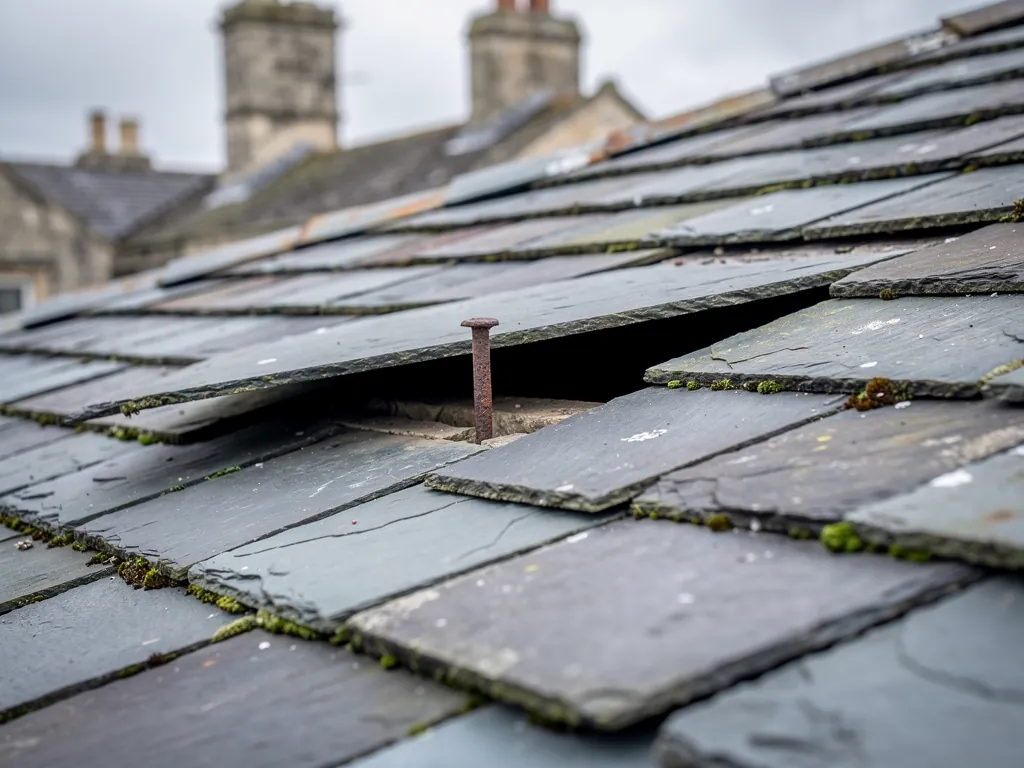 Slipped slates and tilesRefixed with tingles, clips or nails, matched to the slates or tiles already on the roof so the repair does not stand out.
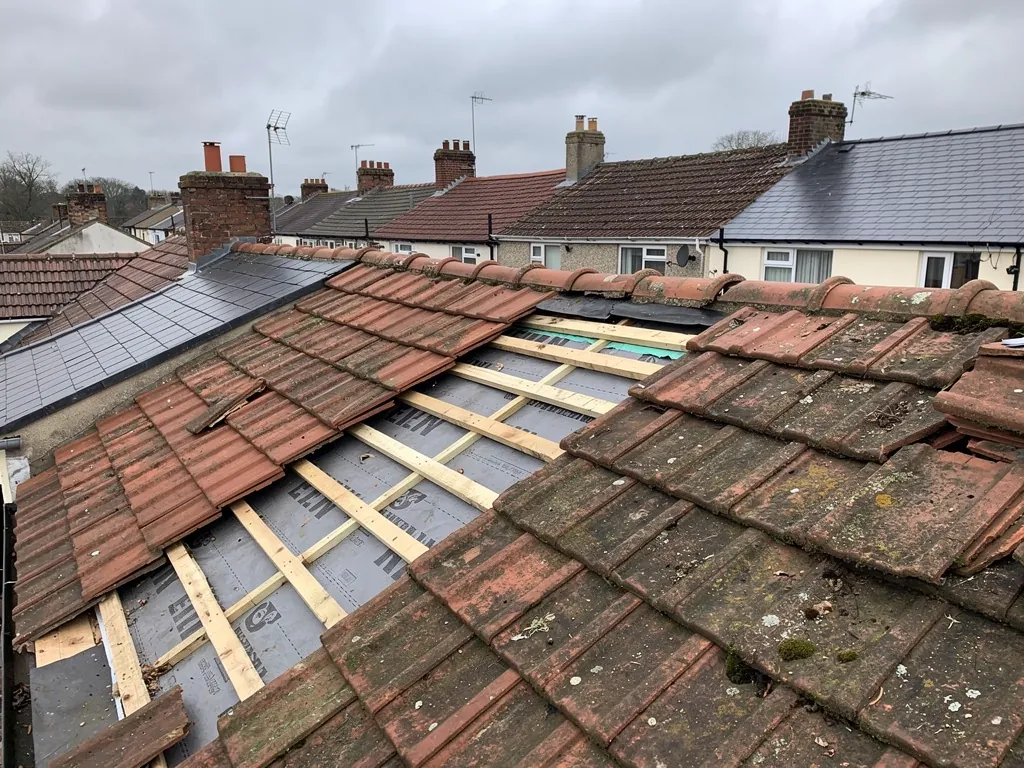 Leaks and damp patchesTraced from the loft and the roof together, so we fix the entry point rather than the place the water happens to drip.
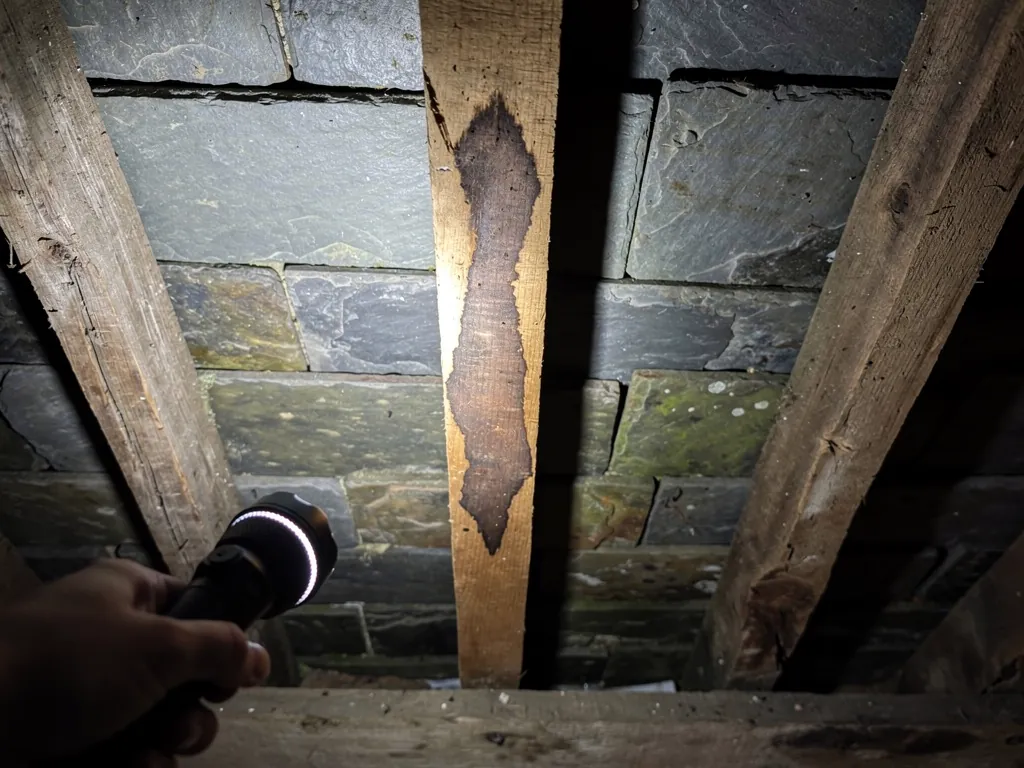 Flashing and valleysLead and mortar joints at a wall or chimney abutment, and the valleys that gather water from two slopes.
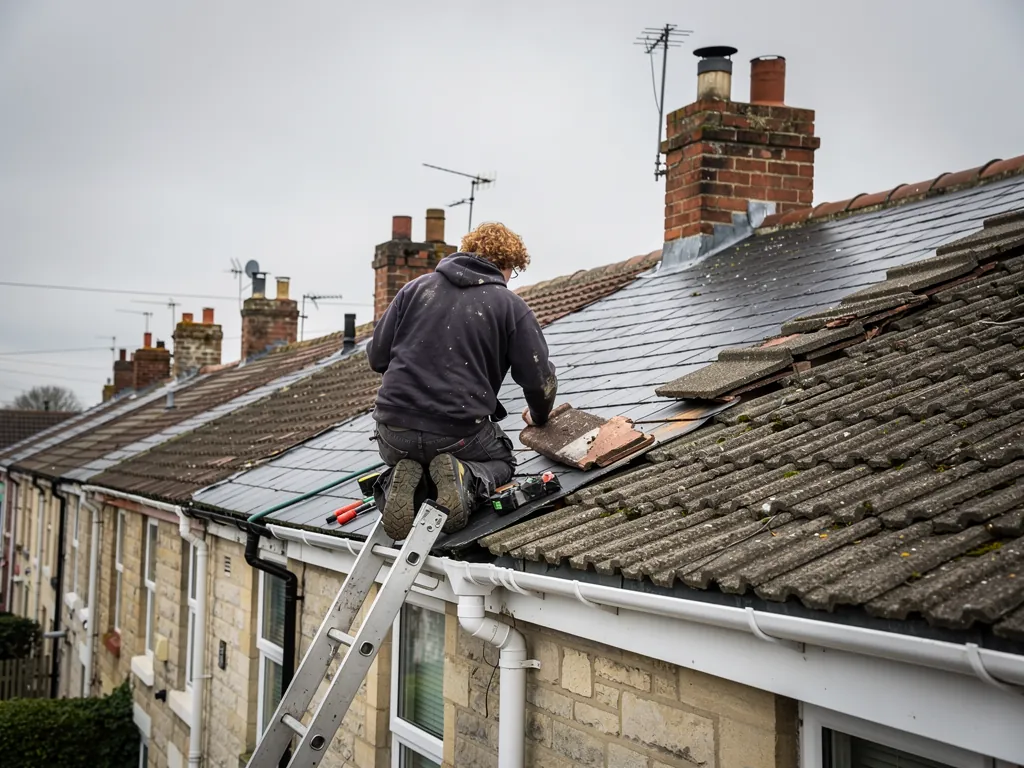 Ridges and vergesLoose ridge and verge tiles re-bedded and mechanically fixed to BS 5534, or converted to a tested dry-fix system.
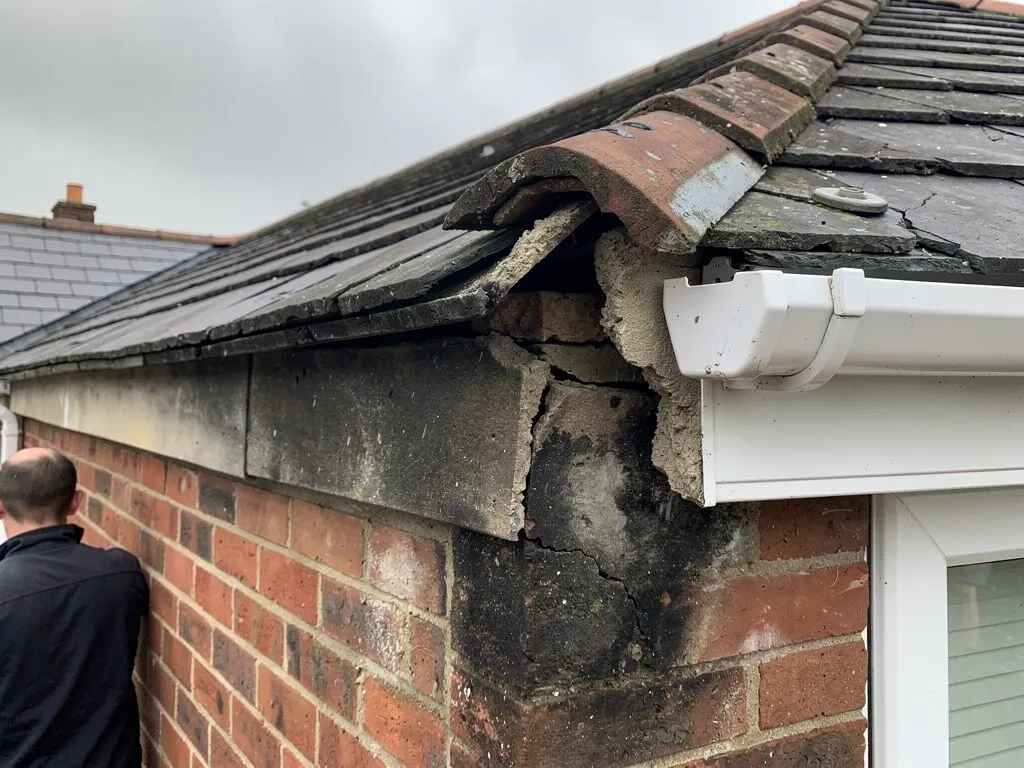
 ChimneysCracked flaunching, failed pointing and tired flashings around the stack, which between them cause many slow leaks.
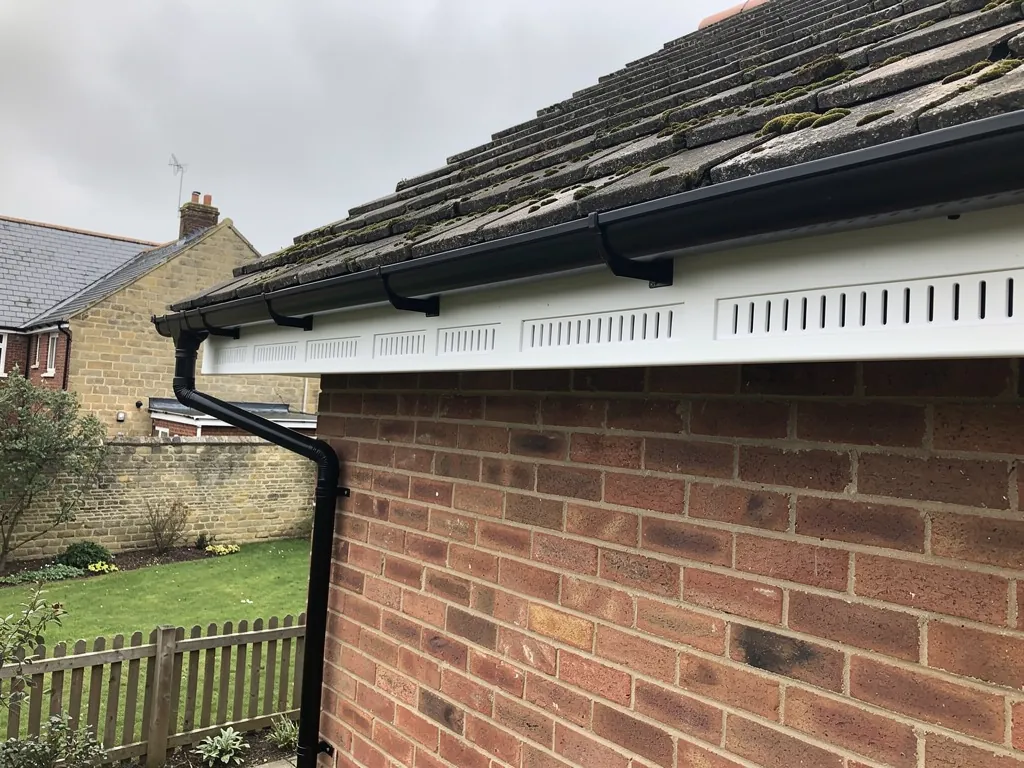
 Storm damageMissing tiles, broken ridges and fallen branches made safe first, then repaired properly once the cause is clear.
Roof repairs, question by question
The questions behind most repair visits in Swindon, from finding the leak to what the day itself looks like.
The short answer
Water usually gets in at a junction rather than through the middle of a slope: flashings against walls and chimneys, valleys, ridges and the edges of roof windows. It then runs along timbers or underlay, so the stain often appears some distance from the real cause.
A damp patch tells you water has reached the ceiling. It rarely tells you where the water came in. On a pitched roof, rain that gets past the slates or tiles lands on the underlay or the battens and runs downhill, sideways along a rafter or across the top of the ceiling until it finds a low point. That is why repairs aimed at the tile directly above a stain so often fail.
Junctions are where most leaks start. Lead flashings where a roof meets a wall or a chimney crack with age or lift when the mortar holding them perishes. Valleys, the channels where two slopes meet, carry the most water on the roof and fill with leaves and moss. Ridges and hips bedded on old mortar loosen in high winds. Roof windows and soil pipes need a seal properly formed at installation, and a tired one lets water track in at the edge.
Not every wet loft is a roof leak. Warm, damp air from the house condenses on the cold underside of the roof, especially where insulation has been added without ventilation, and drips back onto the ceiling on cold mornings. The tell-tale signs are droplets spread evenly across the underlay or on nail tips, and damp that appears in dry, frosty weather rather than after rain. The fix is ventilation, not new tiles, and our answer on telling a leak from condensation explains the checks.
The covering itself fails too, just less often than people expect. Slates delaminate or slip when their nails rust through, concrete tiles crack, and on older Swindon terraces with no underlay at all, a single slipped slate can let rain straight onto the ceiling below. Where the underlay has turned brittle, driving rain that would normally drain away gets through.
Yes, and it is easy to blame the tiles instead. A gutter packed with leaves or sagging off its brackets overflows at the eaves, tracks behind the fascia board, soaks the soffit and stains the wall or the bedroom ceiling below. Timber fascias that have softened lose their grip on the gutter, which makes it worse. The repair may be a cleared outlet and a reset bracket, or new uPVC roofline where the boards have gone. Our gutters, soffits and fascias page covers that work.
Once the roof is weathertight, storm damage becomes a planned repair like any other: matched tiles or slates, a refixed ridge, new lead where a flashing lifted. If you are claiming on home insurance, tell your insurer early, keep photographs and receipts, and expect questions about whether the roof was sound beforehand. The Financial Ombudsman weighs the date, the kind of damage and the roof's prior condition, so dated photographs from our visit can help. Whether a claim pays is the insurer's decision.
We start in the loft with a torch, looking for wet timber, stained underlay and daylight. Then we go up and check the likely entry points above and uphill of the damp. We photograph what we find and show you, so you can see the cause rather than take our word for it. Our guide to finding a roof leak sets out the method, and the most common causes of roof leaks are covered one by one.
If water is coming through now, put a bucket under it, move anything valuable and, if a ceiling is bulging, keep people out of the room. Making the roof safe comes before tracing the cause.

The short answer
National cost guides put a minor repair at around £100 to £300 and a moderate one at £500 to £1,000, with major repairs at £2,500 or more. Access is the big variable: a repair you can reach from a ladder costs far less than one that needs scaffolding.
Repair prices vary more than any other kind of roof work because the job itself varies so much. Replacing two slipped tiles on a bungalow takes a short visit. Rebuilding a valley on a three-storey Victorian house means scaffolding, stripping the slates either side, new lead or a new valley liner, and relaying the slates. Both are "a roof repair".
MyBuilder, updated in August 2026, puts most roof repairs between £150 and £1,500, with minor work around £100 to £300, moderate work £500 to £1,000 and major repairs at £2,500 or more. Ridge tile work, whether re-bedding or replacing, is given as £300 to £600 in the same guide. Checkatrade's October 2026 guide lists stepped lead flashing at £80 to £120 per metre before VAT, and roofers at £280 to £360 a day. These are national figures; your roof sets where yours lands.
Height and access come first. Scaffolding for a standard two-storey house is around £850 to £1,200 according to MyBuilder, which can be more than the repair itself, so we use ladders, roof ladders and towers wherever they are safe. Materials matter next: reclaimed Welsh slate to match an old terrace costs more than a modern concrete tile. Then there is what the repair uncovers. A few rotten battens under a slipped slate are normally part of the job; a sagging rafter is not, and we will stop and show you before going further.
Swindon's housing mix pulls prices in different directions. A slipped tile on a 1980s estate house in Westlea or Freshbrook can usually be reached from a ladder and replaced with a modern tile off the shelf. The same fault on a Railway Village cottage may need reclaimed Welsh slate, careful work around a listed building and a scaffold licence for access. Neither is unusual; they are just different jobs, and the quote should explain which one you have.
We price after we have seen the roof, so the figure reflects your roof rather than a guess, and the price is a good, fair one for the work involved. Our roof repair cost guide breaks the national figures down further.
Ask any roofer whether a quote includes VAT, scaffolding and waste. A price that leaves them out is not comparable with one that includes them. It is also worth asking how long the price holds: materials and scaffold hire change, and a quote that is months old may need refreshing before work starts.
What it typically costs
The answer
Usually, yes. Slate is matched by size, thickness and colour, often with reclaimed Welsh slate on older terraces. Concrete tiles can be harder because some profiles are no longer made, so we may borrow tiles from a hidden slope and fit the new ones there.
A repair that sticks out is a repair you notice every time you walk up the path. On a terrace it can also look out of place against the neighbours' roofs, and in a conservation area that matters more. Matching is part of the job, not an extra.
Swindon's Victorian streets are often roofed in natural slate, much of it Welsh. Slate comes in standard sizes, so the first job is measuring what is there. Colour and thickness come next: Welsh slate has a blue-grey tone that newer imported slate does not always match. For small repairs on a Victorian or Edwardian roof, reclaimed slate of the same size and source usually gives the closest match, and it weathers in the same way.
Fixing matters as much as the slate itself. A replacement slate cannot be nailed through the slates above it, so it is held at the tail with a tingle, a strip of copper or lead, or with a purpose-made stainless hook. Done well, the fixing is barely visible from the street. Old roofs that have been patched with bitumen or with slates glued in place are a sign of a quick fix, and those slates often slip again.
Handmade clay plain tiles vary from batch to batch, which helps a repair blend in. Concrete interlocking tiles are harder. Profiles have changed since the 1960s and 1970s estates were built, and an old tile and a new one of the same name may not lock together. Where a profile is no longer made, a common answer is to take sound tiles from a slope nobody sees, use them on the front, and fit the nearest modern tile on the hidden slope.
Ridge tiles follow the same logic. Half-round and angled ridges come in several sizes, and a ridge that does not seat properly on the tiles below will leave gaps that wind can get under.
Like-for-like repairs do not usually need permission, but changing the material on a listed building needs listed building consent, and in the Railway Village most cottages are listed. We repair in kind and tell you if anything we propose needs the council's view first. Our page on repairing the roof of a listed building goes into the consent side, and slate roofing covers full re-slating.
New slate or tile will look cleaner than its neighbours for a while. Weathering closes the gap, and a reclaimed match closes it from day one. Moss on north-facing slopes softens it further.
A good repair is the one you stop noticing a week later.
MythAny grey tile will do for a quick repair on a slate roof.
FactSlates are matched by size, thickness and colour, and a mismatched piece can let water in as well as look wrong.
The short answer
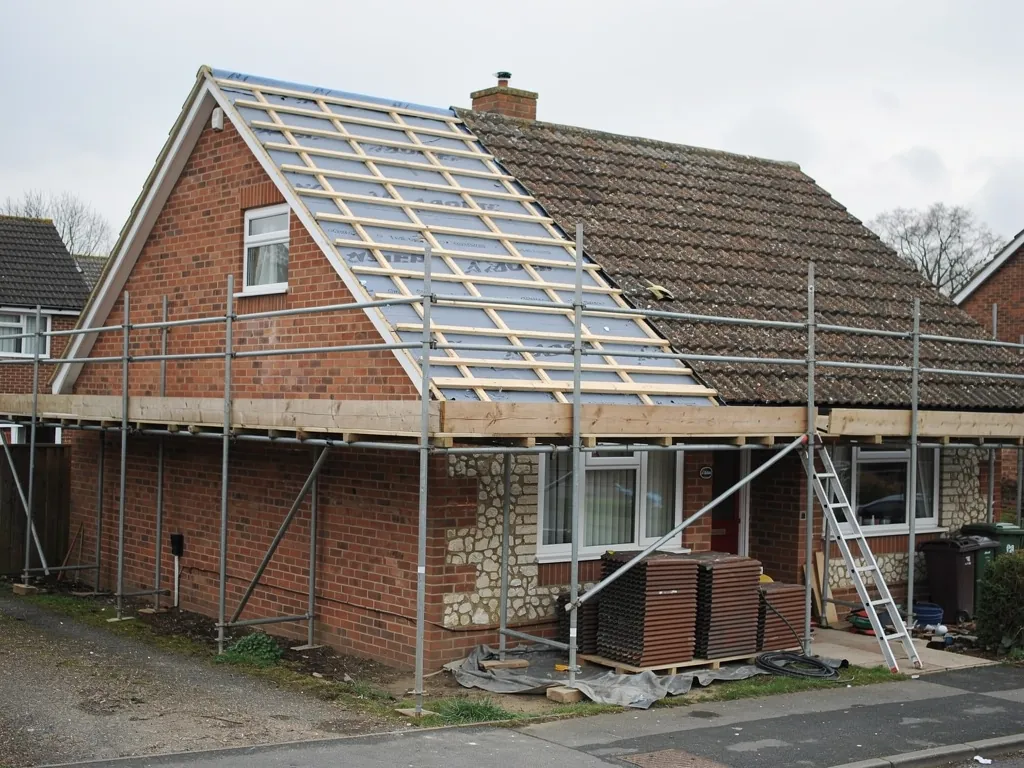
Many repairs do not. Single tiles, ridge sections and gutters on bungalows and most two-storey houses can be reached safely with ladders, roof ladders or a tower. Chimney work, valleys on tall houses and anything needing a long time on the roof usually needs scaffolding.
Scaffolding can be the largest part of a repair price, so it is fair to ask whether it is needed. The answer depends on the height, the length of time on the roof and how the work can be done safely, not on what is quickest for the roofer.
A short repair on a bungalow, a porch, a flat-roofed extension or the lower slopes of a two-storey house can usually be done from a ladder tied in at the top, with a roof ladder hooked over the ridge for work on the slope. A mobile tower suits gutters, fascias and work along the eaves. These keep the cost down and avoid a scaffold standing on your drive for a week.
Ladders are only used where they can be footed or tied safely, and roof ladders are never hooked over a ridge tile that is itself loose. If the safe option is a tower, we bring one.
Chimney stacks are the classic case: a roofer needs a stable platform at ridge height to rebuild pointing or flaunching and dress new lead. Valleys on three-storey houses, long runs of ridge and any job that will take more than a day or two at height are better done from a scaffold. Terraces with no side access sometimes need a scaffold over the front path or a scaffold licence from the council.
Scaffolders work to their own timetable, so a job that needs a scaffold usually takes longer to arrange than one we can reach from a ladder. For a leak that cannot wait, we make the roof safe from whatever access is safe on the day, then schedule the scaffold for the permanent repair. On terraces we also think about the neighbours: a scaffold across a shared front path needs their agreement, and a scaffold on the pavement needs a licence from the council.
The rules do not say scaffolding is required for every roof job. The expectation is that work at height is planned in advance and carried out safely with suitable equipment. Our answer on roof work without scaffolding explains how that plays out on domestic roofs. If we need a scaffold, the quote says so and tells you why.
If a neighbour's land is needed for access, ask them early and tell them how long the ladders or tower will stay.
| Repair | Bungalow | Two-storey house | Three storeys |
|---|---|---|---|
| Slipped tile or slate | Ladder and roof ladder | Ladder and roof ladder | Often scaffolding |
| Ridge section | Roof ladder | Roof ladder or tower | Scaffolding |
| Chimney flashing | Roof ladder | Usually scaffolding | Scaffolding |
| Valley rebuild | Tower | Scaffolding | Scaffolding |
The short answer
A repair made with matching materials and proper fixings should last as long as the roof around it. If it fails within a year or two, the cause was usually missed or the fix was a stopgap, such as sealant smeared over a joint that needed new lead or mortar.
A repair should not be a temporary patch unless everyone agrees it is one. Done properly, a refixed slate, a new flashing or a rebuilt valley becomes part of the roof and ages with it. When a repaired roof leaks again quickly, there are usually three explanations.
The roofer fixed the obvious damage but not the reason water got in. A cracked tile replaced under a failing flashing will leak again at the first heavy rain. This is why we trace first and photograph what we find.
Sealants, mastic and bitumen paint have their place in emergencies, but smeared over a lead joint or a cracked mortar fillet they buy months, not years. Lead that has cracked needs replacing with the right code of lead, dressed so it can expand and contract. Code 4 lead is the usual choice for flashings, and longer pieces are cut into shorter lengths so movement does not split them. Mortar that has perished needs raking out and repointing.
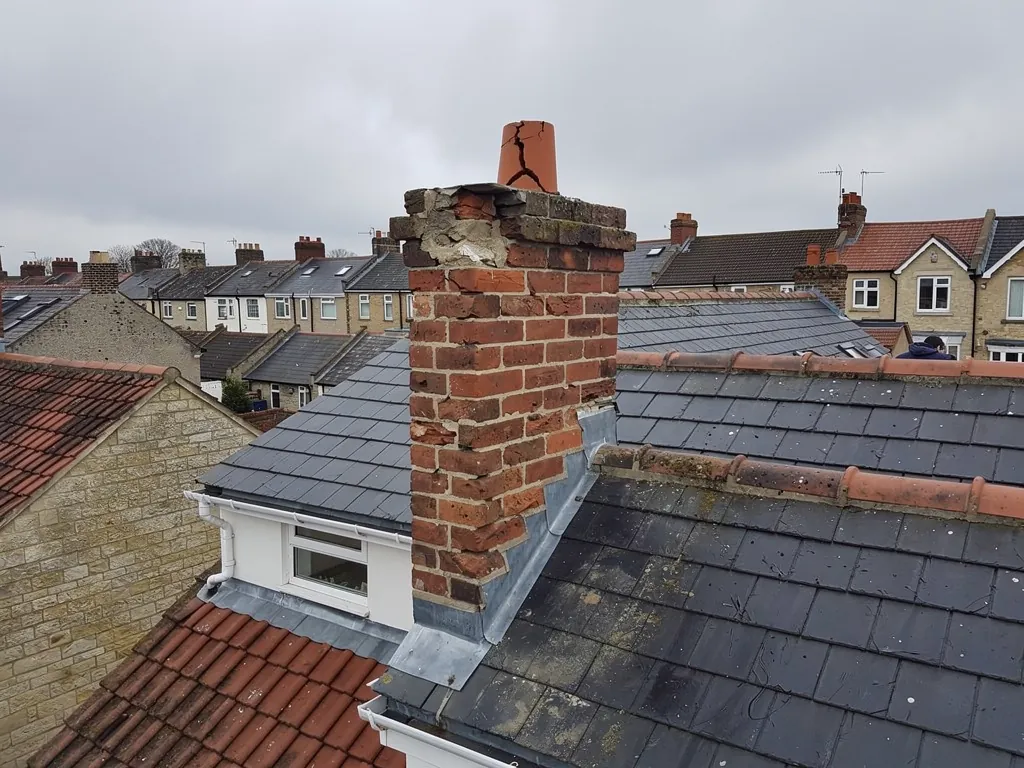
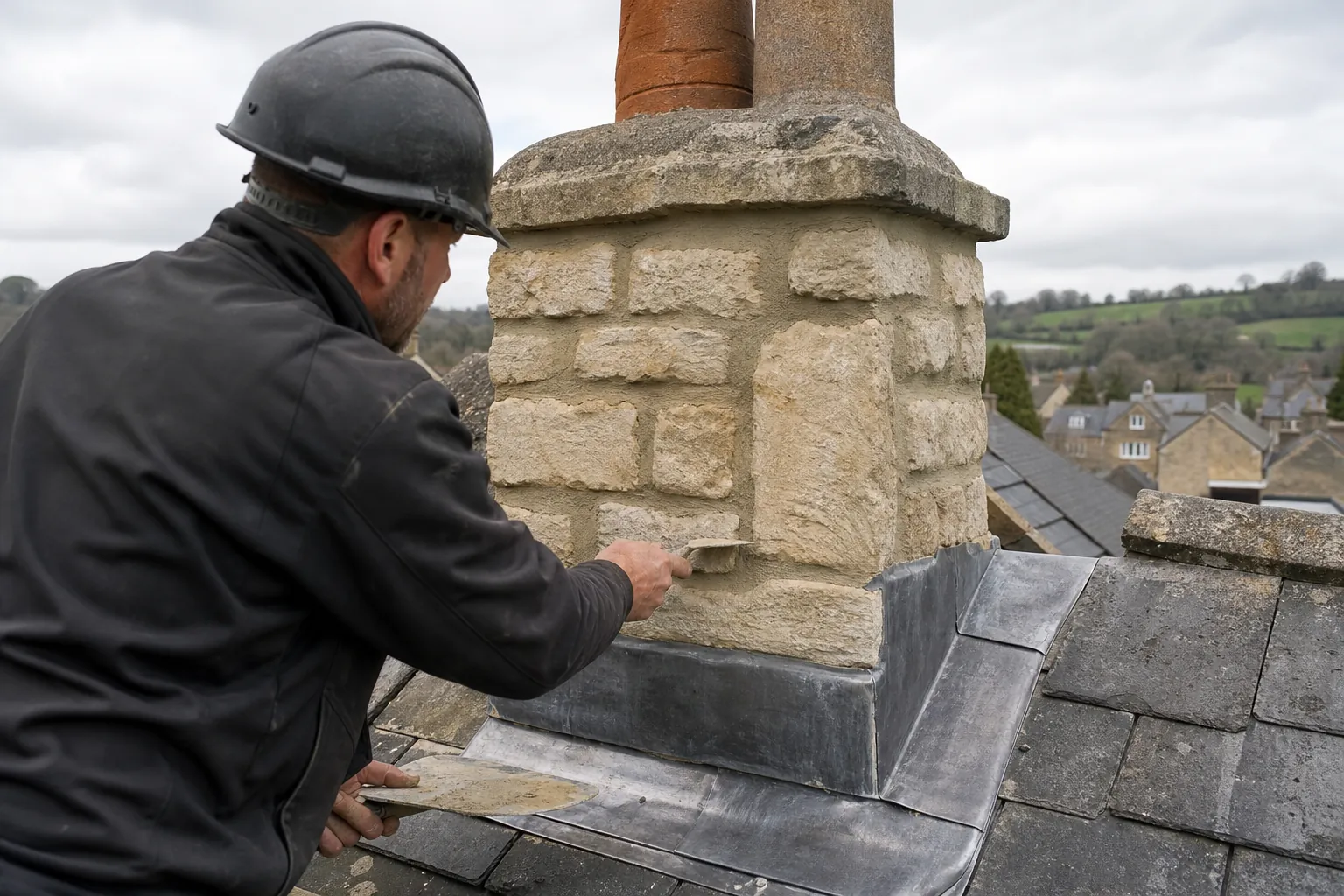
A loose ridge is lifted, the old mortar cleaned off, and each ridge tile bedded and mechanically fixed, as BS 5534:2014 expects. On some roofs it makes more sense to install a tested dry-fix ridge or verge system instead. A chimney repair usually means repointing the brick joints, renewing cracked flaunching, the sloped mortar cap the pots sit in, and dressing new lead soakers and flashings at the stack. A leaning stack or loose brickwork needs a specialist's structural view first. The quality of the leadwork decides whether the stack stays dry, and our chimney repairs page goes into the detail.
The same goes for flat roofs. A blister or a split in felt can be cut out and patched, and that patch can last for years if the felt around it is sound. Painting a whole roof with a liquid coating to stop a leak hides the problem rather than fixing it, and it makes the next repair harder because the new material will not bond to the coating.
On an old roof, fixing one slipped slate does nothing for the hundreds of others held by the same rusting nails. If we think a repair is going to be the first of many, we tell you plainly and show you the evidence, so you can choose between repairing now and planning a new roof as a separate project.
Our repairs carry a 10-year workmanship guarantee, given in writing. It covers our work, not the parts of the roof we did not touch, and the paperwork says exactly what was done. Manufacturer warranties on materials such as membranes and roof windows sit alongside it and are passed on to you where they apply. If a repaired roof starts leaking again, read what to do when a roof still leaks after a repair.
Keep the paperwork and the photos from any repair. If a problem comes back, they show what was done and where.
Our view
A repair should become part of the roof; if it needs repeating within a year, the cause was missed.
The answer
We arrive at the agreed time, set up access, protect the area below, do the repair, check it, and clear up. Most small repairs take a few hours. You do not usually need to be home the whole time, but someone should be there at the start and the finish.
Here is what a typical repair visit looks like.
We park, unload and set up the ladders, roof ladder or tower, or check the scaffold if one has gone up the day before. Anything fragile under the work area, such as pots, garden furniture or a car, gets moved or covered. Dust sheets go down in the loft and on any landing we walk through, and we keep the drive and path clear for you to come and go. If the job needs the loft, we will ask you to clear a path to the hatch.
We open up only what the repair needs. For a slipped slate that means lifting the slates around it and fixing the replacement with a tingle or clip. For a flashing it means raking out the old mortar, removing the old lead and dressing new lead into the joint. Anything unexpected, such as rotten battens spreading further than expected, is photographed and shown to you before we go further, and nothing is added to the bill without your agreement.
Noise is usually modest, and grinding is rare on a repair. If you work from home or have a baby sleeping under the roof, tell us and we will plan around it.
Where we can, we test the repair with water before we pack up, and we check the loft from inside. Old slates, tiles, lead and debris leave site with us. You get photographs of the finished work and the guarantee paperwork.
For small repairs we ask for payment when the work is done and you have seen it. On bigger jobs the quote sets out any staged payments before anything starts, so there are no surprises on the day. If you signed the contract at home after our survey, you have 14 days to cancel, and we only begin within that period when you ask for that by letter or email.
Small repairs can often be done in light rain, but high winds, ice and heavy rain stop work on a roof. If the forecast turns, we make the roof safe and come back. Roof repairs in winter covers what can and cannot wait.
If your roof is leaking right now, our emergency roof repairs page explains how we make it safe first.
More detail on leaks, costs, materials and particular parts of the roof, from bay windows to parapet walls.
Small repairs can sometimes go ahead in light rain, and we can always make a leaking roof safe with a temporary cover. Lead work, mortar and anything that needs dry surfaces waits for a dry spell.
Usually, yes. The loft shows us where water is getting in and how far it has spread, and it lets us check the repair from inside afterwards. A clear path to the hatch helps.
Yes. Splits, blisters and leaking upstands on felt, EPDM rubber and GRP fibreglass roofs, including dormer and garage tops, can often be repaired. If the deck is soft or water ponds across the roof, a new covering is usually the better answer, and our flat roofing page covers that.
We stop, photograph it and show you before doing anything that is not in the quote. You decide whether to go ahead, and any extra is agreed in writing first.
Someone needs to let us in at the start, show us the loft hatch if we need it, and see the finished work. In between, most customers simply get on with their day.
Yes, in matching materials. Repairs in kind do not usually need consent, but a change of material or method on a listed building needs listed building consent, so we check before proposing anything different.
Be wary of anyone who knocks to say they noticed a loose tile from the street, quotes before looking properly, wants cash only or money up front, or finds new problems once they are on the roof. A reputable roofer shows you photographs of the fault on your own roof, gives a written price as one total, puts a business address on paper and the guarantee in writing. A rough estimate over the phone is fine as a guide. Our guide to choosing a roofer has more checks, and Citizens Advice can pass a complaint to Trading Standards.
Not often. The national energy schemes pay for insulation, heating and solar panels, not for slipped slates or leaking flashings. Councils do have a power under the Regulatory Reform (Housing Assistance) Order 2002 to help owners repair their homes, and some offer grants or loans to eligible households, so ask Swindon Borough Council, or your own council in Wiltshire, for advice before work starts.
Yes. Alongside residential work we repair let houses, flats and small business property. Our page on roof repairs for landlords covers tenants and access, and larger buildings sit under commercial roofing.
As a local roofer we cover Swindon and the towns and villages within 30 road miles, across Wiltshire and beyond, including Chiseldon, Haydon Wick, Wanborough, Highworth and Royal Wootton Bassett.
It helps. Gutter cleaning once the leaves have fallen, clearing moss from valleys and tile laps, and a look at the ridge and flashings after a gale catch small faults on a tiled roof before they let water in. Our roof cleaning and moss removal page explains the methods we use.
Send us a photo of the damp patch, the slipped tile or the gap in the ridge, taken safely from the ground or the loft, and tell us roughly when the leak appears. We will arrange a visit to trace the cause, and if water is coming in now we will make the roof safe first.
Tell us what’s happening and we’ll call you back.
Or call 01793 626096
Message us on WhatsApp