
The owner of a listed house usually asks one thing first: can I just fix it? Sometimes you can. A few slipped slates put back on the same roof, with the same fixings, is ordinary maintenance. Stripping a slope, changing the covering, swapping lead for another metal or rebuilding a chimney falls on the other side of the line. Protection attaches to the building's whole character, and its roof carries much of that.
This guide explains where the line falls, what like-for-like repair means in practice, and how we approach a listed roof in and around Swindon. Treat it as general guidance rather than legal advice. Your own council's conservation team makes the call on your building, so put the question to it before any work begins. For the wider rules on re-roofing and permission, see our page on roof planning permission. Terraced owners will also want our guide to terraced house roof repairs, and landlords of a listed let can read landlord roof repair duties.

When does a roof repair need listed building consent?
The 1990 listed buildings Act, in section 7, bars any alteration that would harm what makes a listed house worth protecting, unless it is authorised first. Section 9 makes breaking that bar an offence. Size is not the test. What counts is whether the job changes what makes the building special.
In roofing terms, that gives a rough sorting of jobs.
Jobs that normally sit on the safe side
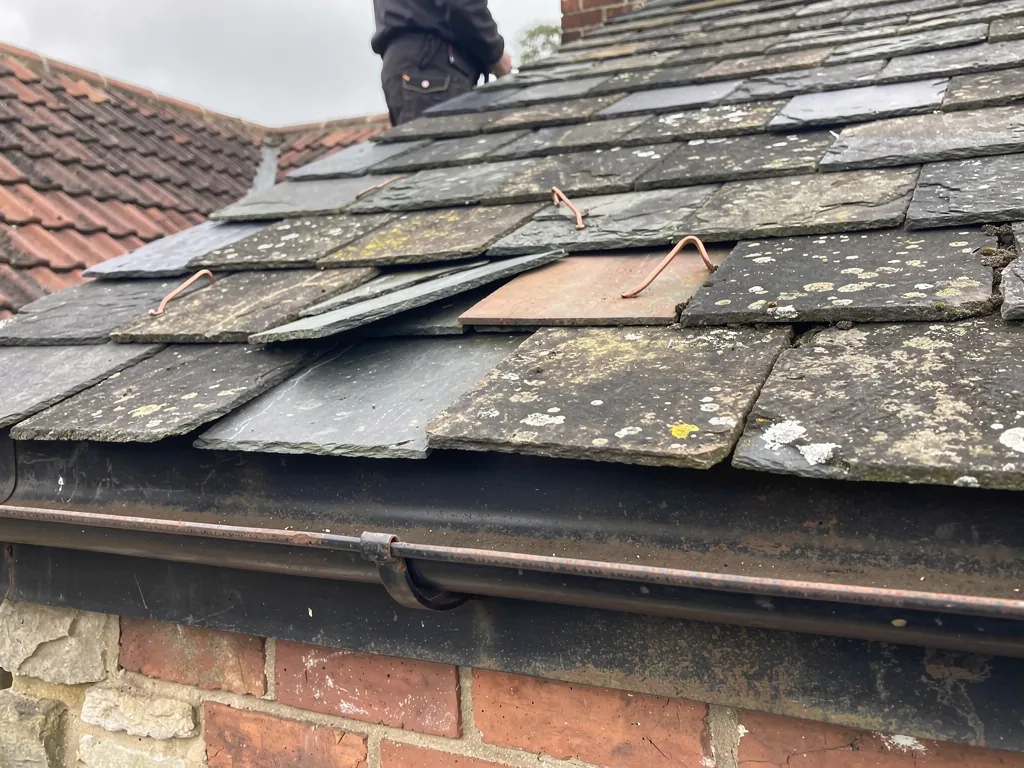
Refixing a handful of slipped slates, replacing a cracked tile with a matching one, clearing a valley, rodding a downpipe and re-pointing a few loose ridge joints in the original lime mortar are repairs that keep the building as it is. Even so, you should ask the conservation officer before you assume, because what counts as minor on one building can matter a great deal on another.
Jobs that usually need consent
Stripping and re-covering a slope, even in the same material, can affect historic fabric such as old battens, hand-cut rafters or original sarking. Changing the material, relaying slates in a different pattern, fitting roof windows, adding solar panels, removing or rebuilding a chimney stack and changing the lead details around a parapet are all alterations that need a decision first.
Listed building consent, planning permission and Building Regulations are three separate systems. One job can trigger all of them, one of them, or none, depending on what you are doing.
Where you are unsure, and especially where the building is old enough to have surprises under the slates, the least costly route is a short email to the council with photographs and a plain description, rather than a repair that has to be reversed later.
What like-for-like really means on a roof
Like-for-like is the phrase everyone uses and few people define. For a roof it means the replacement matches the original in material, size, texture, colour, laying pattern and fixing method. A new slate that looks similar but is a different thickness will sit differently, throw a different shadow and weather differently, and an experienced conservation officer will spot it from the road.
Matching starts with finding out what you actually have. Many listed roofs have been repaired several times, so the slope in front of you may be a patchwork of 1950s tiles, Victorian slates and modern replacements. We note what is original, what is later and what has failed, with photographs of every area, so the written quote, and any consent application, describes the roof as it really is.
Why a cheaper lookalike can be refused
Concrete tiles, fibre-cement slates and reconstituted stone rarely pass as substitutes on a historic building. English Heritage policy, reproduced in Cotswold District Council's 2000 technical guidance, called such artificial products inappropriate for real stone slate roofs. Your own authority may phrase it differently, but the idea that the covering should match the original runs through most listed work.
Reclaimed or new?
Reclaimed material is not automatically the better choice. That 2000 guidance preferred new stone slate over used stock, and added that reclaimed slate should go back only onto the property it came off, since buying it in strips some other old building. On your roof we reuse what comes off it first, then bring in new or carefully sourced material only for the shortfall.
Who do you ask in Swindon before you start?
Swindon Borough Council has a conservation contact: conservation@swindon.gov.uk. The council's conservation areas page gives that address for anyone wanting more information, and it is the sensible first email for a listed roof inside the borough. The council also encourages pre-application advice on planning matters in general, which is helpful when you are not sure whether a job crosses the line.
If your building is outside the borough, the same question goes to the council that covers your address. That may be Wiltshire Council, the Vale of White Horse, Cotswold District or West Berkshire, depending on where you are. We can tell you which one applies if you give us the postcode.
What to send the council
A short description of what has failed, photographs of the defective area and of the roof as a whole, and a note of the materials you propose to use are enough to start the conversation. The photographs from our survey are written up for exactly this purpose, so you do not have to climb a ladder yourself.
What the council can and cannot do
The conservation team can tell you whether consent is needed, what it expects in the way of materials and detail, and how long a formal application is likely to take. We cannot hurry it along, and we would rather you waited for a clear reply than started on a hopeful reading of the rules.
Remember that the council decides, not the contractor. We report what we found and what we suggest, and we will never describe a job as exempt when that judgement is the council's.
Roofs in conservation areas and the Railway Village
A building does not have to be listed for these rules to matter. Swindon's own conservation areas page lists 27 areas, from the Old Town to villages such as Wroughton, Highworth and Chiseldon, and it flags Article 4 directions at Bishopstone and in the Swindon railway village. An Article 4 direction removes some of the permitted development rights that would otherwise let owners change their house without applying.
The Railway Village shows how the layers stack up. The council's 2021 appraisal records a 1970 listing for the cottages, and the village became a conservation area in 1975. From 2020 to 2021 it formed part of Swindon's Railway Conservation Area. The Article 4 direction dates from 1980, and an older council leaflet states that listed building consent is usually required there. The appraisal describes the roofs as generally slate.
For a terrace like this, a repair in matching slate to the same pattern is the normal expectation. Our page on the Railway Village roofs goes into the local detail.
A dish or aerial fixed to a Railway Village stack or slope is something the council says it will resist, and it would need planning permission as well as listed building consent where relevant.
On an unlisted house, matching re-roofing seldom needs a planning application, yet listed buildings and Article 4 areas are the two named exceptions. Check first.
Lead, ridges, chimneys and the details that cause trouble
Listed roofs rarely leak through the middle of a slope. They leak at the details: lead flashings, valleys, parapet gutters, hips, verges and chimney junctions. Those are also the places where the wrong repair does the most damage, because a sticky modern sealant smeared over old lead can hide a failing joint for a winter and cause rot behind it.
Where lead has failed, we replace it in lead, not in a substitute, and we choose a code to suit the job. On a roof with a long history, the previous work may have used a lighter code than the position needs, which is one reason old repairs fail early. Our page on leadwork on listed buildings explains the options, and the chimney side is covered under listed chimney repairs.
Ridges and verges
On an old roof the ridge may be clay, stone or lead rather than a modern tile. A traditional ridge can be re-bedded in a lime mortar if the council wants the original method, and we can add a hidden mechanical fixing where that is appropriate and acceptable. BS 5534:2014 changed the standard approach, so a ridge that looks traditional may now have a modern fixing beneath the bedding.
Stone and Cotswold-edge roofs
Stone slate roofs have their own rules of thumb, including diminishing courses, where slate size shrinks steadily from eaves to ridge. For buildings on the Cotswold side of our area, see listed stone roofs, which covers that material in depth.
Hidden extras: insulation, wildlife and old fixings
A listed repair is not only about the outside. When slates come off, the roof structure below is exposed, and that is the moment to look at timbers, battens and any old repairs. Rot in the ends of rafters or a sagging purlin is common on buildings of this age. If the survey finds it, we tell you before work starts and show you the photograph, because it changes the scope and may change what the council needs to see.
Insulation is another point. Upgrading it under the covering can be sensible, but spray foam is a poor choice on a listed building: the RICS consumer guide warns that it must not go into a listed or other protected building without prior consent, and removing it later could damage the structure. If your roof needs warmer insulation, ask us about options that can be taken out again.
Old roof spaces suit bats and nesting birds, both of which are protected, so we look before disturbing one and stop work if we find any.
What the work looks like on site
We protect the roof with scaffold and sheeting where needed, keep a note of every slate and tile as it comes off, sort the reusable ones for relaying and clear the site and waste at the end. The 10-year workmanship guarantee comes in writing with the job, and the advice stays the same as on any repair: do only what the fault needs.
If the roof is leaking badly before consent comes through, a temporary make-safe such as sheeting is generally a different matter from a permanent repair, but tell the council and photograph what you do. Our page on roof repairs explains how we handle urgent leaks, winter repair limits apply to mortar and sealant, and the repair guarantee answer says what the written guarantee covers.