
Seen from above, a terrace is a single roof cut into private lengths. The ridge may run unbroken past several front doors. Chimney stacks sit astride the dividing wall with a flue from each house. Gutters and parapets continue from one property to the next. When water gets in, the place it shows is often not where the fault is, and the person who needs to know about it may live next door.
That changes how repairs are planned. It affects who has to agree, how the roofer reaches the roof, what can be done from your side alone and how the cost is shared. This guide covers the shared features that cause trouble, the practical problem of reaching the roof when a side passage is missing, and how to raise the subject with a neighbour without turning a leak into a dispute.
If you already have a stain on a ceiling, our guide to ceiling water stains will help you work out what it may mean before you call our roof repairs team.
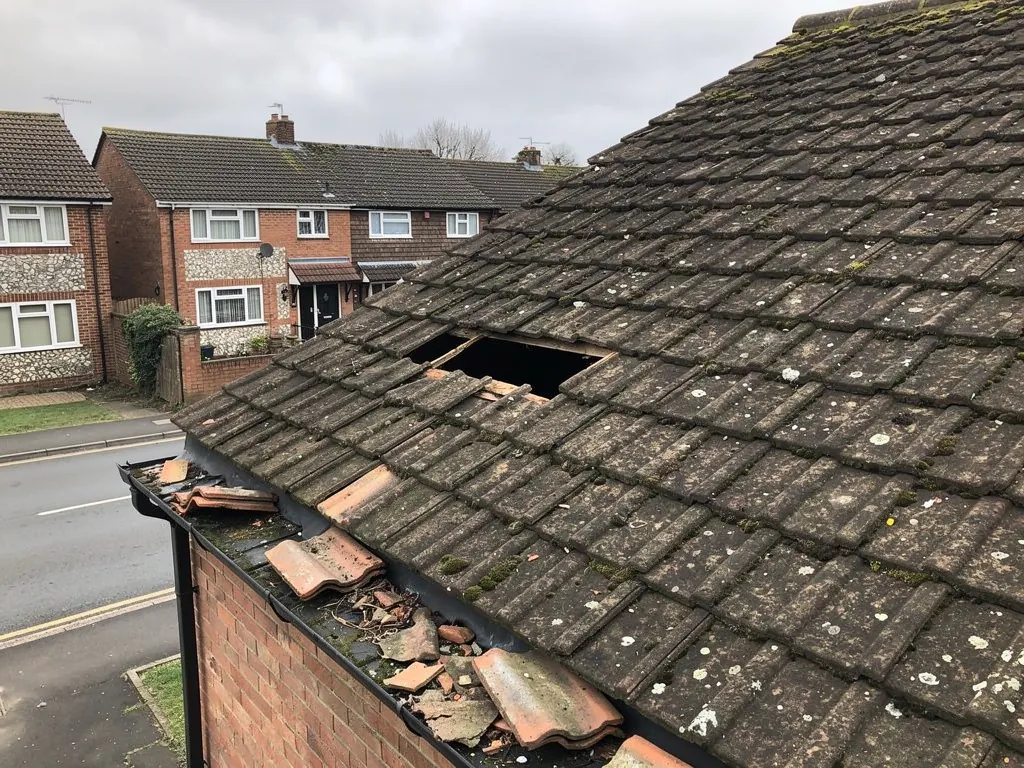
Where a terraced roof shares its weak points
The parts of a terrace that fail are usually the parts that belong to more than one house. A mid-terrace home has no gable end, so the main risks sit along the party walls and at the front and back eaves.
What fails at the party wall?
Where the roof slopes meet the wall between two houses, a flashing closes the gap, commonly lead let into the mortar course and folded down over the slates or tiles. Some roofs have a raised brick upstand called a parapet, with a gutter or lead lining behind it. If the lead cracks, the mortar holding it perishes or the parapet coping lets water through, rain runs behind the covering and appears as damp on the wall or the ceiling beside the party wall.
Why do shared valleys and gutters matter?
Some terraces have a valley gutter running between two parallel roofs, or a single gutter that serves several houses. One blocked outlet can flood a length of gutter and send water over the back of it into several lofts. A valley in lead or GRP that has split affects whichever house it sits above, but the water may track along the timbers into the next. Our answer on blocked roof valleys explains why clearing comes before condemning.
Are the fascias and gutters also shared?
Often they are continuous. A fascia board may run along the whole terrace with a joint at the party line, and one house's rotten length affects the line of the gutter. Dealing with it neatly usually means matching profile and colour with the neighbours, which is another reason to talk first.
Shared chimney stacks
The stack is the most common shared item and the most common source of arguments. A single brick stack typically carries a flue from each of two or more houses. Each house owns its side of the stack, or its share, but the stack stands as one structure.
Defects here are rarely contained. If the pointing on one face has failed, water enters the brickwork and runs down into both flues. Cracked flaunching, the mortar cap that slopes water off around the pots, lets rain into the top of the stack. A flashing split on your side may pour onto your neighbour's ceiling. You might see staining on a chimney breast in an unused bedroom, and the cause could be the other half of the stack.
Who pays for shared stack repairs?
There is no simple rule that suits every terrace. The usual starting point is that each owner pays for their side, and shared items such as the stack head or the flashing across the party line are split by agreement. What matters in practice is that the work gets done in one visit, because scaffolding is the main cost. MyBuilder's scaffolding guide, updated in August 2026, gives chimney scaffolding at around £400 to £900, and splitting a single set-up between two households is usually cheaper than paying twice.
What about removing a stack?
Taking down a stack that sits on the dividing wall falls under the Party Wall etc. Act 1996: GOV.UK names it among the works a neighbour must be told about. Our shared chimney stack answer goes into this in detail.
Reaching a terraced roof when there is no side access
Many terraces have no side passage at all. The roof can be reached from the street at the front, from a back yard or a rear lane, or sometimes only through the house. The route decides the method and affects the price, so the survey looks at it first.
At the front, the issue is the pavement. Scaffold standing on a public footway may call for a council licence, and MyBuilder's guide puts a scaffold licence at around £50 to £200. Fast, small jobs may be possible from a ladder or a tower on private land, but anything that involves two hands, heavy materials or a chimney stack usually calls for proper scaffold. Our guide to roof work without scaffolding sets out the difference.
Can the roofer come through my house?
Sometimes the best route to a rear roof is through the house, up the stairs and out of a window or hatch. If so, we protect floors and furniture with sheets and boards, wear clean footwear indoors and agree timing with you first. Materials still need to reach the roof, so some jobs use a hoist or are carried over the front.
What if a neighbour's property is the only way in?
Then we need their agreement, and the request is best made before the day. For ordinary repairs a friendly conversation, followed by a short message confirming the day, is usually all it takes. Call 01793 626096 if you want to talk through who to approach first.
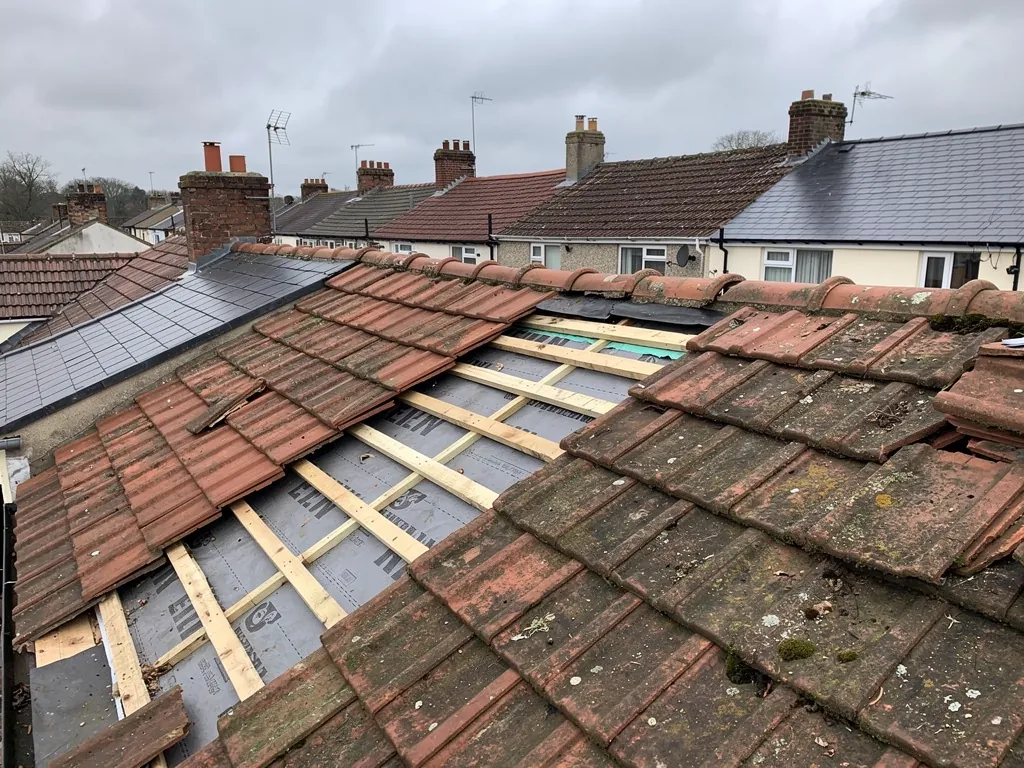
Talking to the neighbours before you book
Disputes between neighbours over a roof are often not about the roof. They are about surprise. A scaffold appearing at dawn on a Monday, a chimney being opened without warning, or a bill that arrives with no explanation lead to bad feeling in a way a short conversation would have avoided.
A good approach is to knock, explain what you have seen and offer to share any photographs. If the roof surveyor has found a fault on a shared item, show them the picture rather than describing it. People find it easier to agree to work when they can see the problem, and they are more likely to share the cost when they know what it is for.
What should we agree between us?
- Who owns which part of the stack, gutter and party-line flashings, using the deeds if need be.
- Who will allow access, on which days, and where materials may be stored.
- How the cost of shared items and the scaffold will be divided.
- When the work is expected to start and finish, so everyone can plan around noise and dust.
- How a bigger-than-expected finding will be handled.
Do I have to get my neighbour's consent?
For work wholly on your own roof and from your own land, generally not. Cutting into a party wall, removing a chimney from one or needing to enter their property is a different position. The Party Wall etc. Act 1996 sets out when a notice is required, so read it before planning anything structural. Our page on landlord roof repairs covers a related situation where the person paying is not the person living in the house.
Old terraces and the rules that follow them
Many terraces are Victorian or later, and some still carry the original slate roof or an early replacement. Roofs of that age have their own habits. Underlay may be missing, nails may be iron, and the lead at party walls may be decades old. A repair can look small from the street and turn out to involve a whole length of flashing.
Some terraces carry extra rules. The Railway Village became a conservation area in 1975 and merged into the wider Swindon's Railway Conservation Area in 2020 to 21. Its slate roofs are noted in the council's appraisal ("generally slate"), and an Article 4 direction adopted in 1980 requires permission for work that would normally need none. Most properties there are listed. Anything more than a straight like-for-like repair is worth raising with Swindon Borough Council's planning team first, and see our guide to listed roof repairs for how consent affects the timetable.
Does like-for-like matter on a terrace?
It does. Putting a different tile or colour on one house in a row is visible from the street, and on a protected terrace it may need permission. Even where it does not, the terrace looks better when repairs match, and matching reclaimed slates or tiles takes time to source.
Do repairs like this need Building Regulations approval?
The Planning Portal's test for ordinary repair work is under 25 per cent of the total building envelope and under 50 per cent of the roof; under both, no Building Regulations application is normally needed. Structural alterations do need approval, and we look after the notification when the work needs one.
Fixing a leak that crosses the party wall
One of the most frustrating terraced faults is a leak you cannot trace to your own roof. A stain appears near the party wall, you check your tiles and flashing and find nothing wrong, but it keeps happening in heavy rain.
Water moves along timbers and through brickwork. A failed flashing on the next-door roof can send damp across the party wall. Equally, your own defect may be soaking the neighbour's wall. The only reliable way to tell is a look at both sides, which needs access to both roofs.
How do we survey a leak that crosses the line?
With your agreement and your neighbour's, we look at the stack, the party-line flashing, the valleys and the gutters on either side, and photograph what we find. A hose test, starting low and working up, can narrow down the fault. Our guide to finding a roof leak sets out the method, and our answer on abutment leaks covers the wall junction in particular.
What if the neighbour will not engage?
Do what you can on your own side, document it with dated photographs and put your request in writing. A temporary repair can keep your own house dry while the discussion continues. Where the fault lies in their part and they will not act, the council or a solicitor can advise, and we would rather you got that advice than guessed.
Once surveyed, you get a written quote plus pictures of the roof itself. A finished repair carries our written 10-year workmanship guarantee. If a sealant patch has been tried already, see sealant roof repairs for why it often lets go again.