
A ceiling stain makes people reach for the phone and the stepladder in the same minute. That is understandable, but the stain only tells you that water has arrived somewhere it should not be. It says nothing about where the water started. A damp ring under a bedroom roof slope might be rain coming through a slipped slate, warm breath condensing on cold timbers, a weeping pipe joint in the loft or a gutter that has been spilling behind the fascia board for a month.
Each cause leaves a slightly different signature, and a few minutes of looking before anyone climbs a ladder saves a lot of wasted repair. This guide covers the four usual suspects, the checks you can do from inside the house, and what to do tonight if the ceiling is already wet. If the roof does turn out to be the cause, our guide to how a roof repair is carried out shows what happens next.
What the stain itself can and cannot tell you
Plaster and plasterboard soak up water and carry it sideways before it shows. The stain you see is where the water finally gave up travelling, which is often well away from the entry point. So read the pattern rather than the position.
A roof leak tends to leave a patch with a darker, slightly crinkled edge, because each wetting dries back to a tide line and the next one pushes a little further out. Several rings inside one another mean repeated wetting over weeks or months. Condensation behaves differently: it produces a mottled, spreading greyness, often with black speckled mould at the edges, rather than a clean brown tide mark. A weeping pipe usually makes a localised dark patch that grows steadily and does not care about the weather outside.
Does the colour mean anything?
Brown is the colour of old timber, dust and dissolved plaster carried by water, so it points to water that has passed through the roof structure or the ceiling void. A pale yellow stain tends to be fresher. Black dots are mould and mean the area has stayed damp, not that the leak is bad. No colour proves a cause on its own.
Should I check the stain more than once?
Yes. Mark the edge in pencil, write the date beside it, and look again after the next heavy rain and after a dry, cold night. A stain that grows only after rain and a stain that grows with no rain are different problems, and the pencil line settles which one you have.
When the roof is the cause
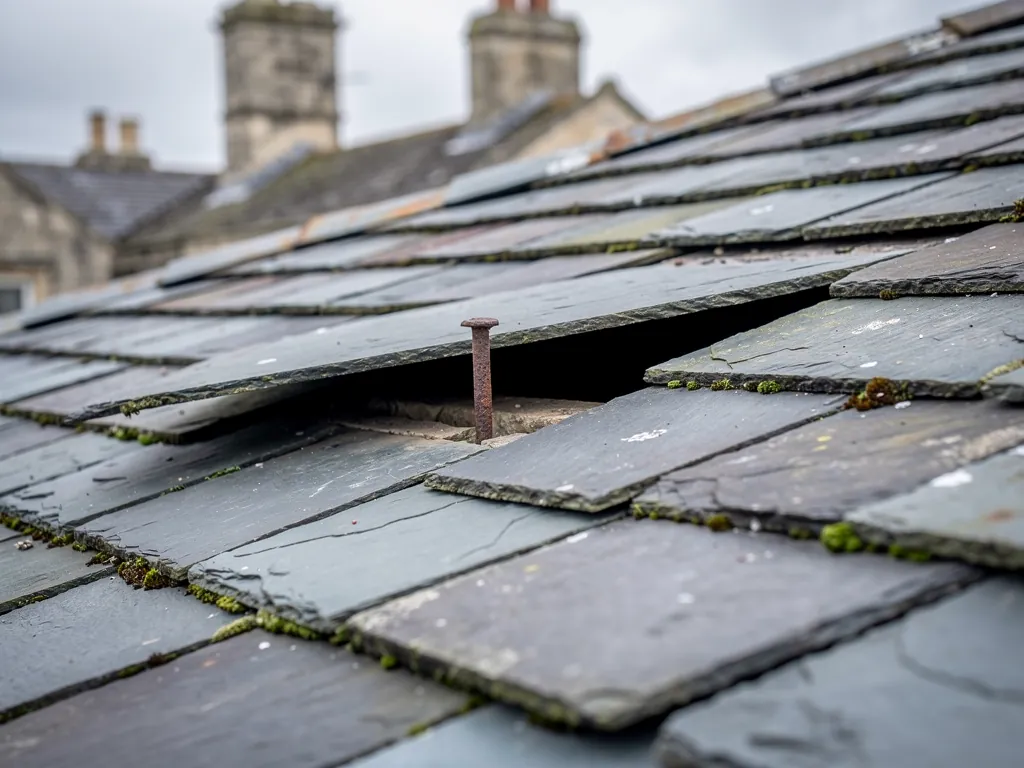
Rain coming through the covering is the cause people expect, and it does account for plenty of ceiling stains. The pattern is that the patch appears or spreads during or soon after rain, often a day or two later once the timbers and plaster have soaked through. It is more likely on a ceiling directly under a roof slope, near a chimney breast, beside a party wall or under a valley.
The entry point is almost always at a junction: a wall flashing, the lining of a valley, a cracked or slipped slate or tile, or mortar missing from a ridge or verge. Our guide on the usual causes of roof leaks goes through each in turn.
Why is it wetter when the wind blows from one side?
Rain driven sideways gets under flashings and between slates that stay dry in a plain downpour. If the stain only grows when the weather comes from the same quarter each time, the fault is probably on the slope or wall facing that way. A note of the wind direction beside your pencil line is useful to a roofer.
What if the roof looks fine from the garden?
Ground level is a poor place to judge a roof. A cracked tile sits in shadow, a lead flashing lifts at the top edge where you cannot see, and a slipped slate looks like its neighbours from the lawn. A survey from the roof itself, or a close drone view, finds what binoculars miss.
If the ceiling is bulging or dripping, do not wait for the next dry spell. Water pooled in the plaster adds weight and can bring a section of ceiling down.
When damp air inside the house is the culprit
Steam from cooking, showering, drying washing and simply breathing rises through the house into the loft. If the loft is cold and poorly ventilated, that moisture meets the cold underside of the covering or the timbers and turns to water. It drips onto insulation, soaks the ceiling from above and shows as a stain even though no rain has got in.
The telltale is timing. Condensation is worst in cold, still weather, often in the morning, and arrives in dry spells as readily as wet ones. It is also more noticeable where loft insulation has been pushed right to the eaves, blocking the gaps that let air move. Our guide to telling condensation from a leak gives a longer set of tests.
Can I check for condensation in the loft?
On a cold morning, look at the nails that come through the underlay and at the face of the rafters. Beads of moisture, frost on nail tips or damp patches on timber with no matching hole above suggest condensation. Dark spotting on rafters is another sign. Stay on the joists or a board, never between them.
Does ventilation matter that much?
It does, because insulation and ventilation have to work as a pair. Extra insulation without air movement at the eaves can turn a dry loft into a damp one, and extractor fans that vent into the loft instead of outside make it worse.
Curing condensation is usually a matter of moving air and moisture, not replacing a roof covering, which is why naming it correctly matters. New slates for a condensation stain solve the wrong problem.

When the water comes from a pipe or tank
Plumbing leaks cause some of the most confusing stains because they ignore the weather. Cold water tanks, overflow pipes, heating pipework in the loft, a joint under a bath or shower tray, and a radiator valve in the room above can all send water through a ceiling.
The pattern here is steadiness. A pipe leak tends to grow at much the same speed whether it is sunny or pouring. If the stain sits under a bathroom, an en-suite or a kitchen, plumbing should be the first suspect rather than the roof. A tank overflow that dribbles outside the wall points to a faulty float valve, though staining inside can still happen if the overflow run is blocked or kinked.
How do I tell a pipe leak from a roof leak?
Look at what is directly above the stain, and ask whether it appeared after rain or after someone had a bath. If it grows when a tap or shower is used and never in wet weather alone, it is plumbing. A simple check is to read your water meter, turn off every tap, and read it again after an hour or two. A moving dial points to a leak somewhere in the supply.
What if it is a heating pipe?
A falling pressure gauge on the boiler, or a system that needs topping up more often than it used to, backs up a heating leak. Switch the supply off, call a plumber or heating engineer, and keep the roofer in reserve until the pipework has been ruled out.
Painting over a stain before the pipe is fixed only hides the evidence for a few weeks.
When it is a gutter, a wall or a window
Some stains come from water that never touches the roof covering. A blocked or sagging gutter overflows in heavy rain, and the water runs back behind the fascia board, wets the top of the wall and the timber plate that carries the rafters, and appears as a stain along the edge of an upstairs ceiling. Our page on gutters, soffits and fascias explains the repairs involved.
Walls matter too. Eroded pointing, a failed render, a leaking window sill or a bay roof can let water into a wall that runs alongside or above a ceiling. Chimneys are a frequent offender: a stack with open joints soaks up rain and passes it down inside the breast, where it stains the ceiling next to it.
Could a neighbour's roof be responsible?
In terraces and semis, yes. A shared chimney stack, a party wall flashing or the valley between two roofs can carry water from one house to the other before it shows on a ceiling. If the stain sits beside the party wall and your side of the roof looks sound, mention it to the neighbour. A repair that covers both sides costs less than two separate callouts.
Gutters are the easiest cause to rule out. Watch them in a heavy shower. If water pours over the edge or drips from a joint, you have found part of the answer.
What to check first, in order
Work from the least effort to the most. None of this needs a ladder against the house.
- Date and outline the stain in pencil, and photograph it with a coin or tape measure beside it for scale.
- Ask what is directly above: a bathroom, a tank, a radiator, an external wall, a chimney breast, a roof slope or a flat roof.
- Think back to the weather and to the last bath, and see whether the stain grew after rain, in the cold, or when water was used.
- Watch the gutter above the stain during the next shower for overflow or dripping joints.
- With a torch, look into the loft from the hatch. Check for wet or darkened timber, dripping nails, soaked insulation or a pipe joint with a crust on it.
- Check the water meter with every tap off.
That order rules out the cheap causes first and leaves the roof for last. If the loft is wet and the pipes are dry, the next question is where the rain gets through, and our guide on finding a roof leak picks up from there.
What should I do tonight if the ceiling is wet?
Move furniture and bedding clear. If the ceiling is bulging with water, put a bucket underneath and make a small hole at the lowest point of the bulge with a screwdriver, so the water drains in a controlled way instead of letting the plaster collapse. Avoid using light fittings in the wet area until an electrician has checked them.
Should I paint over the stain once it is dry?
Only after the cause is fixed and the ceiling has dried fully. A stain-blocking primer goes on first, or the brown tide mark returns through emulsion.
Who to ring, and what a roof survey involves
Call a roofer when the stain grows after rain, when the loft timbers are wet and the pipes are dry, when slates or tiles are visibly missing, or when you have ruled out plumbing and gutters and the stain keeps returning. Call a plumber first if the stain sits under a bathroom or follows water use. Call both if you cannot tell.
Leaks are a priority for us, and a wet roof gets a temporary cover or a quick refixing of loose slates before anything else. Then we survey, photograph the areas involved and put a written quote together, so the evidence is in your hands before you commit. Our recommendation is whatever small repair cures the fault, and the work carries a 10-year workmanship guarantee in writing.
Does a repair always follow?
No. If the survey finds condensation, we tell you and explain what would help, which is often ventilation rather than roofing. If it points to a plumbing fault, we tell you that too. A diagnosis that sends you to the right trade is worth having.
If you rent your home and the stain appeared after a leak, who arranges and pays for the repair turns on your tenancy. Our guide to landlord roof repairs covers the usual position for residential lets, and roof repair costs explains what moves the price. For everything under one heading, see roof repairs in Swindon.