
Ask a roofer for the single most common cause of roof leaks and you will usually get a question back: what kind of roof? A slate roof on a Victorian terrace, a concrete-tiled estate house and a felted garage each fail in their own way. What they share is that water rarely punches through a sound slope. It gets in where the roof changes direction, meets something else, or has a fixing that has given up.
That is useful to know, because it tells you where to look and why a repair aimed at the tile above a ceiling stain so often misses. This guide works through the usual suspects in roughly the order a roofer checks them. For the method of actually finding your leak, see our guide to tracing a roof leak.

Flashings where the roof meets a wall
Wherever a roof slope runs into a wall, whether that is a party wall on a terrace, the side of a dormer or the back wall of a lean-to extension, the gap is sealed with a flashing. On older roofs that is usually lead, tucked into a mortar joint in the brickwork and dressed down over the slates or tiles. On some newer houses it is a mortar fillet, a wedge of sand and cement along the joint.
Both fail with age. Lead fatigues if it was fixed too tightly or cut in lengths that were too long, and cracks along the bends. The mortar that holds the top edge into the wall perishes and lets the lead pull away, so rain runs down the wall and behind it. Mortar fillets shrink and crack away from the wall, leaving a gap that water follows straight onto the roof timbers.
What it looks like
Damp on the ceiling or wall close to where the roof meets the wall below, often worse when rain is driven from one direction. From the garden you may see lead lifted at the top edge or cracked mortar along the joint.
Soakers and stepped flashings
On a slate or plain-tiled roof against a wall, small pieces of lead called soakers are laid between each course and a stepped flashing covers them from above. If the soakers were left out when the roof was last relaid, which happens on quick re-roofs, the stepped flashing alone cannot keep water out and the joint leaks from the first heavy shower. Lead of the right weight matters too: soakers are usually Code 3 and flashings Code 4 or 5.
Valleys between two slopes
A valley is the internal channel where two roof slopes meet, such as where a back extension joins the main roof or around an L-shaped house. It carries the water from both slopes, so it handles more rain than any other part of the roof, and it collects whatever the wind brings: leaves, twigs, moss and the odd tennis ball.
Traditional valleys are lined with lead. Newer roofs often use preformed GRP or plastic valley troughs, and some tiled roofs use valley tiles cut to form the channel. Each fails differently. Lead valleys also suffer from moss and lichen run-off, which is slightly acidic and slowly eats into the lead along the line where water is channelled. Lead splits where it has been fixed too rigidly or where a joint was lapped too short. GRP troughs crack or lift at the edges. Cut tiles along the valley can slip, and the mortar bedding them perishes.
A blocked valley can leak even when the lining is perfect. Water backs up behind the debris and spills over the edge of the lining onto the timbers, so clearing it is the first step before anyone condemns the valley.
Our answer on what happens when a valley gets blocked goes into that in more detail.
Slipped, cracked and missing slates and tiles
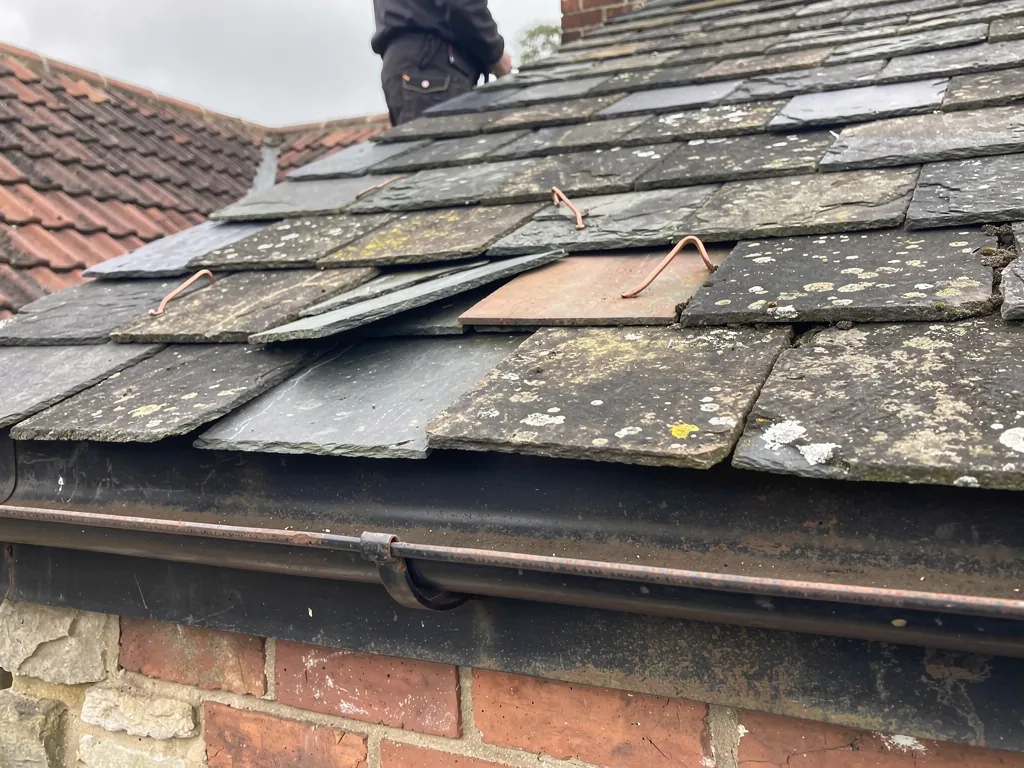
This is the cause most people picture, and it is a real one, though often less dramatic than it looks. A single slipped slate leaves a gap the width of the slate below it. On a roof with sound underlay the water lands on the membrane and drains to the gutter, and you may not notice for months. On an older roof with no underlay, which is common on Swindon's Victorian streets, the same gap lets rain straight onto the ceiling.
Nail sickness
Slates are held by nails, and on old roofs those nails were often iron. They rust through over decades and the slates start sliding out one after another, often in a line along the same course. A roof doing this is telling you the fixings are failing everywhere, not just where the slate has gone. A few slipped slates can be refixed with tingles or hooks; dozens suggest the roof is heading for a re-slate.
Cracked tiles
Concrete tiles crack from frost, foot traffic and age, and clay tiles can split along a lamination. Hairline cracks may not leak at first but open up over winters as water freezes in them.
Foot traffic is an overlooked cause. Satellite installers, aerial fitters and well-meaning neighbours walking on a roof crack slates and tiles that look fine from the ground. If a leak appears soon after someone has been on your roof, start with the route they took.
Ridges, hips and verges
The ridge caps the top of the roof, hips run down the outside corners of a hipped roof, and the verge is the edge at a gable end. On houses built before 2014 these were often bedded on mortar alone, which was standard practice at the time. Mortar shrinks, cracks and washes out, and once it goes the tiles can rock and lift in high winds.
A loose ridge lets rain in at the joints between ridge tiles and along the bedding. Verges fail when the mortar between the tiles and the undercloak at the gable end falls out, which also gives birds a way into the roof space.
Since BS 5534 was revised in 2014, mortar alone is not relied on to hold ridge and hip tiles; they are mechanically fixed as well. Dry-fix systems, tested to BS 8612, replace the mortar with clips, seals and caps. When we re-bed a ridge on an older roof we add mechanical fixings, and dry-fix is often the better long-term answer. Our ridge, verge and dry-fix page explains the options.
Chimneys
A chimney stack punches straight through the roof, so it brings together several of the weak points above in one place. Water can get in through the flashing where the stack meets the slope, through porous or open-jointed brickwork above the roof, through cracked flaunching (the sloped mortar cap around the pots), or straight down an uncapped flue.
Disused flues are a particular culprit. Once a fireplace is blocked up, the flue no longer dries out with the warmth of a fire, and rain falling straight down it soaks the brickwork from the inside. A cowl or a ventilated cap keeps the rain out while letting the flue breathe, which stops damp patches appearing on a breast that has not seen a fire for years.
The giveaway is often a damp patch on a chimney breast inside, or staining on the ceiling right next to the stack. Brickwork that has lost its pointing soaks up rain like a sponge and passes it down inside the stack, where it shows up as brown stains on wallpaper in a bedroom below. Stacks shared between terraced houses add a twist: the leak may be on your side while the fault is on your neighbour's half of the stack.
Chimney work almost always needs safe access at ridge height. Our chimney repairs page covers repointing, flaunching, flashing and capping.
Flat roofs, outlets and upstands
Flat roofs on garages, kitchen extensions and dormers have their own list of failure points. Felt blisters and splits as it ages, especially where the roof was laid without enough fall and water sits on it for days after rain. The edges matter as much as the middle: upstands where the flat roof meets a wall, trims at the edge, and outlets where water drains into a gutter or downpipe.
Ponding is a cause in itself. British Standard guidance for flat roofs sets a finished minimum fall of 1:80, and the roof should be designed for 1:40 so it still drains after tolerances and deflection. Older extension roofs laid nearly level hold water, which works into every small defect and freezes in winter.
Material matters as well. Torch-on felt typically lasts 10 to 20 years according to Less, while EPDM and GRP usually last longer when the deck beneath stays sound. A roof that has been patched several times is often reaching the point where another patch only moves the leak along.
A leak under a flat roof often shows up well away from the fault, because water travels along the deck before it finds a gap.
Our flat roofing page covers when a patch will do and when the covering needs replacing.
Gutters, roof windows and the smaller details
Some leaks start below the roof covering altogether. A blocked or sagging gutter overflows back behind the fascia in heavy rain and soaks the wall plate and the top of the inner wall, which looks exactly like a roof leak from inside. Gutters should fall gently towards the outlet; one that has dropped at a bracket holds water and overflows at the wrong point.
Roof windows leak at the flashing kit around the frame, especially if it was fitted without the manufacturer's flashing or has been damaged. Soil and vent pipes need a properly formed lead slate or a purpose-made collar where they pass through the roof. Satellite dish brackets fixed through slates or tiles, and aerial cables run under them, are another small but regular source of trouble.
Condensation
Finally, not every wet loft is a leak at all. Warm air from the house condensing on a cold roof can soak the underlay and drip onto insulation, particularly where loft insulation has been added without ventilation. If the damp appears in cold, dry weather rather than after rain, condensation is the likelier culprit.
If you have a leak now, our roof repairs team traces the cause before quoting, and the guide to common roof repairs on Swindon homes shows what the fix usually involves.