
People often picture a roof repair as one dramatic job: a ladder, a bucket of mortar and a patch. In practice the work sorts into a few recognisable kinds, each tied to one part of the roof and one way it ages. A Victorian railway terrace with its natural slate, a 1930s semi under clay tiles and a 1990s estate house with concrete interlocking tiles all wear out in different places.
Knowing the types helps in two ways. It lets you read a quote and see whether the scope fits the fault, and it shows why the lowest-priced fix is sometimes the wrong one. Below, each repair is described as a roofer would do it, with the signs that point to it. For the warning signs that come first, see signs your roof needs repair.
Replacing and refixing tiles and slates
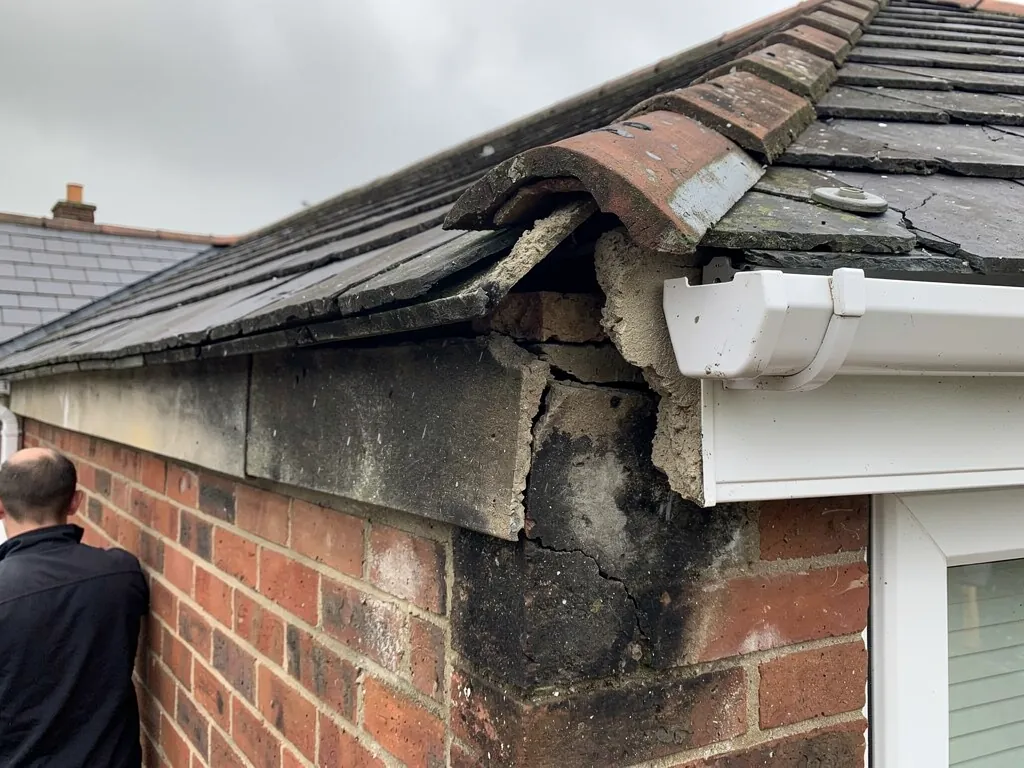
The most frequent job on any pitched roof is lifting a damaged covering and putting a sound one in its place. A cracked concrete tile, a slate that has slid down its nail or a clay tile split by frost all come under this heading. The roofer lifts the course above, removes the broken piece, slides in a replacement and refixes the neighbours so they sit flat.
It sounds simple, and the difficulty is matching. A new tile beside a weathered one looks bright for a couple of years, and an old pattern may no longer be made. Reclaimed tiles are the usual answer on older roofs, and a roofer worth hiring keeps a stock of salvaged slate and clay for exactly this.
What are tingles and why are they used?
A tingle is a narrow tongue of lead or copper that hooks round the bottom of a slate and is nailed to the batten, the timber strip the slates hang from. It holds a slipped slate in place without lifting the whole course, and it suits a roof where the nails are failing but the slates themselves are sound. A scattering of tingles is a sensible repair. Dozens of them across one slope suggest the fixings are giving way all over, and a re-slate may be the honest answer.
When does a few cracked tiles become a bigger job?
When the cracking spreads. Concrete tiles that are crazed across a whole slope, or clay tiles with surface spalling in the same course, are reaching the end of their working life. A repair then buys a short extension, not a cure. Our guide on what damages roofs shows how that wear develops.
Ridges, hips and verges
Three lines on a pitched roof are finished with shaped tiles or caps. The ridge runs along the crest. On a hipped roof the hips slope down each projecting corner, and the verge dresses the raking edge that overhangs a gable end. Traditionally all three were bedded on mortar, and the mortar is the weak link: it shrinks, cracks and washes out, then the tiles start to shift. Gaps along a ridge admit rain driven by wind, and a loose ridge tile in a gale is a hazard to anyone below.
The usual repair is to rake out the failed bedding, relay the tiles on fresh mortar and add mechanical fixings. Since BS 5534:2014, mechanical fixings (clips, screws or straps) are fitted to ridge and hip tiles in addition to their mortar bed. A dry-fix system, tested to BS 8612:2018, swaps most of the mortar for a ventilated strip and clamps, which avoids the repeat cracking wet bedding suffers.
Is re-bedding a ridge expensive?
MyBuilder's guide, updated on 21 August 2026, quotes £300 to £600 for ridge tile re-bedding or replacement, and its dry ridge page quotes a typical job at £500 to £1,000. Those are national guide figures. What moves the number on a real house is the length of ridge, the height and the scaffold needed; our written quote follows the survey. More detail sits on our ridge, verge and dry-fix page.
What goes wrong at a verge?
The mortar between the tile edge and the undercloak, the strip that supports the tiles along the gable, drops out. Tiles then rock, rain gets behind them, and birds can find a way in. Pointing the verge afresh, or fitting a dry system, closes the gap.
Flashings and leadwork
A flashing is a strip of waterproof metal, nearly always lead on a house, that closes the joint between roof and wall, chimney or roof window. Soakers are small lead pieces interleaved with slates or plain tiles, and the flashing sits over them. Between them they keep rain from tracking down a wall face and getting behind the covering.
Failed leadwork is a leading reason for a brown ceiling. The lead fatigues and cracks at its bends, the mortar that grips its upper edge in the wall joint perishes, and the metal pulls clear. Repair ranges from re-wedging and repointing a lifted section to cutting out a worn stretch and replacing it. Where an old flashing is cracked in several places, replacing the whole run is more sensible than patching, because new lead joined to fatigued lead rarely lasts.
Which lead code is used?
Lead sheet is graded by code number. Leadworx calls Code 4 the usual pick for general flashings, with Code 3 reserved for soakers and Code 5 for heavier or vertical details. A roofer should be able to tell you what is going on your roof. See our lead roofing page for more.
Why not seal the gap with mastic?
Because it fails fast. Sealant sits in a joint that moves with temperature, and it cracks within a season or two. It also has to be cleaned off before lead can be properly fixed. As a short-term storm measure it is fine; as a repair it only postpones the work.
Leadwork beside walls and chimneys gets early attention on a survey, since a small defect there can wet several rooms.
Valleys and the places where slopes meet
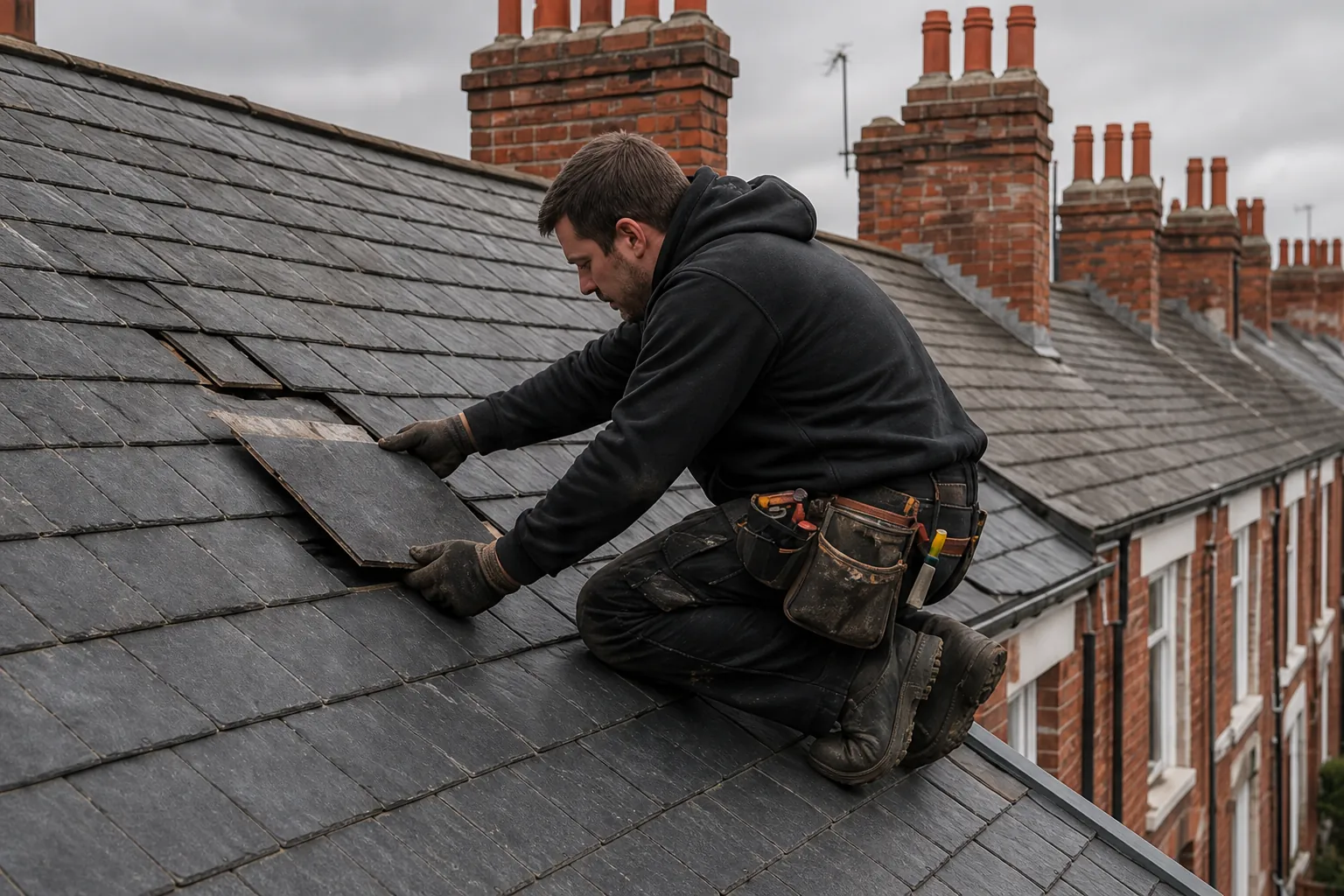
A valley is the inward-facing gutter formed when two slopes join at an angle, as happens where a back extension abuts the main house. Water arrives from both sides, so no other stretch of covering is asked to carry as much, and leaves, moss and grit settle in it. Traditional valleys are lined with lead. Many later roofs use preformed plastic or GRP (glass-reinforced plastic) troughs, and some use cut tiles with a mortar bed.
The usual repairs are clearing a blocked valley, replacing a split section of lining, re-bedding cut tiles that have slipped and dressing the edges so water cannot spill sideways. A blocked valley can mimic a failed one, so clearing comes first. Our answer on blocked roof valleys goes into it.
Can a valley be repaired in sections?
Sometimes. A short split in lead can be cut away and a new length lapped in, provided the lining on either side is sound. Where it has thinned along the whole length, a full replacement lasts longer than a run of patches.
What about the swept valley on a Cotswold-edge roof?
Stone slate roofs use specially cut slates that curve gently into the valley, rather than a lead channel. That is specialist work, and the cost is higher; it is covered on our Cotswold stone roofing page.
Chimney repairs
A chimney sits right through the roof, so it collects most of the defects above in one place. Typical repairs are repointing open mortar joints, re-forming the flaunching (the angled mortar collar that holds the pots), renewing the lead flashing at the base and capping a flue nobody uses. Each is a modest job in itself, though all need safe working at height.
Chimney leadwork on its own is a cheaper repair than people expect. MyJobQuote, in a September 2026 guide, gives a patch repair at £150 to £250 and a full replacement at £350 to £460 without scaffold. Repointing a stack and rebuilding one are very different jobs, and MyBuilder's August 2026 guide separates them, with rebuilds running well beyond repointing.
Why does the damp patch show on the chimney breast?
A flue that no longer carries fire warmth takes in rain, and the bricks drink it from within. A cap with vents shuts out the weather yet lets the flue air. The patch then dries, though the wallpaper behind may already be marked.
Who looks after a shared stack?
Where houses are terraced, one stack straddles two homes, so a repair usually involves a conversation with the neighbour. Our chimney repairs page sets out what to agree.
Flat roof details and small extension roofs
Flat roofs on garages, kitchens and dormers fail in their own ways. Felt blisters or splits, seams lift, and water ponds where the fall is poor. Upstands (the short vertical lip against a wall) and outlets (where water drains away) take most of the stress.
The usual repairs are patching a split, re-sealing a seam, replacing a failed upstand or trim, and refitting a drainage outlet. On older felt, a patch may hold for years or fail within a season, depending on whether the surrounding felt is sound. Newer single-ply EPDM or GRP roofs can be repaired in their own materials, but a patched flat roof that has ponded for years often needs the covering replaced.
How do I know if a patch is enough?
If the leak sits at a single defined spot, the felt around it is supple and the deck beneath is dry, a patch is reasonable. Several leaks, brittle felt or a soft deck mean the roof is past patching. Our flat roofing page explains how we decide.
Does ponding matter?
Yes, because standing water speeds up wear. The standard finish aims for a minimum fall of 1:80, designed at 1:40 so it still drains after tolerances and deflection. A roof that holds a puddle for days after rain has lost that fall.
How repairs differ across terraces, semis and estates
The same fault looks different depending on the house. On a Victorian terrace, expect slate, shared chimney stacks, lead valleys and no modern underlay under the original covering, which is why a single slipped slate can drip straight onto a ceiling. Our guide on terraced house roof repairs goes into that.
A 1930s semi is often clay tile, with hips, a bay window roof and a chimney at the party wall. Failures cluster at the hip ends and the lead around the bay. A late twentieth-century estate house will usually have concrete interlocking tiles, a dry verge or mortared verge, and a ridge bedded in mortar, so the repairs are often cracked tiles, verge mortar and ridge bedding.
Does season matter?
It affects planning more than quality. Cold and wet weather brings forward the faults that are already there. Our guide to roof repairs in winter looks at which jobs wait for better weather and which cannot.
Where patching runs out
A repair fits a fault confined to one spot, on a roof whose other areas are healthy. It stops suiting when the trouble is everywhere: rusted nails along every slope, felt that cracks wherever it is touched, or timbers gone soft. By then, repeat visits cost more than one proper job, and the photographs from the survey make the case plainly.
Two practical points apply to any repair. Scaffolding is needed for most work above a single-storey eave, and some quotes include it while others do not, so ask. And if a re-roof is on the table, the Planning Portal sets the Building Regulations test: building control approval is normally unnecessary below 25 per cent of the total building envelope and below 50 per cent of the roof, and applies beyond that. If yours counts as notifiable work, we talk you through the consent and look after the notification.
If you are still working out where the water enters, start with how to find a roof leak. Our roof repairs hub lists every repair guide, and each job carries a 10-year workmanship guarantee in writing.