
Winter roof work is a series of trade-offs. Water is getting in now, yet the materials we would use to stop it are at their least cooperative. Mortar wants to cure slowly in mild, damp air. Sealants and bituminous products want a dry, clean surface. The ladder, the slope and the daylight all get worse together.
None of that means a leaking roof has to be left alone until spring. It means the first job is to stop the water, using methods that suit the conditions, and the second job is to carry out the permanent repair when it will last. This guide sets out where that line falls: what the temperature limits on mortar and sealant really mean, how short days and slippery slopes affect access, and how to tell a repair that cannot wait from one that can.
If water is coming through a ceiling today, our roof repairs team can help, and the checks in our guide to the signs your roof needs repair will help you describe it when you call.
Why cold changes how a roof is repaired
A roof repair is only as good as the bond between the new material and the old. In winter that bond is the weak point. Cold, damp surfaces stop adhesives and sealants gripping, and moisture sitting in the brick or tile face prevents mortar from taking up properly. The product itself is rarely the problem. The conditions are.
Every mortar, sealant, adhesive-backed flashing tape and bituminous compound comes with a data sheet, and that sheet states a minimum temperature for application and, usually, a requirement for the surface to be dry and free of frost. Those limits are not marketing caution. They exist because the chemistry slows down or stops in the cold, and a repair that looks finished on the day can fail within weeks.
Can a roofer just wait for a dry hour?
Sometimes, but a dry hour is not the same as a dry surface. Slates and tiles hold water, and brickwork on a chimney stack can stay saturated for days after rain has stopped. A morning that looks bright can still leave a stack too wet to point. We judge it by touching and looking at the surface, not by the weather forecast.
Does cold damage the tiles themselves?
It can contribute. Water that has soaked into a cracked tile or an open mortar joint expands as it freezes and opens the gap a little further each time. That is why hairline damage that did nothing in September can start letting water through after a hard frost, and why winter is when old faults announce themselves.
Mortar and sealant: what the temperature limits mean in practice
Mortar is used on a roof for ridge bedding, verge pointing, chimney repointing and the sloped cap around the pots called flaunching. All of it needs to cure rather than simply dry. Fresh mortar that freezes before it has set can crumble, lose strength and flake away in the following spring, which means the repair has to be done twice.
Lime mortars, which suit older brick and stone, are slower still and are particularly poor candidates for a cold snap. Where an old stack needs repointing in lime, we would rather wait for a spell of mild weather than rush it in January and watch the joints fail.
Is there a way to make a mortar repair safe in the cold?
Only within limits. Covering fresh work with insulating sheeting protects it from a light overnight frost, and mixing and laying it in the warmest part of the day helps. Neither is a substitute for a forecast with no hard frost expected for the days afterwards. If the forecast says otherwise, the work is better left.
Where a ridge needs re-fixing in cold weather, a mechanical dry-fix system is often easier than a bedded one, because it does not rely on mortar curing. In any case, the 2014 revision of BS 5534 means the ridge and hips are clipped or screwed as well as bedded.
What about sealant on a leak?
Sealant is a temporary measure in any season, and in winter it is a gamble on a damp surface. It can slow a drip while a proper repair is arranged, but it is not the repair. Our page on sealant roof repairs covers when a smear of it helps and when it only hides a failing joint.
Short days, wet slopes and safe access
Daylight is the quietest constraint on winter roof work. A crew can reach a property at half past eight and be losing the light before four, and a repair that takes six hours in June may take two visits in December. Working on a roof in poor light is where mistakes and falls happen, so we stop rather than finish by torchlight.
The surface matters as much as the light. Frost on slates is slippery in a way that rain is not. Moss and algae, already a hazard in summer, turn glassy on cold mornings. Wind that would be a nuisance at ground level can catch a sheet of lead or a ladder at height. On a day when the footing is not safe, the answer is to wait for it to clear, not to take a risk to hit a date.
Does safe access mean scaffolding every time?
No. A small repair on a low roof can sometimes be reached from a ladder with proper stand-offs and a secure footing. A chimney stack, a higher roof or any job where a person has to work with both hands usually needs scaffold or a tower. Our guide to roof work without scaffolding sets out when each is sensible.
Why might you postpone a visit I booked?
Because ice on a path, a forecast gust or a wet, frosted ridge can make the day unsafe. We would rather phone you and move it than push on. If water is actively entering the house, we prioritise making it safe first.
What to deal with now
Some faults should not sit through a winter. Anything that lets water into the roof structure, or that could come loose in a gale, is a job for now, even if the final repair has to wait for better weather.
- Active leaks. Water entering over several days soaks the underlay, battens and rafters, and wet timber is the start of rot. Stopping the water comes first, even by temporary means.
- Loose or broken coverings. A single gap is quick to deal with and cheap to fix, and a gap left through a few storms can become a bigger one.
- Loose ridge, hip or verge tiles. These can lift in the wind and fall, which is a danger to anyone below. Fixing or removing them is a safety job, not a cosmetic one.
- Lifted lead or flashings. Where lead has peeled back at a wall, chimney or dormer, water goes straight behind it.
- Blocked valleys and gutters. Leaves and debris make water back up and spill over the lining. Clearing them is quick and often stops a leak that looked like a major fault. See our answer on blocked roof valleys.
What does a make-safe look like?
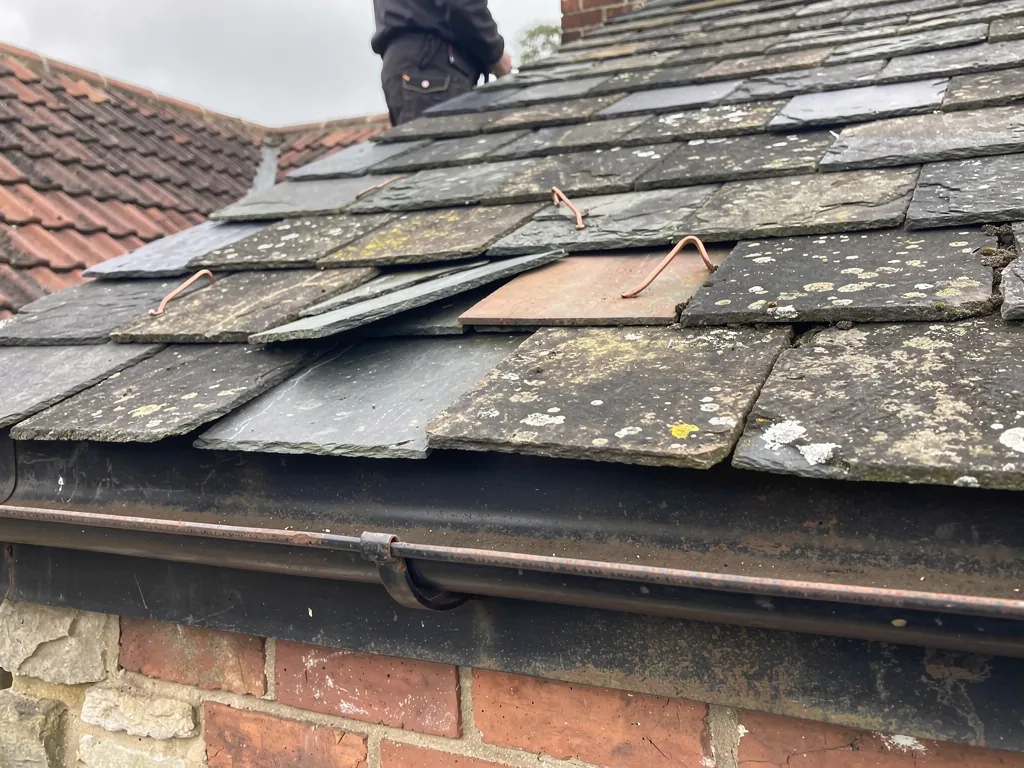
Usually one of three things: refitting a slipped slate with a clip or hook, laying a patch of lead or a flashing tape over a split, or sheeting a section of the roof while the permanent repair is planned. We tell you which one we have done and what it is for, so a temporary repair never gets mistaken for a finished one. Where a repair has not worked, the page on a roof that is still leaking covers what to check next.
What can safely wait until spring
Plenty of roof work is a better job in April than in January, and waiting costs nothing so long as the roof is watertight in the meantime.
- Repointing chimneys and verges where the mortar is tired but the stack is not leaking.
- Moss and lichen removal, which does little harm over a few more weeks and is easier when the surface is dry.
- Replacing a flat roof covering that is ageing but holding. Adhered membranes and felt need a dry deck and some warmth to lay well.
- Re-bedding a full run of ridge tiles that are sound but showing worn bedding.
- Upgrades and improvements that are not stopping water, such as new roof windows, extra ventilation or insulation changes.
How do I know a leak is small enough to wait?
You do not, without looking. A small stain can be a few drops from a condensation problem or the first sign of a failing flashing. If you are unsure, a survey with photographs tells you which, and a note on what to watch for lets you monitor it safely. Our answer on whether a small roof leak can wait sets out the questions we ask.
Will a temporary repair hold all winter?
A well-fitted temporary repair should hold for the season, but it is a bridge, not a destination. We record what we have done so we can come back and replace it with a permanent repair when the conditions suit, and the work we do carries a 10-year workmanship guarantee in writing.
Terraces, listed roofs and shared stacks in a cold spell
The buildings that most need winter care are often the ones that are hardest to repair in it. A terrace has shared chimney stacks and valleys where a defect on one side leaks into the house next door. Our guide to terraced house roof repairs explains how to handle that conversation with a neighbour, and winter is a good moment to start it because a temporary make-safe can be agreed quickly while the permanent work waits.
A listed roof raises a different problem: consent. Listed building consent is required for work that affects the building's special interest, and whether a like-for-like repair counts depends on its scale. That process takes time and cannot be hurried by a leak, so a temporary measure that does not alter the fabric often buys the time needed. The page on listed roof repairs goes through what to raise with the council before work starts.
Who should I tell if the repair affects a neighbour?
Anyone whose roof, wall or chimney the work touches. A short conversation before scaffolding goes up avoids misunderstandings about access and cost. Where a party wall is involved, the Party Wall etc. Act 1996 may apply, and we would rather you check before work begins than after.
What happens after a survey in winter?
We photograph the roof, explain what we found in plain words and send a written quote. If the permanent repair is better left until spring, the quote says so, and we agree a plan for the gap. You can reach us on 01793 626096, over WhatsApp, or via the form on this page.