
Most roof repairs start with something small that was noticed in time: a darker patch above the bedroom window, a slate on the path, a gutter that keeps overflowing. The signs below are the ones we look for first, and you can spot most of them without leaving the ground. None of them says the roof as a whole is finished. Nearly always they point to one detail that wants attention.
That distinction matters. A repair deals with one fault on a roof whose other parts are still sound. Replacement raises different questions with warning signs of their own, and those belong on the replacement pages. Here we stay with early signs and small fixes. Please stay on the ground while you look. A pair of binoculars, the zoom on your phone and a torch for the loft will tell you plenty without a ladder.

Marks and damp inside the house
The first sign is often indoors. A brown or yellowish ring on a ceiling, a patch of bubbling paint, wallpaper lifting at a seam or a faint musty smell in an upstairs room can all point to water getting in from above.
Which stains matter most?
Stains with a defined edge and a darker rim are usually from water that has dried and returned, which suggests a repeated leak. Stains that grow after rain point to the roof. Stains that appear in cold, dry weather are more often condensation or plumbing. Our page on water stains on the ceiling sorts out which cause is which.
Does the position tell you anything?
It does, though less than people hope. Water travels along rafters, felt and plasterboard before it drops, so the mark may appear a good distance from the actual gap. A patch beside a chimney breast hints at the stack or its flashing. One on a top-floor ceiling next to an outside wall suggests a flashing or a gutter. One near a bathroom could still be plumbing.
Do not ignore a stain because it is dry now. Damp that comes and goes is still damp, and timber that is wetted and dried repeatedly rots. Photograph it with a date, mark the edge in pencil and see whether it spreads over the next wet spell. That record is useful at the survey, and it helps separate a fresh leak from an old one that was fixed.
Where water is dripping near a light fitting or socket, turn that circuit off at the consumer unit and bring in an electrician as well as a roofer. Wiring and water must be kept apart.
What shows from the garden or the street
Stand back across the road or at the end of the garden and look along each slope. Roofs are made of rows, so a fault shows as a break in a pattern.
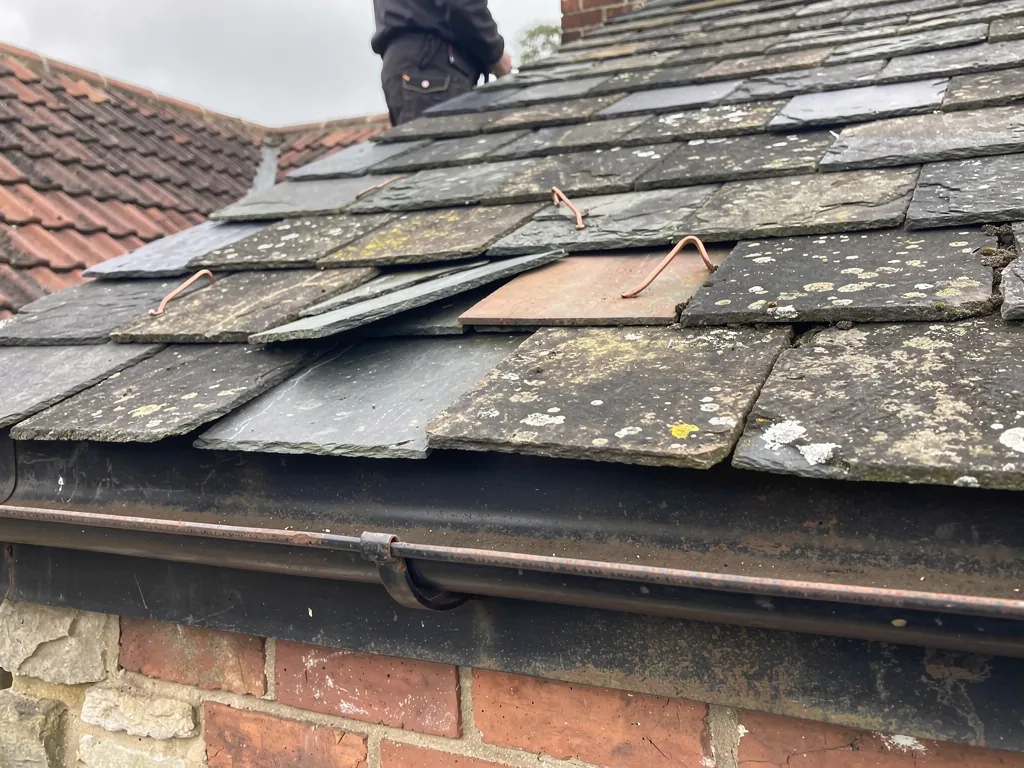
- Gaps and slipped slates. A visible hole in a row, or a slate that has dropped below its neighbours, lets water onto the underlay or, on older houses without one, straight into the roof space.
- Cracked or chipped tiles. Hairline cracks open wider with frost. Fragments turning up in the borders or the gutter give the game away.
- Tilted or lifting ridge tiles. The ridge is the capped line at the very top where the slopes meet. A wavy line, or missing mortar beneath it, means the tiles are loose.
- Lifted or cracked lead. Look for a silver-grey strip along a wall or around a chimney that has curled away or split.
- Debris in valleys. Valleys are the channels formed where two slopes join, and when one clogs, water can spill over its edge.
- A dark patch on a chimney. Crumbling pointing, a lean in the stack or missing cement around the pots are all early warnings.
Few of these cause a leak the day they appear, which is exactly why they are worth fixing early, before the next spell of wet weather. Our page on the most common roof repairs shows what each one involves and how long it tends to take.
Is moss on the roof a sign?
It is a sign that a roof is damp and shaded, often on the north-facing slope or under trees, and a heavy coat of moss keeps the covering wet. It does not always mean damage, but it can lift tiles and block valleys, and it is worth watching. Our roof cleaning and moss removal page covers when to clear it and when to leave well alone.
Gutter and roofline clues
What happens at the eaves says more than you might expect. A gutter that overflows in ordinary rain, drips at a joint or has sagged between brackets is moving water in the wrong place, and the water often ends up behind the fascia and in the top of the wall.
Look for these signs:
- Green or black staining on the wall under a gutter joint.
- Grit in the gutter that looks like sand. On concrete tiles it can be the surface wearing away; on a slate roof it can be fragments of slate.
- Plants or seedlings growing in the gutter, which show it holds water and soil.
- Peeling paint or soft wood on the fascia and soffit, the boards under and across the eaves.
- Gaps where the fascia meets the wall, which birds and insects use.
Can a gutter fault look like a roof leak?
Yes. Water that spills behind a gutter wets the timber the rafters sit on and the head of the inner wall, and the mark it leaves on an upstairs ceiling looks just like a roof leak. The two are often confused, which is why the survey looks at both. If you see an overflow in heavy rain, our answer on why a roof leaks only in heavy rain goes through the wind-driven and blocked-channel causes.
Many gutter faults are quick to put right, and one caught early can spare a ceiling. Brackets that have loosened can be refixed, joints resealed, and a section that has dropped can be re-hung to its fall. Where the run is cast iron or old plastic that has gone brittle, replacement may make more sense, and the cost differs from a roof repair. The gutters and soffits service covers repairs and replacement if the run is beyond saving.
Signs on a flat roof
Flat roofs on extensions, garages and dormers show their age differently from pitched ones. They are less easy to see from the ground, so a look from an upstairs window or a safe vantage point is worth the effort.
What does ponding tell you?
Water that stays on the surface for days after rain, a sign known as ponding, means the roof is not draining properly. It may have too little fall, a sagging deck or a blocked outlet. Standing water searches out each tiny defect and expands as it freezes, so it deserves attention even while the ceiling underneath stays dry.
What else should you look for?
Look for blisters in the covering, splits and cracks along seams, gaps where the roof meets a wall, and a surface that has gone brittle or shows the layer beneath. Felt lifting at an edge, or pulled back from an upstand, gives water an easy way in. EPDM and GRP fail differently: EPDM tends to lose adhesion or tear at corners, and GRP can crack along movement lines or at poorly formed joints.
One patch can put a flat roof right, provided the deck underneath is sound. If the patches are numerous and the covering is tired, the survey will say so and explain what each option means. For the wider picture of what causes flat roofs to leak, see the usual causes of roof leaks.
Signs in the loft
Of all the places to check a roof, the loft is both the most useful and the simplest. Pick a dry day, take a torch, and look at the roof's underside and the insulation while disturbing as little as you can.
These are the warning signs:
- Daylight showing through the covering, which means a gap that water can follow.
- Dark tracks or staining on rafters, battens and the felt underlay.
- Damp or compacted insulation, particularly below a chimney, a valley or a roof window.
- Rusty nails or nail tips, which are sometimes visible on the underside of slates.
- A musty smell, mould or condensation on the roof's underside.
Leak or condensation?
Warm, moist air from the house meeting a cold roof can leave beads of water on the underlay and timbers even when the roof is sound. A leak shows after rain and clusters under a fault, whereas condensation appears in cold weather, spreads across a wide area and often follows cooking, bathing and drying clothes indoors. Both need dealing with, but with different fixes. It helps to note the weather and the time each time you see wet.
Should you touch what you find?
Do not walk on the ceiling joists unless you know how, since the plasterboard between them will not hold you. Look, photograph, and leave it. The photographs help us enormously, and we can usually tell from them which part of the roof to look at first.
After a storm, in winter, and when to ring
Weather is the best prompt for a check, and it costs nothing. After a gale or a hard frost, walk round the house and look up. Slates and tiles on the ground, a loose ridge, a dislodged flashing or a fallen aerial are all signs that the roof took a knock. A short check of the loft the next day can show whether anything got through.
A simple log helps whatever you find. Note the date, the weather, where you saw the sign and a photograph, and keep the entries in one place on your phone. A pattern, such as a stain that returns after every south-westerly or a gutter that overflows at the same joint, is far more useful to a roofer than a single memory of damp. If you rent, send the same record to your landlord, whose duties are set out in our guide to landlord roof repairs, and on a terrace, share it with the neighbour whose roof joins yours.
Winter makes small faults larger. Water gets into a crack, freezes and widens it, and the cycle repeats. That is why catching a fault in autumn is easier than fixing the consequences in February. Our guide to roof repairs in winter explains what can wait for spring and what cannot.
Is the building old or listed?
If so, take extra care before arranging any work. A listed house may need consent before even a modest repair, and so may some in a conservation area, and the materials usually have to match. We cover that in repairing a listed building roof.
When should you pick up the phone?
When you see water, a missing section of covering, a sagging line or daylight, do not wait for a second sign. Our survey brings photographs and a written quote that show the size of the job, and the advice is to repair only what the fault needs. For the time most jobs take, read how long a roof repair takes. Our roof maintenance checklist turns the signs above into a yearly walk round, and the roof repairs page explains how we deal with them.