
A roof does not ask for much attention. It asks for a little, regularly. The expensive repairs are usually the ones that began as a blocked gutter, a slipped slate or a crumbling joint that nobody noticed for a couple of winters. Looking costs nothing, and a pair of binoculars and a torch will do most of the work.
The checklist below is organised by season because the weather decides what is most likely to go wrong and when you can reasonably check it. Everything here is done with both feet on the ground, or in the loft. Climbing onto a pitched roof, reaching gutters from a ladder or walking a flat roof edge calls for proper access equipment and training. If you spot something in these checks that you do not understand, photograph it and send it to us through the form on the Skyline Swindon Roofing site, and we will tell you what it means.
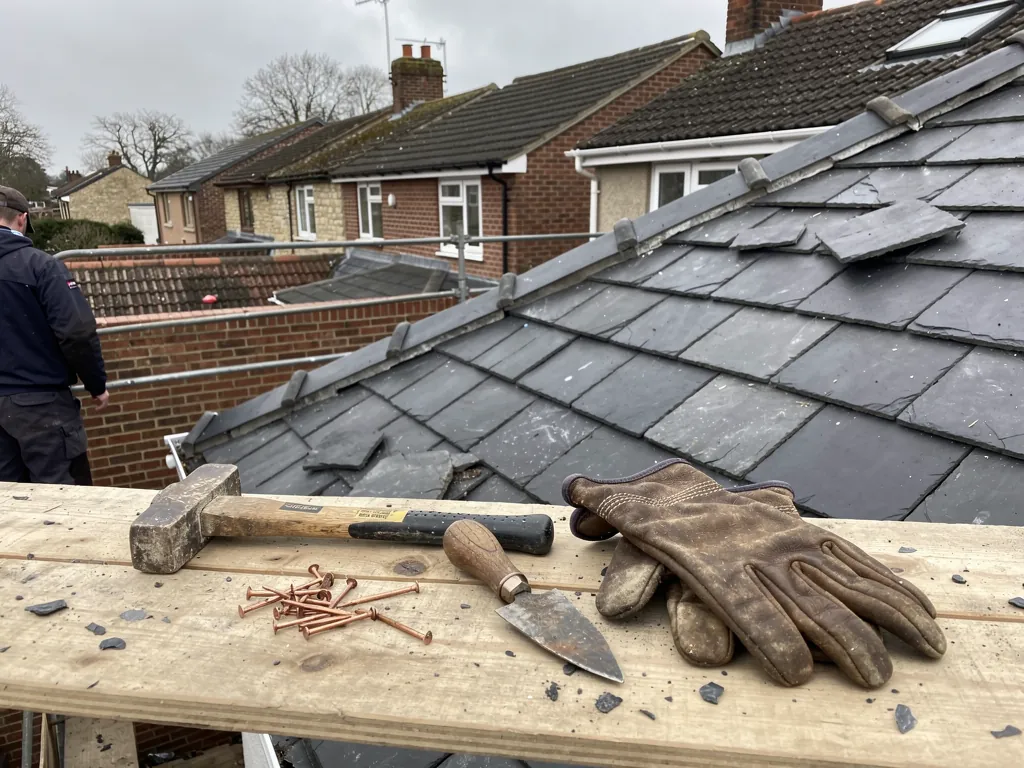
Before you start: safety and what you need
A few minutes of preparation make the checks more useful and keep you off the roof, where most of the avoidable accidents happen.
- Binoculars, or a phone camera zoomed in, to read slopes from across the street or an upstairs window.
- A torch for the loft, and a pair of gloves in case something sharp is hiding in the insulation.
- A notebook or a notes app, so you can compare this season with the last.
- A phone that can take close, dated photographs.
Stay on the ground or inside the house. A wet slate or a mossy concrete tile can be slick, and a fragile flat roof can give way. If you must use a ladder to look at a low gutter, have someone foot it and never lean out. Anything higher than a single storey belongs to a professional.
One health note matters for older houses. For a house built or refurbished before the year 2000 the HSE's rule of thumb is to treat asbestos as present, and external soffits are on its list of spots where asbestos insulating board can sit. So do not drill, sand or break up soffit boards, roof sheets or old garage panels while you tidy. If a board looks damaged, leave it alone and ask for advice.
Spring: check what the winter did
Spring is the time to find out what the cold months left behind. Frost opens small cracks, wind lifts loose parts and wet leaves leave blockages in the gutters.
What should I look for from the garden?
Stand back far enough to see each slope in turn and scan for slates and tiles that have slipped, cracked or gone. A slate that has slid down shows as a tongue of paler surface and a gap above it. Look along the ridge for a line that has dropped or tiles that have shifted, and at the verge for crumbling mortar. Note any bright patches on the ground where debris has fallen.
What about the loft?
Torch in hand, check the roof's inner face for chinks of daylight, damp patches on timber, drips landing on insulation and any musty smell. Check the corners and the areas around the chimney, soil pipe and any roof window. Water marks that look dark and dry may be old; fresh, cool or glistening ones are current.
Spring is also a good moment for the chimney stack. Inspect the pointing, the flaunching (the sloped mortar cap round the pots) and the lead where the stack leaves the slope. Our chimney leaks page explains what failing joints look like.
Summer: the best time for a close look
Dry weather and long evenings suit the checks that need a clear view. Summer is also when roofers and scaffolders have the most room in their diaries, so a repair noticed now can be booked without the rush that follows a storm.
Walk round and check the roofline: fascias, soffits and bargeboards. These timber or plastic parts take a lot of weather. MyBuilder advises an inspection of fascias and soffits every five years, with replacement typically needed at 10 to 20 years depending on material and weather. Look for peeling paint, soft or split timber, sagging boards and gaps where the board meets the wall.
This is also the moment to look at flat roofs from an upstairs window. After several days of dry weather, standing water should have gone. Water still sitting in a pool tells you the fall is poor or the deck has dipped. The guidance cited for flat roofs gives a finished minimum fall of 1:80, with 1:40 as the design target to allow for tolerances, so a puddle that stays for days deserves a roofer's opinion.
Check moss and lichen as well. A thin green film does little harm. Deep cushions soak up rain and sit wet against the covering, and they can choke valleys and gutters. On cost, MyBuilder's cleaning guide puts a moss removal job at around £300 and upwards, and it warns that a pressure washer can harm delicate tiles. Our roof cleaning and moss removal page covers the methods.

Autumn: gutters, valleys and getting ready
If you do one seasonal job well, make it this one. Falling leaves, seed pods and the odd lost ball collect in gutters, downpipe tops and valleys, and the first long wet spell then finds them.
Look for gutters that overflow in rain, because that usually points to a blockage or a bracket that has dropped. Manufacturers such as Brett Martin recommend gutters be laid with a gentle fall towards the outlet, and FloPlast quotes a fall of 1:350 for its system, so a run that holds water along its length has probably sagged. Look for stains on the wall below the joints, green growth in the gutter and rusting on cast-iron sections.
Downpipes matter just as much. Check that water leaves each one freely and runs away from the wall. A downpipe that discharges at the base of a wall can soak the foundations, which is a damp problem rather than a roof one but starts at the roof.
Do I need to clear valleys and flat-roof outlets?
Valleys and outlets should be clear of leaves and silt. Debris in a valley pushes water over the lining onto the timbers, and a clogged flat-roof outlet turns the surface into a pond. Clearing them by hand is a job for someone with safe access, so if you cannot reach it from a window, book it. Our guide to gutter cleaning gives the detail.
Autumn is also the time to ask a roofer to look at anything you noted in spring and summer, before the weather turns. Bats and nesting birds are protected animals, so if either is living in your roof space, keep clear and ask for advice.
Winter: watch and record, do not climb
Winter is the season for observing, not working. Wet and frosty surfaces are the most dangerous, and repairs in poor conditions are rarely the best repairs. What you can do from indoors and the ground is valuable.
During or just after heavy rain, check ceilings and the tops of walls for new marks, and look in the loft when it is dry outside to see whether any drips are from the roof or from condensation. A wet loft in cold, dry weather points to warm air condensing on cold surfaces rather than a leak, often because ventilation has been blocked by insulation. Marley's guidance on cold-roof ventilation, drawing on BS 5250, describes continuous ventilation at the eaves, so make sure loft insulation has not been pushed hard into the eaves.
What do I do once a storm or snow has passed?
Walk round the house once the wind has dropped and look for tiles, ridge sections or flashing on the ground, and for sagging gutters or displaced downpipes. Take photographs from the ground, and keep out from under anything that looks loose. Our guide to checks after a storm goes through what to look for, and our approach to leaks is to make a leaking roof safe first. Do not go up onto snow or ice to clear it.
If you have to arrange a temporary cover, keep receipts and speak to your insurer before ordering anything beyond a make-safe.
Year-round checks: chimneys, flashings, flat roofs and lead
Some parts of the roof fail on their own schedule rather than the calendar's, so they deserve a look each season.
- Flashings. These are the lead or mortar seals at the joint between a roof and a wall or chimney. Check for lifted edges, cracks along bends and gaps in the mortar line that anchors the top edge.
- Chimneys. Check for leaning, loose pots, a crumbling cap, vegetation and white salts on the brick.
- Ridge and hip tiles. Under BS 5534:2014 mortar on its own no longer holds these, and they are fixed mechanically too. Older bedding that has cracked or shrunk should be checked by a roofer.
- Flat roofs. Look for blisters, splits, lifted edges and debris around outlets. Less gives torch-on felt 10 to 20 years, so a felt roof of that age with several patches on it may be close to replacement.
- Roof windows and vents. Look for staining or condensation around frames and for gaps in the flashing kit.
Note dates and photographs each time. Over a few years the record shows how fast something is changing, which helps you decide between a repair now and a planned replacement later. In a heritage street, keep in mind that some work needs consent first; Railway Village roofs explains how that works in Swindon's conservation areas.
What to leave to a roofer, and what it may cost
Your checks produce a short list. Some items you can handle, such as clearing a gutter from a safe low position or replacing a missing downpipe bracket at ground level. Others need professional access and tools.
Hand these to a roofer.
- Any slipped or missing slate or tile, because the repair involves working on the slope.
- Lead flashing, valleys and chimney work.
- Ridge and verge repairs or re-bedding.
- Flat roof splits, blisters and ponding.
- Anything you suspect may contain asbestos.
- Roof windows that leak or have lost their seal.
A sensible way to start is a survey. We photograph your own roof and send a written quote, with only the work the fault needs. If you want to know how a roofer's time is usually priced, our answer on the roofer day rate explains it.
For wider context, a walk round the town with an eye on roofs is a good way to learn what different coverings look like as they age; our guide to Swindon's attractions suggests places to try. If you are buying, roof checks before you exchange uses the same habits. Our workmanship carries a 10-year guarantee in writing.