
A gutter has one task: catch the rain that runs off the roof and walk it to a downpipe. Leaves, moss washed off the tiles, grit from the roof surface and the occasional ball all settle in the channel, and once enough has built up the water has nowhere to go. It tops over the front edge, runs down the wall, or backs up behind the fascia where nobody sees it until the paint blisters.
Cleaning is therefore maintenance, not a luxury, and it is one of the least expensive ways to protect the roofline. But the method matters, and so does what gets noticed while the job is being done. A gutter cleaned from a ladder by someone who looks at nothing else clears the debris. A gutter cleaned by someone who also checks brackets, joints and the roof edge catches the next problem early. For repair advice see leaking gutters, and for the wider service start at gutters, soffits and fascias.
What builds up in a gutter and why it matters
The material in a gutter is rarely just leaves. Tile surfaces shed fine grit as they weather, and it washes straight down into the channel. Moss grows in the damp corners of a roof, dries out in summer and tumbles down in clumps. Birds drop twigs and nesting material. Seeds from sycamore and ash land in the channel and sprout there. Under a tree, the whole lot decomposes into a dark, wet compost that grows weeds with real roots.
Each of those does damage in its own way. A full channel is much heavier than an empty one, and plastic brackets bend under the load while old cast iron can pull the whole run away from the fascia. Standing water in a metal gutter corrodes it from the inside. Frozen debris in winter can split a plastic joint. And water that overflows near the wall can soak the brickwork, which is slow to dry on a north-facing elevation and eventually shows as green staining or damp patches indoors.
What an overflow tells you
When water pours over the front lip of a gutter in the middle of a run, the usual cause is a blockage at the outlet or a stretch that has sagged. When it drips from a joint, the seal has gone, and cleaning alone will not stop it. When it runs behind the gutter rather than over it, the fall or the fascia needs attention. Telling those apart before anyone climbs up saves a wasted visit.
Cleaning methods compared
There are three ways gutters are cleaned on ordinary houses, and each has a place.
| Method | How it works | Good for | Limits |
|---|---|---|---|
| Hand clearing from ladders or a tower | Debris is scooped out with a trowel or gloved hand and bagged; the channel is then flushed with water | Heavy build-up, plants, silt, close inspection of every joint | Slower; needs safe access at the right height |
| Vacuum poles from the ground | A suction head on an extension pole draws loose debris into a bin | Light leaf fall on low roofs, regular upkeep | Struggles with wet compost, moss lumps and twigs; hard to see joints |
| Flushing and rodding the downpipe | Water or a rod clears the pipe and outlet once the channel is empty | Slow-draining outlets and blocked pipes | Pipe blockages deeper in the drain are a separate job |
Poles from the ground are tempting because they avoid ladders, and on a bungalow with light leaf fall they are a perfectly reasonable job. On a two-storey house they work at the limit of their reach, the head sits at an awkward angle, and the person holding the pole cannot see what is happening in the channel. They clear the top layer and leave the compacted layer beneath.
What about access towers?
For a long run, a porch roof below the gutter or a house with a steep drive, a low scaffold tower can be a better answer than a ladder. It gives a level platform, keeps both hands free and spares the gutter from a leaning load. It also lets whoever is working look straight along the channel, so joints, brackets and the fascia face are all in view at arm's length. That extra setup adds to the visit, and it is one of the things the written quote reflects when access is awkward.
How often to clean your gutters
There is no single schedule that suits every house, because the amount of debris depends on what surrounds the roof. A sensible baseline is to clear the gutters once a year, in late autumn once most of the leaves are down. A house with trees overhanging the roof, or beside a wooded lane, benefits from a second visit in spring, after seeds and catkins have dropped. A house with no trees nearby and well-kept tiles may be fine with a look every year and a clear-out when needed.
Certain things shorten the interval. Roofs with heavy moss growth send much of it into the gutters, so cleaning the roof surface and the gutters together makes sense. A flat-roofed garage or extension drains into a small gutter or hopper that fills quickly, especially under a tree. Shallow plastic half-round gutters hold less before they overflow than deep square ones. And a gutter with a very slight fall holds more standing debris, so it clogs sooner than one that drains cleanly.
Should you wait until it overflows?
Waiting for the first overflow means the water has already been going where it should not. The first few hours of heavy rain are when it does the most harm, because the fascia and wall have been dry. A yearly check in dry weather is easier, safer and cheaper than a wet scramble during a storm.
The checks that should happen while someone is up there
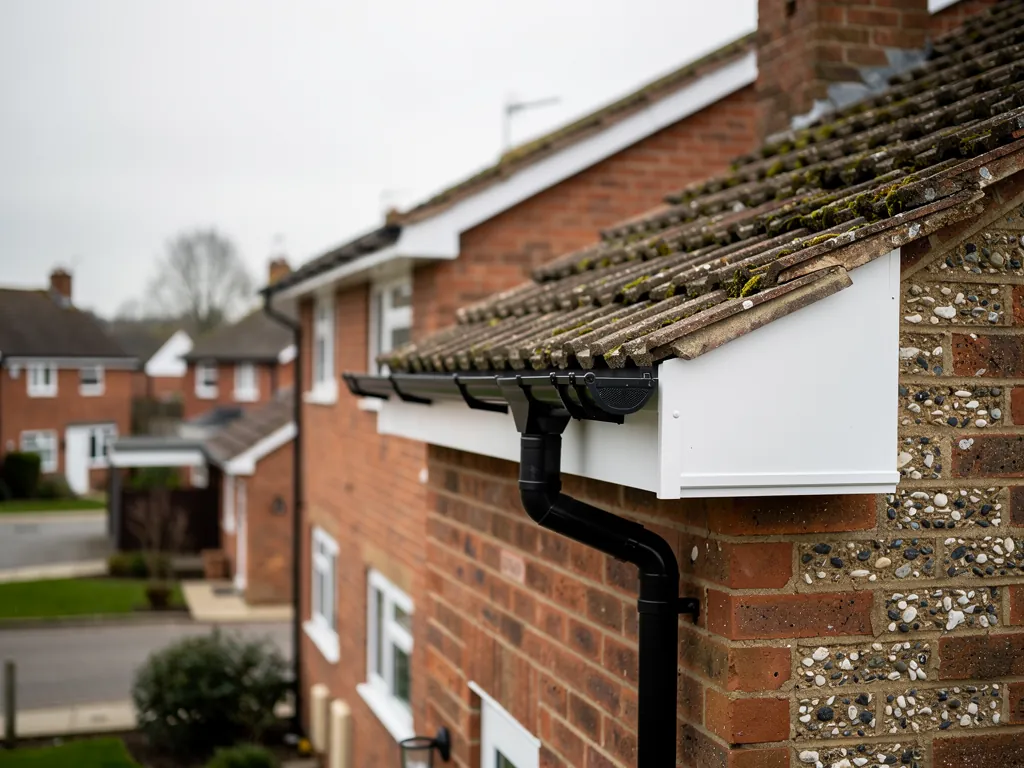
This is where a good visit differs from a quick scoop. With the channel empty and the roofline right in front of you, a lot becomes visible you would never spot from the lawn. We look at the following on every gutter job.
- Brackets and clips. Are they all present, tight and in line? Manufacturers recommend a bracket roughly every 500 mm to 900 mm depending on the system, so a visible gap is a sagging gutter waiting to happen.
- Joints and unions. Rubber seals perish and sealant dries out. Marks on the wall below a joint show years of slow dripping.
- Fall. Pour a bucket of water in at the far end and watch where it pools. Gutters should slope gently towards the outlet. Our page on gutter fall explains the figures.
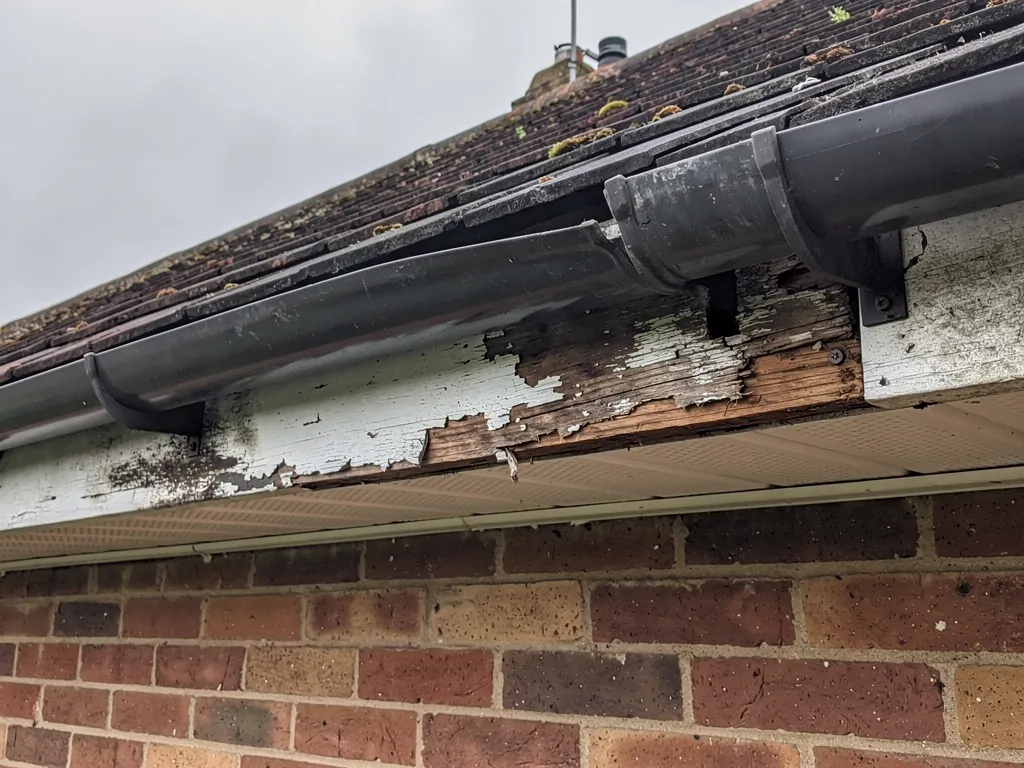
- The fascia behind. Press a screwdriver into the board behind the bracket. Soft timber, flaking paint or green staining mean water has been getting in.
- The roof edge. The bottom row of slates or tiles should overhang the gutter so water falls into it. A slipped bottom course drops water behind the channel.
- End caps and stop ends. They split and drip, and tend to give up early on plastic systems.
A bucket of water poured into the gutter finds problems that dry debris hides. If it leaks, pools or runs the wrong way, the channel needs repair, not just cleaning.
Downpipes, outlets and the drain at the bottom
Cleaning the channel only solves half the problem if the water cannot leave the system at the other end. Outlets are the narrowest point, and a lump of compost or a tennis ball wedges there. Below the outlet, a downpipe can be blocked by a nest, silt washed off the roof or a compacted plug of leaf mould, and the water it should be carrying stays in the gutter.
Once the gutter is clear, running a hose into the outlet shows whether the pipe passes water freely. If it does not, the pipe has to be rodded or taken apart at a joint. Beyond the pipe, the gully or drain at ground level can be silted up as well, so water backs up the downpipe from underneath. That is a drainage problem rather than a roofing one, but it looks identical from the outside, which is why we trace the flow all the way down. Our guide to downpipes covers materials, sizes and connections.
Shared downpipes on terraces
On older terraces a single downpipe can serve two houses at a shared gutter junction. A blockage on one side backs water into the other, which is worth remembering before assuming it is your own channel at fault.
Cast iron and older systems need a different touch
A cast iron gutter is heavy, brittle and sometimes painted many times over. Scraping it hard with a metal tool can break the bolted joints or strip off paint and expose bare iron to the weather. Plastic scoops are gentler. Inside a cast iron channel, a build-up of old debris often hides pitting, and a fresh coat of bitumen paint on the inside can extend its life if the metal is still sound. If you have cast iron, our guide to cast iron gutters describes how to look after it.
Aluminium and plastic gutters can be damaged in other ways. Aluminium dents, so a ladder should never rest on it. Plastic gutters can be pushed off their clips by a ladder leaning on the front edge, which is why stand-off brackets exist. Clay or concrete tiles overhanging the edge can be cracked by careless work. A proper cleaner works round all of this by setting the ladder on stabilisers or using a tower and treating the roofline as something that must survive the visit.
What about gutter guards?
Brush or mesh guards reduce how much debris gets in, and they suit some houses. They do not remove the need to look at the system. Fine silt and moss still get through, and a guard can hide a developing problem. We discuss the trade-offs in our guide to gutter guards.
Doing it yourself, and when to hand it over
Cleaning gutters on a single-storey extension or a bungalow from a stable ladder is something many householders manage. The risk rises sharply on a two-storey house. Ladder falls are a well-known cause of injury, and a gutter job is exactly the sort of task where someone leans out sideways at the top of a ladder.
If you do it yourself, use a ladder tall enough to stand with three rungs above the working height, with a stabiliser or stand-off so it does not rest on the gutter. Ask someone to foot it, check the ground is firm and level, and never lean out beyond the width of your hips. Wear gloves, because gutter muck can contain bird droppings and sharp debris. Avoid working near overhead cables, and do not climb onto the roof.
If nests are in the channel, birds nesting at the time are protected, so leave the nest and come back once the young have gone.
Hand the job over when the roof is high, the eaves are over a conservatory or porch, the gutters are cast iron, or you notice leaks, sagging or rotten timber. Leaks and storm damage get priority from us. Every gutter visit ends with a written note of what we found, plus photographs of any problem areas. Where cleaning shows repair is needed, the written quote follows.