
Walk down an older street in Swindon, Highworth or Wroughton and you will see them: half-round or ogee gutters in dark iron, sitting on brackets fixed straight into the rafter ends. Many have been there for the best part of a century or more, and plenty still work.
They also fail in ways plastic does not. Iron rusts from the inside, joints weep, and the weight of a full gutter pulls on brackets that were never designed for it. This guide explains what you are looking at, how the system goes wrong, what a repair involves, what replacement options exist and what to check if your property is listed or sits in a conservation area. The full picture sits in our gutters, soffits and fascias work, and the materials comparison is in our guide to gutter materials.

What a cast iron system is made of
Cast iron guttering comes in lengths of a metre or two, with a socket at one end so each length overlaps the next. A bolt through the joint pulls the two halves together, with a bed of sealant or old-fashioned putty between them to make it watertight. Fittings such as stop ends, angles and outlets are cast to match. The common profiles are half-round, with a plain curved section, and ogee, which has a flat back and a moulded front shaped like a letter S.
Brackets are different from plastic ones. Many Victorian and Edwardian systems have the gutter held on cast or wrought brackets screwed straight into the rafter feet, often with no fascia board at all, because the roof was built with exposed rafter ends. Houses with a fascia may have the gutter fixed through the face of it with long screws or on strong brackets.
The gutter drains into a cast iron downpipe through an outlet, and the downpipe runs to a shoe or a hopper at the foot. Cast iron downpipes are fixed by ears that bolt to the wall, and rust can open the joints in these too. Our guide to downpipes and drains covers the lower half of the system.
Why is cast iron so heavy?
The metal is thick, brittle and dense, which is why it lasts, and why a full length holds a lot of water and sludge. A blocked cast iron gutter is far heavier than a blocked plastic one.
Can I tell cast iron from cast aluminium?
A magnet sticks to iron and not to aluminium. A scrape on the back shows grey-black metal for iron and bright silver for aluminium.
How old iron guttering fails
Cast iron seldom fails all at once. It declines in stages, and the stage tells you what the fix will be.
The first problem is rust, and it starts on the inside. Rain, leaf mould and sediment sit in the bottom of the channel and attack the metal where the paint has worn away. The outside can look sound while the base of the gutter flakes through. You find out when a patch of the gutter drips or a section crumbles when you tap it.
Joints go next. The sealant between lengths dries out and cracks with movement, and the bolts rust and seize. A weeping joint leaves a green or dark stain on the wall below and, if left, soaks the masonry. Often the iron is fine and only the joint needs remaking.
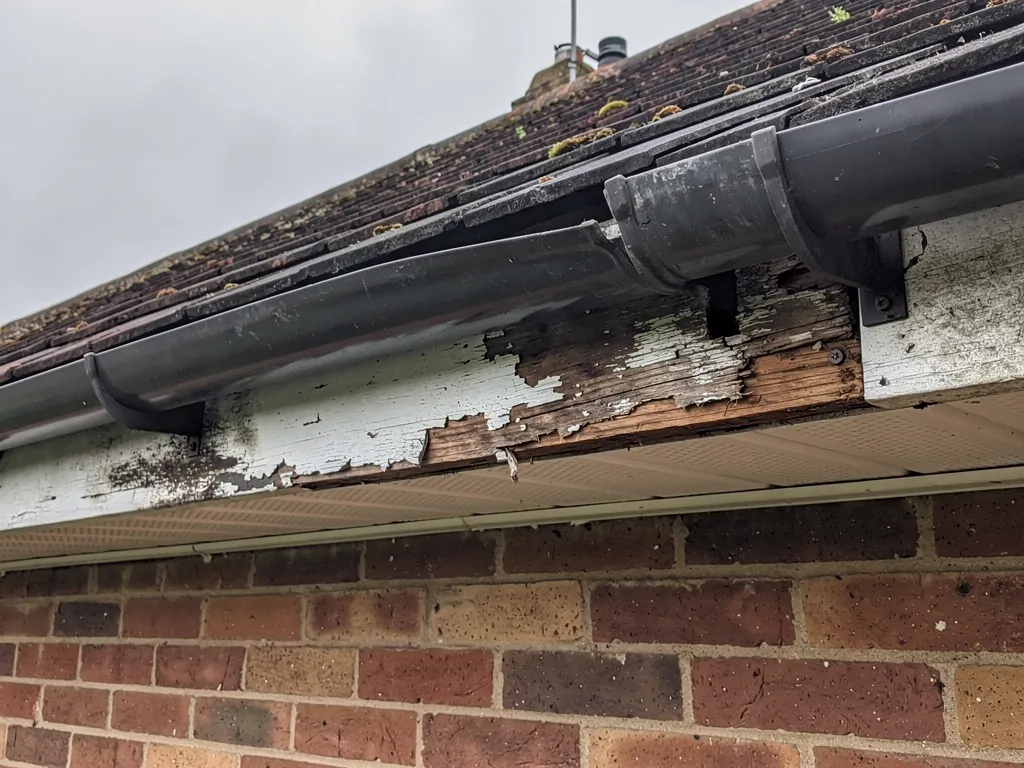
Brackets and fixings fail from weight and rot. If the rafter ends or the fascia behind are decayed, screws lose their grip and the gutter sags. A run that has dropped at one end holds water and spills over the lip in the wrong place.
A tap with the handle of a screwdriver tells you plenty. A clear ring means sound iron. A dull thud or a piece that gives way means the metal has gone.
Is a crack a reason to replace the whole run?
Not always. Cast iron is brittle, so a crack may be from a knock, a ladder or frost in a blocked section. A single cracked length can often be swapped for a reclaimed or new one.
What causes the green stains below a joint?
Water escaping from the joint and running down the wall. It is a sign that the seal has failed, not necessarily that the gutter has.
Repairing old cast iron gutters
If the metal is basically sound, repair is often the right route. It keeps the original material, which suits an older house, and it usually costs less than replacement. The work follows a pattern.
The gutter is cleaned out first, because you cannot judge a rusty channel until the sediment is gone. Loose rust and flaking paint come off with a wire brush or scraper. Old paint on a house of this age may contain lead, so we avoid dry sanding and keep the dust under control. Bare metal is treated with a rust converter or primed straight away, then painted inside with a bitumen-based paint and outside with a suitable exterior coating.
Leaking joints are undone, cleaned, resealed with new sealant and bolted up again. Seized bolts are cut and replaced with new galvanised or stainless ones. Short holes can be patched, though a patch on a heavily corroded base is only a delay.
Brackets are checked for firmness and refixed or replaced. The fall is adjusted so water runs to the outlet. Manufacturers of modern systems typically recommend a gentle fall, roughly 1:600 to 1:350 depending on the system, and the same gentle gradient suits iron.
How long does a repaired gutter last?
It turns on the amount of sound metal left and how well the inside is protected. A well-prepared and painted gutter will often give many more years of service, but we do not promise a figure. Yearly cleaning is what keeps it going.
Is it worth repairing if several sections have rusted through?
When the base has corroded along most of the run, replacing those lengths is the sounder answer. Our survey photographs show which sections are which, and the written quote follows.
When to replace, and what with
Replace when holes run along most of the base, when several lengths are cracked, when brackets will not hold in the rafters, or when repeated joint repairs keep failing. The question then is what goes in its place.
New cast iron is still made and is the closest like-for-like match. It is heavy, so it needs good fixings and sound timber to carry it. It is also the usual choice on listed buildings. Reclaimed lengths are sometimes used for individual sections, though quality varies, and you need to check there are no cracks along the back.
Cast aluminium is a popular alternative. It is lighter, does not rust, and can be cast in the same half-round and ogee profiles with decorative brackets. It looks like iron once painted and is easier to fit, which matters on a high gable. Whether it is acceptable depends on the building, and a conservation officer may prefer iron on a listed house.
Plastic lookalikes exist, but their profiles are thinner and the surface rarely convinces up close. They work as a budget route on unprotected houses where the profile matches what was there. Our guide to gutter materials compares them in detail.
Will a different profile look wrong?
It can. A half-round gutter on a house that had an ogee changes the line of the eaves. We match the profile unless there is a reason not to, and our survey notes record what is there.
What does replacement cost?
MyBuilder's guide updated 21/08/2026 gives £30 to £70 per metre for gutter replacement generally. Cast iron sits on its own terms, and the price depends on length, height, brackets and fascia condition. The figure for your house comes in the written quote after survey.
Brackets, fascia boards and the timber behind
Heavy guttering stands or falls on what carries it. This is where many repairs go wrong. A cast iron gutter that has dropped is usually telling you the timber has let go.
On houses with exposed rafter ends the gutter brackets are screwed into the sides of the rafter feet. Those ends sit in the weather and can rot, especially where an old leaking joint has been wetting them for years. Where a fascia exists, the board needs to be strong enough to hold the weight, and rot in the fascia is a frequent reason a gutter pulls away.
If the timber is soft, we cut out the rotten section and splice in new wood, or replace the fascia where that is more sensible. A new iron gutter fixed to a weak board will not stay put, however good the metal. Bracket spacing matters too. Manufacturers of plastic systems quote a maximum of around 900 mm between supports on a straight run, with closer spacing in snowy areas; cast iron is far heavier and brackets are usually placed more closely.
Why does my gutter sag between brackets?
Because it is full of water and sludge, or because a bracket has loosened. Our answer on a sagging gutter goes into the causes.
Can fascia and gutters be done in one visit?
Yes, and it is usually sensible. The gutter comes off, the timber is dealt with, and the gutter goes back on or is replaced. One scaffold covers both.
Paint and maintenance
Cast iron rewards a bit of routine care. Left alone, it corrodes slowly from the inside out. Looked after, it outlasts most modern alternatives.
Clean the channel at least once a year and again after autumn leaf fall. Sediment holds water, and wet sediment eats the paint. Our guide to gutter cleaning explains how to do it safely and what to check as you go.
Repaint when the finish starts to fail rather than waiting for rust to appear. Outside, use a primer suited to iron followed by exterior gloss or an iron-specific coating. Inside, bitumen paint gives a waterproof, flexible layer that resists the sediment. Do not paint over flaking rust or a wet surface, since the paint will lift again within a season.
Look at the joints each year. A joint that is weeping now will be leaking properly next winter. Our guide to leaking gutter joints covers the sealing process.
How often should cast iron gutters be repainted?
There is no fixed interval. Exposure, aspect and prep all matter. Check the finish every year and renew it when it dulls, chalks or flakes.
Listed buildings, conservation areas and Article 4 directions
Old iron gutters are often part of what makes a house look right. That is why they come into the planning system. Swapping guttering for the same thing does not normally need an application, as the elevation looks unchanged. A change of material or profile is a different matter.
Listed buildings are stricter. Listed building consent covers works that change what makes the building special, and a new gutter material or profile may fall under that. Conservation areas add their own controls, and an Article 4 direction withdraws specified permitted development rights across a defined area. Within Swindon, Bishopstone and the Railway Village carry them, and the Railway Village cottages were listed in 1970.
The practical advice is simple. If the house has a heritage designation, put the question to your council's planning team before you alter the material, profile or colour. Swindon Borough Council covers the borough and neighbouring councils cover their own patches. Keep photographs of what is there now. Our guide to roofline work in conservation areas covers the wider roofline.
Do I have to keep cast iron on a listed house?
Often you will be expected to repair or match it. That is a decision for the council, not us, so ask before ordering anything.
What about a house that is old but not listed?
You have more freedom, though the street may still look best with iron or a close match. We can talk through the options on the survey.