
Guttering is rarely the first thing anyone notices about an old house, which is exactly why it matters in a conservation area. A cast iron half-round gutter on a painted timber fascia looks quite different from a square-line plastic run on a white board, and a whole terrace of the second kind erodes the character that led the council to designate the street in the first place.
Swindon has plenty of designated streets. The council's conservation areas page lists 27 entries, from Old Town and the Railway Village to Wroughton, Highworth and Bishopstone, and two of them, Bishopstone and the Railway Village, carry Article 4 directions. This guide explains what matching materials means in practice and which rules can apply. Treat it as general guidance: for your own address, take it to the council's planning officers before you place an order. For ordinary prices, see our gutter replacement cost guide.
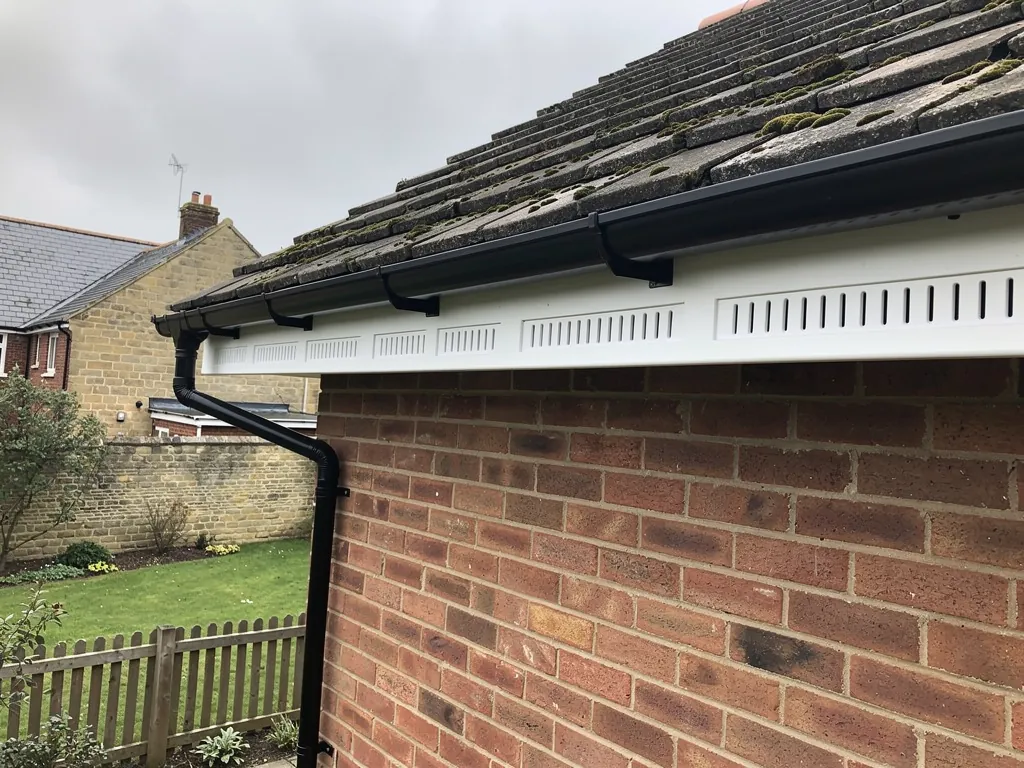
What matching the roofline actually means
Matching is about three things: the material, the profile and the finish. The material is the easy part to describe. On a Victorian or Edwardian terrace it is usually cast iron guttering and downpipes, with timber fascias and soffits. Cast aluminium is made in profiles that copy cast iron, and it is a common way of keeping the look with less weight and less rust.
The profile is the cross-section of the gutter. Half-round and ogee (the S-shaped profile with a moulded front) look quite different on the wall, and the council will usually want the same one back. A deep, boxy plastic profile reads as modern even when painted black.
The finish includes colour, sheen and detail: painted black or a traditional dark tone, rather than a white or woodgrain plastic. Brackets matter too. Rise-and-fall brackets, rafter-fixed brackets and fascia brackets all sit differently, and the original method may be part of the character.
Does like-for-like always mean the same material?
Not necessarily. Like-for-like means the same appearance, and the council decides how closely it needs to match. On some houses a profile that looks the same in a different material is accepted; on others, particularly listed buildings, the original material is expected.
Our gutter replacement cost guide shows how the price moves with material, and the survey photographs record the existing profile so the new run can follow it.
Which rules can apply to a gutter swap
Ordinary repair is not usually development. Maintenance, improvement or alteration that leaves the outside looking materially the same is carved out of planning control by section 55 of the 1990 planning Act. Swapping a gutter for an identical one, or mending a section, normally fits that.
Three things can change the picture. The first is a listed building. A listed building needs listed building consent for works that touch its special interest, and replacing original cast iron guttering with modern plastic can do just that. Carrying out such works without consent is an offence under the 1990 listed buildings legislation. The second is an Article 4 direction, which removes permitted development rights that would otherwise apply, so work that is normally free of control may need an application. The third is a planning condition on an earlier permission.
Is a conservation area itself enough to need permission?
No. Conservation area status alone does not stop like-for-like repairs, and it does not mean every change needs permission. What it does is raise the stakes for changes that alter appearance, and it can bring extra controls on tree work, demolition and publicity for applications.
Who do I ask?
The council's planning team for planning questions, and its conservation officer where the building is listed. For Swindon the planning pages are on swindon.gov.uk, and the council publishes an email address for conservation enquiries. Ask before work starts, not after: it is far easier to adjust an order than to replace a finished run.
The Railway Village and its Article 4 direction
The Railway Village is the group of streets built to house the Great Western Railway's workers, and it is the best-known protected roofline in Swindon. According to the council's appraisal, the cottages were statutorily listed in 1970, and the village became a conservation area in 1975. Between 2020 and 2021 it was folded into a larger Railway Conservation Area, after the village and the railway works areas were merged and extended.
An Article 4 direction was adopted for the village in 1980. The council's appraisal says it covers the residential streets in the village and Church Place, and that it brings into planning control things such as painting the exterior of a building, any extension or alteration, the erection of garden structures and the creation of vehicle crossovers. The leaflet that went with the 1980 direction also says most of the village is listed, so listed building consent is the usual route.
In the Railway Village, treat any change to the visible roofline, including a change of gutter colour or material, as a question for the council before you order.
What roofs does the village have?
The appraisal calls the roofs heavy-looking, steeply pitched and generally slate. Guttering beneath a slate slope reads as part of the same composition, which is one reason the council cares about it. The same document says dishes and aerials fixed to chimneys or roofs will be resisted.
Where can I get an answer?
The council's conservation page gives an email address for conservation enquiries, conservation@swindon.gov.uk. Send photographs of the existing guttering and say what you propose to fit. The answer tells you whether a householder can proceed, whether an application is needed or whether the work must follow the original specification.
Other protected streets around Swindon
The Railway Village is not the only place to take care. The council's conservation areas page also names Bishopstone, which has its own Article 4 direction, along with Swindon Old Town and its sub-areas, Wroughton, Highworth, Chiseldon, Liddington and Castle Eaton among others. Each has its own appraisal describing what makes the place distinctive, and those documents are written to help owners decide what is appropriate.
Further out, the same questions arise in the market towns we work in. Cirencester, Marlborough, Malmesbury and Faringdon each have their own councils with their own conservation teams, and a gutter replacement in one may be handled differently from the next. Listing status applies wherever the building is, and it is the listing, not the area, that creates the strictest control.
What about the National Landscapes?
Both the North Wessex Downs and the Cotswolds now carry the title National Landscape, adopted on 22 November 2023, and the legal designation is unchanged. That status affects some extensions and cladding, but it does not turn a like-for-like gutter swap into something that needs permission. The National Landscape bodies advise; the council decides.
Should I check even if I am only repainting?
If you are in the Railway Village, yes, because the direction names painting the exterior. Elsewhere, a repaint in the original colour is maintenance. A repaint that changes the colour of a prominent roofline feature is worth a quick call to the council, since a conservation officer may have a view on what suits the street.
Cast iron, aluminium or timber: choosing a replacement
When the original run is beyond repair, the choice is between like-for-like cast iron and one of the look-alike alternatives. Cast iron is the authentic option and, if kept painted, a well-fitted run can last a very long time. It is heavy, so the brackets and the fascia behind must be sound, and the joints need periodic attention. Our guide to cast iron gutters goes into the maintenance.
Cast aluminium copies the profiles of iron, comes in half-round and ogee, is light enough to fit to modest timbers and does not rust. It is typically powder-coated, which gives a durable finish without annual repainting. On a conservation area house, council officers may accept it where the profile and colour match, but a listed building is another matter and the council should be asked first.
Plastic costs least of the three to buy, and some profiles imitate cast iron. A square or deep profile, or white and woodgrain finishes, will usually stand out in a protected street. Black half-round plastic is less obtrusive, but the council may still prefer metal.
What about the fascia and soffit?
Traditional boards are painted timber. Replacing a rotten board with new timber in the same section and finish is the closest match. White cladding over a painted fascia changes the appearance, so check before capping an old board. For comparison of costs, our fascia and soffit cost guide shows typical national figures.
Soffits, ventilation and getting the detail right
Old roofs breathe through their eaves. Many Victorian houses have timber soffits with small gaps or no soffit at all, with the rafter ends open to the air, and a roof that has been quietly ventilating for a century can be upset by an enthusiastic upgrade. Fitting a tight plastic soffit with no vents, or packing insulation hard against the eaves, can trap moisture in the roof space. Our soffit ventilation guide explains how airflow at the eaves works and why it matters on older houses.
Old soffits can also contain asbestos insulating board, which HSE lists as a material found in external soffits. Board of this kind looks much like ordinary board, and most removal work falls under HSE's higher-risk rules, so a suspect soffit stays untouched until it has been identified. HSE advises presuming asbestos is there in any building from before 2000, whether built or refurbished.
Why do details like the fascia depth matter?
A deeper or shallower fascia changes the shadow line under the eaves, and a different bracket type changes how far the gutter stands from the wall. In a terrace, a single house with a different depth stands out against its neighbours. That is why the survey records the existing board sizes and the profile before anything is ordered.
Detail is where the cost sits too. Access to the eaves on a tall terrace usually means scaffold, and scaffold over a public pavement may need a permit from the council. Find out whether a contractor's price includes VAT and scaffolding; our written quote follows the survey.
Planning the work and what to send us
Replacement in a protected street goes best when the order is clear before anyone touches the roofline. Start by finding out what applies to your address. Look up the street on the council's conservation areas page, check whether the building is listed, and ask whether an Article 4 direction covers it. When in doubt, email the planning team a photograph; asking first is sensible.
Then gather the details we need for a survey: clear photographs of the gutter profile, some of the fascia and soffit taken from the ground, and the colour now. If the current guttering is original cast iron, mention it, because that changes the repair-or-replace conversation. A repair, such as refitting a joint or replacing a few brackets, is often accepted as maintenance and keeps the original fabric.
When we survey a roofline in a protected area, the written quote names the material and profile we propose, so you can show it to the council and agree it before work begins. Where listed building consent or planning permission is needed, we explain what to apply for, and you or your agent make the application. The work carries our written 10-year workmanship guarantee.
Where the council asks for cast iron or a matching metal profile, say so when you contact us. The quote is built around what the council will accept.
Timing helps too. Council responses take time, so allow for that before booking scaffold. The roofline replacement time guide covers how long the work itself takes once everything is agreed, and the gutters, soffits and fascias page lists the rest of what we do at the eaves.