
A loft is full of warm, damp air whether you like it or not. Cooking, showers, drying washing and breathing all add moisture to the house, and some of it finds its way upstairs through light fittings, loft hatches and gaps around pipes. Where that air meets cold roof timbers or the underside of the roof covering, it condenses. Over a winter, a loft with no way to dry out can grow mould on the rafters, soak the insulation and leave a damp smell in the bedrooms below.
The remedy built into most pitched roofs is a flow of fresh air that enters at the eaves and leaves at the ridge or through the roof covering. Soffit vents are the entry point. This guide explains how much opening the guidance suggests, what the different vent types are, how loft insulation can block them and how to recognise trouble. For the parts of the eaves themselves, see our guide to what fascias and soffits do.
Why a cold loft needs moving air
In a traditional cold roof, the insulation lies along the ceiling joists and the space above stays close to outside temperature. That is the design: the warmth stays in the rooms below, and the loft is a cold, dry buffer. The weak point is moisture. Water vapour from the house rises, passes through any gap in the ceiling, and meets cold surfaces. If the air in the loft is still, the vapour condenses on the underside of the roof covering, the rafters and the felt, and drips back onto the insulation.
Moving air stops that. Fresh air entering at the eaves warms slightly in the loft and carries vapour out through high-level vents or the roof covering. That is why the guidance on moisture in buildings, BS 5250, sets out ventilation openings for cold roofs.
Does every roof need ventilation?
Not in the same way. A warm roof, with insulation at rafter level and a sealed construction, is designed differently, and a flat roof has its own detailing. The soffit airflow described here applies to a pitched cold roof, which covers most houses with a loft.
What if the loft feels dry anyway?
A dry loft in summer proves little. Condensation happens in cold, still weather, when the house is warm inside and the loft is near freezing. A visit in January, with a torch, tells you far more than a look in July.
What the guidance says about eaves openings
Marley's guidance on cold roof ventilation, which cites BS 5250, gives the following figures. With a non-breathable (HR) underlay, eaves ventilation should run along the whole length of the eaves, 25 mm wide on roofs pitched at 15 degrees or less and 10 mm wide on roofs steeper than 15 degrees. Roofs steeper than 35 degrees, those spanning more than 10 metres and lean-to or mono-pitch roofs also need an additional continuous 5 mm opening at high level.
Where a breathable (LR) underlay sits over a ceiling that is well sealed beneath an air-permeable covering, the guidance allows ventilation at the eaves through normal eaves construction at 3 mm, or 5 mm at high level, subject to third-party certification. Normal ceilings are ventilated at the eaves, plus the batten space if the covering does not let air through.
Those are the figures a designer works from. They are not a pass mark for an existing house, where the real question is whether air moves at all. A soffit with 10 mm of open area along its length is no use if the gap is plugged with insulation.
The openings quoted here are for the length of the eaves, not for a few vents spaced along it, so a single disc vent per bay does not necessarily meet the figure.
Types of soffit vent and where each suits
There are three common ways of getting air through an eaves detail, and each suits a different situation.
Disc vents are round plastic grilles pushed into holes drilled in a flat soffit board. They are cheap and quick, but each one admits only a small amount of air, and a row of them spaced a metre apart can fall short of a continuous opening. They suit repairs where a soffit board is otherwise sound.
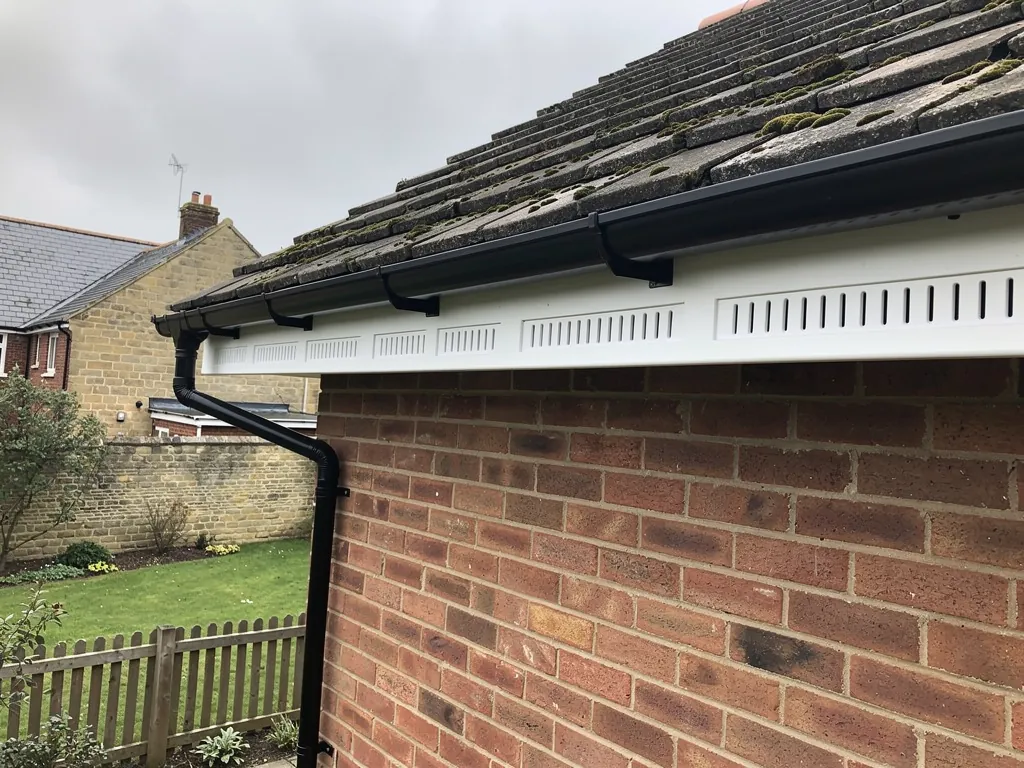
Continuous strip vents are narrow slotted profiles that run along the soffit, either set into a hole routed in the board or built into a purpose-made vented soffit panel. They give an even flow along the whole eaves and are the usual choice on new uPVC soffits.
Over-fascia vents are slotted strips fixed on top of the fascia board, under the first row of tiles or slates. They are useful where the soffit is narrow or missing, or where a roof has very little overhang, because the air enters at the top of the fascia instead of underneath.
Can the roof covering itself ventilate?
Some modern coverings and underlays are designed to breathe, and tile vents can be set in the roof slope as well. Those are specific products with their own instructions, so a roofer checks the system installed before adding or removing vents.
Is a vented soffit panel better than drilling holes?
Where a whole soffit is being replaced, a vented panel is usually the neater route, since the opening is built in along the full length and does not rely on drilled holes. Our fascia and soffit materials guide lists the options.
How insulation and clutter block the airflow
The commonest reason a vented soffit fails to work has nothing to do with the soffit. It is the loft insulation. Over the years, householders top up the layer on the floor of the loft, and the rolls are pushed neatly into the eaves, where they sit against the roof felt and fill the gap the air should travel through. The vents at the soffit are open, yet air cannot get past the insulation into the loft.
The remedy is a rigid or plastic eaves ventilator, sometimes called a baffle or tray, fixed between the rafters at the eaves to hold a clear air path above the insulation. These cost little, can be fitted from inside the loft and let the insulation go right out to the wall plate without blocking the gap.
What else gets in the way?
Paint is a surprisingly regular culprit. A soffit repainted several times can have its drilled vents or slots clogged with paint. Nests can fill the gap behind a vent, and spiders' webs and dust block fine mesh over time. Boxes and stored items pushed against the eaves restrict airflow from the inside.
Should I take insulation out?
No. Moving it back from the eaves or fitting baffles keeps the insulation and restores the path. Loft insulation matters for heating bills, and the answer is to keep both: thick insulation and a clear gap above it at the eaves.
Foam sprayed onto the roof's inner face is another matter, because it changes how the roof behaves. The Energy Saving Trust, in guidance updated in May 2026, does not recommend foaming a leaking roof before the leak is cured, and notes that roof timbers can rot where there is a leak or condensation.
Signs that a roof space is not breathing
The giveaways usually appear in winter, in the loft or on the ceilings below. With a torch, look at what is under the roof covering and at the timbers around the eaves. Beads of water on the felt or the nails, a grey bloom of mould on the rafters, damp stains on the insulation or a musty smell point to condensation rather than a roof leak.
Inside the house, patches of black mould in the corners of top-floor ceilings, a damp smell in the bedrooms under the eaves or wallpaper lifting on an upstairs wall can all follow from a loft that is not drying. Those signs often get blamed on a leak, though the roof covering is sound.
How can I tell condensation from a leak?
A leak shows after rain, and it tends to follow a particular route from a particular spot. Condensation appears in cold, dry spells as well as wet ones, covers a wide area and is worst on the north side or near the eaves where it is coldest. Our guide to roof repairs deals with the leak side.
Is mould on the soffit the same problem?
Not always. Black or green growth on the visible face of a soffit is often caused by a leaking gutter wetting it from outside. Staining that also appears on the inside, or in the loft above, suggests the roof space is holding moisture. Our guide to mouldy soffits separates the causes.
Fitting vents when the soffits are being replaced
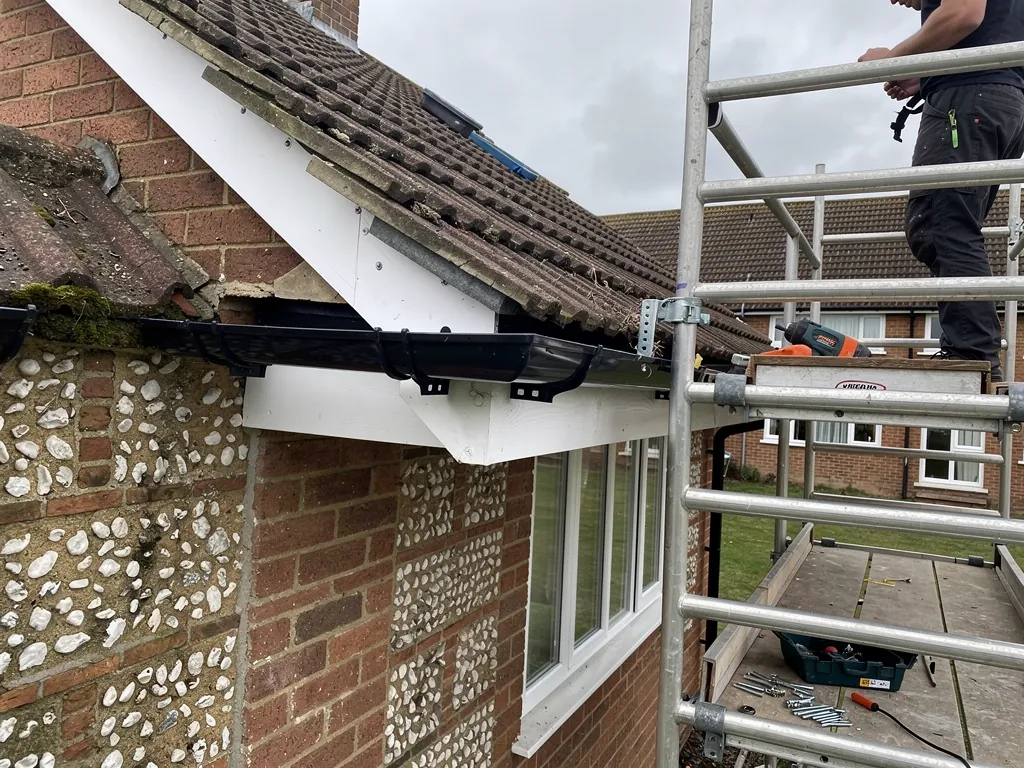
The best moment to sort out eaves ventilation is when the roofline is being replaced, because the old soffit is already off and the eaves are open. A new vented panel or a continuous strip goes in with no extra access. If the old roof had no soffit vents at all, the survey notes it and the quote reflects the change.
A tight plastic soffit can make an older roof worse. Houses that lived for decades with timber soffits, open joints and rafter ends that let air in can lose that airflow when sealed boards replace them. A sensible replacement keeps or improves the ventilation that was there, and we look for this on every roofline survey.
What about a house with asbestos soffits?
Some older soffits are made of asbestos insulating board, which looks like ordinary fibre board and cannot be told apart by eye. HSE lists external soffits as a place it is found, and says most work to remove it falls under its higher-risk rules. If a soffit might date from before 2000, nobody should touch it until it has been identified. Our guide on asbestos soffits explains the steps.
Who should do the work?
Anyone able to work at the eaves safely and recognise the roof construction. Fitting a vent in the wrong place, or covering an existing gap with a new board, can reduce airflow. The survey photographs show what is already there before anything is changed.
Cost, timing and how to ask for a survey
Vents themselves are inexpensive; the cost sits in access and the boards around them. MyBuilder's guide, updated on 21 August 2026, gives typical national figures of £100 to £180 per metre for soffit work and £80 to £150 per metre for fascia, with scaffold approximately £20 to £40 per square metre. These are typical ranges, not a quote. The length of the eaves, the height of the house, the material chosen and what is found behind the old boards all move the figure, and our gutter replacement cost guide shows how the pieces add up.
A vent-only job, such as fitting baffles in the loft or adding disc vents to sound boards, is a small piece of work. A full fascia and soffit replacement with vented panels takes longer, and a house with several elevations means a bigger scaffold.
What should I send to start?
Photographs of the underside of the eaves from the ground, a few of the loft near the eaves if you can reach them safely, and a note of when you see condensation. Tell us if the loft insulation has been topped up, because that is the first place the airflow stops.
Our survey photographs the eaves and soffits on your house, then a written quote follows. A 10-year workmanship guarantee backs the work, set out in writing. The wider range of eaves work is described on the gutters, soffits and fascias page, and the bargeboards guide covers the gable end.