
Gutter replacement prices are easy to find and hard to apply. A cost guide gives a national figure per metre. Your house has a particular length of gutter, a particular height and a particular fascia behind it, and those three things move the total more than the headline rate does.
This guide starts with the published numbers, with their source and date, then works through what changes them on the houses we see around Swindon: a 1930s semi, a Victorian terrace, a 1980s estate house. It also covers scaffold, because on a two-storey house access can cost as much as the gutters themselves. Prices here are typical UK figures from third-party guides, never a Skyline quote. After a survey you get a written quote for the whole job. For the wider service, see gutters, soffits and fascias.
The published per-metre range
The MyBuilder price guide on replacing gutters, fascias and soffits, last updated on 21 August 2026, lists guttering replacement at £30 to £70 per metre. It is a UK-wide spread that covers plastic at the lower end and heavier or metal systems higher up, in different regions and different levels of access.
The same guide gives figures for the boards the gutter hangs from, which matter if they need to be renewed at the same time:
| Item | Typical UK range | Source |
|---|---|---|
| Guttering replacement | £30 to £70 per metre | MyBuilder, updated 21 August 2026 |
| Fascia | £80 to £150 per metre | MyBuilder, updated 21 August 2026 |
| Soffit | £100 to £180 per metre | MyBuilder, updated 21 August 2026 |
| Removal and disposal | £150 to £300 | MyBuilder, updated 21 August 2026 |
Read these as a way into the discussion, not as a price for your house. A figure per metre cannot know whether your gutter is a plastic half-round on a bungalow or a run of cast iron on a three-storey end of terrace.
What the range means for a typical house
Multiplying the per-metre range by the length of gutter gives a rough idea of the gutter element alone. These are illustrations of the arithmetic, not our prices and not a quote.
- A terrace with about 8 metres of gutter at the front and 8 metres at the back, 16 metres in all, works out at £480 to £1,120 for the gutters on the published range.
- A semi with about 24 metres in total comes to £720 to £1,680.
- A larger detached house with 40 metres would land between £1,200 and £2,800.
The length of your own run is what matters. A rectangular terrace is easy to measure, but a hipped roof, a bay window, a porch and an extension each add metres, corners and outlets. The spread between the bottom and the top of the range is wide, and where a job lands inside it depends on the material you choose, how many corners the run has and what the fitter finds when the old gutter comes off.
Why do two houses of the same size cost different amounts?
Because the roof's shape does not follow the floor area. One semi has two straight runs, and the next has a hip, a side extension and a sloping lean-to. Each change of direction needs a corner fitting and extra brackets, and every outlet needs a downpipe connection.
Does a bigger gutter cost more?
It can. Deeper channels and wider outlets carry more water and cost more per metre, but they earn their keep on a large roof or under a long valley that sends a lot of rain to one point. On a small terrace a standard half-round is plenty. We size the channel to the roof area it drains, and say why in the written quote. If your present gutter overflows in ordinary heavy rain even when it is clean, that is a sign it was undersized, and it is worth fixing at the replacement stage rather than copying the old size.
Scaffold and access
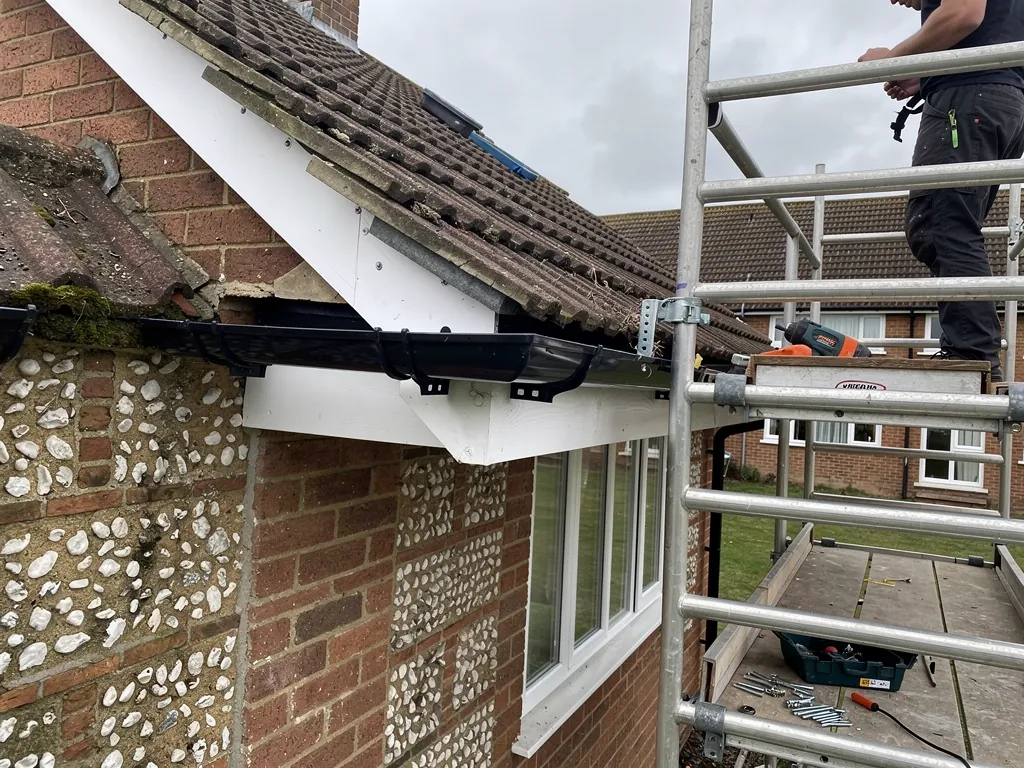
On a bungalow or a ground-floor extension, a tower or ladders may be enough. On a two-storey house, gutters sit around five to six metres off the ground, and working there safely means a scaffold or a mobile tower with a proper platform. That is a major part of the cost.
Published figures vary. MyBuilder's scaffolding guide, updated 21 August 2026, gives around £850 to £1,200 for a standard two-storey house set-up, and a weekly domestic hire of £300 to £900. Checkatrade, in a February 2026 guide, puts scaffolding for a semi-detached house at around £875 per month. MyBuilder's gutter guide also quotes scaffold at approximately £20 to £40 per square metre. Those numbers are for a full scaffold; a smaller job may only need part of it, and the figure moves with the house.
Check whether a firm's total covers scaffolding, because it is the item most likely to be left out of a low-looking figure. Ask about VAT at the same time: some published guides, including Checkatrade, show prices excluding VAT.
Where fascias, soffits or roof repairs are also needed, one scaffold serves all of them. Doing the work in a single visit usually costs less than separate visits that each need access.
What moves the price on a Swindon semi or terrace
These are the factors that matter most on the houses we meet.
Material
Plastic sits at the lower end of the published range, and aluminium, cast iron, zinc and copper climb from there. Our gutter materials guide shows how they compare.
Height and access
A rear extension with a flat roof is cheap to reach. A tall gable end over a drive with a car on it is not. Narrow side passages, steep gardens and parked cars all slow the work.
Terraces and shared runs
On many older terraces, gutters meet at a shared junction or a box gutter between two houses. You may need your neighbour's agreement to do the work, and sharing a scaffold with them can cut the cost per household. Our page on shared gutters goes through that.
What is behind the old gutter
Once the old channel is off, the fascia shows its condition. Rotten boards or crumbling rafter ends need work before anything new is hung from them, and that changes the scope. Our fascia and soffit cost page sets out those figures.
Downpipes, outlets and corners
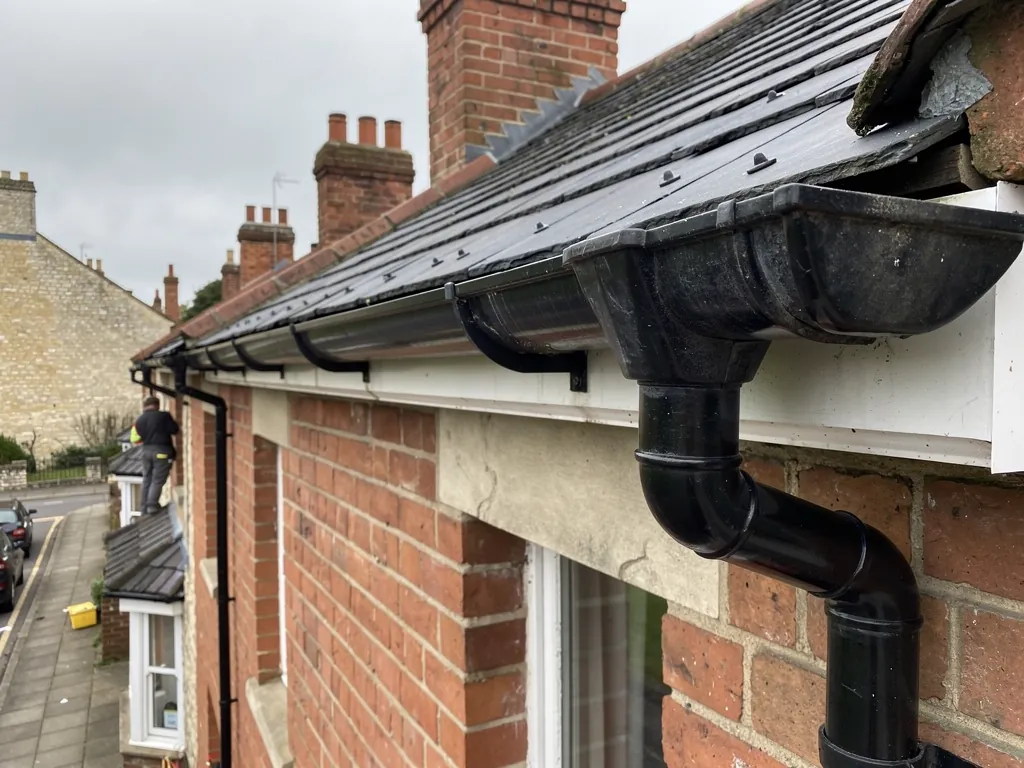
Downpipes in poor condition are usually changed with the gutter, because new gutter on an old pipe leaves a weak joint at the connection. A pipe that is stained, leaning or loose on its clips tells you the same thing, and a cracked or split section is cheap to renew while the access is up. Our guide to downpipes shows what is involved.
Timing and weather
Gutter work is best done in dry spells. Autumn leaf fall is the time most people notice the problem, but late spring and summer are easier on the ladders and the sealants. A failing run that is dropping water onto a wall gets dealt with first, and the proper replacement is planned afterwards.
Repair, partial replacement or the full run?
Replacing every gutter is not always the answer. The rule we work to is the smallest job that cures the problem, and sometimes that means a new section, a re-sealed joint or a reset bracket. A repair makes sense when the fault is local: one leaking union, one sagging length, a cracked stop end, a pool at a single low point. Replacement makes more sense when the fault is general.
- Joints weep along the whole run, not at one spot.
- The plastic has gone brittle and chalky, and cracks when touched.
- Cast iron or steel is rusted through at several places.
- The run has been patched more than once and keeps failing.
- The fascia behind has to be renewed anyway.
- The gutter is too small, so it overflows in ordinary heavy rain.
The signs that point towards replacement are easy to see from the ground. Stains running down the wall beneath a joint, green streaks, paint blistering on the fascia, weeds sprouting from the channel, a visible sag between brackets, water pooling in the middle of a run after rain and rust flakes on a metal channel all say the same thing: the system is no longer carrying water where it should. None of them is an emergency on its own, but together they mean the water has been going into the wall and the fascia for some time. A photograph of each from a safe spot helps us judge, and it sits alongside what our survey finds on the roof.
If the symptom is a leak at a joint, see leaking gutters first; a cleaning and a re-seal costs a lot less than new channel. If the water is running behind the gutter, the problem may be the roof edge rather than the gutter, which our page on the gap between roof and gutter covers.
Fascias, soffits and the roofline in one go
The gutter is only one layer of the roofline. When the fascia is sound, replacing the gutter on its own is straightforward. When it is not, you are faced with a choice: do the gutter now and the boards later, with a second scaffold, or do both together.
Doing both together costs more on the day, since MyBuilder's guide puts fascia at £80 to £150 per metre and soffit at £100 to £180, but it usually works out better overall. The scaffold is up once, and the new gutter fixes to new boards, which means the brackets bite into sound timber and the line of the roof edge comes out true. Our guide to how the roofline fits together explains the parts.
On a house in a protected area, replacement should match what is there. Our page on roofline work in conservation areas covers the planning side. Swindon Borough Council lists 27 conservation areas and notes Article 4 directions for Bishopstone and the Railway Village, while a listed house could need consent before the gutter material changes. Ring the council's conservation officers before you commit to a material.
How to compare quotes properly
Two quotes for what sounds like one job can sit far apart, usually because they cover different work. Put the same questions to every firm you ask.
- Which material, which profile and what size of gutter?
- How many metres, and how many corners and outlets?
- Does the total cover scaffold, and for how long?
- Is VAT included?
- Will the downpipes be changed, and are new brackets included?
- What happens if the fascia behind turns out to be rotten?
- Is the old gutter taken away?
You get all of this from us in writing. We survey the house, photograph the roofline and write up one total for the whole job, and we say plainly what we found. We think our prices are good and fair, and we are happy for you to weigh them against anyone else's. A 10-year workmanship guarantee in writing covers the work, and the site is cleared and the rubbish taken away. Send photographs of your gutters through the enquiry form, or call 01793 626096, and we will arrange the survey.