
Fascia and soffit work is priced by the metre, and the final figure is mostly decided by two things that have nothing to do with the boards themselves: how high they are, and what is hiding behind them. That is why a quick phone price is rarely a firm one.
This page sets out the typical national ranges published by a named cost guide, explains what each one covers, and shows what moves a total up or down on a real Swindon house. All the figures are typical UK numbers from one third-party guide, dated, and none of them is a Skyline price. For what the parts are and how they fit together, start with the roofline explained; our gutters, soffits and fascias page lists everything we do on the roofline.

The typical ranges, in one place
MyBuilder's cost guide for gutter, fascia and soffit replacement, updated 21/08/2026, is the source for the figures below. Treat them as national typical ranges, not as quotes.
| Item | Typical published range |
|---|---|
| Fascia and soffit combined | around £150 per metre |
| Fascia board | £80 to £150 per metre |
| Soffit board | £100 to £180 per metre |
| Bargeboard | around £195 |
| Guttering replacement | £30 to £70 per metre |
| Scaffold | approximately £20 to £40 per m² |
| Removal and disposal | £150 to £300 |
The same guide suggests a look at the boards every five years, with replacement typically falling somewhere between 10 and 20 years, depending on material and local weather. A retailer's page puts uPVC boards at 20 to 40 years, so the true figure for any house depends on exposure, fitting and upkeep.
Why is soffit dearer than fascia in these ranges?
A soffit is a wider board, often with vents, and it is fixed from below in a cramped space. Fascia is narrower and sits at the front face. Both can swing either way once the building is surveyed.
Do these figures include VAT?
The guide does not set that out per line, so when you compare any prices, check whether VAT is included. Our written quote after the survey states the total.
What a per-metre price actually covers
A price per metre usually means a board fitted to a house in reasonable condition. It tends to cover the board, the fixings, the sealing and finishing of joints, and the labour to fit it. What it does not cover is everything the board turns out to be hiding.
Most older roofs carry the gutter on the fascia, so a fascia replacement means taking the gutter off and putting it back, or fitting a new one. Where the rafter ends behind are rotten, or the soffit is damp and crumbling, extra timber work is needed. Any of these can move a total well away from a typical figure.
Metres matter. A short run on a bungalow and a full wrap on a four-bed detached are very different jobs. Measure the eaves on every side you want done, and add the gable edges if bargeboards are included. A simple semi-detached house might have eaves on two long sides and two short gable returns, while a detached house with a hipped roof has eaves all round.
The quote you receive from us is a single total price for the whole job, written after the survey. It is based on photographs and measurements of your own house.
Is a very low price per metre a warning sign?
It can be. Very cheap boards may be thin, the labour may exclude removal, and the fixings may skip a proper ventilated soffit. Ask what is included in the total, and whether VAT and scaffold are in it.
Why do two firms quote different totals for the same house?
Because they may be pricing different jobs. One may include replacing the gutters and another not. One may quote for vented soffit and another for plain board. Ask each to confirm what the total covers.
Scaffold and access: the big swing factor
On many jobs the scaffold costs more than a week of labour. It is also the item most often left out of a casual phone price. The reason is simple: eaves on a two-storey house are out of reach of a ladder for any job longer than a short patch.
MyBuilder's guide gives scaffold at approximately £20 to £40 per m². Its separate scaffolding page, updated 21/08/2026, gives around £850 to £1,200 for a typical two-storey set-up, while Checkatrade's scaffolding guide quotes about £875 a month for a semi. These are national typical figures from two independent sources, and they differ because the scaffold varies with the house.
Things that push scaffold up include a long frontage, a detached house with all four sides to cover, a side access that is narrow or blocked, steep ground, and a job that needs the scaffold in place for several days. Things that bring it down include a short terrace frontage, level ground and an easily reached elevation.
On a bungalow, or on a single-storey extension, a tower or a well-secured ladder platform can be enough, and the cost drops. For a pavement frontage, a licence from the council may be needed, which the MyBuilder scaffolding guide puts at £50 to £200. Ask any firm whether scaffold and licence are included in its total.
Can the same scaffold serve other jobs?
It can, which saves money. If the chimney needs repointing, the ridge re-bedding or the bargeboards replacing, doing the lot while the scaffold is up is the efficient way to buy the access once.
Can I put up my own scaffold to save money?
We would not advise it. Working at height from a poorly erected platform is how people get hurt, and insurers and landlords care how access was arranged.
Removal, disposal and what is behind the old boards
Taking off the old boards is not free. The guide quotes £150 to £300 for removal and disposal, a typical national figure. The old boards, fixings and any rubbish from the eaves need to leave the site, and a skip or a tip run is part of that cost.
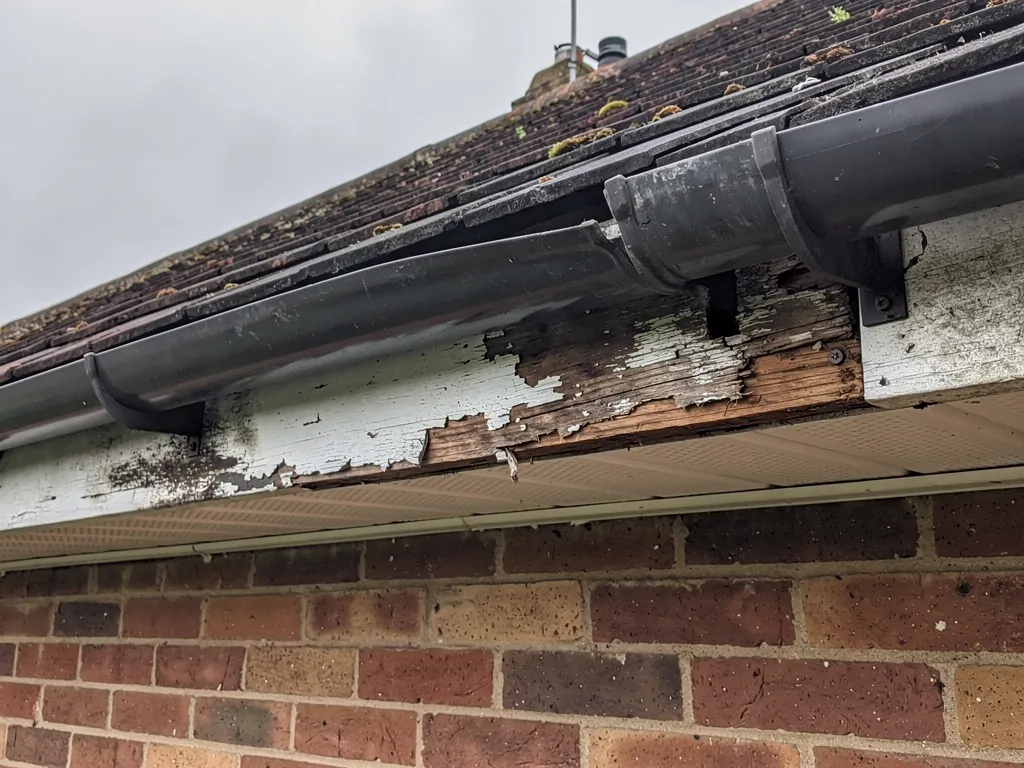
Condition behind the boards drives the biggest variations. Once the old fascia comes off, the rafter feet are exposed, and a rotten end needs a repair before anything can be fixed to it. Behind the soffit sit the wall plate and the tops of the rafters, where old leaks sometimes leave damp. A fascia that looked sound from the pavement can have a decayed back face.
Soffit boards on older houses deserve care. HSE names external soffits as one spot where asbestos insulating board is found, and advises that a house built or refurbished before 2000 should be treated as containing some. Most removal of that board is licensed work, and the board cannot reliably be told from a safe one by eye. We do not break or drill suspect boards. Our answer on asbestos soffits explains what happens next.
If your house dates from before 2000 and the soffits are flat grey sheets, do not drill, sand or break them. Photographs to us come first, and we advise on the next step.
Why can the price change after the old boards come off?
Because the survey sees the outside, and the boards hide the rest. We note likely problem areas on the survey and explain what could change, so a surprise is less likely.
Material choice and what it does to the total
The board you choose changes the price, the upkeep and the finish. Our guide to fascia and soffit materials covers the options in more detail. In cost terms, the main choices run as follows.
uPVC is the common modern choice. It is low maintenance, available in white, black, grey and woodgrain, and normally the lowest purchase price. A vented soffit adds a small amount but protects the roof space. Wood is a traditional option that suits period homes, and it needs painting every few years. Capping, where new cladding is fixed over existing sound timber, can lower the cost where the old boards are firm, though it hides what is behind. Our guide to fascia capping covers when that makes sense. Composite and aluminium boards cost more and suit specific looks.
Colour has a modest effect. Standard white is usually the easiest to supply. Black, grey and woodgrain can be more expensive and more variable in availability. Our black roofline page looks at the dark finish.
Is it cheaper to replace gutters at the same time?
Usually it is more efficient, because the gutter has to come off for fascia work anyway, and new boards behind a tired old gutter is a false economy. See gutter replacement cost for the sourced ranges.
Will cheaper boards save money in the long run?
Rarely. A thin board that warps or discolours costs more than a better one over time, because you pay for the scaffold again.
Who does the work: roofer or general builder
Fascias, soffits and bargeboards sit where wall meets roof, so the work can go to a carpenter, a general builder, a roofline specialist or a roofer. Each does the board fitting. The differences show up where the board meets the roof covering.
The lower row of tiles or slates usually overhangs the fascia, and the felt or underlay should lap into the gutter. If the board is replaced without attention to that detail, water can run behind the new fascia. A roofer understands how the tiles, the underlay and the verge work together. Our answer on whether roofers fit fascias goes through it.
Where tiles have to be lifted, ridge fixings checked or verge details rebuilt, one contractor doing it all is simpler and reduces the number of visits. We explain consent where it is needed and look after the neat finish at the roof edge.
When you compare prices, compare what each firm will do at the tiles and underlay as well as at the board. A total that excludes that work may look lower and leave you with a leak.
How do I compare two totals fairly?
Ask both to confirm the same things: whether the gutter is replaced, whether the soffit is vented, who supplies scaffold, whether VAT is in the price, and how the rubbish leaves the site.
How to get a firm price from us
The quickest route is to send photographs of each elevation, taken from the ground in daylight, and a note of the house type and approximate age. Include any close-ups of rot, peeling paint or sagging gutters. Tell us whether you want bargeboards done and whether you want the gutters replaced at the same time.
We then survey the roof edge, take photographs from the scaffold position or ladder, and record what is behind the boards where we can see it. Our visit is followed by a written quote giving one total for the job, at a fair price. Our aim is the smallest job that properly cures the fault, so where capping over sound boards is enough, that is what we propose.
The work comes with a 10-year workmanship guarantee in writing. Ring 01793 626096, message us on WhatsApp, or send the enquiry form, and at handover the area is tidy with the waste gone.