
Is a stone slate the same as a stone tile?
Yes, they are the same covering. Local custom decides the word: tile tends to be used in the south of the Cotswolds, slate in the north.
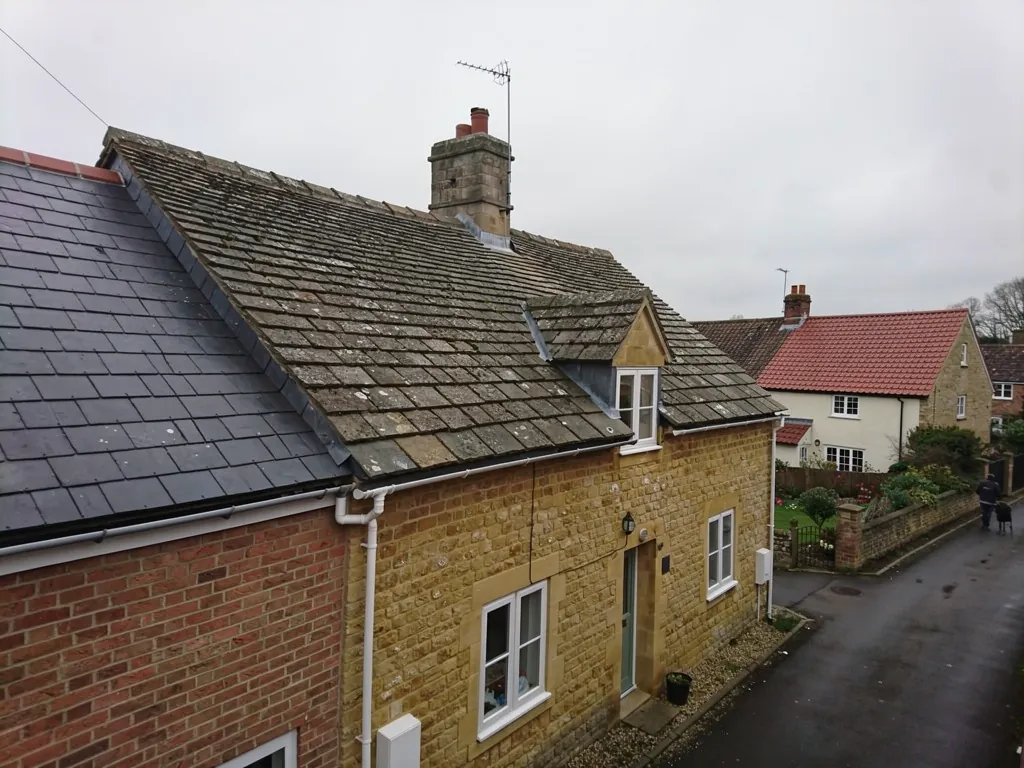
Limestone slates hung on oak pegs, graded from heavy eaves courses to small ridge slates. We repair, re-peg and relay them in matching stone, and show you the evidence first.
Yes, they are the same covering. Local custom decides the word: tile tends to be used in the south of the Cotswolds, slate in the north.
It is better not to. Odd modern tiles weigh differently, sit differently and look wrong. A stone roof is repaired with stone of the same type and size.
No. Water jets can strip the surface of soft limestone and force water under the slates. Moss comes off by hand, with a scraper, a little at a time.
| Job | Typical cost |
|---|---|
| Stone slate roof, per square metre | £160 to £210 per m² |
| Welsh slate re-roof, for comparison | £140 to £180 per m² |
| Hand scraping moss from a roof | £5 to £10 per m² |
| Scaffolding, standard two-storey house | £850 to £1,200 |
| Repairs to a Cotswold stone roof | priced on survey |
Treat these as signposts. Stone differs so much between roofs that the figure is settled once we have surveyed yours, and the written quote follows.
Checkatrade's slate cost guide (last updated September 2026; its stone slate figure is not Cotswold-specific); MyBuilder's slate, cleaning and scaffolding price guides (August 2026 editions).
See all costs Re-pegging and slate replacementPerished or slipped slates replaced with stone of the same type, size and thickness, and hung on oak pegs the way the roof was first built.
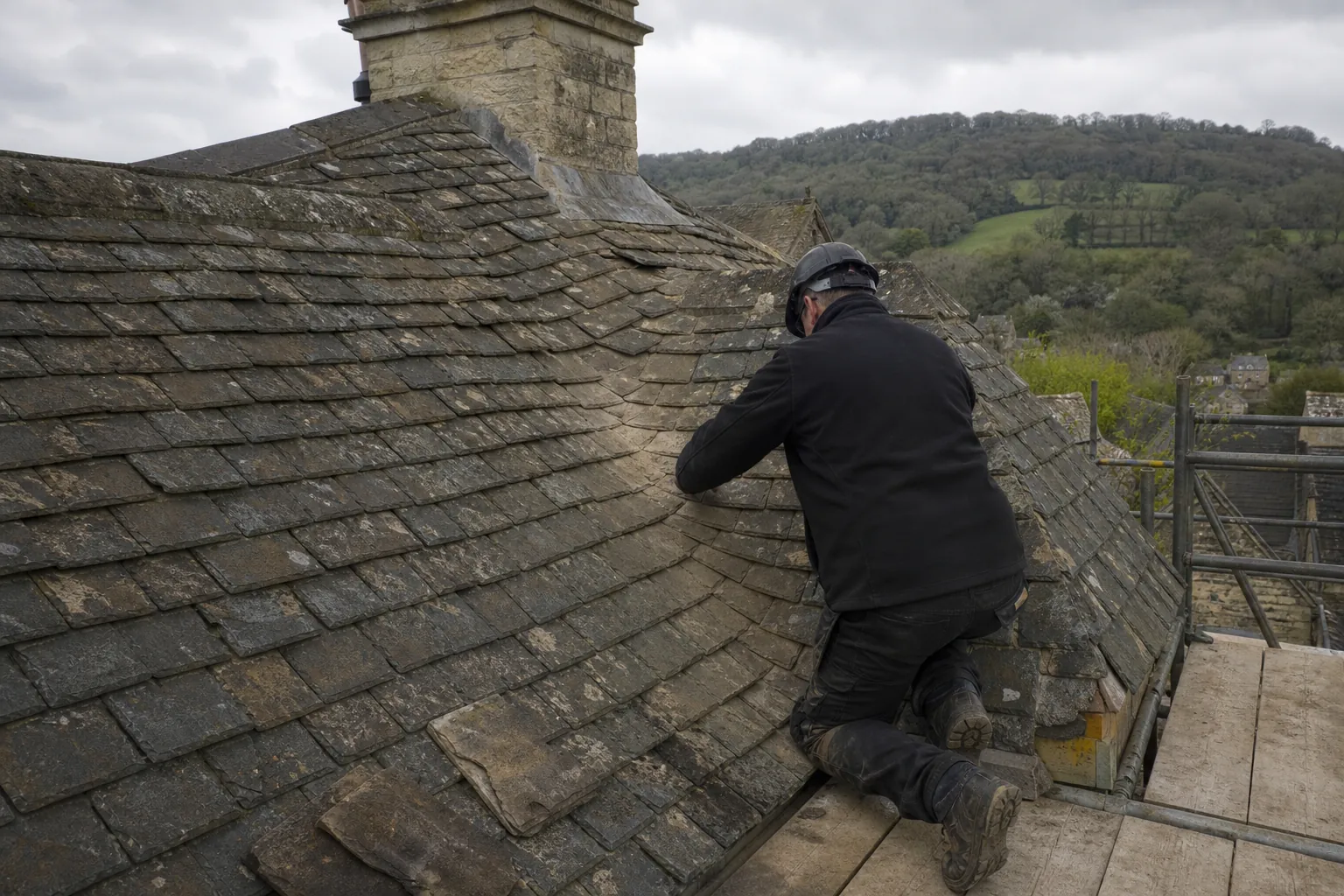 Stripping and relayingWhere a roof is worn out we strip it in sections, sort every slate by length, and lay the sound ones back in graded courses.
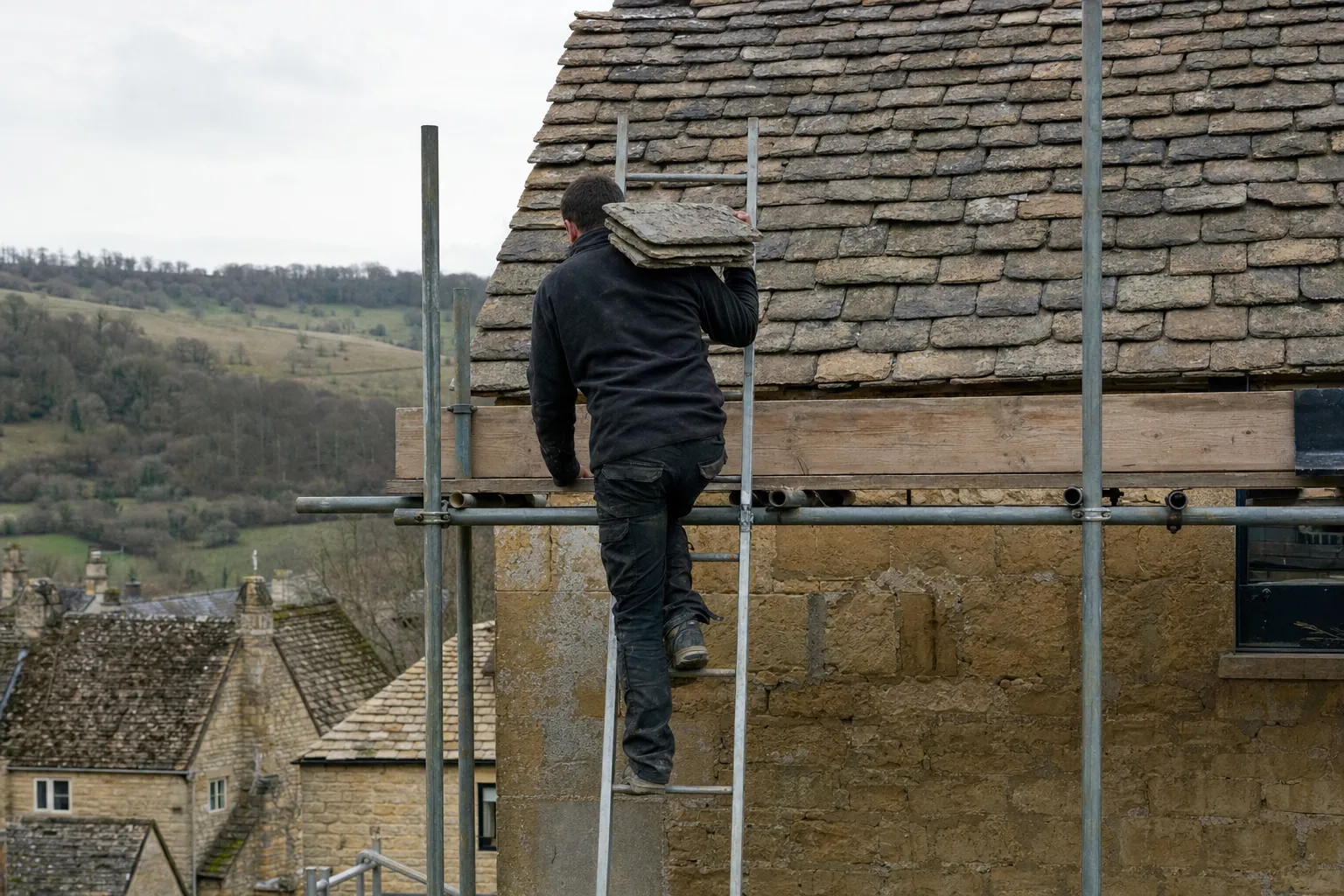 Swept valleysSpecially cut slates that curve gently where two slopes meet, rebuilt in stone rather than swapped for a cheap lead channel.
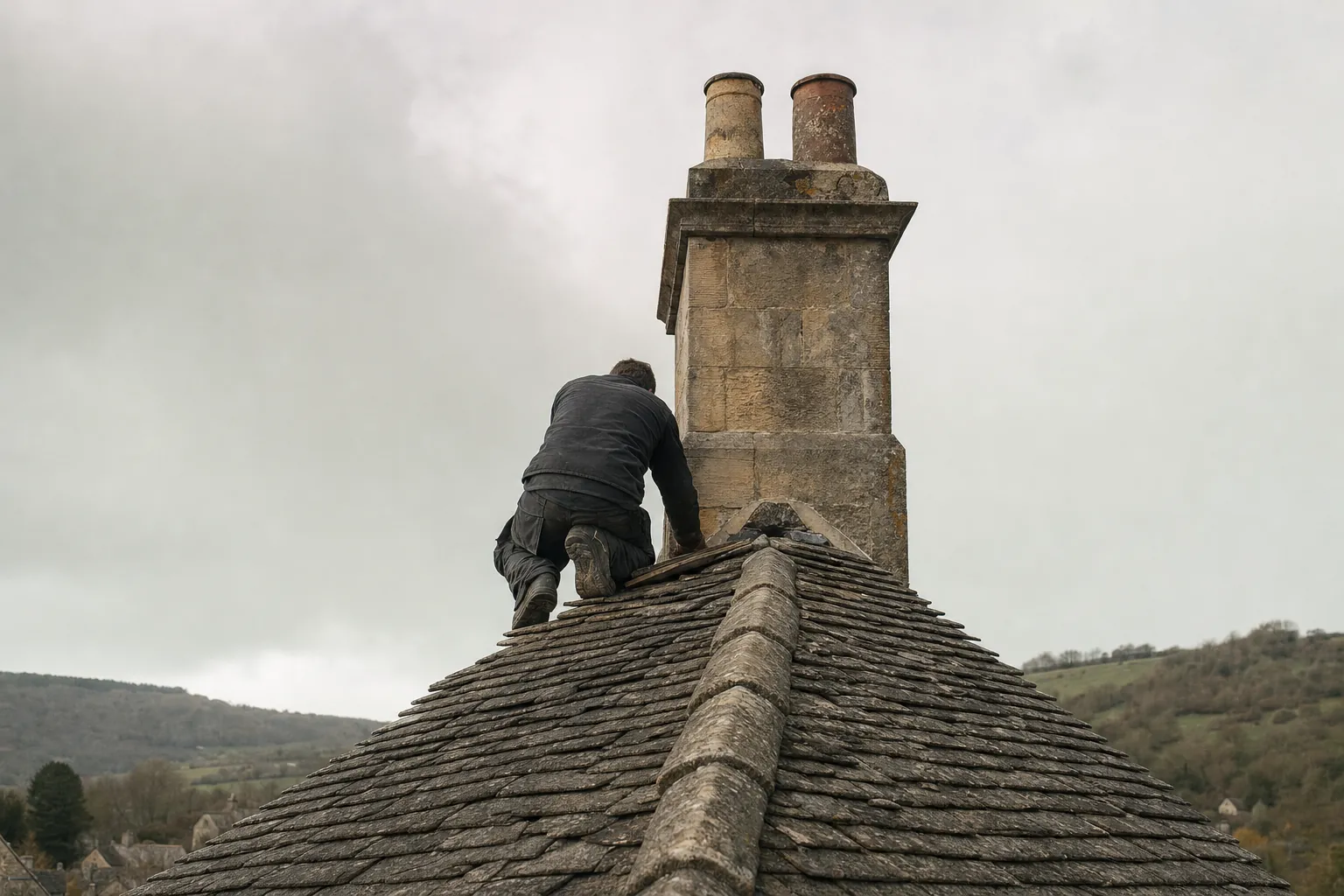 Ridges, verges and abutmentsDressed stone ridges, bedded verges and lead flashings at walls and chimneys, repaired in the same material as the original.
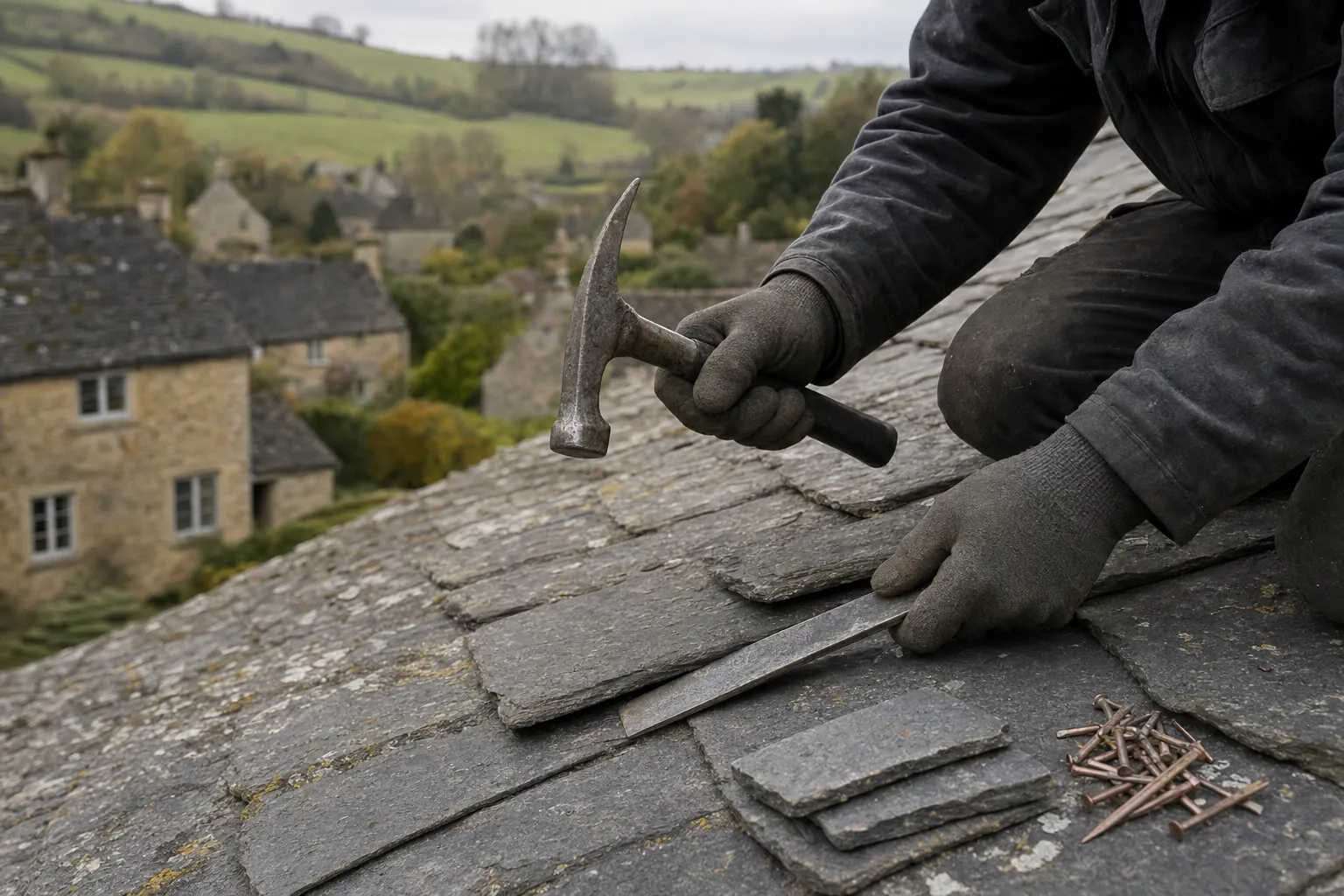 Hand scraping and moss controlMoss and lichen scraped off carefully by hand, which protects soft limestone that a pressure lance would damage.
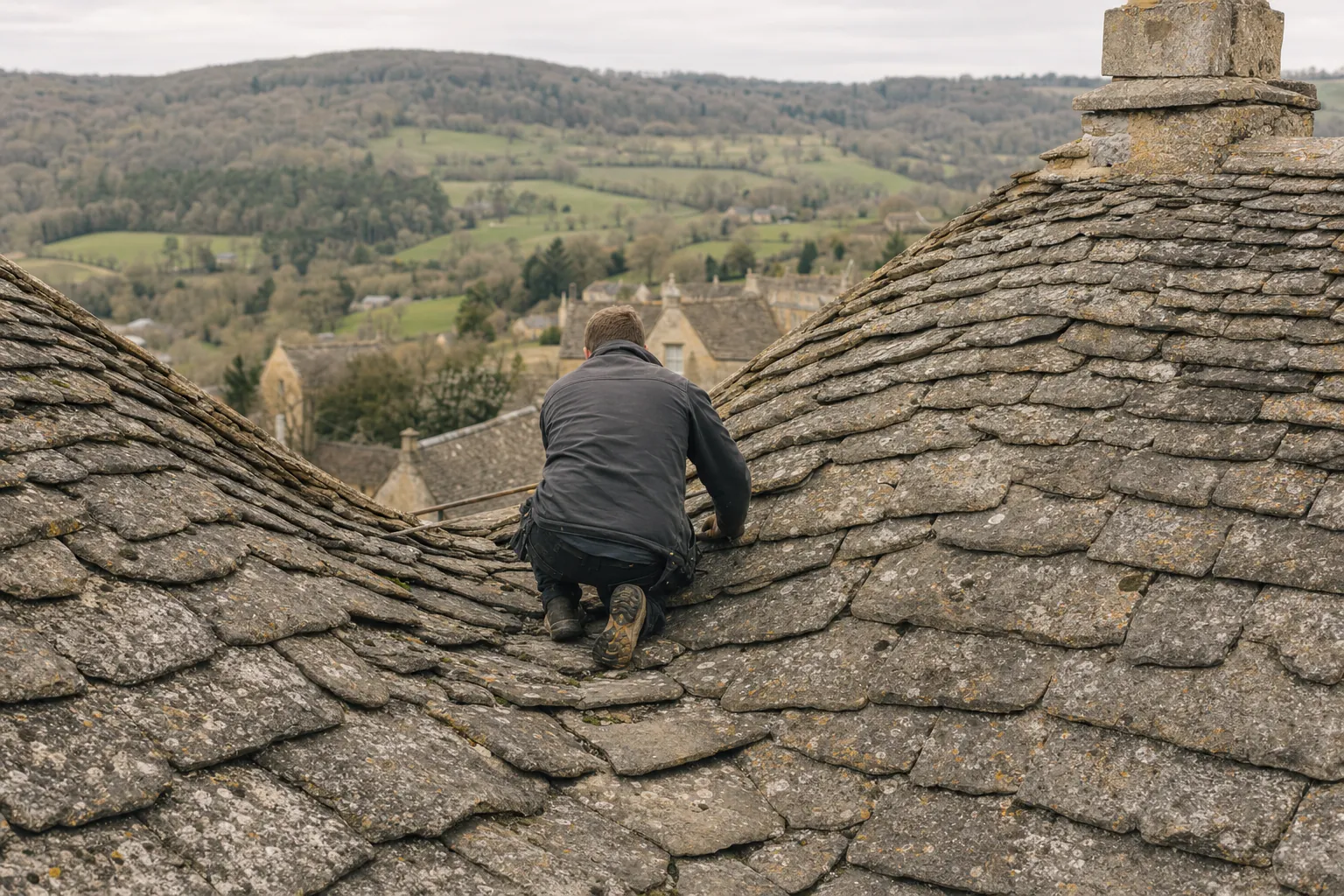 Surveys before consentA photographed survey of the slates, battens and timbers, which also gives you the detail a conservation officer is likely to ask for.
Cotswold stone roofs, question by question
What the covering is, why it is laid the way it is, and how to repair, cost and protect it without damaging what makes it special.

The short answer
Cotswold stone slates are cut from limestone, not from the sandstone or slate used elsewhere in Britain. Two oolitic limestones supply them: Forest Marble, split by hand soon after it is dug, and Stonesfield Slate, which needs to be frozen before it will split.
People often call these roofs slate, and the name is reasonable, but the stone is not slate in the geological sense. Cotswold District Council's technical guidance for owners explains that two stones supply the traditional covering, and both are oolitic limestones. That one fact explains why the roof behaves as it does and why it has to be treated differently from a Welsh slate roof.
Forest Marble is the coarser of the two. It is split by hand soon after it comes out of the ground, while it still holds its quarry water. Stonesfield Slate is different: it was left out to freeze, and the frost opened the layers so that thin, even slates could be split off. The Stone Roofing Association notes that the Forest Marble does not need frosting but that peg holes are harder to make in it. Both end up as rough, textured slates.
It varies more than the postcards suggest. The Cotswolds National Landscape describes the area's limestone as running from silvery and creamy white, through shades of grey, to a golden ochre, with the iron oxide in the stone setting the shade. On a roof, years of weather, lichen and moss then mute and darken the slates, so a slope that has been up for a century rarely looks like a freshly split one. That is why a repair is matched against the weathered slates around it, not against a new sample.
Limestone is porous and softer than true slate. It takes up moisture, it carries moss and lichen readily, and it can fail from the face outwards, the surface flaking away while the slate underneath stays sound. That is why cleaning, fixing and replacement all follow different rules on a stone roof. Our answer on what Stonesfield slate is goes into the geology.
Some stone slate roofs in the wider region are sandstone. Conservation guidance is firm that the two must not stand in for one another, and must not share a roof. They age differently and they look different, so a mixed repair shows. When we survey, we identify the stone first, because every later decision depends on it.
According to the guidance, traditional stone slate roofs run in a belt that starts around Chipping Campden at the top and ends close to Bath at the bottom. From Swindon our stone roof work reaches into Gloucestershire at Cirencester, Fairford, Lechlade, Tetbury and Stroud, into Oxfordshire at Burford, and across north Wiltshire to Malmesbury and Cricklade, wherever older houses, farm buildings and barns carry stone. If your roof is stone, the repair has to start from the stone, not from what is in a merchant's yard.
Not sure whether you have limestone, sandstone or a manufactured copy? Send a close photo of a few slates and one of the whole slope. The grain and the edges usually answer it, and the survey confirms it.
| Stone | Type | How it is split |
|---|---|---|
| Forest Marble | Oolitic limestone | By hand, soon after extraction |
| Stonesfield Slate | Oolitic limestone | Frost-split after exposure |
| Sandstone slates | Sandstone, a different roof | Never mixed with limestone |

The short answer
The stone breaks naturally into many small slates and few large ones, so the roof is laid in diminishing courses. The longest slates, called cussoms, form a double course at the eaves. Followers come next, and the smallest, short cocks, sit at the top of the slope.
Look at a good stone roof from the lane and you will see the slates get steadily smaller as the eye moves up to the ridge. It is not decoration. It comes from how the rock breaks and from how water travels over the roof, and a roof that ignores it looks wrong and sheds water badly.
The guidance describes the biggest slates as normally about 600 mm long, some up to 750 mm, and says they go at the eaves in a double eaves course. These are the cussoms. The slates that follow them up the roof are called followers. At the highest part of the slope the smallest slates, the short cocks, can be as little as 150 mm long. Our guide to diminishing courses on stone roofs sets out the whole range.
Rock splits into more small pieces than large ones, so a quarry or a strip-out yields far more short slates than long ones. Laying the large ones low means the heaviest slates sit where the wall plate and the eaves carry the load, while the lighter small slates sit near the ridge where there is least support. Water also has the longest path at the bottom of the roof, so the biggest slates take the most flow.
Traditional slates are hung, not nailed through the face. One or sometimes two wooden pegs pass through a hole drilled near the top edge of each slate, and the peg hangs the slate over the batten. The guidance says oak was usually cleft to form the peg. A pegged slate can be lifted and rehung without cracking its neighbours, which is why a good stone roof can be repaired in small sections for generations.
A replacement slate has to be chosen for its place in the roof. A slate that is the wrong length breaks the gauge and leaves a course that is too tight or too loose. Our answer on stone slate names and sizes explains the vocabulary, so that a survey report naming followers and short cocks makes sense when you read it.
Reading the roof from the ground gives you a good first check: if the slate sizes jump about instead of grading steadily, a past repair probably used salvage that was never sorted.
The answer
Often a stone roof can be repaired, because slates are hung individually and can be lifted and replaced. When many slates have perished, pegs have failed across a slope or the battens below are rotten, relaying is the proper answer. We show you which, with photographs, before you decide.
Stone roofs are among the most repairable coverings there are. They are also among the easiest to repair badly. The question is not whether a repair is possible but whether it deals with the cause, so we look at the whole slope before we quote for a single slate.
A few slipped, chipped or perished slates in an otherwise sound roof are a repair job. We lift the slates around the fault, replace the broken ones with matching stone, rehang them on oak pegs and check that the courses still grade properly. Our page on stone slate repairs describes the method. It is a small, tidy job on a ladder or tower, and it should leave no visible patch. Grading, pegging and swept valleys are specialist work, and the quality of the stone and of the pegging decides how long a repair lasts, so ask any contractor how they will match and hang the replacements.
The warning signs are slates flaking in layers, pegs that have rotted or snapped across a whole slope, sagging between the rafters and battens that crumble when we press them. A relay means stripping the slope in sections, sorting the slates by length, discarding the perished ones and laying the sound slates back in graded courses. The guidance says that about half the slates have commonly perished by the time a roof is stripped, so a supply of matching replacement stone has to be allowed for.
Stone slate roofs are very heavy, about 1000 kg for every 10 square metres. Rafters and wall plates that have carried that load for a century can be tired, and a relay is the moment to find out. We photograph the timbers once the slates are off and tell you what we see before going further. Our guide to relaying a Cotswold stone roof sets out the sequence in full.
Yes. A new roof in natural stone suits an extension, a rebuilt outbuilding or a new house where the planning conditions ask for it. The stone is bought in from a quarry, graded into courses on site and hung on pegs over battens in the same way as an old roof. Stone is heavy, so the structure is designed or checked for the load first. Second-hand stone is meant only for the building it was stripped from, so a new stone roof normally means new stone, which can take time to source. Our answer on a stone roof on an extension covers the planning side.
Water usually gets in where stone meets something else. Two terms first. A flashing is lead dressed into the joint where the roof meets masonry, and a valley is the trough where two slopes meet. Both are worth checking on any stone roof that leaks, because the slates in the middle of a slope are rarely the culprit. Where leadwork is needed we choose a suitable code of lead for the position, and our lead roofing page explains the codes and how they are fixed.
Every stone roof has its own history of patches. We read that history on the survey: where earlier repairs used the wrong length of slate, where an old cement fillet has trapped water, where a bitumen patch has been smeared over a joint. Undoing a poor past repair is often the first job, and it is better to know that before a price is agreed.

If you cannot tell whether a roof needs repair or a relay, ask for the decision to be made on photographs of the actual slates and timbers. A written quote that names the reason is worth more than a verbal verdict from the ground.
MythA leaking stone roof always has to be stripped and relaid.
FactMany leaks come from a few failed slates, pegs or flashings, and hung slates can be lifted and replaced without disturbing the rest of the slope.
The short answer
Checkatrade's September 2026 guide puts the average stone slate roof at around £160 to £210 per m², a national figure that is not specific to the Cotswolds. Real prices depend on the stone, the roof's shape, access and how much old stone can be reused, so a survey fixes yours.
Stone roofing has a reputation for being expensive, and per square metre it is certainly above a concrete tile roof. It is also a covering that can outlast most others, so the sensible comparison is cost over many decades rather than the first invoice. Here is how the numbers fit together.
Checkatrade's slate cost guide, last updated in September 2026, gives the average stone slate roof as around £160 to £210 per m². The page does not say the figure is Cotswold-specific, so use it as a signpost. The same site and MyBuilder price Welsh slate re-roofs at about £140 to £180 per m², with Spanish slate at £100 to £130 and reclaimed slate at £110 to £150. MyBuilder's guide was updated in August 2026. Our guide to Cotswold stone roof cost goes into what moves the number.
Four things matter most. The first is the stone itself: new Cotswold stone slates, graded and delivered, cost more than a standard roofing slate. The second is how much of the existing stone can be reused after sorting, because every sound slate relaid is one fewer bought. The third is the roof's shape, since swept valleys, dormers, hips and many abutments all add labour. The fourth is access: MyBuilder gives £850 to £1,200 for the scaffold on a typical two-storey house, and a heavy stone roof is not a job for a ladder and a hope.
The biggest unknown is the structure under the stone. We lift a few slates at the survey where we can, to see the battens and rafters, so the quote is not built on a guess. Timber repairs, if needed, come with a photograph and a reason before any work starts, and nothing is added without your agreement.
Reconstructed Cotswold-style slates are made from concrete. Bradstone's data sheet gives a minimum pitch of 30 degrees and a laid weight of about 84 kg/m², with diminishing lengths and random widths to imitate the real thing. They cost less than natural stone, but under the heritage policy below they are not suitable for historic buildings. On a modern extension or an outbuilding they can be a fair choice, and our page on reconstituted stone roof tiles sets out where they fit.
The Cotswold District Council guidance says that, with regular maintenance, a Cotswold roof can easily last 100 years and might last 200 or 300. That is a traditional statement, from a 2000 guide, not a promise for any single roof. What shortens the life is usually neglect or rough handling: rotted or snapped pegs, battens that have gone soft, valleys left choked and a pressure wash that strips the face of the stone. Our answer on how long a stone roof lasts goes further.
When you compare quotes for a stone roof, check that each one says what stone is being supplied, whether it is new or reclaimed, how the courses will be graded and who is responsible for any extra timber work.
What it typically costs
The short answer
Matching-stone repairs rarely need a planning application, but a listed building is different: altering its roof covering where that touches its character needs listed building consent, and Cotswold District's local plan resists replacing natural roofing with modern material. Check with your council's conservation team before work starts.
A stone roof is often the main reason a building looks the way it does. That is why councils and heritage bodies take a close interest in it, and why the paperwork should be settled before the first slate comes off.
Planning law treats maintenance and repair that does not materially affect the building's external appearance as outside the definition of development. So a repair in matching stone seldom needs a planning application. Two things change that: a listed building, or a direction removing permitted development rights in a conservation area. If you are unsure, phone the council's planning officers before work begins, and certainly before you sign a contract with a roofer.
The Planning (Listed Buildings and Conservation Areas) Act 1990 says anyone carrying out works that would affect a listed building's special interest needs listed building consent, and doing so without it is an offence. The Cotswold District local plan policy quoted in the council's guide says proposals to remove natural roofing from the roofslopes of a listed building, and replace it with modern materials, will not be permitted if they would harm its architectural or historic interest. A change of covering is the obvious trigger, but heavy-handed repair can also be one. Our guide to listed building consent for stone roofs goes through the steps.
The English Heritage policy reproduced in the council's guide says new stone slates should be used wherever possible rather than second-hand ones. Reclaimed slates belong only on the building, or group of buildings, they came off, and the two kinds of stone are never combined. Substitutes such as fibre resin slates, concrete tiles and reconstituted stone are called inappropriate for historic buildings. Our page on reclaimed and new Cotswold stone slates explains the thinking.
Many stone-roofed villages are conservation areas, where the council pays attention to materials and detail. A village hall or farm building may be treated differently from a house, so say what the building is when you ask. Our answer on stone roofs in conservation areas covers the ordinary house case.
We explain which consents apply and the papers the council will probably ask for, and where Building Regulations notification is needed for the work we handle it. The decision on consent sits with the council, not with us, so we help you put photographs and a written specification in front of them.
Lead time matters. Applications for listed building consent take a while to decide, so start the conversation with the conservation officer early rather than when the roof is already leaking.
On a listed stone roof, the council decides what is allowed and we build the case.
The answer
Check it from the ground each year, keep gutters and valleys clear, and take moss off by hand with a scraper instead of a pressure lance. The council's guidance suggests that yearly scraping could double a stone roof's life, though that is traditional advice, not a guarantee.
Stone roofs reward regular small attention and punish a single heavy-handed clean. Most of the damage we see on them comes from the wrong treatment, not from age.
MyBuilder's roof cleaning guide warns that a pressure wash may damage delicate tiles, and soft limestone is as delicate as it gets. A lance strips the face of the slate and drives water under the courses. Hand scraping is slower, and MyBuilder puts it at about £5 to £10 per m². The Cotswold District guidance goes further: scrape a stone roof every year, it says, and it might last twice as long. Our guide to cleaning a Cotswold stone roof covers the method.
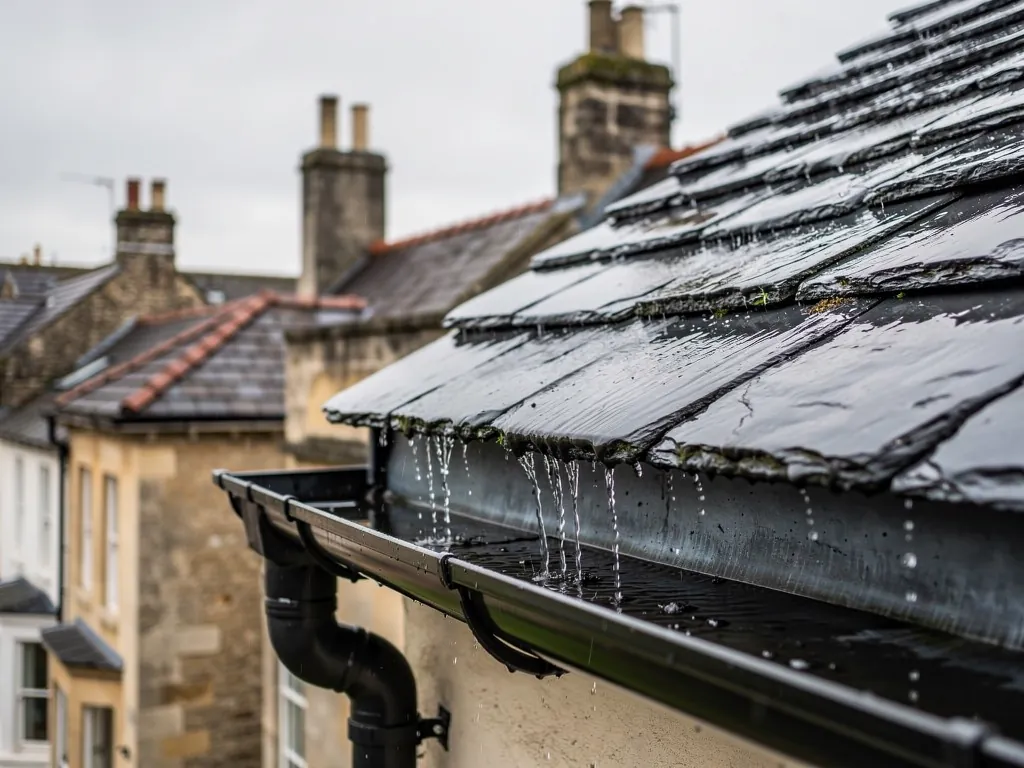
Most of the trouble starts where water lies. Gutters packed with leaves, valleys choked with moss and overhanging branches keep slates wet, and wet limestone is where frost does its work. Clear the channels twice a year. If a downpipe is dumping water against the stone, fix the pipe before it fixes the slate for you.
Slipped slates leave visible gaps or a dark line where the course has dropped. Flaking leaves a pale scatter of stone chips in the gutter. A ridge that has lifted or a verge that has opened will show against the sky. Binoculars from the garden are a good tool: they let you see the roof properly without a ladder. Make a note of anything odd, and photograph it with the date, so that we can see whether it is changing.
Stone that has soaked up water can split when it freezes, so the weeks after a hard frost are a sensible time for a look. High winds shift pegged slates and lift ridge stones, and falling branches crack slates in a way that is easy to miss. If something looks wrong, tell us before a small repair becomes a large one.
On a bright day, go into the loft and study the timbers and the back of the slates. Daylight at a slate edge is normal for a pegged roof, but dark, wet timber or a streak of damp is not. Many older stone roofs were torched with lime mortar on the inside of the slates. If you can see torching crumbling, mention it at the survey. Our guide to Cotswold stone roof maintenance lists the checks to make each year.
Never climb onto a stone roof yourself. Pegged slates can crack underfoot, and the surface is often slippery with lichen. Take photographs from the ground, the loft or an upstairs window and send them to us instead.
Our view
Scrape by hand once a year, and keep the water moving off the stone.
Further reading on slate names, pegs, valleys, consent, cost and care, from the geology of the stone to dormers, verges and abutments on a stone roof.
We aim to match type, size and thickness, and we identify the stone at the survey. Where the original is unavailable, we explain the closest suitable stone before quoting.
Traditional stone roofs were torched with lime rather than lined. Whether to add underlay depends on the building and any consent, and we discuss it at the survey rather than assuming.
Layered flaking usually means the stone has taken in water and frost has opened it. One or two slates can be replaced, but widespread flaking points to a relay.
Yes, though new stone adds weight and the structure has to carry it. A concrete stone-effect tile is lighter, but it will not suit every building or council.
Not unless the survey shows it. We replace only what has failed where we can, and relay a slope when its slates, pegs or battens are failing across the board.
The English Heritage policy reproduced by the council calls them inappropriate for historic buildings, so on a listed building we would expect natural stone to be required.
Send a photo of the whole roof from the ground and a close one of any slipped or flaking slates, and say if the building is listed, or lies inside a conservation area. Wherever the building is, in Wiltshire, Gloucestershire or Oxfordshire, we will arrange a survey, identify the stone, photograph the faults and give you a written quote.
Tell us what’s happening and we’ll call you back.
Or call 01793 626096
Message us on WhatsApp