
People usually ask this question with a roof already in mind: a cottage on the Cotswold edge, a barn conversion with a long stone slope, a village house where the slates have started to slide. The honest first answer is that stone slate is priced by the roof, not by the catalogue. Two cottages with matching footprints can end up thousands of pounds apart, because pitch, stone, chimneys and the condition of the timbers underneath all change the work.
What we can give you is a published national range, clearly labelled as such, and a plain list of the things that push a real roof up or down from it. We cannot give you a Skyline price here, because the number only exists after someone has been up on your roof with a camera. This guide explains the range, the drivers, and how to read the paperwork that arrives once the survey is done.
If you are comparing materials rather than prices, start with our page on stone slate or tile.
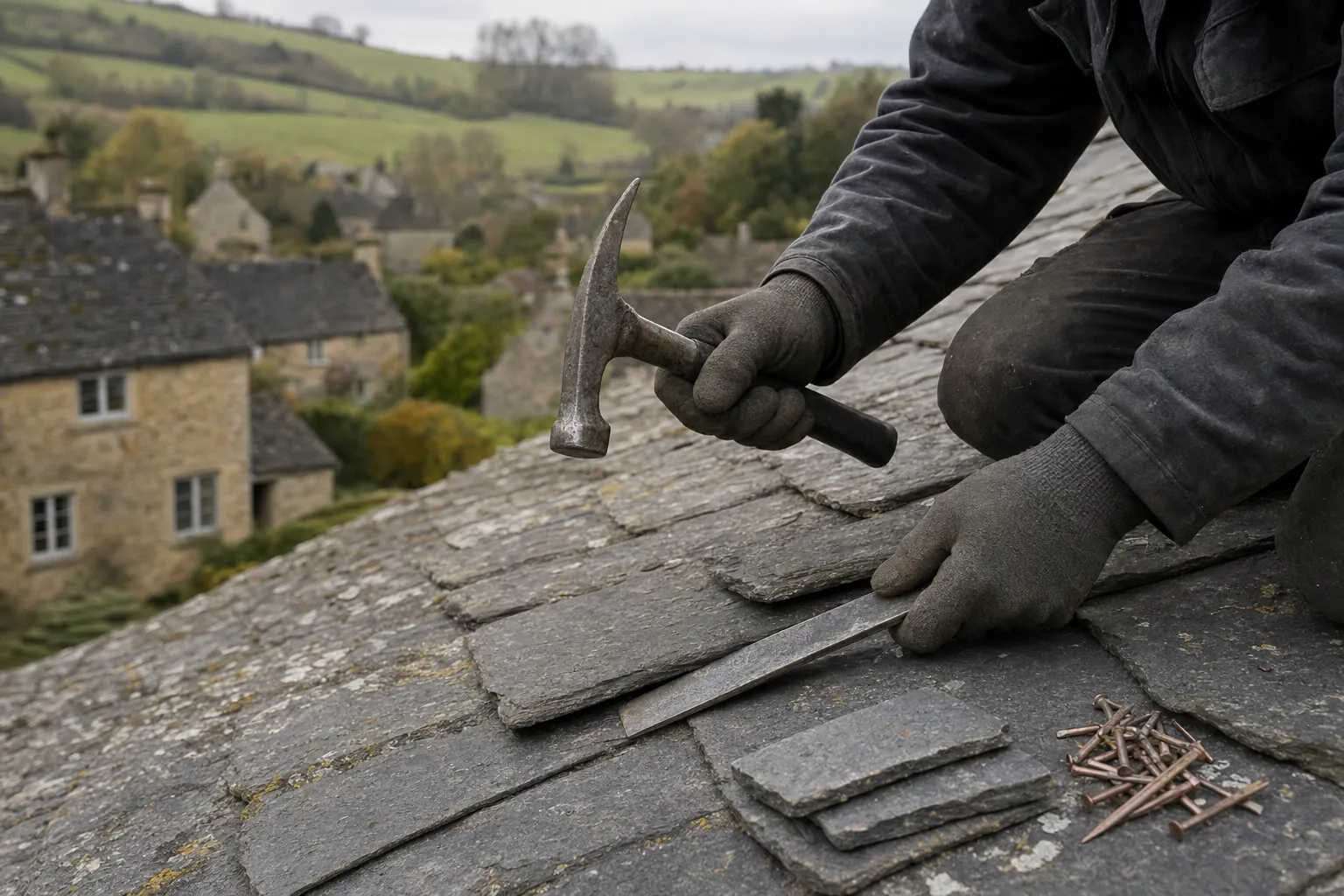
The published range, and what it does not cover
The one national figure we can point to for stone slate comes from a Checkatrade cost guide, last updated in September 2026. It says the average stone slate roof costs around £160 to £210 per m². That is a general UK figure for stone slate, not a Cotswold figure, and the guide says nothing about pegged, graded, hand-dressed roofs of the kind found from Chipping Campden down towards Bath.
The measure is the area of the roof slope, not the floor area of the house. This catches people out on stone roofs more than most, because traditional pitches are steep. The Cotswold District Council technical guidance describes the simplest traditional roof as a straight pitch, usually between 47° and 55°. A steep slope has noticeably more surface than the footprint beneath it, so a quick sum from the size of the house will come out low.
As plain arithmetic on that published range, a roof with 60 m² of slope would land between £9,600 and £12,600. That is a worked example, not a quote. It shows the scale you are dealing with. A stone roof is a planned project that deserves a year of saving and a proper survey, and an emergency purchase made in a hurry rarely ends well. If water is already coming in, we prioritise stopping it, then plan the bigger job for settled weather.
For context, a MyBuilder guide updated in August 2026 gives £100 to £180 per m² for a natural slate re-roof. Slate and stone are different materials with different weights, sizes and laying methods, so treat that as a neighbouring figure, not a substitute.
What pushes a Cotswold roof off the average
The biggest single reason is the way stone is laid. A real stone roof is built from graded slates: the largest sit along the eaves, the smallest near the ridge, and every course is sized to its position. Someone has to sort and select that stone, then lay it slate by slate, because the quarry or the old roof delivers a spread of sizes that must all end up in the right place. A tile roof never asks for that patience. We explain the method in our guide to diminishing courses.
Fixing matters too. Pegged slates carry a single oak pin, or sometimes two, through a hole near the head, and each pin has to be matched to its slate and its batten. Hanging each slate on a peg takes longer than nailing a tile, and the battens need to be set out to suit the diminishing courses instead of a single even gauge.
Valleys, hips and the detail work
A swept valley is cut stone, shaped slate by slate to curve through the roof. A lead valley is quicker. Ridges on traditional roofs were made from dressed stone, and replacing those costs more than a standard ridge tile. Each chimney, dormer and abutment adds a flashing or a stone detail to price.
Pitch and access
A steep roof with a long drop to the ground needs more scaffolding and more careful handling. Narrow lanes in old villages can slow the delivery of stone and the removal of waste, and that has a cost too.
New stone, reclaimed stone and look-alikes
The material choice is the next big lever, and the lowest-looking option is not always the lowest in the end. New natural stone slate is cut to order and is the route most conservation guidance favours. Reclaimed stone has a different cost profile: the slates are already weathered and sized, but they have to be recovered, sorted, graded and checked for cracks, and some will not survive the trip. The Cotswold District Council guidance notes that when old roofs are stripped it is common for about 50 per cent of the slates to have perished, which is a 2000 figure and a useful warning that a pile of old slate is not all usable slate.
Our guide to reclaimed versus new stone goes through the trade-offs, including where supply comes from. The English Heritage sourcing policy that the council guide reprints leans towards fresh stone where it can be had, and limits any second-hand slate to the very roof, or cluster of roofs, that it came off.
What about reconstructed slates?
Reconstructed Cotswold-style slates are concrete products. One manufacturer's data sheet describes them as suitable down to a 30° pitch and about 84 kg/m² laid, in graded lengths with varied widths. They usually sit lower on price, but the same English Heritage policy calls substitutes of this kind inappropriate for historic buildings, so they belong on a modern extension, not a period cottage. A cheaper substitute is only saving money if it is allowed to stay.
A cheaper covering on a protected roof can cost far more in the end if the council later asks for it to come off.
Weight, timbers and the work underneath
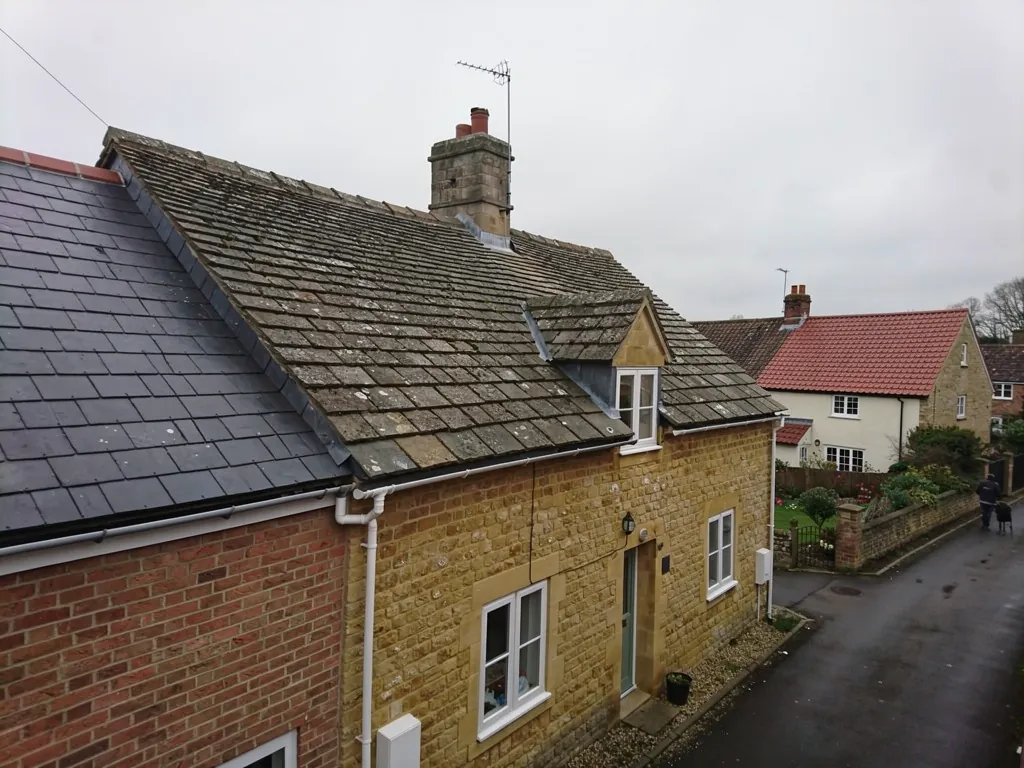
Stone slate roofs are heavy. The council guidance puts them at about 1,000 kg per 10 m². Everything under them was built to carry that weight, and everything under them has also had decades to sag, rot or be notched by later alterations. When we strip a stone roof and find soft timber at the wall plate or rafter feet, the repair belongs to the project, and it is better to learn about it at the survey than on day three.
A change of covering also has consequences for the building regulations. According to the Planning Portal, a covering that makes the structure 15 per cent or more heavier brings in a building control application, while Approved Document A calls a loading increase of more than 15% significant. Going from a light covering to stone is therefore a conversation for your building control body before any scaffold goes up. We explain the notification route and handle it where the work is notifiable.
Scaffolding and VAT
Access is a real cost on a stone roof and belongs in any total you are weighing up. A MyBuilder guide updated in August 2026 gives around £850 to £1,200 for a typical two-storey house, with more for a wrapped or awkward building. Always ask whether a total includes VAT and scaffolding, because two totals that look far apart can describe the same job in different ways.
For the full sequence of a strip, sort and relay, see our page on stone roof relaying.
When maintenance beats a new roof on cost
The lowest bill is often the roof you did not have to replace. Cotswold District Council's old technical guide reckons a regularly maintained roof of this kind can comfortably reach a century, and that yearly scraping could double the life again. Those are traditional claims from a 2000 document, not a promise about your roof, but they point the same way as common sense: moss and lichen hold water against the stone, and water is what splits it in frost.
Cleaning has its own cost. A MyBuilder roof cleaning guide from August 2026 puts slate roof cleaning at £500 to £1,000, but stone is softer than most slate and pressure washing can damage it, so the method matters more than the number. Our page on stone roof cleaning explains what is safe and what is not.
How do I know if repair is enough?
It depends on how many slates have failed and why. A handful of slipped or cracked slates, refixed on new pegs, can be an inexpensive visit. A roof where the pegs are failing everywhere, or where the battens have rotted, is a relay in waiting, and patching it only delays the bill. We would rather tell you which of the two you have, with photographs, than sell you the bigger job.
If you want to understand how long you can expect a sound roof to run, read how long a stone roof lasts.
Reading the written quote
After the survey, our quote reaches you in writing, and the photographs show your slopes as they are. It is one total price for the job as described. Stone work varies so much that the description deserves more attention than the figure. Read it for what it says about the stone itself: new or reclaimed, genuine stone slate or a reconstructed product, and whether the traditional graded courses are being kept.
What should a stone quote tell me?
It should say what happens to the existing slates, how the timbers are being treated, what the ridge and valleys will be, and whether the scaffold and VAT sit inside the figure. It should also say who deals with consent where the building is listed or in a conservation area. Anything vague is worth clarifying in writing before you weigh one total against another. It is also fair to ask how the slates will be sorted on site, how breakages will be handled, and who is responsible for the roof between stripping and relaying if the weather turns.
Our workmanship comes with a 10-year guarantee on paper. That speaks for the quality of our work and says nothing about how long the stone will last. It is a guarantee from us, not an insurance policy.
Send us ground-level photographs, a note of any chimneys or valleys, and the pitch if you know it, and we will tell you what the survey needs to look at. Stone offcuts, broken slates and old battens go in our waste run, and your drive and garden are cleared before we leave.
You can reach us on 01793 626096, by WhatsApp or through the enquiry form. Our Cotswold stone roofing page sets out the whole service.