
A stone slate roof is not a covering you can lift off in a morning and replace with something similar. Every slate is a different size, cut from a natural bed of limestone, and each has a place on the roof that suits its length. Relaying is the job of stripping that roof right back, sorting the stone, discarding what has perished, fixing the survivors again and topping up with new stone to make good the shortfall.
It sits between a patch repair and a full recovering in new material. This guide walks through the stages in order, explains what usually goes wrong, and covers the points that change the price. If you are weighing it against smaller work, our guide to repair or relay sets out the decision, and the page on stone slate repairs covers the lighter option. Both belong to our wider Cotswold stone roofing service.
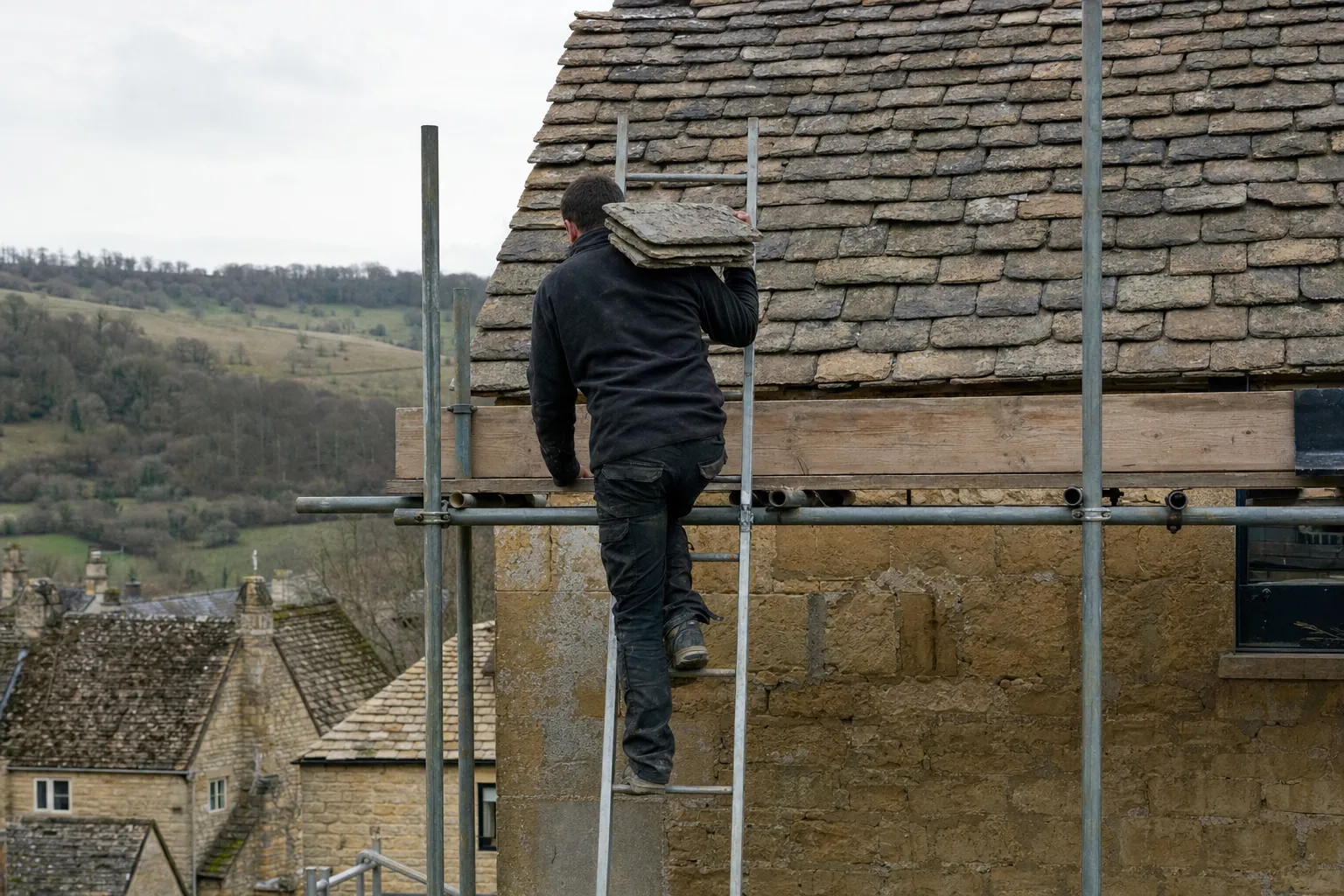
When a roof needs relaying rather than repairing
A patch repair works when the roof is sound and a handful of slates have gone. Relaying comes into the picture once the trouble is scattered over the whole slope, and you can usually see it from the ground. Slates slip in rows rather than singly. The roofline sags between the walls. Daylight shows through the loft where the covering meets the timber. Moss and algae sit heavily on one face, with bare patches beside them where slates have dropped away.
Underneath, the fixings are the usual cause. Pegs rot, nail holes in the stone elongate and break out, and the stone itself flakes along its bedding planes. When that is happening everywhere, repairing slate by slate becomes a treadmill, and each visit means paying for scaffold again.
To decide, we go up for a close look at the slates and into the loft for the timbers beneath. Pictures of the roof as it really is come with the survey, and the quote arrives in writing. Where a repair would solve the problem, that is what we put forward. Relaying is only worth the money when the fixings have failed across the roof.
Stripping: taking the roof apart in order
Work starts with scaffold, a safe edge and protection for the walls and any planting below. Slates come off in courses from the ridge down, because a lower course holds the one above it. Stripping from the bottom would bring the roof down on itself.
Each slate is lifted by hand, not levered, because stone that has sat for centuries is brittle at the nail hole. As the slates come off they are stacked on the scaffold by length, never thrown into one heap. Mixed piles lose the information the roof was carrying, namely which slates sat at the eaves and which near the top.
What is found under the stone?
Stripping is the first time anyone sees the battens, the rafters and the wall plates properly. Rotten battens are replaced. Rafter feet that have been wet for years may need splicing or sistering. Each find is recorded with a picture before it is covered up again, and you hear about it as it happens, not in a bill afterwards.
Why does it take longer than other roofs?
Because the stone is handled twice, once down and once back up, and every piece is looked at. A tiled roof is stripped and recovered in bulk. Stone is moved one slate at a time, which is slow but is the only way to keep what is worth keeping.
Sorting: the step that decides the finished roof
Quarried Cotswold stone splits into many short slates for every long one, and the roof is laid to take advantage of that. The longest, normally about 600 mm and occasionally up to 750 mm, are doubled up along the eaves. These are known as cussoms, and the course above them is the followers. Higher up each course is a little shorter, and at the top the smallest, called short cocks, may measure only 150 mm. That gradual reduction is what gives the roof its look, and our page on diminishing courses goes into it.
Sorting means grading every salvaged slate by length, then judging whether it is still sound. A sound slate rings when tapped and shows no layers lifting along its edge. A tired one sounds dull, flakes at the corner or has a hole that has broken out.
How many slates are lost on the way?
Cotswold District Council's technical guidance of 2000 records that about 50 per cent of slates have often perished by the time stripping begins. Treat that as an old figure and a general pointer. Your roof may lose fewer or more, which is why the quote allows for new stone to make up the difference.
Good stone is never thrown out because it is the wrong size. It simply goes to the course where its length belongs.
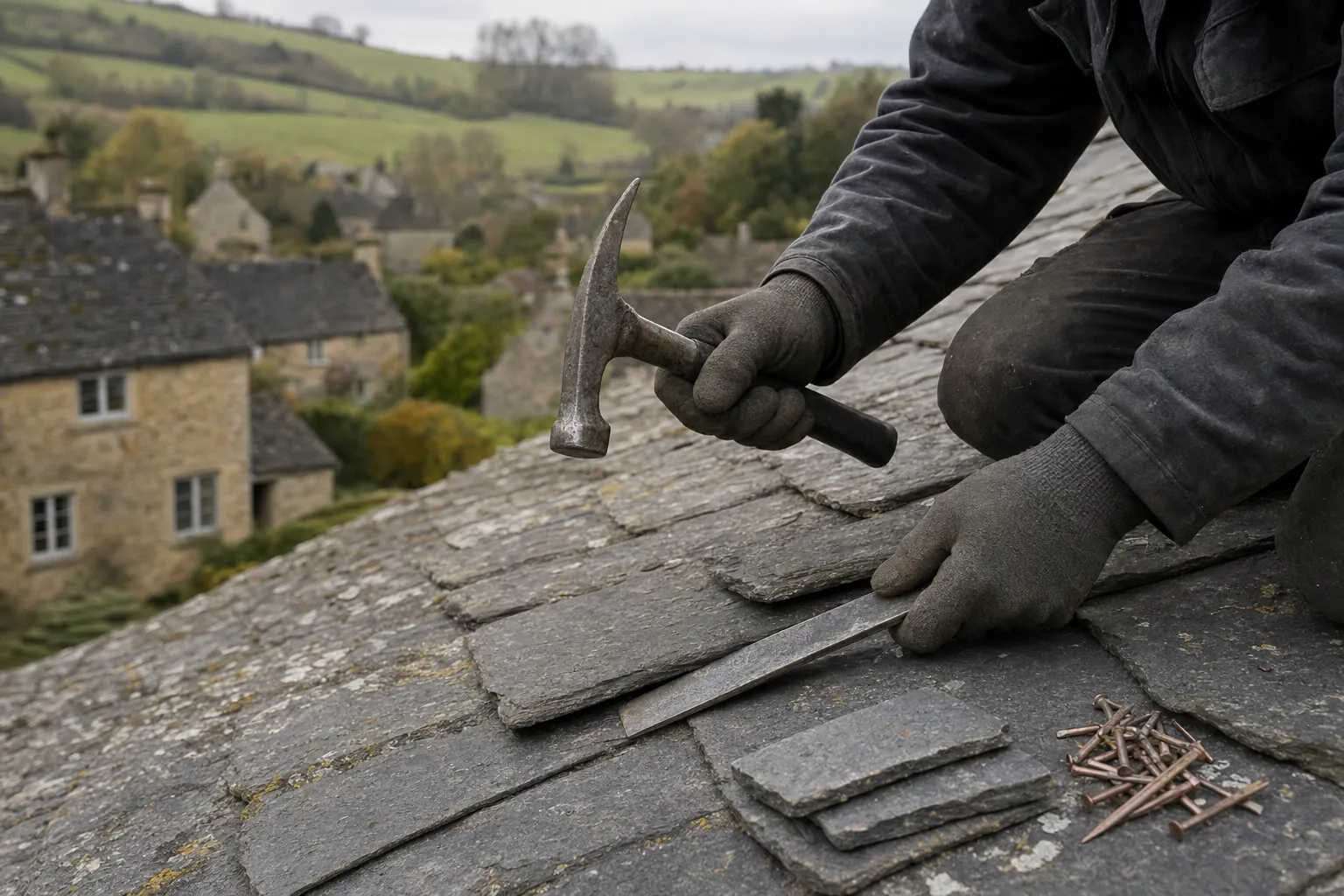
Re-pegging and fixing the slate back
Traditionally a stone slate is held by one, or sometimes two, wooden pegs pushed through a hole near its top edge, so that the slate hangs from the batten by the peg. The council guidance notes that oak was cleft to form the peg. Old pegs are removed and the holes checked. A hole that has worn oval or split is a weak point, and the slate is either turned and re-holed or set aside for a position where the fixing matters less.
New pegs are cut to suit. Our page on oak pegs explains why the material and the fit matter. A peg that is too tight splits the stone, and one that is too loose lets the slate slide.
Can nails be used instead of pegs?
Some roofs have been nailed at some point in their life, usually in a repair. Nail fixings can rust and open the hole. Whether a roof is relaid with pegs, nails or a mix depends on the building and on what the listing or local authority expects, and it is agreed before work starts. You are told what we recommend and why.
How far should each slate overlap the next?
Each slate covers the joint of the one below by a margin set by its length and the pitch, so that rain has no way through. The margin is not guessed. Courses are marked out with a gauge from eaves to ridge before the first slate goes back, and checked as the work rises. Our page on stone roof pitch explains how slope and overlap relate.
Laying back: courses, torching and the ridge
The roof is relaid from the eaves upward, with the double eaves course first, each slate bedded and pegged, and courses stepping up in the order the sorting prepared. At every course the joints are staggered, so no joint sits directly over another. At the hips and valleys the work slows down, because the stone has to be cut or chosen to follow the line. See our guide to swept valleys for how that is done.
Many stone roofs were also torched, which means lime mortar was pushed in from the loft side to seal the gaps between the slates and the battens. Whether to renew it is a decision for each roof, and we cover that in our guide to lime torching. Underlay is a related decision, which our page on underlay under stone discusses.
What goes on the ridge?
Traditionally Cotswold ridges were made from a simple angled section of dressed stone, not clay or concrete ridge tiles. Our page on stone ridge tiles covers matching and replacing them.
At the end, rubbish goes off site and the working area is left clear. Any spare sorted stone stays with you if you want it for future repairs, and a 10-year workmanship guarantee is put in writing.
Reclaimed stone, new stone and the shortfall
Because some slates fail during stripping, nearly every relaying job needs extra stone. The English Heritage policy reproduced by Cotswold District Council says that wherever possible new stone slates, not second-hand ones, should be used, and that reclaimed slates should be kept for the very building they were taken from, or its neighbours in the same group. It also says limestone and sandstone slates must never stand in for each other or be mixed on one roof.
That is why the first question about topping up is what the existing roof is made of. A limestone Cotswold roof gets limestone. Our guide to reclaimed versus new stone explains the balance, and the page on sandstone versus limestone helps you tell which you have.
Is a substitute ever acceptable?
Concrete and artificial slates are manufactured to imitate stone. That heritage policy rates them poorly for old buildings. They may suit a modern building or an extension, as our guide to reconstituted stone slates sets out.
If your house is listed, work that would change the roof covering's character normally needs listed building consent. Check with your council's conservation officer before any stripping starts.
What changes the cost of relaying
There is no honest single price for relaying, because the roof decides it. National guides give a general figure for stone slate: Checkatrade's September 2026 guide gives around £160 to £210 per m² for stone slate. It is not specific to the Cotswolds, and a hand-sorted, pegged roof can sit differently. Treat it as a pointer only.
What moves the price on your roof is practical. The first is the area and the pitch, which control how much scaffold and how many working days are needed. The second is access, because every slate is carried by hand and a roof behind a narrow lane or a garden wall costs more to work on. The third is the shortfall in sound stone, which means new slates to buy. The fourth is what the stripping reveals below the stone, as rotten battens, rafter ends or wall plate repairs add work.
Does the roof structure need checking first?
Yes. The council guidance describes stone roofs as very heavy, about 1000 kg per 10 m², so the frame must carry that load. Our page on stone roof weight and timbers explains what we look at. If a proposal makes the covering 15 per cent or more heavier, the Planning Portal says building control approval applies, and we sort out consent and the notification where the work needs it.
The quote comes to you in writing after the survey, with the survey pictures attached. Ask any contractor whether a figure includes VAT and scaffolding.