
Torching is a lime mortar, usually sand and lime with a fibre such as animal hair, that is pushed into the gaps on the underside of a roof covering from inside the roof space. On stone slate roofs it fills the open joints between slates and around the battens. Before felt and modern membranes existed, it was the layer that stopped fine snow, dust and wind-driven rain from finding a way through a covering that is, by nature, full of small gaps.
It is easy to overlook. It sits where nobody looks, it crumbles quietly, and when it fails the first sign is often dust on the loft insulation or a cold draught on a windy night, not a stain on a ceiling. People also tend to confuse it with the pointing of a chimney or the bedding of a ridge, which are separate jobs.
This guide covers what torching is for, what it is made from, how it fails, and how we deal with it when a stone roof is repaired or relaid. It is general trade knowledge, applied to the particular roof when we survey it.
What torching is, and where it sits
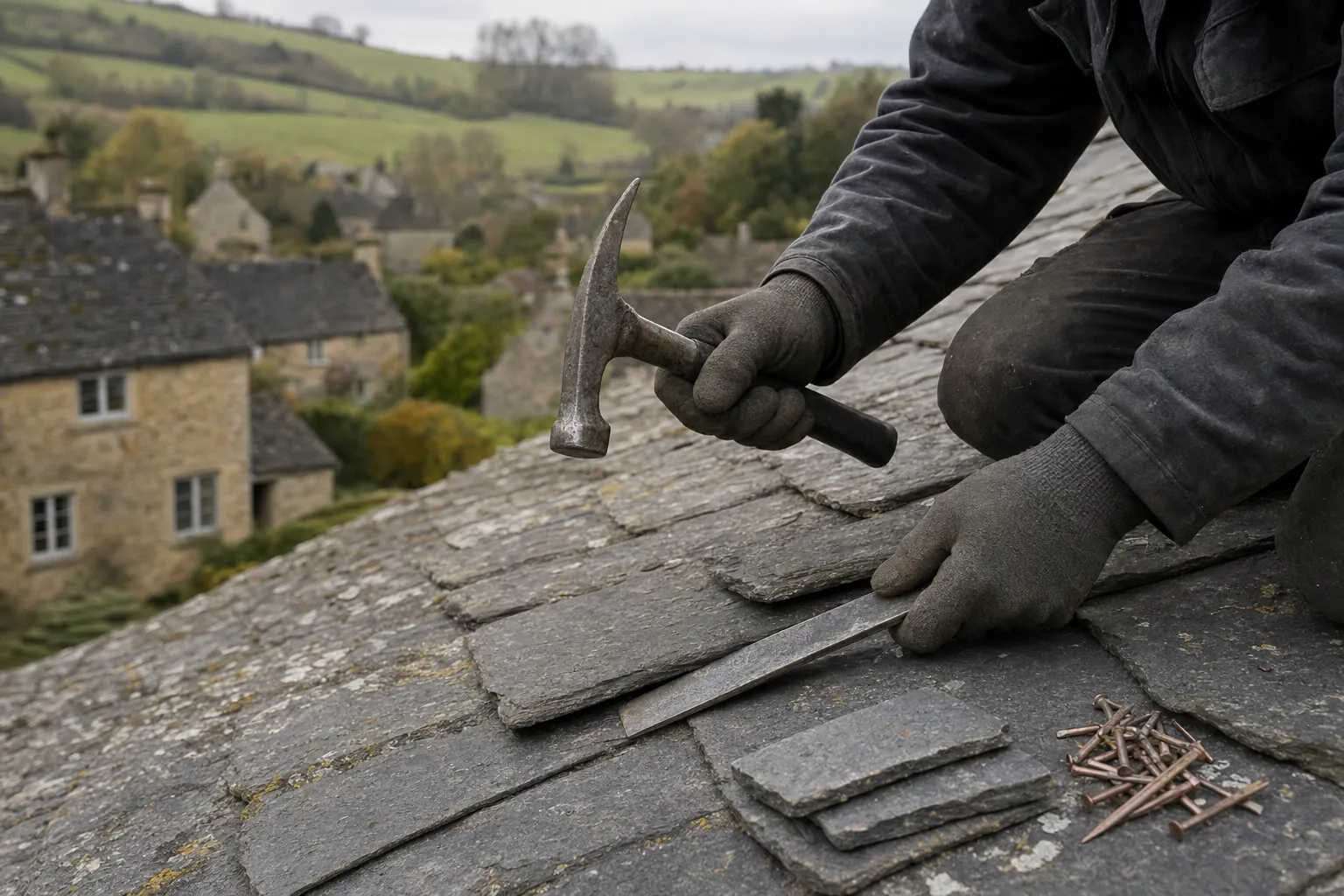
A stone slate roof is a lapped covering. Each slate overlaps the courses below, but the stone is thick, irregular and hand-split, so it does not lie flat against its neighbours the way a machine-made tile does. Between the slates there are small spaces, and the battens that carry the slates are open to the loft. Torching closes the underside of those spaces.
The mortar is applied from inside, after the slates have been hung, by pressing it with a trowel against the underside of the covering where the slate edges meet the batten. It is a flat, rough fillet along the joint, not a thick coat across the whole roof. Done well, it leaves the battens visible and the slates free to move slightly with the seasons.
The Cotswold roofing guidance from the district council describes traditional roofs as slates hung from wooden pegs over the batten. A pegged slate sits on its batten with no fixing nailed through the face, which means the underside of the roof is where the draught gets in. Torching was a practical answer to that.
Where an old roof has been lined with a modern underlay beneath the slates, the torching may have been left in place, removed during the work, or buried. That is one of the things we look for when we survey a stone roof from the inside.
What torching does for the roof
The first job is to stop fine, wind-driven moisture. In a storm, rain and snow can be forced sideways and upwards beneath the lap of a slate. Stone slates are laid with a deep overlap to manage that, but a hand-split slate is never perfectly flat, so air and spray get through. Torching blocks the route at the joint.
The second job is to keep the slates steady. Wind pulls at a stone roof, particularly near the verges and eaves, and a mortar fillet under the slate gives it a little extra support. It does not replace the peg, and it is not what holds the slate up. It does damp the rattle and take some of the load from the pegs.
The third is draught. A stone roof without torching or an underlay can be cold and noisy, with a fine dust forming in the loft from the roof's own particles. A well-torched roof feels calmer.
Does torching keep a roof watertight?
No, and it is not meant to. The slates keep the rain off. Torching is a secondary barrier against the spray and the fine snow that the lapped stone lets through. If a roof is leaking after ordinary rain, the cause is more likely a failed peg, a cracked slate or a defective valley, and we deal with those first.
Is torching the same as pointing?
No. Pointing is the mortar visible on the outside of walls, chimneys and stone ridges. Torching is on the inside of the roof. They may use similar materials, but they are different repairs done in different places, and a roofer who quotes for one is not necessarily covering the other.
Why lime, and why not cement
Torching is made with lime because of what lime does. Lime mortar is softer than the stone it touches, so when the roof moves, the mortar cracks first and the slates are spared. It also lets moisture pass through it as vapour, which matters in a roof where timber, stone and air are all exchanging damp through the seasons. A hard, dense mortar traps moisture against the battens and rafters, and the first place that shows it is the timber.
Cement mortar fails in the opposite way. It is strong, but it is brittle and it does not move with the roof. It cracks away from the stone, and the cracks hold water. Cement smeared over an old roof to stop a leak is a familiar bad repair. It can bind several slates together, so that when the roof flexes, the stone cracks instead of the mortar.
What goes into a lime torching mix?
Traditional torching is lime and sand, with animal hair or a similar fibre to bind it. Mixes vary with the roofer and the building, and what matters most is that the mortar is compatible with an old roof. When we repair or relay a stone roof, we specify lime for any torching, and the written quote names it, so nobody is left guessing what goes under your slates.
Modern products sold as quick fixes are not the same. Foam, sealants and spray-on coatings are used to close gaps from the inside of some roofs, and the Energy Saving Trust has noted its concern about spray foam applied to the underside of a roof without fixing the underlying problem first. We would not use it under a stone roof.
How torching fails and how to spot it
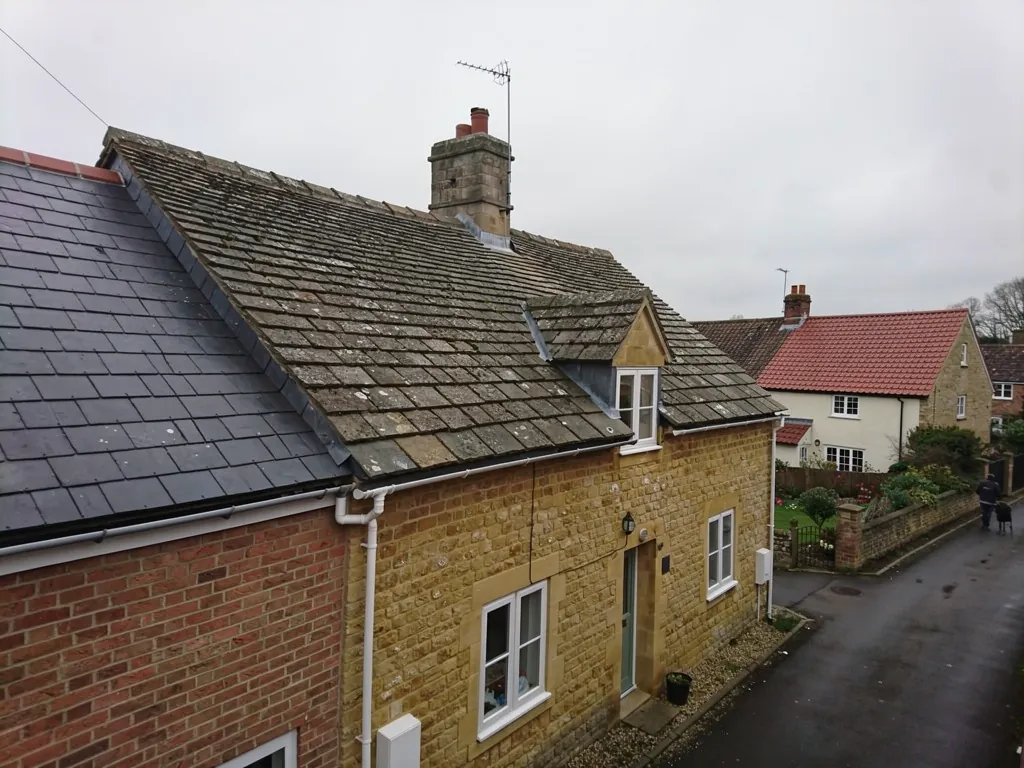
Lime torching has a long life, but not an unlimited one. It fails in a few recognisable ways, and most of them are visible from the loft with a torch and a few minutes.
What does failed torching look like?
Typical signs are grey or white dust on top of the loft insulation, small crumbs of mortar on the ceiling joists, pinpricks of daylight between the slates from inside, and a draught on windy days. Torching that has fallen away in patches leaves the battens exposed, and you may see the underside of the slates where there was once a layer. A rough, powdery surface that comes away on a finger has lost its hold.
Movement causes much of it. As a roof flexes in wind, sags over decades or is disturbed by repairs, the bond between mortar and stone breaks. Moisture is another cause. A roof that leaks, or a loft with condensation, soaks the mortar and weakens it. Frost does the same in a damp spell.
Disturbance is the third. Every time someone replaces a slate or refixes a peg, they disturb the torching around it. An often-patched roof can end up with torching intact in the corners nobody visited and missing along the lines of every repair.
Do not poke at torching with a stick or vacuum it up. If it is crumbling, leave it and photograph it, since loose torching pulled down in one go can open a draught across a whole slope.
Fallen torching is a symptom, and what matters is why it fell. Our guide to stone roof structure explains the timbers that the stone and the mortar both depend on.
When torching is renewed, and when it is left alone
Sound torching is best left in place. It has been working for decades, and removing it risks disturbing the slates around it. If the roof is performing, with no draught, no dust and no sign of moisture, there is no reason to rebuild it.
Renewal is sensible in two situations. The first is a roof being stripped and relaid, where the old torching comes away with the slates and the roof needs a fresh layer once the slates are back. The second is a roof where the torching has failed along one slope or in patches, and the loft shows daylight or dust. In that case a repair from inside, using lime, can be done without lifting the covering.
Can torching be done with the slates still on?
Often, yes, if there is safe access in the loft and the battens are sound. The roofer works from beneath, pressing the mortar into the gaps. It is slow, careful work in a restricted space, and the cost depends mainly on access and the area to be covered, not on the material.
Does it affect insulation?
It can. Torching lets moisture pass as vapour, while deep insulation laid over the joists can change how moist air moves through the roof space. We discuss that at the survey before any work, because a well-meant upgrade can cause damp in a roof that has survived without one.
For the routine care that keeps a roof healthy, see our page on stone roof maintenance and the advice on stone roof cleaning.
Torching, ridges and the other mortar on a stone roof
A stone roof has several kinds of mortar, and they are easy to mix up. Torching sits under the slates. Bedding mortar holds the ridge and, on some roofs, the stone at the verges. Pointing fills the joints in the chimney. Flaunching is the sloped cap around the pots. Each has its own failures, and a fault in one can show up as a symptom near another.
On traditional roofs the ridge was made of dressed stone, and the council guidance records that it was always a simple angled section of stone. Those ridges are bedded in lime. We look at them in our guide to stone ridge tiles, because a loose ridge can let water behind the top courses and wash out the torching beneath.
What do we do on a survey?
From the loft we photograph the torching, the battens and the pegs wherever we can reach them, and mark which areas are sound and which are not. The written quote follows from what the survey shows, and where torching is part of a bigger repair it is described together with the rest.
A written 10-year guarantee covers our workmanship; it is our promise and not an insurance policy. Debris from the loft goes with us when the job is finished. If you have noticed dust in the loft, a draught under the slates or crumbling mortar, ring 01793 626096, try WhatsApp, or send the enquiry form, with a photograph of the loft if you can take one.
For the full range of stone slate work, return to Cotswold stone roofing.