
Few coverings in Britain can match a Cotswold stone slate roof for staying power. Cotswold District Council's technical guidance, written in 2000, puts it this way: with regular maintenance the roof can comfortably reach 100 years, and might reach 200 or 300. The words that matter in that sentence are regular maintenance. Left alone, the same roof loses pegs, then slates, then the timbers beneath them, and a repair that would have cost little becomes a relay.
Maintenance, in practice, is mostly looking. A couple of unhurried checks a year, from the garden and from the loft, catch nearly everything while it is still small. This guide sets out what to look for, where to look, which small repairs repay doing early and when a job is bigger than it appears. It sits within our wider Cotswold stone roofing service, which covers repairs, relays and listed work in the same stone.

A routine that suits a stone roof
Spring and autumn are the natural points. Autumn catches the leaf fall before it settles into valleys and gutters for the winter, and spring shows what the winter did. After a severe storm or a long freeze, an extra look is worth the few minutes it takes.
Nothing in the routine needs you to climb onto the roof. A stone slate roof is heavy, brittle at the edges and slippery when damp, and a stranger's boots crack slates that were sound a minute before. Everything below is done from the ground, from an upstairs window or from inside the loft.
Keep a few notes as you go, with the date, the slope and anything you saw. A photograph taken from the same spot each time makes change obvious, because slipped slates and spreading moss show far more clearly in a series than in memory. The notes also give a roofer, a surveyor or a conservation officer something to go on if a fault needs explaining.
What should I take with me?
A pair of binoculars, a torch and a notebook are enough. Binoculars turn a view from the lawn into a close look at the ridge, and a torch lets you see into the corners of the loft. A phone camera with a good zoom does the same job as the binoculars and leaves a record.
Does the time of day matter?
Low sun from the side picks out the texture of the slates and shows up any course that has slumped, so early morning or late afternoon is ideal. Flat midday light hides detail. Overcast days suit the loft check badly, since weak daylight makes pin-pricks of light harder to spot, and bright days suit it best.
Checks from the ground
Step back until each slope fits in view. A stone roof should look orderly even when it is uneven: courses running level, the largest slates low and the smallest high, no sags and no dark gaps.
- Slipped slates. A slate that has dropped leaves a dark slot across the course and a pale tongue below it.
- Missing or cracked slates. Holes in the pattern, or slates that show a visible line across the face.
- Ridge stones. Check that the line runs straight and no stone has shifted. Traditionally a ridge was a plain angled piece of dressed stone, as the council's guide describes.
- Valleys and swept valleys. Look for debris, vegetation and slates that have moved at the edges.
- Chimneys and abutments. Look at the leadwork and the pointing where the roof meets stone walls and stacks.
- Gutters and downpipes. Overflowing water stains the wall below and soaks the eaves courses.
Trees deserve their own glance. Branches that brush the roof in a breeze wear the slates, and overhanging boughs drop leaves, twigs and seed. Ivy and climbing plants that reach the eaves should be cut well back, since tendrils work under slates and lift them.
Where moss and crust have built up, the place for them is our guide to cleaning a stone roof, which explains why hand scraping is the right method.
Checks from the loft
The loft shows what the outside hides. Go up on a bright day, switch the light off and wait a minute for your eyes to adjust. A stone roof is laid on battens or laths with slates hung on pegs, and where it has been torched with lime the underside is pointed up. Pin-pricks of daylight through the roof are the first sign that torching has loosened or a slate has moved.
What does damp look like up there?
Dark staining on the underside of the battens or on the rafters, damp patches on the wall plate and a musty smell all suggest water getting in. Notice where the stain sits. A mark directly below a valley, a chimney or a ridge stone points at that detail. A mark that spreads in a line following a rafter often means a single slate has slipped higher up and the water has run down the timber.
What else is worth finding?
Fallen lime mortar on the insulation or the ceiling, loose pegs and fragments of slate on the floor all mean something has moved. A pile of oak peg ends or flakes of stone beneath one place is a clear clue. Lime torching, and the roof structure that carries the stone, are covered in our pages on lime torching and stone roof structure.
Take care over insulation too: it hides the joists, and a misplaced foot goes through the plaster below. Do not stand on the ceiling joists. Walk on boards laid across them, and keep clear of any area that looks sagging or wet.
Small repairs worth doing early
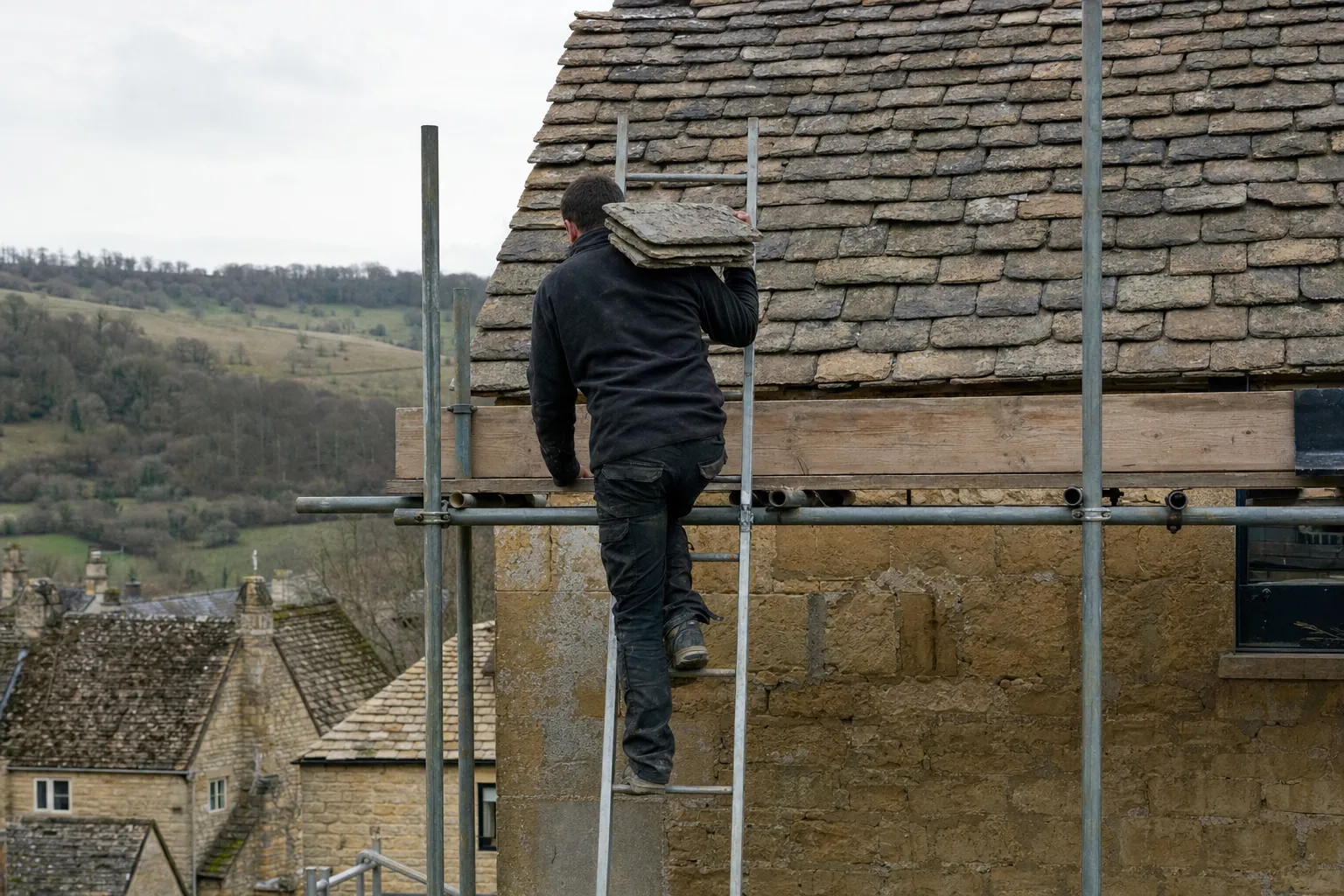
A stone roof rewards early attention because the cost of a repair grows as it ages. A single slate refixed on a new peg is a short visit. The same slate, left to slide and take its neighbours with it, can become a whole course.
The jobs that most often pay off when done early:
- Refixing or replacing slipped and cracked slates, with new oak pegs where the old ones have failed.
- Re-pointing ridge stones and renewing the bedding where it has crumbled.
- Patching lime torching where daylight shows, so wind-driven rain cannot lift slates from below.
- Renewing flashings and soakers at chimneys, parapets and abutments.
- Clearing and relaying a valley that holds debris or has started to open.
Matching matters in every one of these. A replacement slate must be the right length for its course, and it must be the right stone. Under the traditional-stone policy, sandstone is never a substitute for limestone, and the reverse is true too. Our guide to sandstone against limestone slates shows how to tell the two apart. A concrete stone-effect tile dropped into a gap is a worse repair than it seems, and our page on reconstituted stone slates explains why.
A repair should use the same stone, the same length of slate and the same fixings as the course around it, or the roof starts to fail in a new place.
Gutters, trees and the things around the roof
Much of what damages a roof starts beside it. A gutter sagging between brackets collects water and spills onto the eaves, saturating the lowest courses and the wall plate. Gutter makers advise a slight slope to the outlet, somewhere between 1 in 600 and 1 in 350 depending on the system, so a section that dips or holds a puddle is worth putting right.
Clearing the gutters in autumn is the simplest job in the whole routine. Do it from a safe ladder, or have it done, and check at the same time that downpipes run freely and that the water lands in a gully, not against the wall. Cast iron gutters on older houses are heavier and more brittle than plastic ones, and they fail at joints. Check the bracket fixings into the fascia or the stone as well: a gutter full of water is heavy, and loose brackets are how a sound run comes down in a winter storm.
The same attention applies to anything attached to the roof edge. Verge stones, fascia boards and the pointing of a parapet gutter all take their share of weather. A quick look at each, noted in the same book, completes the picture and keeps the roof and its surroundings in step with one another.
Aerials, satellite dishes and solar fittings fixed to a stone roof are another source of slow trouble. Brackets that pass through slates make holes the peg cannot cover, and cables run beneath slates chafe. If something new is to be fixed, have it done by someone who understands stone, and on a listed building ask the council first.
Finally, think about who goes on the roof. Chimney sweeps, aerial fitters and window cleaners all walk across roofs from time to time. A stone roof needs a roof ladder or boards, and anyone who steps on the slates directly can crack several in a visit.
When the job is bigger than maintenance
Some signs point beyond routine upkeep. Several slates slipping across the same course, a slope that has visibly dipped, rafters or battens that are dark and soft, daylight showing across wide areas of the loft and a ridge that has moved all tell you the structure or the fixings are failing in a way patching will not cure.
The same guide reports that around 50% of the slates are commonly perished when a roof comes off. That comes from the experience of relaying, and it is a reminder that a roof can look acceptable from the ground while a lot of its stone is spent. A survey with photographs from the roof settles the question one way or the other.
Our advice follows the fault: where upkeep alone will do, the written quote says so, and if a relay is the sensible answer we explain why and show the evidence. The choice between repair and relay has a page of its own, repair or relay, and the full range of work is on the Cotswold stone roofing page.
For what a year-on-year habit does for a roof, the council's guide has a view worth repeating: a stone roof that gets regular attention may last twice as long as one that does not. Our workmanship guarantee runs for 10 years and is issued in writing, and at handover we clear the site and carry the waste away.