
A stone slate roof that has gone green is not a roof in distress, but it is a roof asking for attention. Moss holds water against the slates, grit and leaf litter pile up in the valleys, and a heavy mat of growth can hide a slipped slate or a failing peg until a ceiling stain tells you about it. Owners, understandably, reach for whatever promises the quickest result, and these days that is often a pressure washer on the end of a long lance.
For Cotswold stone that is the wrong tool. The traditional method is slower and quieter: a person on the roof with a scraper and a brush, taking growth off by hand and looking at every slate as they go. This guide explains why that method wins, what it involves, how often it makes sense and what a national price guide says it costs. If you want the broader picture of looking after a stone roof, start at the Cotswold stone roofing page.
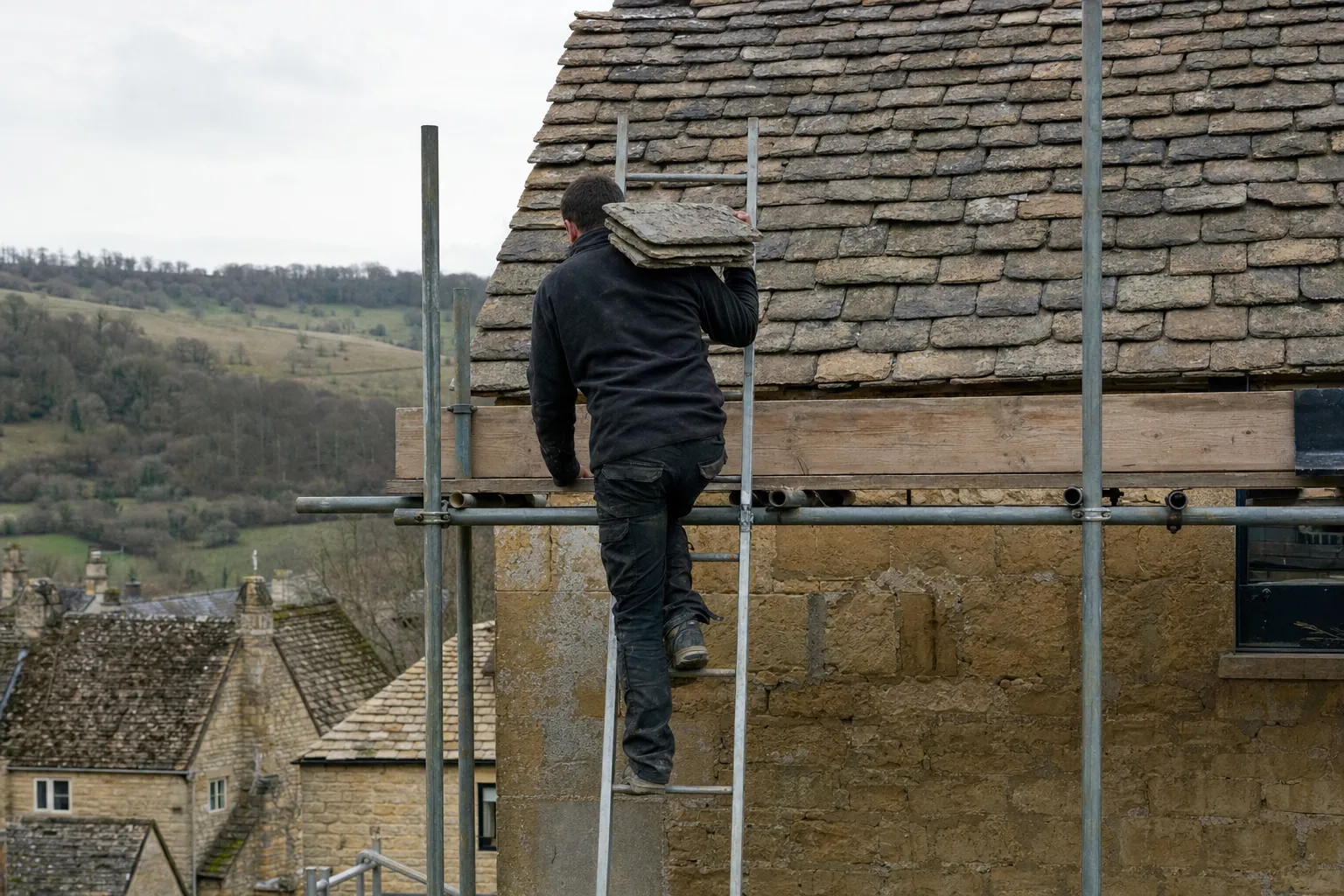
What a stone roof needs cleaning of, and what it does not
Not every green or orange patch is a problem. Thin lichen on a limestone slate is part of how an old roof looks, and it does little harm. Spots of orange, grey and yellow crust across a roof are a sign that the stone is old and has been weathering quietly for generations. Taking all of that off would leave a bare, pale roof that looks wrong beside the walls beneath it.
What needs to come off is the thick stuff. A mat of moss, a layer of compacted leaf mould at the foot of a slope, seedlings rooting in a gap between courses, ivy tendrils creeping under a slate edge. Moss holds rain in its fibres and keeps the slate surface wet for longer, which gives frost more to work on in winter. Growth that sits in the gutter or valley can block the flow so that water backs up under the slates.
Is a green roof a failing roof?
Not on its own. Colour tells you about damp and shade, not about the condition of the stone. A north slope under trees will always go greener than a south slope in the open. What matters is whether the growth is lifting slates, blocking water paths or hiding damage, and only a close look at the roof will tell you.
Should I treat or scrape?
Hand scraping removes the growth itself, where a treatment only kills it and leaves it in place. On a listed building any product applied to the roof is worth clearing with the conservation officer first.
Why pressure washing does harm
A pressure washer is built to push water hard at a surface and strip whatever sits there. Nothing about a stone slate roof is flat or sealed, and it was never meant to be treated as if it were.
The first problem is the laps. Each slate sits over the joint between the two below it, and rain is meant to run off downwards. A jet fired from below or from the side drives water sideways and upwards into those laps, under the slates and onto the battens and the timbers. The roof is soaked from the inside by the very process meant to clean it.
The second problem is what sits under the slates. Traditional stone roofs were often sealed on the underside with lime mortar, a practice called torching. Force-fed water softens and washes out that lime, which is soft by design. Our page on lime torching explains what it does and why it matters.
The third is the stone itself. Oolitic limestone is a soft rock, and a hard jet strips the weathered skin that took generations to form, exposing fresh stone that is more porous. A price guide from MyBuilder, updated on 21 August 2026, lists pressure washing among the roof-cleaning methods and warns that it may damage delicate tiles. A stone slate is delicate in just that sense.
How hand scraping is done
The method is simple, which is part of its appeal. A roofer works across the roof with a plastic or wooden scraper, lifting moss and crust away from the face of each slate, then follows with a stiff brush to sweep loose material down the slope and into the gutter or a collection sheet. A metal blade held at a hard angle can skin soft stone, so a plastic or wooden edge is the sensible choice.
How does anyone get onto a stone roof safely?
Slates of this kind are heavy, and a stone roof carries its own considerable weight on the structure beneath it. The council's technical guide says stone slate roofs weigh about 1000 kg for every 10 square metres. Walking about on loose slates can crack them, so the work is done from roof ladders and crawling boards that spread the load, with scaffold edge protection where the pitch or the height call for it. Good access is part of the job and it affects the price. Where the roof meets a parapet or a chimney, extra care is needed so that a boot or a ladder foot does not crack the slate beside it.
What about the ridge and the valleys?
Ridge stones, valley slates and the courses around chimneys collect the most growth, and they are the places where a slip is most expensive. We clear them by hand, check the bedding and the lead as we go and mention anything that needs a repair.
The work is done in dry weather. A wet stone surface is slippery, and scraping wet moss simply smears it.
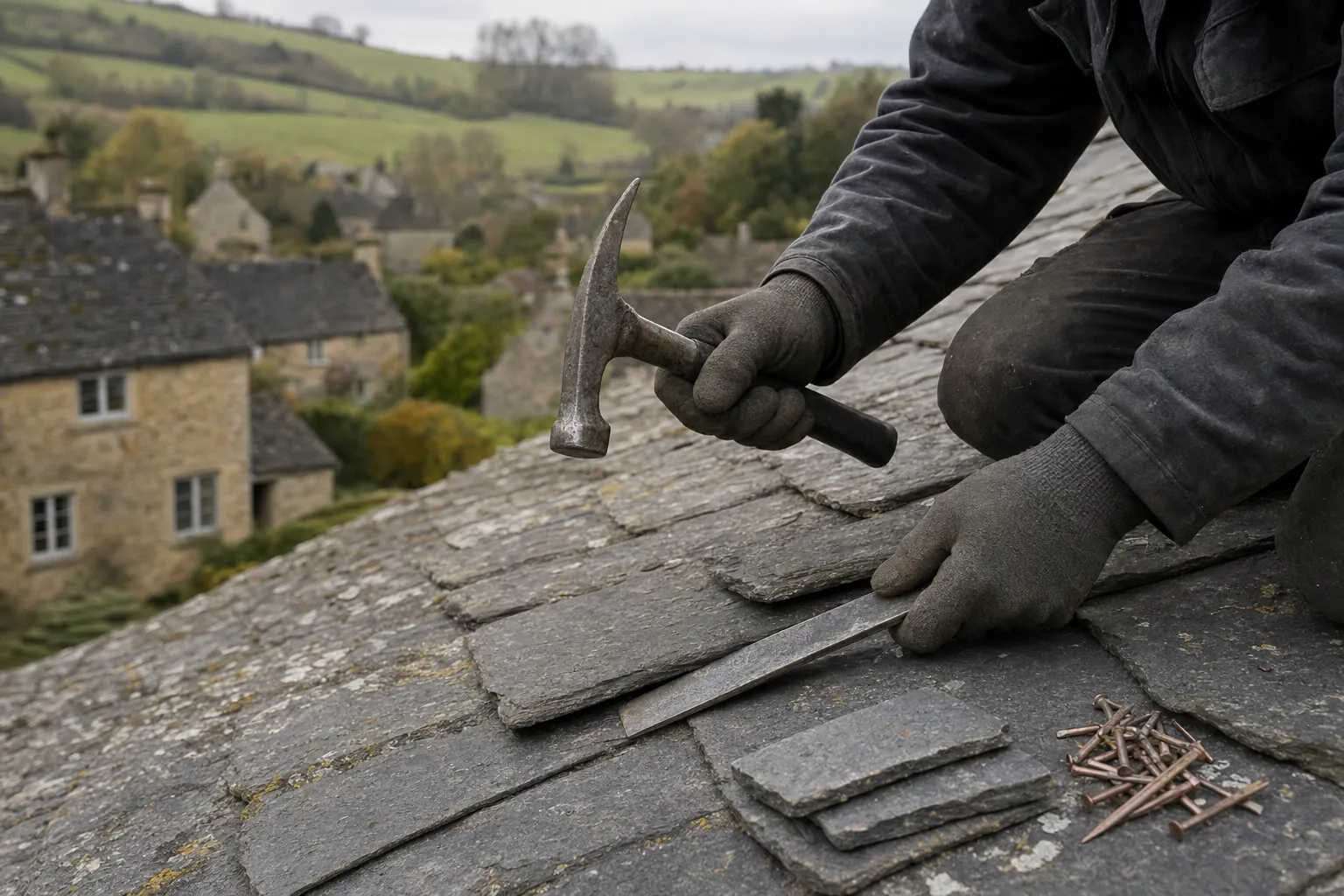
How often should a stone roof be cleaned?
There is no fixed interval, but the old guidance sets a high bar. The Cotswold District Council technical guide, written in 2000, passes on the traditional belief that scraping a stone roof every twelve months could double its working life. It is a traditional rule of thumb, not a guarantee, and nobody should treat it as one. The point it makes is sound, though: regular attention extends the life of the roof far more than occasional large interventions.
Plenty of roofs do well on a lighter schedule. A south-facing slope in the open needs less than a shaded north-facing one under a beech tree. A roof beside a field gets more airborne seed than one in a village centre. Leaf-fall in the autumn is the most useful trigger, since valleys and gutters fill at that time of year and then sit wet all winter.
A practical pattern is a glance from the ground each spring and autumn, then a proper scrape when growth thickens enough to hold water. Our page on stone roof structure explains how the layers beneath the slates respond to damp, which is the reason the habit pays off.
What cleaning shows you
A scrape is also an inspection. Once the cover of moss is gone, every slate can be seen and tested, and faults that were invisible a day earlier stand out.
- Slates that have slipped from their pegs and now sit crooked in the course.
- Laminations, where the stone has begun to split in layers and will shed a flake in the next frost.
- Broken or rotted pegs, which show as a slate that rocks when pressed.
- Lime torching that has crumbled, which shows from the loft as daylight or dust at the slate heads.
- Cracked ridge stones and eroded mortar beds.
Most of these are small jobs when caught early. A slate refixed or replaced after a scrape is a minor repair, while the same slate lost to a winter gale can let water into the roof for weeks. The sizes of replacement slates matter, because a roof is laid in diminishing courses and a repair needs the right length for its place. Our guide to diminishing courses shows how that works.
Our rule is to propose only what the fault demands, so a scrape that turns up two slipped slates ends in a repair to those two, not a proposal to relay the roof. If the survey finds more, we show you the photographs and say so.
What cleaning costs, in national terms
Price guides give a rough idea of how the methods compare, though none is specific to Cotswold stone, and your own roof is priced on its size, height and access. The figures below are from MyBuilder's roof-cleaning guide, updated on 21 August 2026, and are typical UK ranges, not prices from us.
| Method | Typical rate per m² |
|---|---|
| Manual scraping | £5 to £10 |
| Pressure washing | £10 to £15 |
| Soft wash | £15 to £20 |
| DOFF system | £20 to £30 |
The same guide says moss removal starts from around £300. Manual scraping has the lowest rate per square metre on that table, and it is the one that suits stone, so the usual trade-off between cost and care does not apply here. The cost that varies most on a stone roof is access: a steep pitch, a tall house or a tight yard can add scaffold or specialist ladders to the work.
Our page on the cost of a Cotswold stone roof goes into what drives larger jobs. Following the survey you get one written price, backed by photographs, and the site is cleared when the work ends.
Stone compared with Welsh slate
People who have cleaned other roofs often assume the same approach works everywhere. A Welsh slate is a dense, smooth, hard-faced material, and it tolerates more vigorous cleaning than stone does, though even then the laps and the fixings limit what is sensible. Cotswold limestone is rougher, softer and more absorbent, and it carries its history in its surface. Our comparison of stone and Welsh slate sets out the differences in more detail.
The takeaway for cleaning is plain. Use the gentlest method that works, do it by hand where you can, and leave the weathered colour of the stone alone. If a roof contractor proposes a pressure washer for your stone roof, ask how they plan to protect the laps and the torching, and what they will do if water appears in the loft afterwards. A good answer is a plan for scraping instead.
Our work comes with a 10-year workmanship guarantee in writing, and a survey is the first step: we look at the roof, photograph what we find and tell you what it needs, which is often less than you feared.