
Diminishing courses means that each row of slates is a little shorter than the row below it. The biggest stones sit along the bottom edge of the roof, the smallest sit near the top, and everything in between steps down in size. Cotswold buildings are the best-known example in England, though the habit belongs to stone roofing more widely.
It is not a decoration, although it is what gives these roofs their soft, graded texture. The pattern comes from the stone itself, from the way a roof sheds water, and from the weight the structure has to carry. It also explains why a roof like this cannot be stripped and relaid like a tiled one: every slate has a place, and putting a slate in the wrong place leaves a roof that looks wrong and leaks sooner.
This guide uses the Cotswold District Council technical guidance for the names and sizes, and explains in plain words what it means for a repair or a relay.

Why the slates get smaller as they climb
The reason starts in the ground. According to the council guidance, the rock splits into small slates in far greater numbers than big ones, so a quarry, or a stripped roof, gives a heap that is heavy with the smaller sizes. Nobody picked small stones for the ridge out of taste. The heap was what it was, and the roofers learned where each size would work best.
The arrangement suits the water as well. The lower part of a roof slope carries the run-off from everything above it, so it faces the heaviest flow. Large slates there mean fewer joints in the busiest place and a wide overlap between courses. Near the ridge only a little water arrives from above, so a small slate does the same work without trouble.
Weight plays a part as well. Stone is dense, and a big slate with a deep overlap is the heaviest piece in the covering. Setting the large ones at the eaves places the heaviest courses low on the slope, near the walls that carry the roof, instead of piling them up at the ridge. The council guidance describes a whole stone roof as very heavy, at about 1,000 kg for every 10 m².
Finally, there is the eye. A roof that steps down evenly looks calm from a distance, and a sudden jump in slate size reads at once as a repair. That is why conservation officers and neighbours notice badly sorted stone long before a leak appears.
Cussoms, followers and short cocks
The trade has names for the sizes, and the council guidance records them. At the eaves there is a double course of the largest slates, called cussoms. The guidance says these are normally about 600 mm long and occasionally up to 750 mm. Above them come the followers, which start large and step down as the courses rise. Highest of all sit the short cocks, the smallest slates on the roof, recorded in the guidance as only about 150 mm in length.
The doubling at the eaves is worth a moment. The first course is laid twice so that every joint in the lowest course is covered by a second slate, and so the whole bottom edge has the depth to kick water clear of the wall. Most tile roofs do something similar with an eaves course for the same reason.
Is a slate's name linked to its size alone?
Largely, though local naming varies. The same guidance says southern parts of the district lean towards the word tile and northern parts towards slate, so you may hear both words for one material depending on where the roofer learned the trade. We explain the vocabulary further in our page on Cotswold slate names.
What are the sizes in between?
No fixed ladder of dimensions applies to every roof. A roofer sorts the stone into lengths by eye and by tape, then sets the batten spacing to suit what is in the pile. The size of each course is therefore a fact about one roof and one heap of stone, not a table to look up and follow.
How the courses are set out on the battens
On a standard tile roof, battens run across the rafters at one even spacing from eaves to ridge. A diminishing roof cannot work like that, because every course needs a different spacing. The roofer therefore sets out the battens after grading the stone, so that the rows narrow gradually up the slope and the ridge ends on the smallest slates in the pile.
The setting out is a skilled job done before any slate goes on. The roofer works out how many courses the slope will hold, divides the stone into groups by length, and marks the battens so each group lands where it belongs. A mistake here is hard to correct later, because it shows in the courses all the way to the ridge.
What is a headlap, and does it change with size?
Headlap is how far one slate overlaps the course two rows beneath it, and it is what stops wind-driven rain being pushed up and under the slate. In a diminishing roof the lap has to stay adequate in every course, so each batten position comes from the slate length, less the lap and a little for the fixing. The right lap depends on the slate, the pitch and how exposed the building is, so it is something we work out on the roof itself.
If you are relaying a roof, the battens are almost always replaced and re-spaced. Old battens are rarely at the right spacing for a restored pattern. The stages are described in our guide to stone roof relaying.
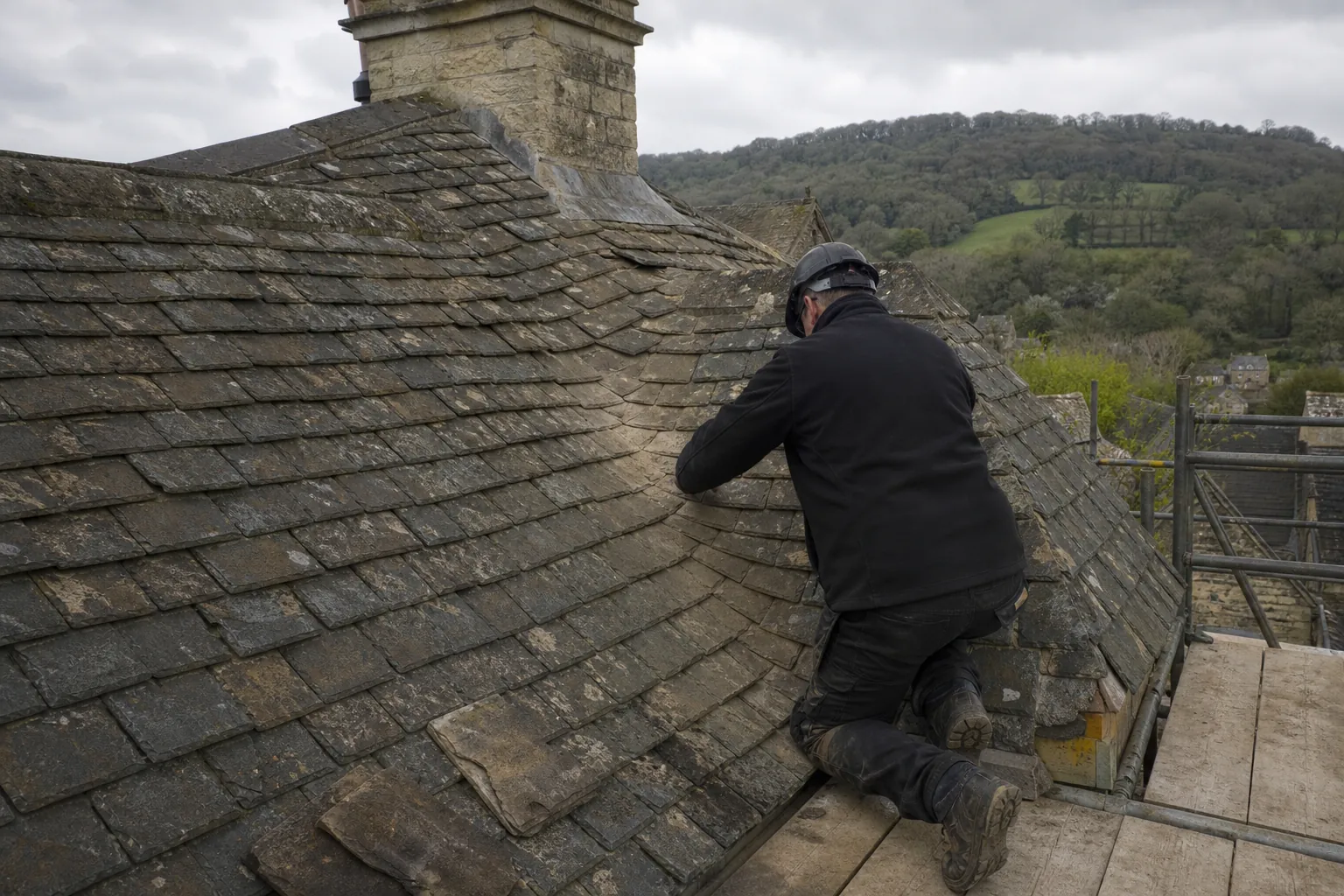
Sorting old stone back into courses
When a stone roof comes off, the work that follows is almost as skilled as the laying. Each slate is lifted by hand, and the good ones are sorted by length into stacks. Cracked or laminated slates are set aside, and a roof stripped after a long life often loses many of them. The 2000 council guidance describes about half the slates as commonly perished once stripping begins. That is an old general observation, and your roof may be better or worse.
The sorted stacks then become a plan. The longest stone goes back to the eaves, the next group up the slope, and so on, with the short ones kept for the ridge. If the lost slates are mostly the largest, the roof may not be able to return to its original pattern, and some new stone has to be brought in to make up the sizes that are missing.
Why does the roof come back looking different?
Because it never comes back in the same arrangement unless the stone is graded carefully and the pattern is rebuilt course by course. A roof relaid without grading looks patchy, with large and small stones side by side. It also sheds water less reliably, because short slates in a lower course have less lap than the design assumed.
Our page on reclaimed versus new stone explains when new slates are needed to make up the shortfall and what policy says about where second-hand stone can be used.
What happens to the pattern when a repair is needed
A single slate that has split or slipped can usually be replaced with a slate of the same length from the same course. That is the sensible repair, and the fixing is straightforward if the replacement has a hole at the right place for its peg. The point of the diminishing pattern for a repairer is that a replacement must be the right size for its course, not just the right colour. A short stone in a long course sits too low and lets water in at the head.
Wider repair is different. When a whole section of roof has failed, the pattern around it needs rebuilding. A patch of mixed sizes among regular courses stands out from the lane and may leave a weak line where the old and new work meet. We would rather take the repair back to a clean line than leave a patch that will be redone in three winters.
Can I mix new and old stone in a course?
It can be done in a small way if the sizes and thicknesses match, but a course should be consistent. Thin new stone beside thick old stone gives an uneven surface that holds water in the wrong places. Mixing different kinds of stone is a different question altogether, since English Heritage policy, as printed in the council guidance, rules out sandstone and limestone ever sharing a roof or being swapped for one another.
For the wider question of when to stop patching and start again, see the hub page on Cotswold stone roofing.
Diminishing courses and the cost of the job
The grading is a major reason that stone roofing costs more than tiling. A tile arrives uniform and a roofer lays it at one spacing. Stone arrives mixed, and every slate has to be considered. The time goes into sorting, setting out the battens and fitting each stone into its place. That is the honest explanation of why a quote for a stone roof reads differently from a quote for a tiled one.
Quality of grading also shows in the finished roof, and it is one of the main things worth asking about. A roofer who has graded properly can tell you how many sizes are in the roof, where the cussoms sit and how the courses finish at the ridge. One who cannot may be laying stone in the order it comes off the pile.
Ask any roofer who quotes for a stone roof how the stone will be sorted and where the smallest slates will end up.
We explain the published national range and the factors that move a roof away from it in our guide to Cotswold stone roof cost.
If you are weighing stone against a tiled alternative, our page on stone slate or tile compares the two on appearance, weight and upkeep.
A survey of a stone roof records the course sizes in photographs, and the written quote comes after that. Our workmanship is guaranteed for 10 years in writing, which is a promise from us and not an insurance product. To arrange a visit, ring 01793 626096, use WhatsApp, or complete the enquiry form, and tell us roughly where the roof is and what you have noticed from the ground.
It also helps to know which side of the house shows the problem. South-west faces take the weather first, and slates on that slope often fail earlier than the rest, though we look at every slope before drawing any conclusion.