
Sooner or later, every conversation about re-covering a Cotswold stone roof arrives at the same fork. Do we hunt for reclaimed slates, which look right and carry decades of weathering, or do we order new stone cut for the job? The answer is not settled by taste or by the size of the budget. It follows a policy that English Heritage set out for stone slate roofs, and that Cotswold District Council reproduced in its technical guidance for owners and occupiers in April 2000.
The wording is brief. The reasoning behind it is longer, and the reasoning repays a few minutes before any contract is signed, because it governs what a conservation officer will accept and what a surveyor may query at sale. This guide walks through the policy one rule at a time and says what each means on an actual roof: where second-hand stone is fine, where it is not, why new stone is the starting point for most repairs, and what to say when a substitute is offered. The wider service is on our Cotswold stone roofing page, and the work itself is covered in our guides to relaying a stone roof and repairing stone slates.
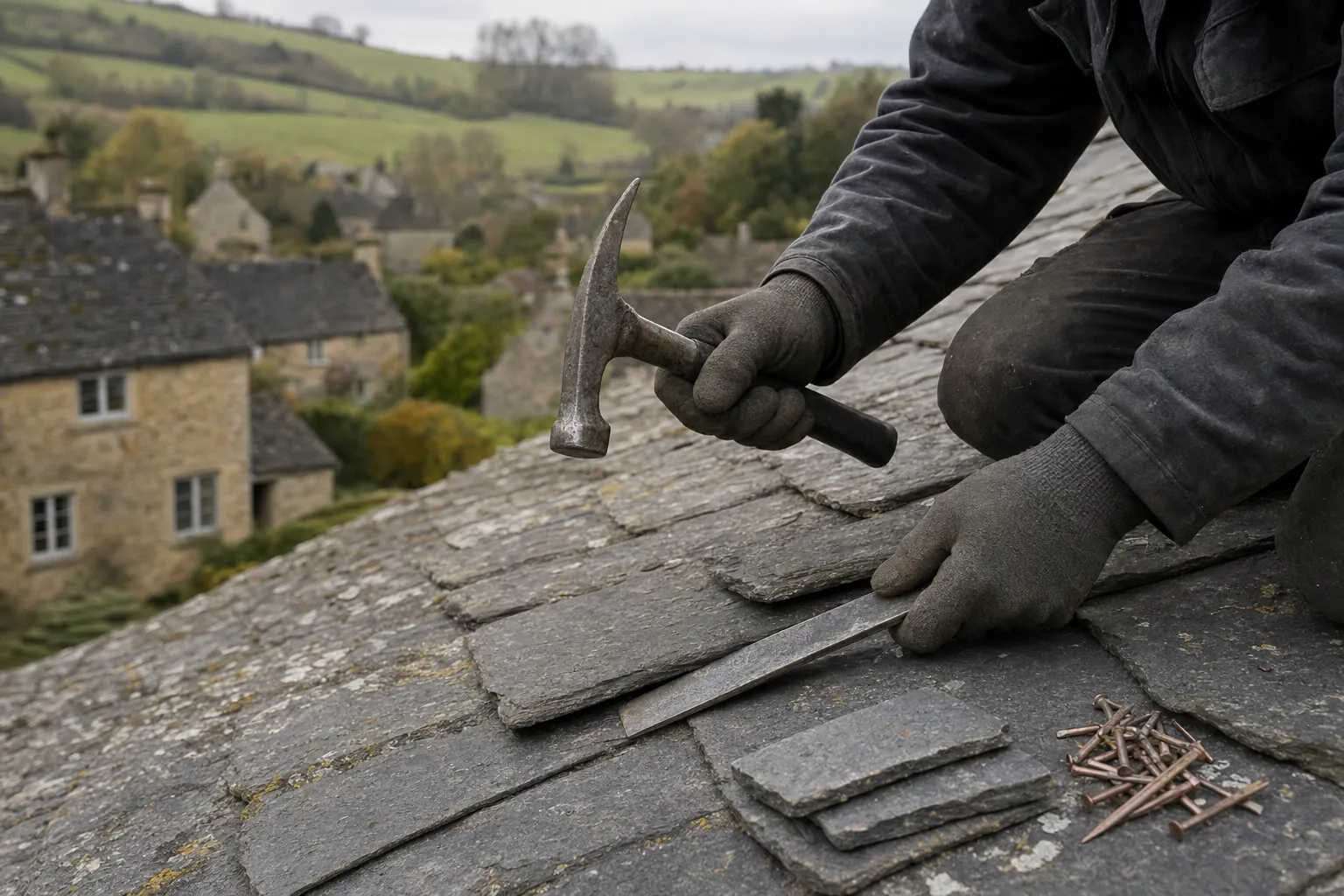
What the policy actually says
The council's guide sets the English Heritage position out in a handful of sentences, and it helps to read them as five separate rules rather than one general mood.
- New first. Buy fresh stone slates wherever that can be done, in preference to second-hand ones.
- Old stone stays home. Salvaged slates are for the very building, or the very group of buildings, that they were lifted from.
- No look-alikes on historic buildings. Resin-fibre slates, concrete tiles and so-called reconstituted stone are classed as unsuitable stand-ins for real stone.
- No swapping rock types. Sandstone and limestone are never interchangeable, and a single roof should not carry both.
- Be wary of saw cuts. A saw-cut slate may disappoint on performance and on looks.
Notice what the list does not say. It does not forbid reclaimed stone outright, and it does not say new stone is always better material. It says new stone is the default choice, that old stone has a proper home on its own roof, and that the look-alikes are a different class of product altogether. Each rule has a practical reason behind it, and the sections below take them in turn.
One caution on dates. The guide is from 2000, so it is best read as the settled traditional approach rather than a current statement of any council's planning decision. When a roof is listed or sits in a conservation area, the local planning team decides what it will accept, and our guide to listed stone roofs explains how that conversation usually runs.
Why old slates belong on their own building
The second rule is the one that surprises people. Salvaged slates, it says, go back to the house, barn or terrace that gave them up. That sounds like a restriction. It is really a consequence of how a stone roof is put together.
A Cotswold roof is laid in diminishing courses. Big slates sit down at the eaves, small ones up near the ridge, and each was dressed and holed to suit its place in that run. When a roof is stripped, the stone comes off in sizes that match the building. Return it to the same roof and the lengths still add up, the weathering still agrees from course to course, and the peg holes still meet the battens. Our page on diminishing courses explains the arrangement.
Move the same slates to a different building and nothing matches. The sizes are wrong for the new rafter length, the weathering is a different colour from its neighbours, and a pile of salvaged stone from three or four roofs rarely holds enough of any one size to finish a slope. There is a wider reason as well. Second-hand use has stripped many other old buildings, and the council's guide notes that this has occasionally happened through theft. A rule that keeps old slates tied to their original roof takes the market out of it.
Why new stone is the starting point
The first rule, new stone wherever possible, rests on two things: supply and stock. Taking slates off one historic building to roof another does not create any stone. It moves a loss from one place to another. New slates, by contrast, add to the total number of sound roofs in the area, and they keep the quarrying and splitting skills alive that the whole region depends on.
There is also a practical argument. Reclaimed slates come with a history you cannot see. Frost may have opened laminations inside a slate that looks sound on its face, and nail holes, or peg holes, that have enlarged over the years can no longer grip. A slate with a hidden flaw may last a few winters on its new roof and then split.
How is new stone made?
The council's guide names the two limestones that Cotswold slates come from: Forest Marble and Stonesfield Slate. Forest Marble is hand-split soon after extraction. Stonesfield Slate is frost-split, meaning the stone is left out to take the weather before it opens along its beds. Either way, the stone's natural habit of breaking into lots of short slates and just a handful of long ones is exactly the proportion a diminishing roof needs.
Is new stone bright orange for ever?
New stone does look fresh at first. Lichen and weather soften it over time. A roof laid with new slates alongside a few retained old ones will blend faster than most owners expect, and a conservation officer will usually prefer that to a mismatch of materials.
Sandstone, limestone and the sawn slate problem
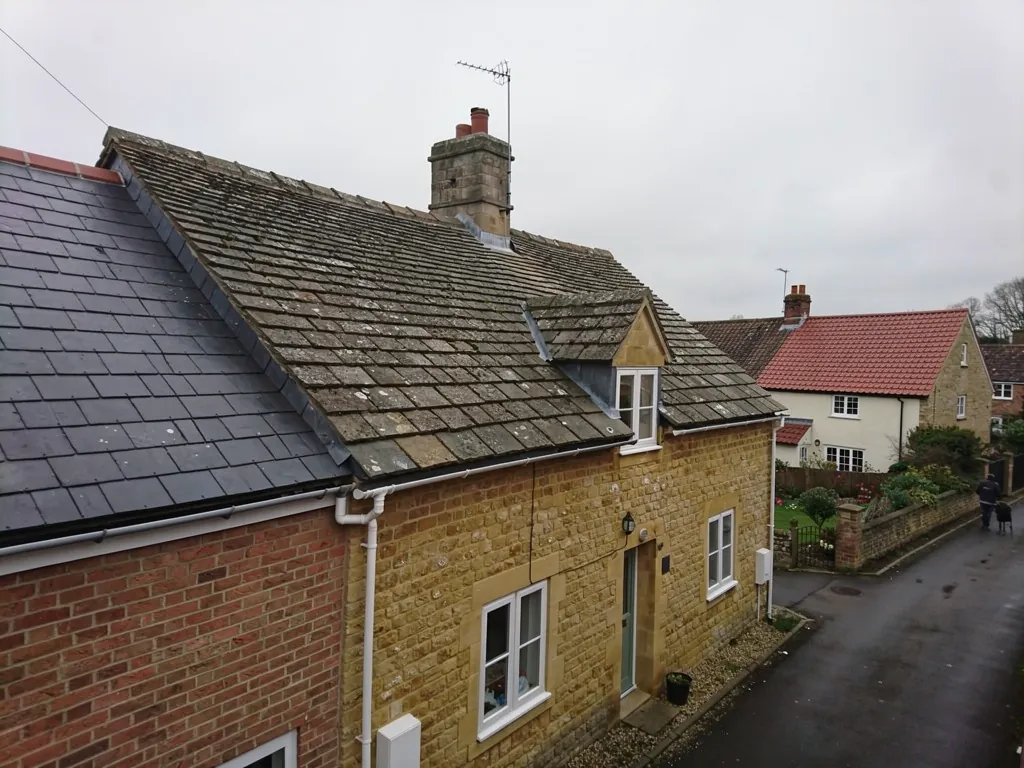
The fourth rule keeps sandstone and limestone slates apart: neither stands in for the other, and neither sits beside the other on one roof. Both are called stone slates in the trade, and to a passing eye a grey sandstone slate and a buff limestone one can look similar. They behave differently. They absorb water at different rates, they split along different beds, they weather to different colours and they are hung differently. A roof that mixes the two ages unevenly, and the difference becomes more visible every year. We have set out how to tell the two apart in our guide to sandstone against limestone slates.
The Cotswold slates covered here are oolitic limestones. If your roof is limestone, repairs and replacements need limestone, and from a source whose stone suits the existing slates.
Before any slate is ordered, ask what the stone is and where it was cut. A supplier who cannot say should not be roofing a listed building.
Sawn slates are the last item on the list. They are cut with a saw to a regular shape rather than split along the natural bed, and the guide describes them as potentially unacceptable on both technical and visual grounds. A sawn face is flat and uniform. A split face has the faint texture and varied thickness that gives a Cotswold roof its character, and sheds water differently as well. Cut stone is a convenience for the supplier, not a benefit to the roof.
Relaying with the stone you already have
The policy leaves one route open that suits most owners: take your own roof apart, sort the stone and put the good slates back. This is the proper meaning of the reclaimed rule, and it is how a stone roof has always been renewed.
In practice the process runs in four steps. The slates are lifted course by course and stacked by size. Each one is checked for splits, delamination and worn holes. The sound ones are set aside for reuse, the failed ones are removed, and new stone is bought to make up the shortfall. The council's guide records that about 50% of the slates are commonly found perished once a roof comes off. Yours may be better or worse, but the figure is a fair warning that a relay is rarely a simple matter of lifting and replacing.
Do the old pegs go back too?
Traditionally the slates hung from the battens on wooden pegs, and the guide records that a cleft piece of oak was the usual material. Old pegs that are still sound can sometimes be reused, but fresh oak costs little beside the scaffold, so brittle ones are best replaced. Our page on oak pegs covers how they work.
What does the shortfall cost?
New stone is the main cost driver of a relay, alongside access, roof size and whatever the survey turns up beneath the slates. Once we have looked, you get the price in writing, with photographs.
When a listed building changes the answer
On a listed building the choice is not only yours. Listed building consent covers works that would affect the character of the building, and a change of roofing material usually does. The Cotswold District Local Plan Policy 27 extract in the council's guide goes further: it resists any move to strip natural roofing off a listed building and put modern materials in its place, where the building's architectural or historic interest would suffer badly. Plan wording changes over time, so check the current plan rather than relying on a quotation from 2000.
The practical rule is simple. Talk to the council's conservation team before the scaffold goes up, tell them what the survey found, and agree in writing what will be reused and what will be bought new. An unlisted house inside a conservation area sits in a grey zone. Matching material laid in place of the old rarely needs planning permission, but an Article 4 direction or a planning condition can withdraw that freedom, and the safe course is the same: ask first.
If you have been offered a cheaper alternative, our page on reconstituted stone slates explains why the policy calls them inappropriate for historic buildings.
Choosing between the two on a practical basis
Put the policy aside for a moment and think about what you want from the roof over the next fifty years. A reclaimed slate offers instant weathering and costs less per slate. A new slate offers known quality and the full thickness of the stone.
Where the building is not protected and the stone is simply being replaced, most owners find the best result is a mix: their own sound slates relaid in the visible slopes, with new stone making up the numbers on the slopes least seen. That respects the policy on reuse and protects the budget. The mix works only if the new stone matches the old in type, so the first job in any quote is to identify what you have.
Should a supplier offer you a pile of reclaimed slates at a tempting price, ask three things. Where did they come from? Was the building they were taken from protected? And do the sizes suit your rafter length? Slates with no stated origin are exactly what the policy is trying to keep off the market.
Our approach is to propose only as much work as the fault needs, so a survey sometimes finds that a few courses are all that need attention. You receive a single written price with survey photographs of your roof, and the decision on which stone goes where stays with you. Workmanship carries a 10-year guarantee, also in writing.