
Stone slate roofs are repairable in a way that most modern coverings are not. Because each slate is separate, hung from a batten and overlapped by the courses above, a single failed piece can be taken out and replaced without disturbing its neighbours, provided the person doing it knows how the slates lock together. That is the skill. Prising out a slate is easy; getting a replacement back under three others without cracking them is not.
This guide explains how repairs are done, how to match the stone, what temporary measures do and do not achieve, and the point at which a roof has too many faults to patch. If you have reached that point, our guide to relaying a stone roof picks up from here.
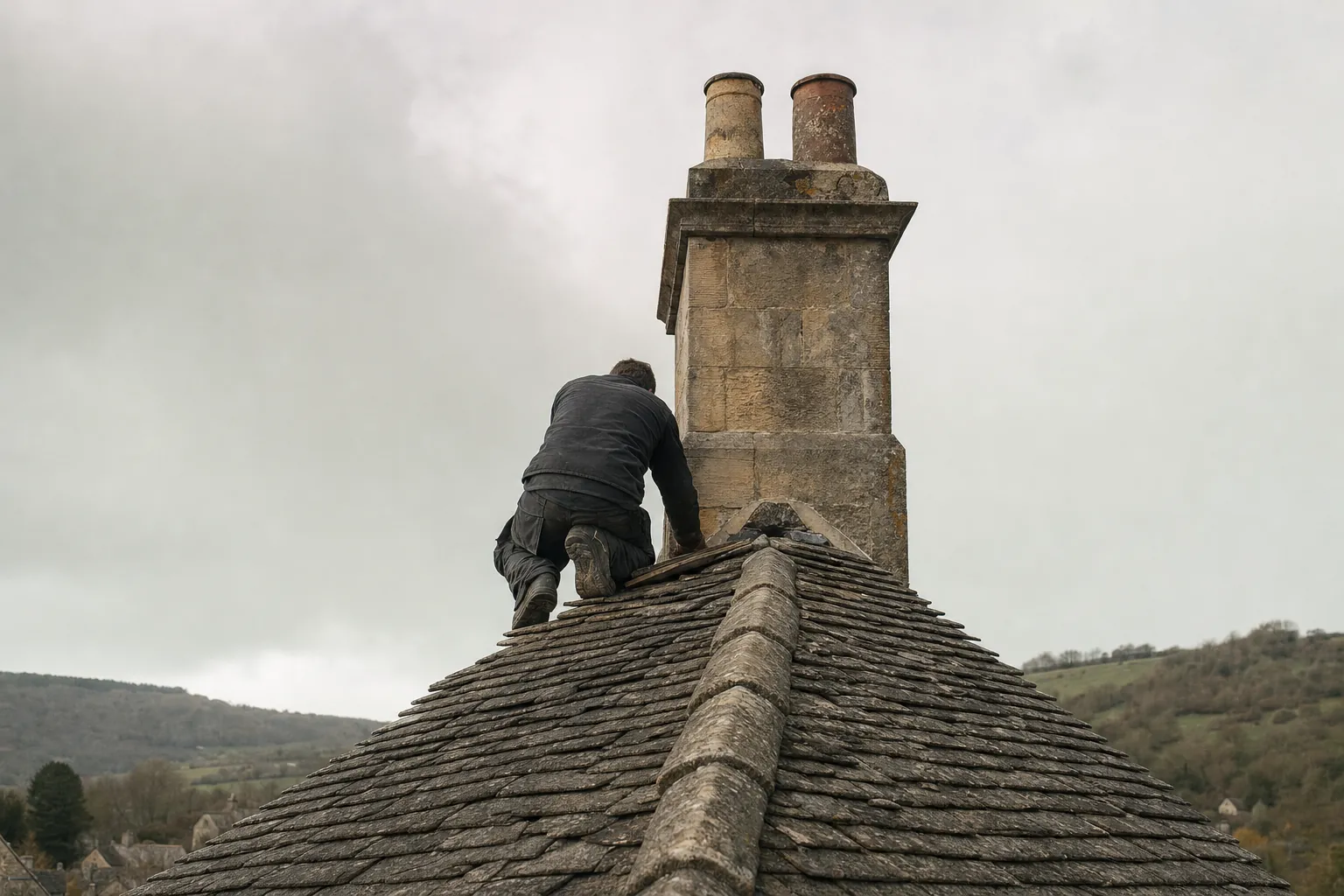
Reading the signs of a failing slate
Most owners first notice a repair is needed through a stain or a drip, but the roof usually gives earlier warnings. A slate that has dropped a few centimetres shows as a gap in an otherwise regular course. A cracked slate shows a pale line across the face. A slate that has lost its peg tilts outward at the bottom edge, and you may find fragments on a path or in a gutter after strong wind.
Look from the ground with binoculars before anyone goes up. Bare patches where lichen has been knocked off can indicate a slate that has moved. Fallen stone is a clue too: if the pieces are thin flakes, the slate has laminated along its bedding, while chunky pieces point to a cracked slate or a failed fixing.
Inside, torch the underside of the roof in daylight. The slate edges show where light gets through, and wet marks on the battens or rafters show where water has been tracking. A stain on the ceiling is rarely directly under the fault, so trace it back up the slope.
Please do not walk on a stone roof. Slates crack under a boot, and a repair visit often finds that the last visitor to the roof caused half the damage.
Replacing a broken slate
To replace a slate, the slates around it must be eased clear of the pegs that hold them. A slate hangs on its peg over the batten, and the courses above and below overlap its edges, so the repairer lifts the neighbours slightly, slides the broken stone out and removes what is left of the old peg.
The new slate is chosen for length first, so its bottom edge lands where the course expects it, and for thickness and colour second. It is holed, pegged and slid into position, then the courses above are lowered back onto it. Done in this way no sealant is used, and nothing is hidden under the slate to force it into place.
What if there is no room to slide a slate in?
On a tight, well-laid roof the neighbours may be too snug to lift. In that case a repairer can fix the new slate with a lead or copper strip tucked under the course above and turned up over the slate's lower edge. It works well as a repair but it shows if used widely, and it relies on the metal being the right gauge and hidden from view. We explain which method we propose before we start.
Can a cracked slate be left?
Sometimes. If the crack is hairline, does not pass through a hole and the slates above still cover the joint, it may be watched. A crack that opens at a hole or runs across the face will let water through and should be replaced.
Re-pegging slipped slates
The most common fault on an old roof is not a broken slate but a slipped one. The slate itself is whole, yet the peg that holds it has rotted or snapped, and gravity has pulled it down until it sits askew. Re-pegging is the simplest and best fix: the slate is eased back, a fresh peg goes through the hole, and the slate hangs where it belongs.
Traditionally the peg was oak, cleft to shape, and the slate was hung over the batten by it. Our oak pegs page covers how they are made and fitted. The peg is the part that fails first, because it sits in a wet joint year after year, so a roof can shed slates in a line while the stone itself is perfectly good.
Is re-pegging enough, or are the battens at fault?
When many pegs fail at once, look at the battens. If the timber beneath the pegs is soft, new pegs will not hold for long. At that point the repair needs to widen, replacing a section of battens and re-hanging a whole area. This still falls short of a full relay, and our repair or relay page explains how the line is drawn.
If the hole in a slate has broken out, the slate is re-holed higher up, which shortens its effective length slightly. A repairer will place it in a higher course to compensate.
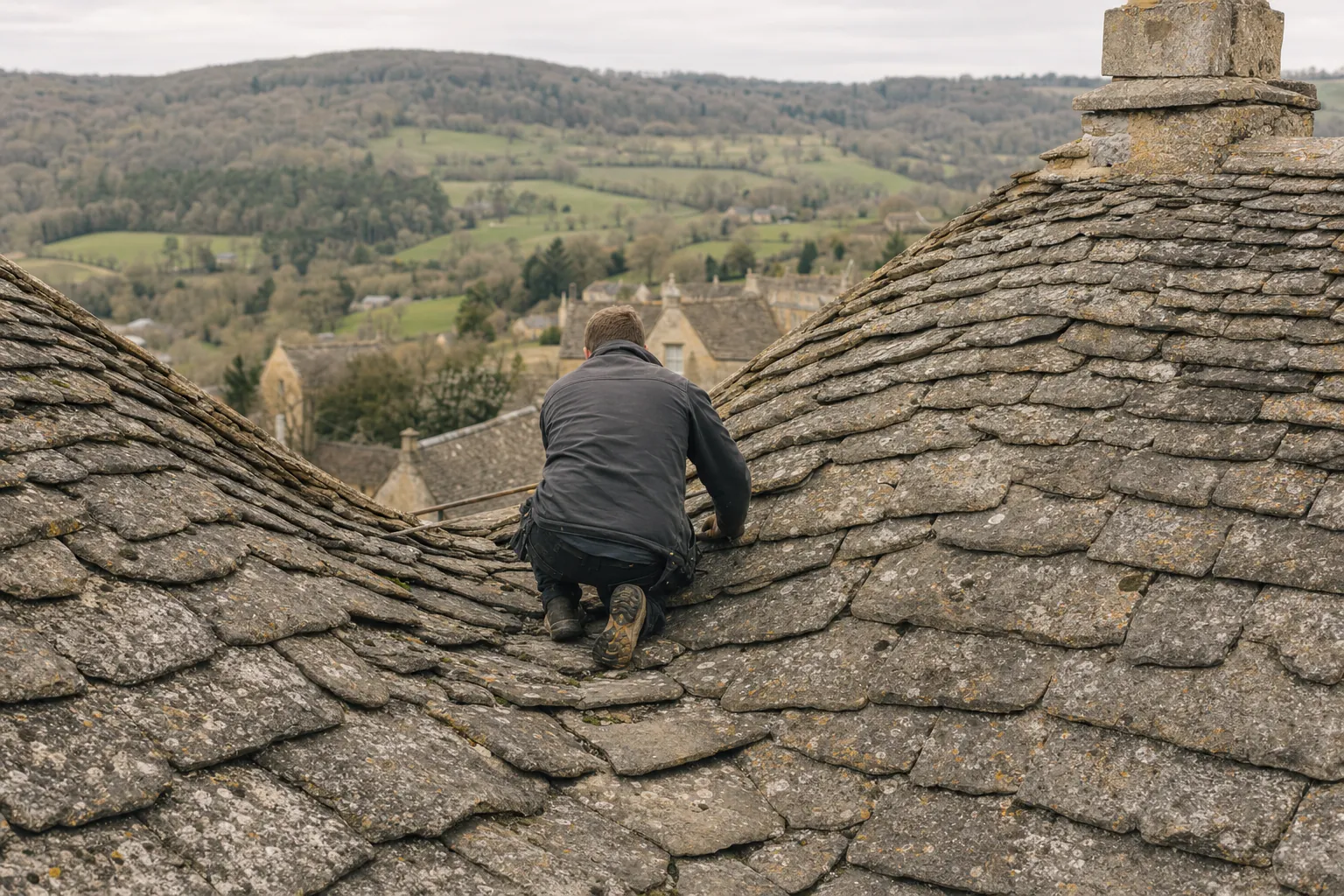
Matching the stone: names, colours and sizes
A good repair is hard to see from the road. That depends on matching the stone type, the size and the weathered colour. The slates on a Cotswold roof are cut from two oolitic limestones named Forest Marble and Stonesfield Slate. Per the council's account, workers split the former by hand shortly after digging, whereas frost does the splitting of the latter. They differ in texture, and a sandstone or limestone slate should never be swapped for the other.
Size matters because of the diminishing courses. The longest slates belong near the eaves, the shortest near the top, so a replacement is chosen by the length its course demands. If the right length is not available, the repair can look wrong even if the stone itself is right. See our page on Cotswold slate names for the trade vocabulary used when ordering.
Should I use salvaged slates for a repair?
English Heritage policy, as reproduced in the council guide, says reclaimed slates belong with the building that gave them up, and that new stone is the first choice wherever possible. A pile of spare slates from your own roof is the ideal supply for repairs. Buying second-hand stone from elsewhere can encourage the stripping of other old buildings.
Temporary measures and what they cost you later
A leaking roof in a storm needs stopping, and there are sensible emergency measures. A tarpaulin battened down over the damaged area keeps water out. A strip of lead slid under a slipped slate can buy time. Making a leaking roof safe comes first, and leaks and storm damage get priority on our list.
What does not help is the tub of mastic, bitumen or expanding foam that finds its way onto many old roofs. Sealant smeared over a crack traps water behind it, stains the stone and must be scraped away before any proper repair can begin. Cement mortar fills are a particular problem, since they are harder than the stone around them and can crack neighbouring slates as the roof moves.
Will home insurance pay for a repair?
That turns on the wording of the policy and on what caused the damage. The Financial Ombudsman Service asks if there was a storm, if the damage looks like storm damage, and if wind and rain were the real reason for it. Policies often exclude gradual wear. Which? points out that a poorly maintained roof is a common reason for a refused claim. We do not handle claims, and no one can promise one will succeed. Our guide to insurance and stone roofs has more detail.
Working on the roof: access, weather and what a visit involves
Stone slate repairs are fiddly at height, so the first decision is how to reach the work. Small jobs near the eaves may be done from a tower or a mobile platform. Anything higher on the slope needs scaffold, a ladder tied off to a stable point, or crawling boards that spread the weight. Walking directly on the slates is what you want to avoid, because a cracked slate this week becomes a leak next month.
Weather decides the day. Wet stone is slippery, wind makes lifting slates dangerous, and frost can crack stone that has taken up water, so jobs are planned for dry, still spells where possible. If a leak will not wait, the first visit makes things safe and the proper repair follows when conditions allow.
What do I need to do before the repair visit?
Clear the area below the work, move cars, and tell us about any ceilings that have been stained or bulging. If you have spare slates from the original roof, show us where they are, because they are often the best match. A loft hatch that opens easily and a torch on the loft side save time.
How do I know the repair has worked?
The next heavy rain is the test, and a quick look at the ceiling afterwards reveals the answer. Old stains will not vanish, so mark their edge with a pencil line and check whether it spreads. A stain that stays put, and dry battens when you look in the loft, mean the fault is dealt with.
Listed buildings, scraping and the point of diminishing returns
If the house is listed, even a small repair can matter. Under section 7 of the Planning (Listed Buildings and Conservation Areas) Act 1990, an alteration that changes how a listed building looks and feels needs consent, and replacing natural stone with another material would plainly do so. Like-for-like repair using the same stone is a different matter, but the conservation officer at your council is the person to ask. Our guide to listed stone roofs goes through the rules.
The council guide also records a tradition of maintenance. It claims a roof scraped clear every year might last twice as long, which in practice meant a yearly round of clearing moss and debris and resetting anything loose. Small repairs done early are what that tradition amounts to.
When is it time to stop patching?
When faults appear faster than you can fix them. If slates are slipping in rows, the battens are soft in several places or someone is called out each winter, the roof is showing that its fixings are failing as a whole. Scaffold for each visit adds up, and a relay may cost less over the next decade than serial patching. We say which we think is right and why, and will quote for the smaller job if it properly solves the problem.
One part of the roof calls for more specialist repair than any other, and our guide to swept valleys explains why. The wider service is described on our Cotswold stone roofing page.