
Picture the inside corner formed where two roof slopes run into each other: that is a valley, and the rain from both slopes pours into it. Modern roofs mostly line that corner with lead or a plastic trough and cut the covering to follow it. Cotswold stone roofs have a different tradition. Instead of a straight, hard crease, the stone is laid to sweep round the corner in a soft curve, so the valley seems to flow from one slope into the other with no metal in sight.
That is a swept valley. It is one of the most admired details on an old stone roof, and also one of the most skilled to build or repair. This guide explains how it is made, why it can fail, and what the alternatives mean for the look and life of the roof. For wider context on repairs, see stone slate repairs.
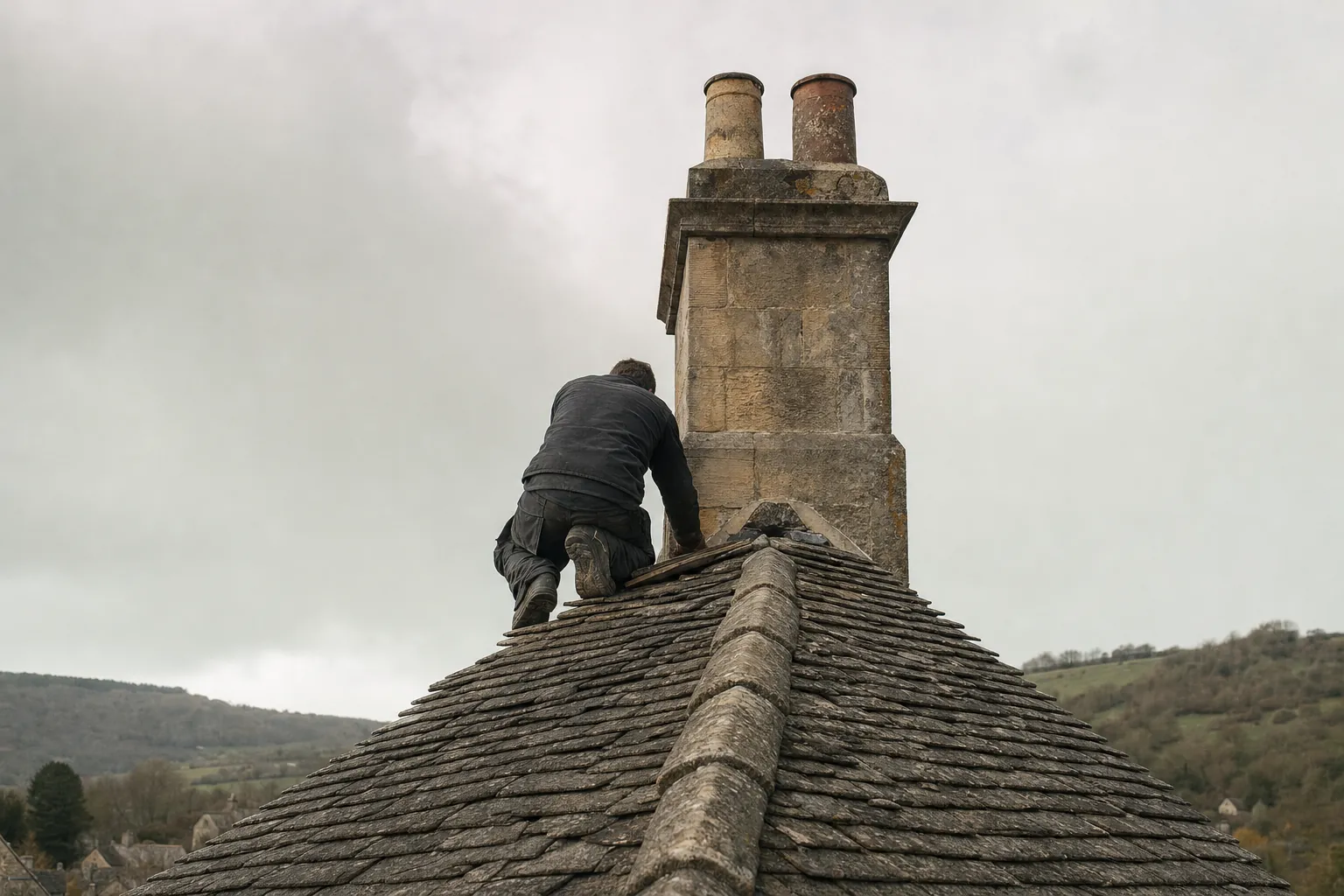
What makes a valley swept
In a swept valley the courses of slates on each slope do not stop at a straight cut line. Specially cut slates are used, shaped to form a gentle curve to the roof, as Cotswold District Council's technical guidance puts it. The courses curve round the angle, so water running down one slope is led smoothly round and down the other, with no open gutter.
The effect is visible from the street. A straight valley reads as a line, with a gutter of lead or colour of different material. A swept valley reads as a soft fold in the roof, with the stone texture continuing unbroken. That is why conservation officers and owners alike tend to prefer it where an old roof had one.
The curve also does a practical job. Water runs through the overlaps of the cut slates, which are laid so that each course covers the joints of the one below, much as it does in the main slopes. The sweep slows the flow, which helps in heavy rain where two large slopes are draining into one narrow corner.
The cut slates and what they are called
The vocabulary is local and varies from place to place, but the council guide gives the terms used for the pieces. The slate at the base of the valley, where the two slopes meet, is the bottomer. The slates laid either side of it, tapering up the curve, are called lie-byes or side skews. The shaped slates that carry the curve onward are skews.
A slater builds the valley from the bottom up. The bottomer is cut and set first, since it fixes the line. The side skews follow in rising courses, each cut to a different angle so that the curve is smooth. A mason's hammer and a good eye do the work, and every slate is trial fitted before pegging.
Does each valley need its own set of slates?
Largely, yes. Because the angle between the slopes, the size of the stone and the pitch all differ from roof to roof, the cut pieces are made to suit. Spare cut slates from one roof rarely fit another. Our page on Cotswold slate names lists more of the trade terms.
Can the stone be cut with a machine?
The guidance warns that sawn slates can be technically and aesthetically unacceptable in historic work, so hand-shaped cutting is the norm for repairs to old roofs. The finish matters because a saw leaves an edge that weathers differently.
How swept valleys fail
The valley takes more water than the rest of the roof does, since the run-off of two slopes is gathered into it. If the cut slates are poorly bedded, or the pegs have rotted, they shift, and the joint opens. Debris is the second cause. Leaves, moss and bird nesting material pack into the overlaps and hold water against the stone and the timbers.
Because there is no metal gutter beneath, a failure shows quickly inside. Inside, a mark tends to show on the plaster underneath the line of the valley, often worse in prolonged rain. Another sign is a visible hump or dip along the valley, where the stone has settled or the battens have rotted.
Why do the battens and boards under a valley rot first?
The valley is the wettest line on the roof. Water that gets under the stone drains down it, and the timber sitting along that line spends more of its life damp than any other. Rotten valley boards are a frequent discovery on stripping, and the stone above them has to be lifted to deal with them.
Do not push mortar or sealant into an open joint in a swept valley. It blocks the path the water is meant to take and makes the leak worse.
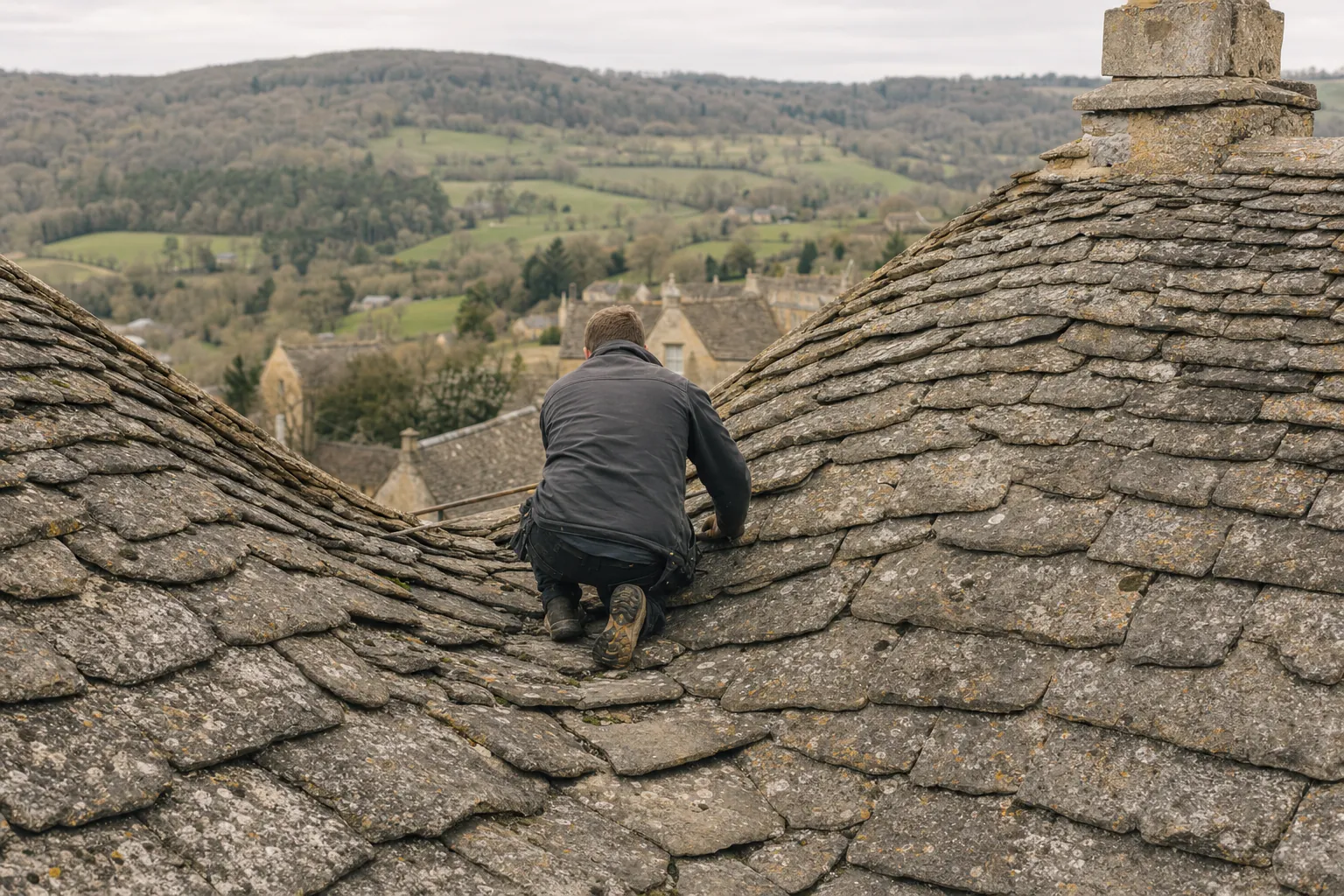
Repairing or rebuilding a swept valley
A small fault can sometimes be put right by lifting the courses either side, replacing a cracked skew or re-pegging a slipped one, and laying them back. When the timber beneath is sound and the curve is true, this is a modest job and a fair example of a repair that matches the size of the fault.
When the valley board or battens have rotted, or the curve has lost its shape, the valley is stripped back and rebuilt. The slater lays out the line again, replaces the timber, and cuts or selects new bottomers and skews. Sound old slates are used again, sorted back into their positions. Where they are not, new stone of the same type is cut. The principle matches the rest of the roof: salvage what is good, and match the rest.
Is it a job for a general roofer?
It needs someone who has laid stone, since the curve cannot be improvised. Ask whoever quotes how they plan to cut the pieces, what they will do about the boards beneath, and whether they will show you photographs of the valley before and after. Our survey photographs and written quote cover those points.
The same skill applies where a valley meets a stone verge or a dormer, and our guide to relaying a stone roof covers how valleys are rebuilt when the whole roof is stripped. For the full range of this work, see Cotswold stone roofing.
Looking after a swept valley between repairs
Care for a swept valley is mostly a matter of keeping it clear. Leaves, seeds and bits of moss collect in the curve, hold damp against the stone and send water sideways under the courses. A look from a safe spot after autumn leaf fall, with binoculars if the valley is high, shows whether debris has gathered. Clearing it is a job for a person with proper access, working gently by hand, since a hose or a stiff brush can disturb pegs and lift the cut slates.
Overhanging branches deserve attention too. A tree that drops leaves directly into the valley guarantees a build-up, and a branch that rubs the slates in wind wears the stone. Cutting back is cheaper than repairing the roof beneath it.
What should I watch for through the year?
Check the ceiling below the valley after heavy rain, look for slates that have shifted out of line, and notice moss growing thicker along the curve than on the open slope, which suggests water is lingering there. Any of these deserves a closer look before winter.
Does a swept valley need lead underneath?
Some do carry a hidden lining or a bed of material beneath the cut slates, and others rely on the stone alone. Which applies to your roof can only be known by opening a section, so we check at survey where we can and say so if we cannot be sure until the stone is lifted.
Lead and mitred valleys as alternatives
Not every stone roof has a swept valley, and not every owner can afford to rebuild one. The council guidance describes two cheaper forms. A close-mitred valley has the slates cut to meet along a line with lead hidden underneath. An open lead valley has a visible channel of lead between the two slopes. Both are cheaper to construct, though the guide judges that neither looks as good as the traditional valley and advises steering clear of them.
That is a fair verdict on appearance, and the practical side deserves honesty too. A lead valley, when properly laid, is a sound and long-lasting detail, and lead flashing can last for over 80 years when correctly installed according to MyJobQuote. A close-mitred valley puts the joint of the two slopes right in the wettest spot, which depends on the lead underneath to do the work.
Which suits my roof?
If your roof already has a swept valley, keeping it is nearly always right. If it has a lead valley, replacing it in lead is usually the sensible choice, as converting would alter the roof's character. On a new extension, an open lead valley is a practical option that costs less. For a listed building, the decision may rest with the conservation officer. Our guide to listed stone roofs explains how that works.
Reconstituted slate, insurance and cost
Reconstituted stone slates are made from concrete in a mould and sold in graded lengths and mixed widths. They are cheaper and lighter than natural stone. They do not suit a swept valley, since the curve depends on slates cut by hand to fit, and the same guidance treats such substitutes as inappropriate for historic buildings. See reconstituted stone slates for where they do make sense.
On cost, a swept valley is labour. The stone is minor, and the time is in cutting, trial fitting and pegging each piece. Four things move the price: the length of the valley, its height above ground and how awkward it is to reach, how much timber below needs replacing, and whether the surrounding slates must come off to get at it. Scaffold is part of the picture on any valley more than a short reach from the ground, and a quote should say plainly whether VAT and scaffolding are inside it.
Will insurance cover a leaking valley?
It might, but there is no guarantee. The Financial Ombudsman Service asks whether a storm was the main cause of damage and notes that policies often exclude gradual wear. A valley that has rotted over years is the sort of defect that tends to be treated as wear. Any claim is a matter for you and your insurer, and nobody here can say whether yours would succeed. Read our page on stone roof insurance before you call your insurer.