The short answer
Mostly through access. Ground that slopes steeply makes ladders unsafe, hides downhill gables from the ground and leaves little room for skips and scaffold. Planning the access first often decides whether a modest repair stays modest, and we cover it in the survey.
Stroud grew where five valleys meet, below the western escarpment of the Cotswold Hills, and the streets run up the slopes. Roofs that would be a half-day's work on a flat estate become a question of how to reach them.
Q3.1Why does a hillside house need scaffolding for a small repair?
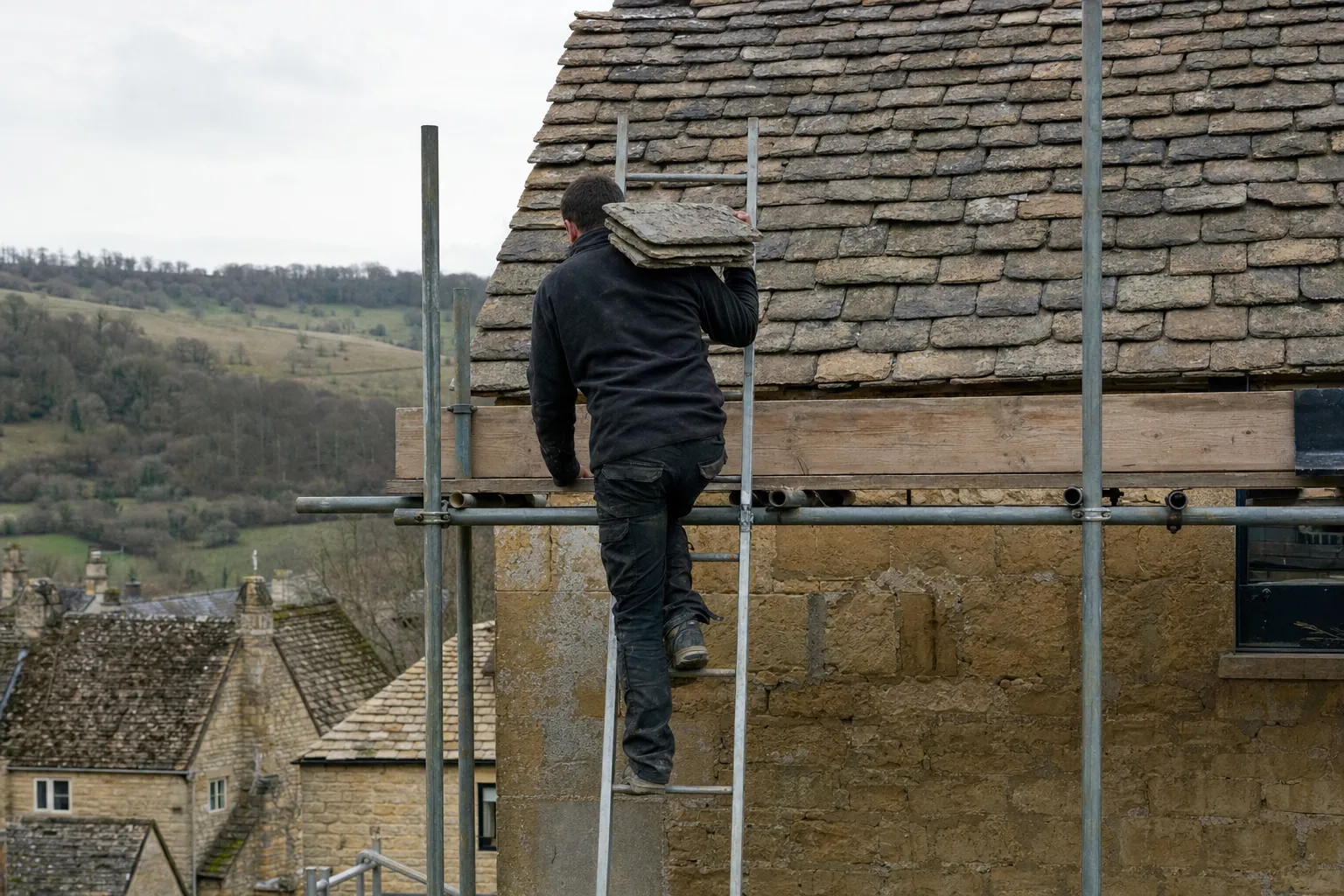
A ladder wants level, firm ground at its foot, and a downhill gable may have a long drop to the pavement or a garden wall. For chimney work or anything at the gable, scaffolding is often the safe answer. MyBuilder's 2026 guide gives around £850 to £1,200 for a standard two-storey set-up, and £400 to £900 for chimney scaffolding at height, so look for scaffolding, and VAT, in any quote you are comparing. The survey tells you whether your roof really needs it.
Q3.2Where does the skip go on a narrow street?
Sometimes there is nowhere at all, which is why we ask before the job starts and plan the deliveries around it. A skip on the road may need a licence from the council, and tight terraces often mean smaller loads taken away more often. Whatever the arrangement, we take the rubbish away, and the road or yard is swept before we leave.
Mills and larger buildings bring their own access questions, and our commercial roofing page describes how we plan work at that scale. For houses, our roof repairs page lists what we look for.
Access also decides how stone, tile and lead reach the roof, and on a steep street the lifting can take longer than the repair. A hoist or a chain of hands up the scaffold is slower than a lorry parked at the door, and the quote reflects that.