Concrete tiled estate rooftops towards green hills

Roofers in Cainscross

Tile, slate, lead and felt for Cainscross, the Stroud valley suburb, and the Cainscross road that links it to Stroud: a stone terrace from before 1825, brick rows from about 1900, villas standing by 1936 and the estates that came later.

Cainscross roofs, from Prospect Place to the newer estates

Terraced stone houses with shared chimney stacks
Prospect Place and the early stone houses

On the Cainscross road towards Stroud, the county history describes Prospect Place, on the north side, as a terrace of four plain stone houses that predates the road itself, which was built in 1825. A more elaborate house stands at the west end, and two brick houses were added at the east end in the later 19th century. A terrace like this raises questions a detached house never does. The roof is one long structure divided by party walls, chimney stacks sit astride the boundaries, and the flashing that seals a stack is shared weather protection for two households. Stone walls tell you nothing certain about the covering above them, so the survey photographs identify what is actually on each slope before a repair is specified.

Red brick terrace with pitched roofs and chimneys
Brick rows around Upper Gannicox

A row of brick houses went up west of Upper Gannicox in 1899 or soon after, with similar houses along Beard's Lane. Rows from the end of the Victorian period were often built with a pitched main roof and a smaller roof over the rear projection, and the line where those two roofs meet is a classic place for a leak. Valley gutters, lead soakers, brick chimneys and cast or timber eaves details all want inspecting. These houses are close to a century and a quarter old, so a roof that has had no attention in twenty years is likely to be asking for it.

Detached house with a hipped tiled roof
Villas and the later estates

Detached villas stood on the south side of the Cainscross road by 1936, and more houses followed east of Upper Gannicox by 1971. Roofs from those decades are commonly concrete or clay tile on timber battens, with hips, verges and bargeboards that take the weather on three sides. What fails is predictable: ridge and hip tiles set on crumbling mortar, tile edges at the verge lifting in a gale, and felt under the tiles that has split or sagged. Porches, garages and low extensions bolted on in later years each wear a covering of their own, and those seldom grow old at the same pace as the main roof, so a survey of the whole property is more useful than one of the house alone. On a hipped roof the hips are the lines to watch, since they meet at an angle that sheds water quickly and loosens whatever holds the tiles in place.

From Swindon down into the Stroud valley

Map showing Cainscross and central Swindon. 30 road miles west-north-west of central Swindon.

Distance
30 road miles west-north-west of central Swindon
Council
Stroud District Council
Council
Stroud District Council
Conservation area
None listed for Cainscross on the council's list
Setting
A Stroud valley suburb west of Stroud along the Cainscross road

Cainscross roof questions

Is Cainscross a conservation area for roofing purposes?

No conservation area on Stroud District Council's list is named after Cainscross, but the list includes Ebley Mills on the valley floor, so check your address on the council's map. None of the council's Article 4 directions covers Cainscross, and listing is judged house by house.

Can one half of a terrace be re-roofed on its own?

Yes, up to the party wall. The shared ridge, stack flashings and gutters need agreeing with the neighbour, and the survey photographs show what is joint and what is yours.

Do 1970s tiled roofs need different care from 1930s ones?

Slightly. Older tiles tend to be heavier and bedded on mortar, while later roofs lean on clips and nails. Both want their ridges and verges fixed mechanically as well as bedded.

Q1

What fails on a Cainscross Road terrace roof?

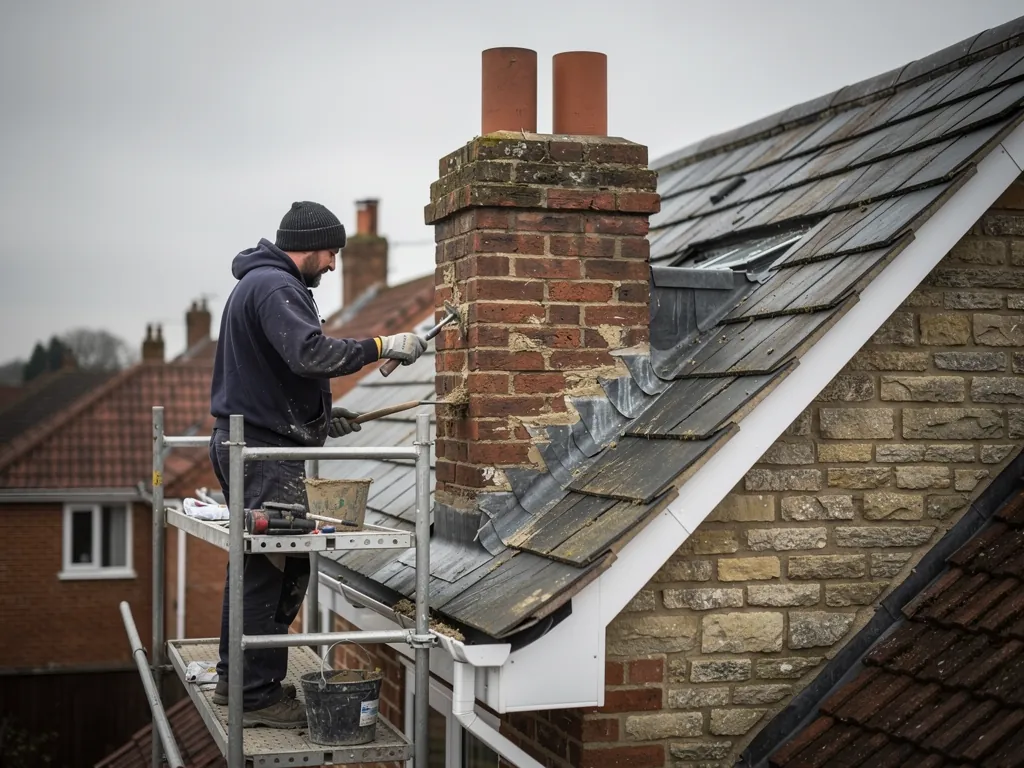
Roofer repointing a stone chimney stack above lead flashing
Roofer repointing a brick chimney stack from scaffolding

The short answer

The joints. A terrace roof is one continuous covering sliced by party walls and chimney stacks, and water gets in where lead meets masonry, where two heights meet, or where a neighbour's repair has been done differently. Tiles and slates are usually the last thing to give out.

Prospect Place is the sort of building the county history picked out on the Cainscross road: four plain stone houses built together before the road existed. Whatever their covering, terraces share certain weak points.

Why does a leak start at the chimney?

A stack that straddles a boundary is wrapped in lead, and the lead is the first part to tire. Sheet lead is graded by thickness into numbered codes. Leadworx describes code 4 as the standard pick for ordinary flashing, and code 5 suits harder-working spots. Thin or badly dressed lead lifts, splits along folds and lets water behind it. Our chimney repairs page covers flashings, pointing and rebuilds.

Whose job is the shared ridge and gutter?

Where a roof crosses a boundary, work to one half affects the other. A ridge cut off at the party wall leaves an awkward end, and a gutter that runs along both fronts rarely has a tidy break. We recommend telling your neighbour before the scaffold goes up, and some work on the wall itself, removing a chimney breast for example, can mean serving the notice that the Party Wall etc. Act 1996 sets out, so confirm the position with a surveyor or the GOV.UK party wall guide first.

Can I mend just my side?

You can, but a repair that stops at the boundary should still tie in with next door's roof, and the survey notes where it will. For anything bigger, roof repairs sets out how we judge the right scale of job.

Where the roof steps down from a taller house to a lower one, the junction is sealed with stepped lead set into the brick joints, and it is a spot where repairs are often skimped. A tidy repair there means cutting a fresh groove, not smearing sealant across the old one. Photographs of each defect come with the written quote, and the conversation with the neighbour then starts from pictures, not guesses.


Q2

Does a Cainscross house need consent to re-roof?

The answer

Usually not. A matching re-roof is normally straightforward, though parts of the valley floor around Ebley lie inside conservation areas. Listed status, a heavier covering and bigger re-roofs are the exceptions, and the council or a registered building control approver is the place to ask.

Stroud District Council's published list of conservation areas has no area named after Cainscross, although Ebley Mills, in the parish, has its own, and its list of Article 4 directions names Wotton-under-Edge, Bisley, Frampton on Severn and two parts of Stroud, but not here. For most homes away from the mills, that removes two common complications.

Does that mean anything goes?

No. Planning rules can still bite where a change makes a real difference to how a building looks, and any single house may be listed whatever the neighbourhood around it. If you are unsure, ask Stroud District Council before ordering materials. Matching the existing covering in colour and profile is the simplest way to avoid trouble.

Where is the Building Regulations line for a Cainscross re-roof?

The Planning Portal draws the line. Small jobs sit below it: under 25 per cent of the total building envelope and under 50 per cent of the roof, with no change to fire performance. Larger re-roofs call for approval, and extra insulation can follow. Fitting a covering 15 per cent or more heavier than the old one is also caught, which matters where concrete tile is replacing slate.

Who handles it for me?

Either the council's building control service or a registered building control approver can deal with it. If your job is one that must be notified, we file that notice and hand you the paperwork when it is done.

For a larger job such as stripping a whole slope, pitched roofing explains the stages from survey to completion. A quick call to Stroud District Council with your address will confirm whether the house is on the statutory list, which is a short question that heads off a long problem.

MythIf your road is not a conservation area, nobody checks your roof.

FactBuilding Regulations apply everywhere, and the weight and extent of a re-roof decide whether approval is needed.

Q3

Are concrete tiles on Cainscross's newer houses worth keeping?

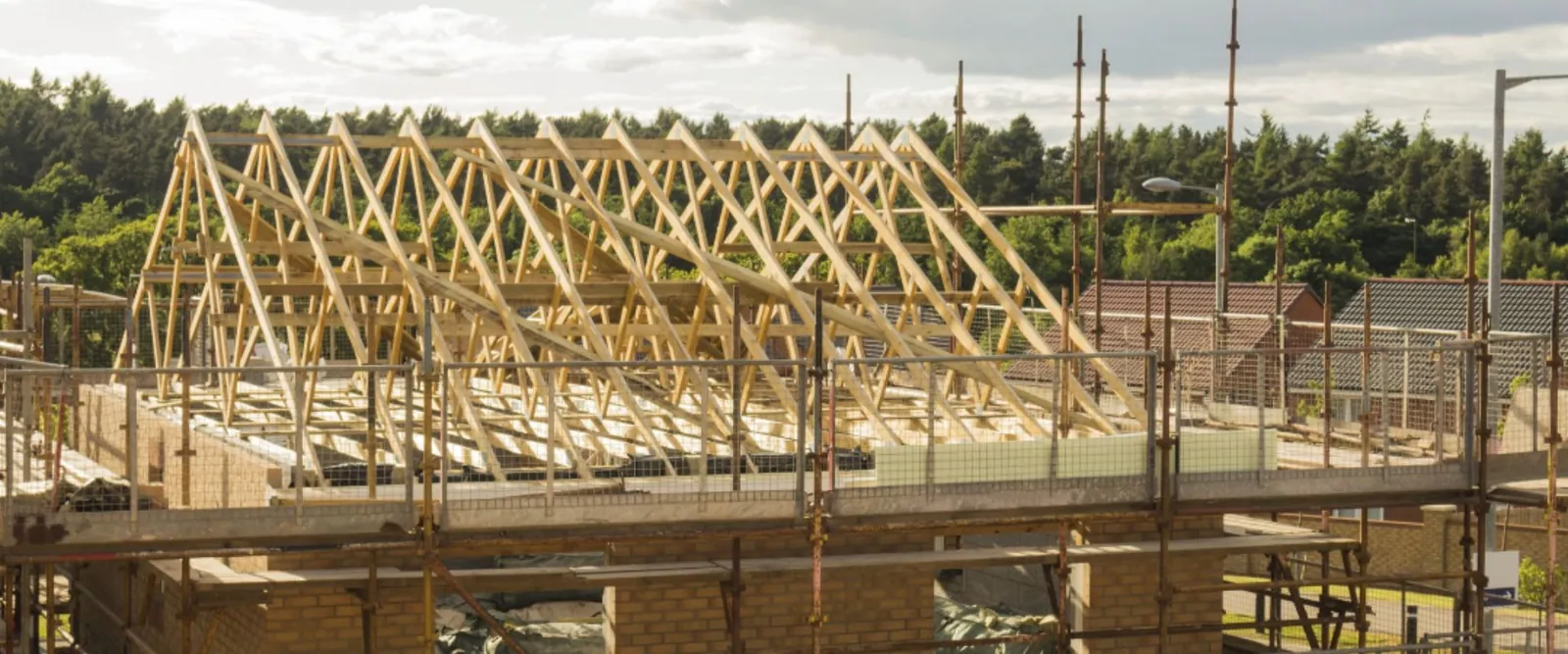
Timber roof trusses on a new brick house behind scaffolding
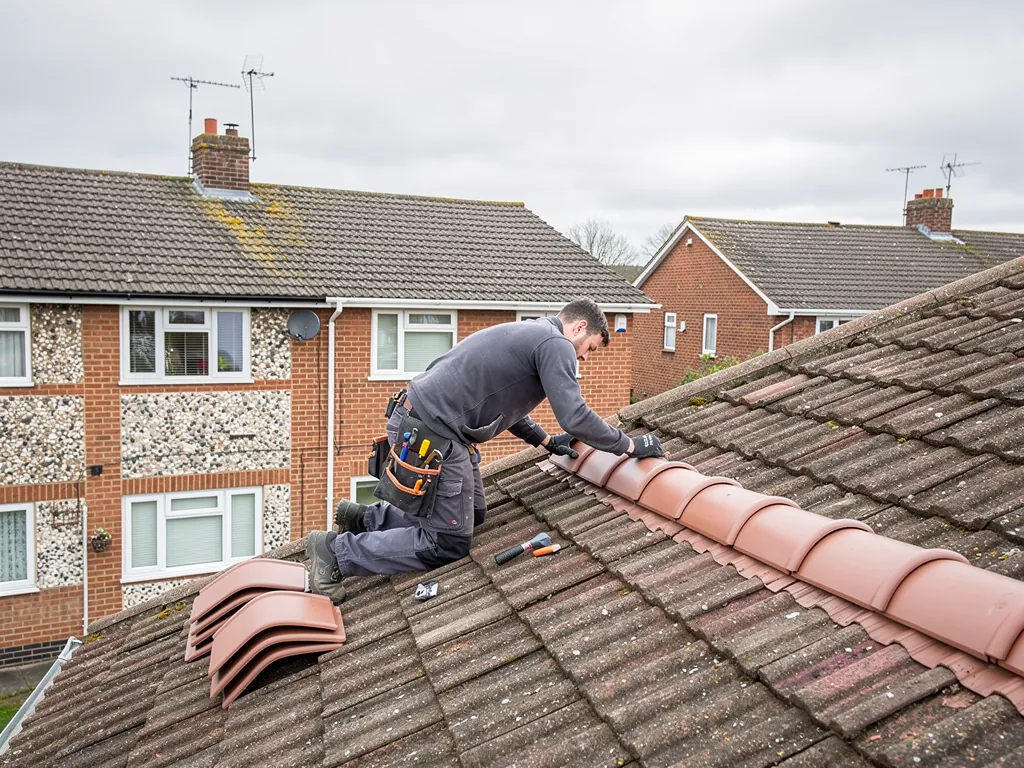
Roofer fixing new red ridge tiles along a concrete tile roof

The short answer

Often, if the tiles themselves are sound. Concrete tiles on an estate house commonly give 30 to 60 years, and the parts that fail first are the ridge, the verge and the felt beneath. Fixing those properly can add many years to a roof that otherwise looks tired.

The Cainscross road filled in layers: villas by 1936, then more building east of Upper Gannicox by 1971. Roofs of those periods tend to be tile on timber, and they are rarely the whole story of what is wrong when they leak.

How long does a concrete tile roof last?

The published guides do not agree. MyBuilder puts replacement of concrete tiles at 30 to 50 years, whereas Marley expects its own tiles to last about 60 years and says that is no guarantee. Our reading is 30 to 60 years, with exposure, workmanship and upkeep deciding where a given roof lands.

What do you fix before replacing?

Ridge and hip tiles come first. Under BS 5534:2014 a bedded ridge is not left to its mortar alone, so it receives pins or clips as well, or a dry-fix kit tested to BS 8612 can replace the mortar. Our ridge, verge and dry-fix page explains the difference. After that come verge edges, slipped tiles and the felt beneath, which can be torn or perished while the tiles above look perfect.

When is a full re-cover the better choice?

When the battens are rotten, when many tiles are cracked, or when the felt has failed across whole slopes, patching becomes false economy. We say plainly which category yours falls into, and the photographs back it up. Hip and verge tiles on a 1930s villa are also worth a look, because their bedding is the oldest part of the roof and the first to crumble. A bargeboard (the board that finishes a gable edge) can rot unseen behind fresh paint.

Our written quote follows the survey. When you weigh several quotes, check each for VAT and scaffolding.

What published guides say about lifespans (not promises)
CoveringTypical lifeGuide
Concrete tile30 to 50 yearsMyBuilder, 2026
Clay tile40 to 60 yearsMyBuilder, 2026
Natural slate80 to 100 years or moreMyBuilder, 2026

Questions from Cainscross Road and Beard's Lane

Why does a Cainscross terrace roof leak beside the chimney when the tiles look sound?

The tiles are rarely the culprit. The lead apron around a shared stack lifts or splits, mortar crumbles at the base, and rain tracks down inside the wall. The cure is usually new lead and repointing, not new tiles, and because two houses share the stack, both owners will want to see the survey photographs of the exact spot.

Do you work on the brick houses near Upper Gannicox and Beard's Lane?

Yes. Brick houses from around 1899 onwards have valleys, rear projections and chimney stacks that all need checking, and we repair, re-cover or make safe depending on what the survey turns up. The photographs of each fault travel with the written quote, so you can show them to anyone you like.

Can I re-roof my half of a Prospect Place style terrace in a different tile?

You can ask, but a visibly different covering beside a neighbour's can change how the whole terrace reads, and planning rules may apply if the appearance changes materially. Check with Stroud District Council first. Matching what is next door is the safer route.

Do you cover Stroud and the villages up the valley from Cainscross?

Yes, within thirty road miles of Swindon. The areas page is worth a look if you live further up the valley, and a phone call or the enquiry form settles the question.

Ask us about your roof

Tell us what’s happening and we’ll call you back.

  • Photos of what we find
  • A written quote
  • 10-year workmanship guarantee

Or call 01793 626096

Call Get a quote