Rear tiled roof of a brick semi seen from the garden

Roofers in Bussage

Roof repairs, ridge and verge work, chimneys and re-covering in Bussage and Brownshill, from the old lanes below the Victorian church to the estate streets laid out on Manor Farm.

Bussage's roofs, from church tower to estate close

Hillside cottages with a church behind
The older village and its church

Bussage is a hillside village above the Frome valley, with an older part and a newer one. St Michael and All Angels was founded by Thomas Keble and consecrated in October 1846, and the older lanes around it hold the village's earliest roofs. On a hillside that old, houses step up the slope, rooflines follow the contours and walls and roofs lean on each other. Where one of these roofs is natural stone, repairs follow stone-roofing practice, and our survey tells you what you have. Whatever the covering, valleys, chimney flashings and wall abutments are the first places we check, since a house built into a slope gives rain more than one route inside.

Rows of tiled estate houses
The Manor Farm Estate

The newer part of Bussage was formerly the Manor Farm Estate, and Robert Hitchens Ltd was its primary builder. One builder working across an estate tends to leave families of near-identical houses, which is useful to know when a roof needs mending: a single street can share a tile profile, a ridge detail and a set of weak spots. Interlocking tiles, ridges with crumbling mortar underneath, tired valley liners and porch or garage roofs that give out ahead of the main one are the jobs that come up. Mending one house often shows us what its neighbours are due. For an owner, that can mean comparing notes with next door before ordering materials.

Roofs stepping down a wooded hillside
Steep lanes and the valley slope

Bussage lies close to the A419 between Brimscombe, Eastcombe and Chalford Hill, near the River Frome, and the land falls steeply to the valley. That affects roofs in practical ways. Tree cover shades slopes and holds damp, so moss and leaf litter gather in valleys and gutters. Rainwater has a long run down the hill and needs somewhere to go. And access is harder: steep drives, narrow lanes and gardens that fall away behind the house make scaffolding more involved. How a crew reaches the roof is assessed before we price it, since access can shape the job as much as the roof itself.

From Swindon to the Frome valley

Map showing Bussage and central Swindon. 26 road miles north-west of central Swindon.

Distance
26 road miles north-west of central Swindon
Council
Stroud District Council
Council
Stroud District Council
Conservation area
Bussage and Brownshill Conservation Area
National Landscape
Cotswolds National Landscape

Bussage roof questions

Is my Bussage house in the Bussage and Brownshill conservation area?

The designation covers Bussage and Brownshill. Stroud District Council can say whether your address is inside it, which matters most if the work will alter the way the roof looks.

Does Bussage have an Article 4 direction on roofs?

Stroud's list of Article 4 directions in conservation areas does not include Bussage. Listed buildings and planning conditions can still limit what you do, so check your address.

Why can one estate street have the same roof fault on every house?

Houses built by one builder to shared designs often share tiles, ridge details and valley construction. When one fails in a particular spot, the neighbours' roofs may be due the same attention.

Q1

How does a steep Bussage lane affect roof work?

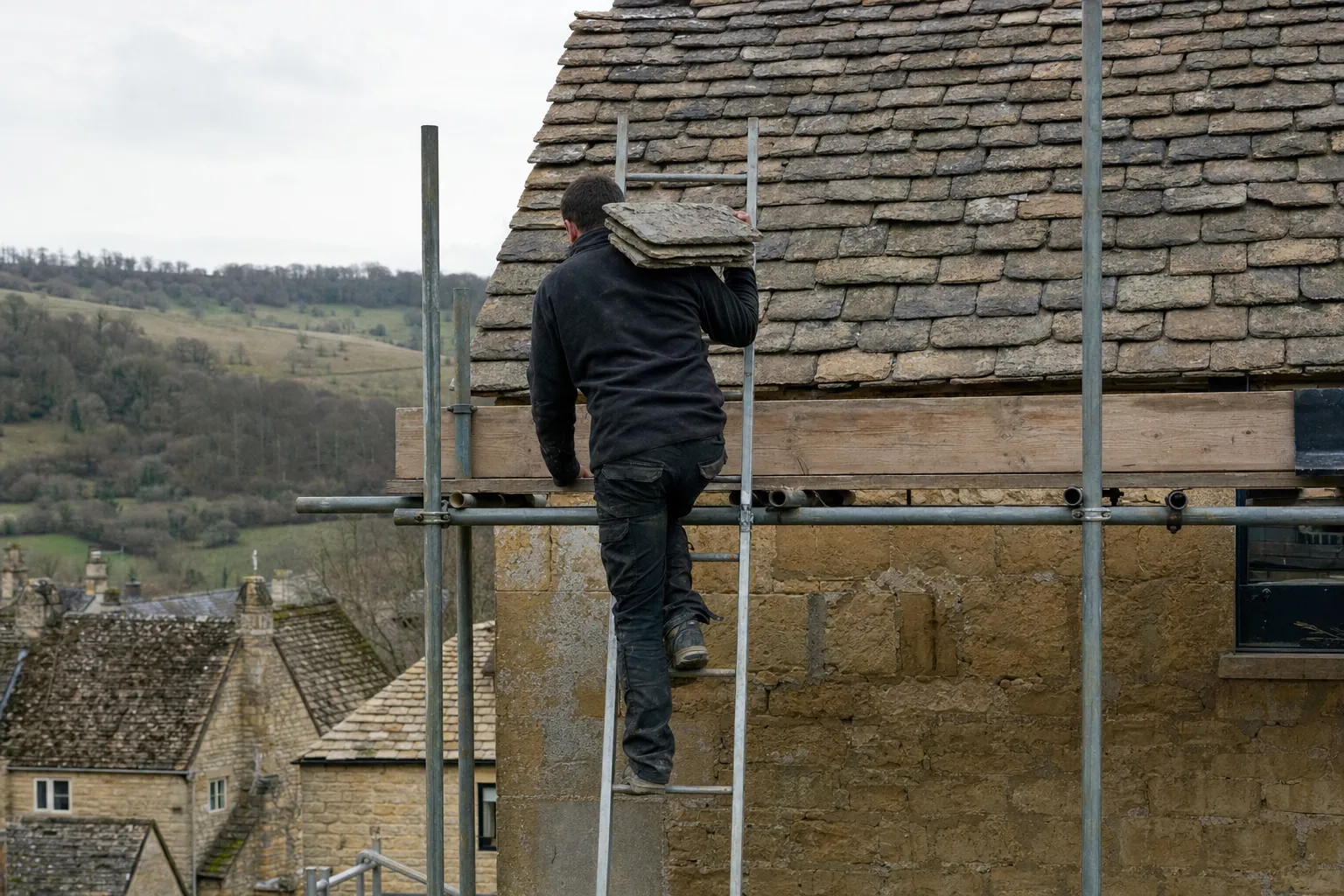
Roofer carrying stone slates up a ladder on scaffolding
Blocked gutter full of leaves overflowing down a brick wall

The short answer

Through access, more than anything. A pitched roof on a slope can be harder to reach, and scaffolding, deliveries and safe handling of materials take more planning. We study access at the survey, so the quote reflects the real site and not an assumed flat one.

On a hillside village, the roof can be the easy part. Getting to it is the hard part, and it is worth understanding before you compare prices.

Why does scaffolding cost more on a slope?

A scaffold needs a level, stable base, and where the ground falls away it needs extra boards, longer legs or stepped lifts. Narrow lanes can mean permission to occupy the road, or hand-carrying materials up a drive. MyBuilder gives around £850 to £1,200 for a standard two-storey house setup on level ground (updated 21/08/2026), so a sloping plot can come in above that. Ask every firm whether scaffolding is in the price.

Can some jobs be done without it?

Sometimes. A few loose ridge tiles or a split flashing can be reached from a roof ladder or a tower when the site permits, which keeps the job small. Larger repairs, and anything close to an eaves edge above a steep drive, need edge protection. We do not skimp here, and where a scaffold is needed we explain why. Our roof repairs page shows how a repair gets scoped, and when a bigger job is justified.

What does the survey tell me about access?

It records the approach, the fall of the plot, the height to the eaves and where materials would be stacked. Those notes go alongside pictures of your own tiles, and our written quote follows afterwards, so you can weigh it at your leisure. If the best answer is a repair that needs only a ladder, that is the job we put forward.

Gutters matter more on a hillside too, because the water has a long way to fall. A blocked downpipe at the top of a drive can send a stream down the wall below, so drainage gets a look whenever we are up there.

What it typically costs

  • Scaffold for an ordinary two-storey house£850 to £1,200
  • Domestic scaffold, weekly£300 to £900
  • Tall stack scaffold£400 to £900
  • Fully wrapped semi or terrace£1,500 to £2,600
National typical figures for level ground; a steep plot or narrow lane can push them up. MyBuilder scaffolding cost guide, updated 21/08/2026.
Q2

Does re-roofing in Brownshill need consent?

The answer

Planning permission is not usually needed to put back the same covering, conservation area or not, yet it pays to ask Stroud District Council before you change a material or a roof's appearance. Larger re-roofs can trigger building control, and a listed house always needs its own consent.

Bussage sits inside a conservation area and the Cotswolds National Landscape, which sounds restrictive. Day to day, though, most roof jobs are routine.

Where is the boundary of the designation?

The conservation area is called Bussage and Brownshill, so it reaches beyond the village core. Stroud District Council can tell you if your road is inside it, and it is best to ask before work is priced. Within a conservation area the council has a particular interest in how a roof looks from the street. Our guide to tiled roofs in conservation areas explains what tends to matter.

Does having no Article 4 direction mean anything goes?

No. Stroud lists Article 4 directions for other conservation areas and not this one, so householders keep the usual permitted development rights. But a listed building, a condition attached to an old planning consent or a change that materially alters the roof's appearance can still need an application. When in doubt, ring the council.

When does building control apply?

The Planning Portal's thresholds are 25 per cent of the building envelope and 50 per cent of the roof, and work staying beneath both limits rarely needs a building control application. Pass one of them, or pick a covering 15 per cent or more heavier, and approval becomes necessary, with insulation possibly improved. Whether the council or a registered building control approver deals with it is a choice we talk through with you.

The Cotswolds National Landscape body is an adviser. Stroud District Council takes the planning decision, so the council is who you ask about the look of your roof, and a quick call can save a lot of trouble later.

Our view

Ask Stroud District Council about your address first; a five-minute call usually settles it.

Q3

How long should a concrete tile roof on the estate last?

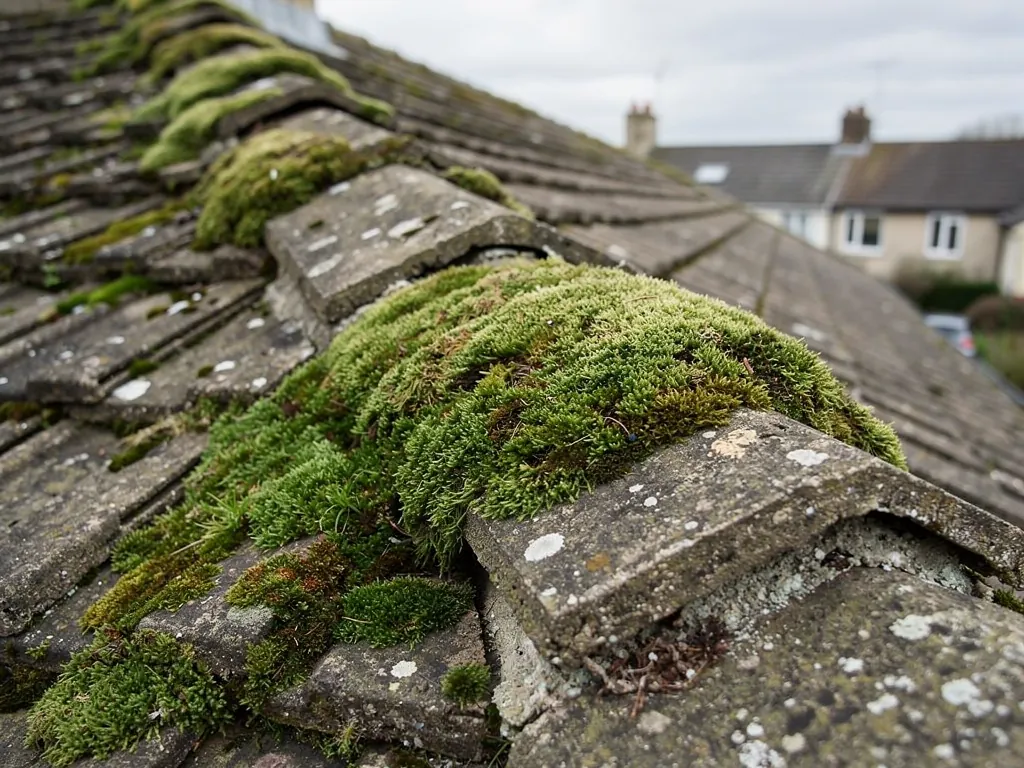
Thick moss growing over ridge and concrete roof tiles
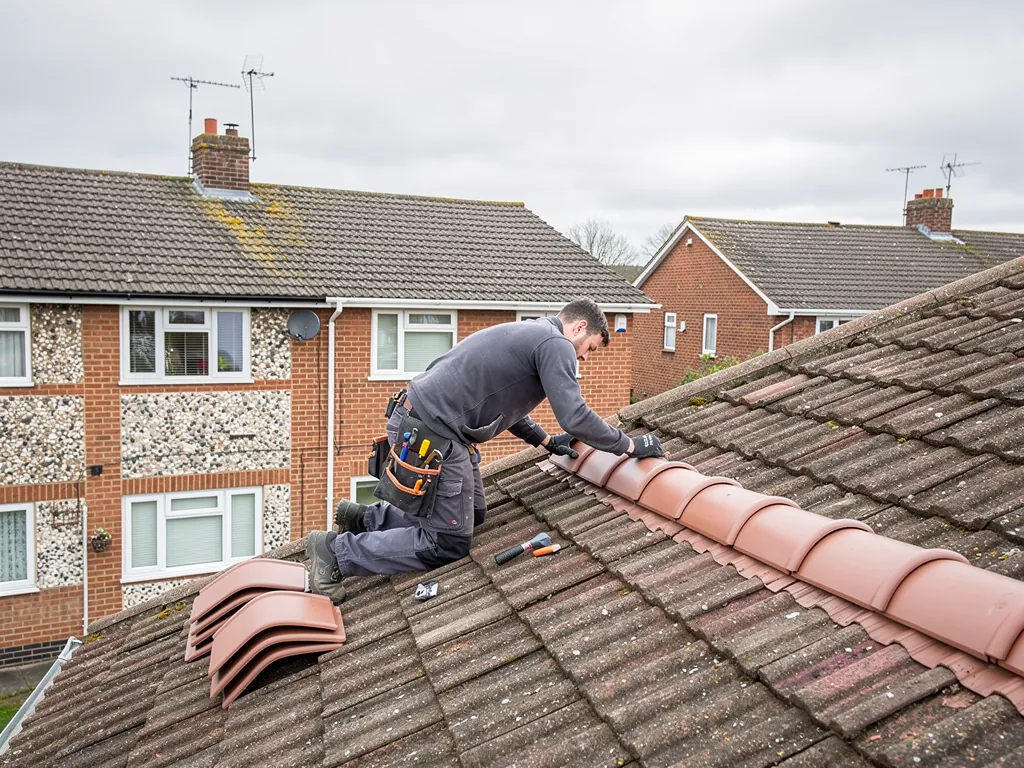
Roofer fixing new red ridge tiles along a concrete tile roof

The short answer

National guides put concrete tiles at roughly 30 to 60 years, and the tiles often outlast the parts around them. Ridge bedding, valley liners, underlay and fixings usually need attention first, and a repair on those can add many years without re-covering the whole roof.

Concrete tiles have long been the covering of choice for housing estates, and the Manor Farm Estate is the kind of place where they turn up. Their lifespan depends on exposure, workmanship and upkeep, and the sources disagree on the range.

What do the guides say about lifespan?

MyBuilder says concrete tiles typically need replacing after 30 to 50 years, while Marley expects its tiles to last around 60 years and adds that this is not a guarantee. A safe summary is often 30 to 60 years. Those are national ranges, not a forecast for your roof, so a look at the actual tiles tells you more than the build date.

What wears out before the tiles do?

Ridge and hip bedding, the lead or GRP lining of valleys, felt that has torn or perished, and the small roofs over porches and garages. The 2014 revision of BS 5534 stopped ridge tiles relying on mortar alone, and the tiles are now held by fixings as well as the bed beneath them, so older estates often need ridges redone. Our ridge, verge and dry-fix page sets out what each choice involves.

When is a repair enough, and when is it time to re-tile?

When the tiles are in good order and the trouble sits in one ridge, valley or flashing, repair is the sensible job. If tiles are flaking at the surface or snapping on touch, or the battens and felt are failing across a whole slope, re-roofing is the better choice. Our pitched roofing page covers that decision.

Either way, the survey photographs let you see your tiles up close, from ridge to eaves, so the decision rests on evidence, not guesswork. If a neighbour on the estate has had a similar repair, show us what was done; it saves time and tells us what has already held up on your street. Photographs from over the fence are often enough to start with.

MythConcrete tiles are maintenance-free for life.

FactThey often last 30 to 60 years, but ridges, valleys, felt and fixings need attention well before the tiles are finished.

Questions from the hillside lanes

Why does moss collect so heavily on shaded Bussage slopes?

Trees and the lie of the hill keep some slopes in shade and damp for long stretches, which suits moss and algae, and leaf litter clogs valleys and gutters. A thin film of moss is chiefly a cosmetic matter, but a deep layer keeps water pressed against the tiles and can block drainage. We clear it with care, because pressure washing can damage delicate coverings, and then check what lies beneath.

Can you match a tile on one of the estate's houses?

Usually, yes. Concrete interlocking tiles come in a limited number of profiles and colours, and we check the profile, the weathering and the lap on your roof before ordering anything. Where an exact match no longer exists, we blend the replacements into an inconspicuous slope. Our matching roof tiles page explains how.

Do you also cover Chalford Hill, Brimscombe and Eastcombe?

Yes. Bussage and the Frome valley villages that neighbour it all fall comfortably within our working area out of Swindon. Call 01793 626096 or fill in the enquiry form with your road name; we confirm it is in range before anything is booked, and a photographed survey follows.

Is the roof of a Victorian village church a job for the parish?

Yes. Anglican churches that remain in use are governed by the faculty system, so the parish and its advisers decide the approach. We are happy to survey and quote a roof like that, with a 10-year workmanship guarantee in writing, but the permission route is the parish's to settle first and comes before any work starts.

Ask us about your roof

Tell us what’s happening and we’ll call you back.

  • Photos of what we find
  • A written quote
  • 10-year workmanship guarantee

Or call 01793 626096

Call Get a quote