Edwardian brick villas with clay tile roofs and decorative ridges

Roofers in Bisley, Gloucestershire

Tile and slate mending, complete re-roofs, stacks and extension roofs in Bisley, from the Cotswold stone houses on the hilltop above the Frome valley to the lanes that run down to Wells Road.

Bisley's roofs, from the lock-up to Lypiatt

Stone cottages with gabled roofs
Cotswold stone houses in the village

Bisley is known for its Cotswold stone houses, and the village around All Saints church is built of them. What sits on top of those walls is a separate question, and one a survey has to answer house by house, because the roof covering is not something you can read from the road. Some stone-walled houses carry stone slates, some carry clay or natural slate that replaced them long ago, and some have later concrete tiles. Gables, copings, valleys and chimney stacks are built into the stonework itself, which means a leak at one of them tends to show as damp in a wall rather than a drip from a ceiling. The church of All Saints was mostly rebuilt in the early 1860s, and the older houses near it have been through just as many changes.

Large stone house with many chimneys
Manor houses and large estates

Two of the best-known houses nearby are Lypiatt Park and Nether Lypiatt Manor, and they set the tone for the larger properties in the parish of Bisley-with-Lypiatt. Smaller manor farms and rectory-style houses follow the same pattern on a reduced scale. Roofs on houses of that scale are long, steep and broken up by dormers, valleys, parapets and clustered chimney stacks. The work involves hidden gutters, lead flashings and big areas of covering that need a safe vantage point to inspect. When a house is listed, the question of material comes before the question of price, and the choice of material is settled with you in conversation before a single order is placed.

Old stone outbuilding with a small roof
Small buildings and outhouses

Bisley's smaller historic structures are part of its character: a two-cell lock-up built in 1824, a Saxon wayside cross on Bisley Road and the structure with seven spouts on Wells Road, fed by the Seven Springs. Garden walls, outbuildings and barns around the village have roofs of their own that rarely get a thought until a slope slips, and a small leak into a store or workshop can ruin tools and timber before anyone notices. Small roofs are cheaper to put right, but they are often the ones that have gone longest without a look. Ridges, verges and the junction where an outbuilding meets a main wall are where we start, and a few photographs of each are enough to show what is wrong.

From Swindon up into the Cotswold hills

Map showing Bisley and central Swindon. 28 road miles north-west of central Swindon.

Distance
28 road miles north-west of central Swindon
Council
Stroud District Council
Local authority
Stroud District Council
Landscape
Cotswolds National Landscape, on the hills east of Stroud
Parish
Bisley-with-Lypiatt

Bisley roof questions

Do Bisley's stone houses all have stone roofs?

No. The walls are Cotswold stone, but the covering on top varies. A survey identifies it before any method is chosen.

Can roof work near All Saints church be done in matching materials?

Yes. A repair that keeps the existing covering and fixing pattern is the usual approach, and on a church-side street that is also the approach neighbours tend to welcome. Anything that alters the look is checked with the council first.

How windswept is a roof on Bisley's hilltop?

More than one in a sheltered hollow. Verges, ridges and eaves take the weather first, so their fixings deserve the most attention.

Q1

Which covering is on a Bisley stone house?

Reclaimed Cotswold stone slates sorted by length beside a limestone wall
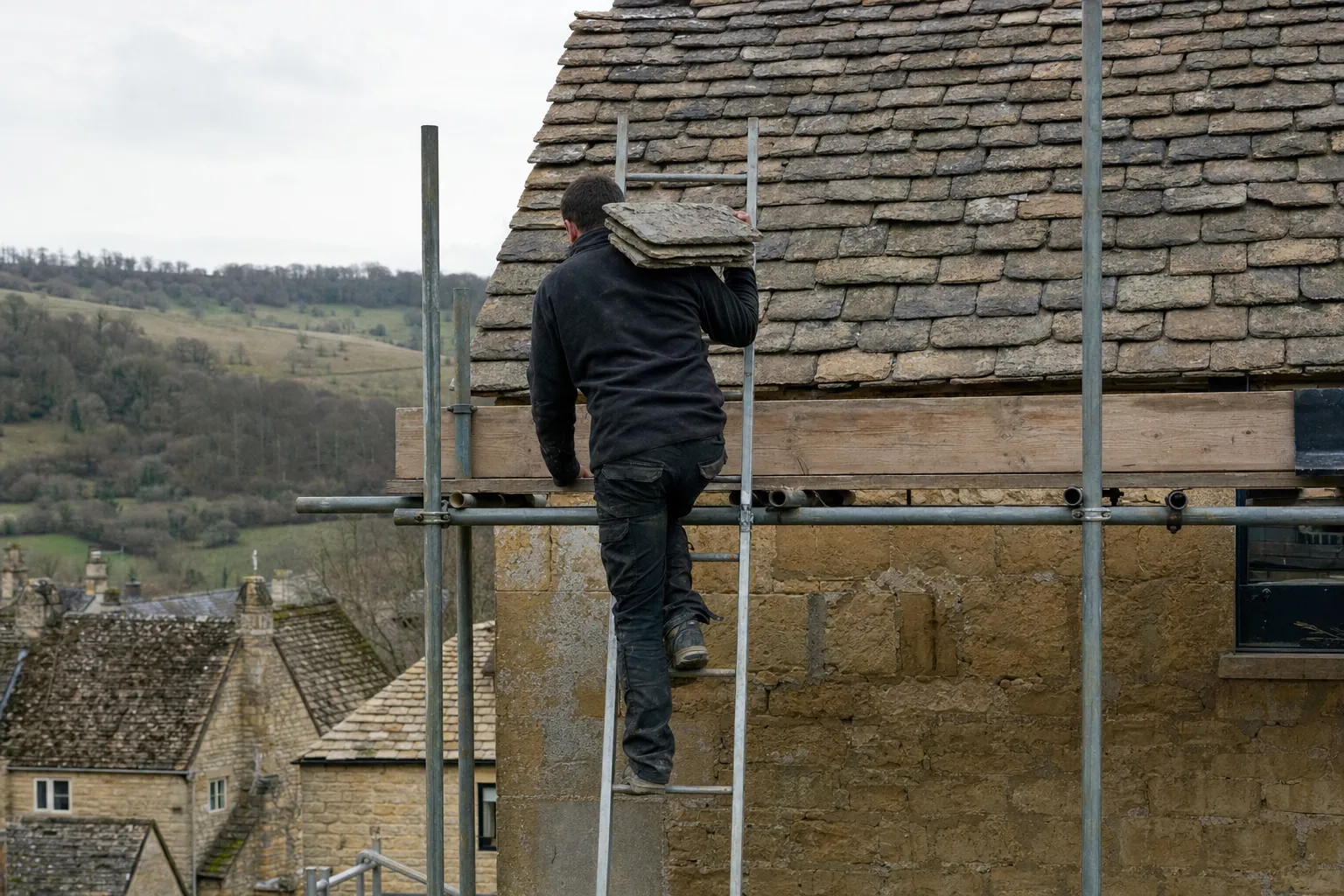
Roofer carrying stone slates up a ladder on scaffolding

The short answer

It could be one of several. Bisley is known for Cotswold stone walls, but the covering above them may be stone slate, clay tile, natural slate or concrete tile. The walls do not tell you, and the roof is identified on site before we say what kind of repair it needs.

People often say that a stone-walled village must have stone roofs. In practice, a roof gets replaced several times in the life of a wall, and each replacement was chosen for the money and materials of its day. A house that started with stone may have been re-covered in something lighter in the nineteenth century, and again in the twentieth, which makes the visible roof one of several the same rafters have carried.

Why does the covering decide the repair?

Because each material fails in its own way. A stone covering loses pegs and battens before it loses stones. A clay tile cracks at the nib or the corners. Natural slate fails at the nail holes, and concrete tile loses its surface and its ridge bedding. A repair that suits one will do harm to another, so the first job is to name what is there. Our Cotswold stone roofing page covers the traditional method, and the roof repairs page covers the rest.

How much does the weight of the covering matter?

Stone roofs are very heavy, about 1000 kg for every 10 square metres of roof, according to the Cotswold District Council technical guide of 2000. A roof timbered for stone can carry lighter material, but a lighter roof timbered for slate cannot always carry stone. Where a swap is proposed, we ask for the roof timbers to be checked by someone qualified, because a rafter that has carried one load for a century may not suit another, and the Building Regulations apply if the new covering is 15 per cent or more heavier.

Will a repair look different from the rest of the roof?

It should not. We match size, tone and laying pattern, and the survey photographs show the neighbouring courses so the match is judged by eye. If an earlier patch used a mismatched material, the photographs will show it, and you can weigh up whether putting it right is worth the money.

MythA village of Cotswold stone walls must have stone slate roofs.

FactThe walls tell you what was quarried, not what covers the roof. Coverings are changed many times over a building's life.

Q2

How should a hilltop Bisley house be fixed against the weather?

The answer

With attention to the edges. The ridge, the verge edges and the eaves line are where a gale gets a grip first. Fixings on those lines matter more than the covering across the middle of the slope, and a check of them is part of every survey we do on an exposed house, whether the covering is stone, clay or concrete.

Bisley sits high on the hills above the Frome valley, with open ground around it and the slopes falling away towards Stroud. A house in that position has more sky above it than one in a sheltered hollow, and the roof feels the difference.

Where does wind do its damage?

It starts at the edges. A verge, the sloping edge of a gable roof, is held by mortar or a trim, and when that fails the wind can lift the first tiles. The ridge line rises above the slopes and gathers the air as it rushes over the top. The eaves are the third place, where the lowest course can be lifted if the fixings are poor. Since BS 5534:2014 the standard has not trusted mortar to hold ridge and hip tiles on its own, and a sensible ridge repair today is mechanically fixed. Options for mechanically fixed ridges and verges are set out on our ridge, verge and dry-fix page.

Is it a repair or a strip?

If the covering is sound and only the edge has failed, the repair is local. If tiles are slipping across a whole slope because the nails or battens have given up, a local repair will not hold, and the lifted tiles will show you why. The test is quick to explain. We lift a few and look at what holds them, then show you the photographs so the decision is yours.

What can I check from the ground?

Stand back in the garden or on the lane and look along the ridge for gaps, at the verges for loose or dropped mortar, and at the gutters for tiles or fragments that have slid down. If you can send photographs, we will reply with a view on whether a full visit is called for.

Q3

Who decides what can be done to a Bisley roof?

Rolled lead roof covering over a bay above white windows
Long flat roof on a 1960s brick building being re-covered

The short answer

Stroud District Council decides planning questions, while listing brings its own consent for changes that affect a house's special interest. Bisley lies within the Cotswolds National Landscape, whose role is advisory. Roof work that falls under the Building Regulations goes through building control.

For most households the answer is that nobody needs to be asked, and a roofer should say so plainly. A repair that keeps the existing materials and appearance is upkeep. The questions arise when you want to change something, or when the building has a status.

Is my house listed?

Bisley has houses of real age, and the two great houses of the parish, Lypiatt Park and Nether Lypiatt Manor, are both listed Grade I. Whether a given house is listed is a matter of public record, and Stroud District Council can confirm it. If yours is, anything that bears on its special interest requires listed building consent, and that covers the choice of roofing material.

Does the National Landscape change the rules?

The Cotswolds National Landscape has carried that name since 22 November 2023. It offers planning advice, while the council makes the decisions, and a matching re-roof is not stopped by it. If you are thinking about a dormer or a new roof window, read our skylights page before you plan, since the rules change on land with that status.

What does building control cover?

Past the Planning Portal's thresholds, which are 25 per cent of the building envelope or 50 per cent of the roof, building control approval applies to a re-cover. So does a covering 15 per cent or more heavier. Stroud District Council and registered building control approvers both handle this, and we take you through the notification. Bisley's conservation area was first designated in 1975, and whether its boundary takes in your street is something the council can answer, so it is worth asking early.

Ask before you change

Repairs in matching materials are routine, but a change of covering is the point to speak to the council.

Questions from the hills around Bisley

Why do Bisley stone houses show damp below the gable?

Usually because water is entering at the wall head. Copings, kneelers and the flashing along the roof edge are part of the wall, and when their joints open, rain soaks the stonework. The stain you see lower down is simply where it emerges. Our job is to find the opening and mend that, not to treat the mark.

Do you work on barns and outbuildings around Bisley?

Yes. A barn or outbuilding gets the same survey as a house, with photographs of each slope. The covering could be stone, tile, slate or profiled sheet, and the method is chosen with you first. A ten-year workmanship guarantee applies, and it is put in writing.

Do you cover the villages around Bisley in the Cotswold hills?

Yes. Our patch includes the villages around Stroud and across the Cotswold hills that are within 30 miles of Swindon by road, and the areas page lists them. If yours is missing, ring or message us and we will confirm.

Are bats a concern when an old Bisley stone roof is opened up?

The law protects bat roosts and active birds' nests, and an old stone roof full of crevices suits both. If we spot signs, work pauses while we advise on the next step. A look from outside often shows whether this is likely.

Ask us about your roof

Tell us what’s happening and we’ll call you back.

  • Photos of what we find
  • A written quote
  • 10-year workmanship guarantee

Or call 01793 626096

Call Get a quote