Victorian brick terrace street with slate roofs and chimneys

Roofers in Thrupp, Gloucestershire

Roof repairs, re-roofing, leadwork and flat roofs in Thrupp and Brimscombe, from houses climbing the valley sides to the old mill buildings beside the Frome and the canal line.

Thrupp's roofs, from mill yard to valley side

Large mill roof with valley gutters
Mill buildings by the water

Thrupp's building stock begins with its mills. A cloth mill is recorded here as early as 1381, Griffin Mill was founded in 1600, Ham Mill made textiles from 1601 until 2000, and Phoenix Mill was the site of the Phoenix Iron Works. Buildings of this kind carry wide-span roofs, often with valley gutters between long pitches, parapet gutters behind the walls and rooflights mended again and again with mastic. Leadwork and drainage matter more than the covering. One blocked outlet in a valley between two long slopes can put water into the building within minutes of heavy rain, so outlets, gutters and flashings are what we inspect first, with every slope photographed from a safe access point.

Terraced houses stepping up a hillside
Houses on the valley sides

The Frome Valley is narrow here, and the lanes climb steeply on either side. Brimscombe grew rapidly once the Thames and Severn Canal and Brimscombe Port opened in 1789, so houses from that burst of building are part of the picture around Thrupp. On sloping plots, access is the practical question. Scaffold may have to stand on a bank or a narrow pavement, a ladder may not reach safely from the road, and carrying materials up steps takes time. Older roofs of this kind tend to have shared chimney stacks, short upstands where the roof meets a neighbour's wall and small valleys over rear extensions. Leaks usually begin at those joints, and they are what the survey photographs show first.

Modern tiled houses with a flat porch
Church, manor house and later homes

Holy Trinity at Brimscombe is the parish church, and nearby Burleigh Court, now a hotel, is a Grade II listed house of about 1800, altered around 1930 by Clough Williams-Ellis. Any roof change that alters how such a house looks or what it is made of calls for listed building consent, so the covering is never a casual choice there. Away from the older buildings, homes and extensions from later decades bring a different set of faults: ridge tiles with crumbling bedding, tiles split by frost, tired felt beneath the covering, and flat-roofed garages or porches that need help years before the main roof does. Matching the existing covering keeps a repair modest in size and cost, and our visit on site settles whether a repair is all that the roof calls for.

From Swindon down into the Frome Valley

Map showing Thrupp and central Swindon. 27 road miles west-north-west of central Swindon.

Distance
27 road miles west-north-west of central Swindon
Council
Stroud District Council
Local authority
Stroud District Council, for planning questions
Setting
Narrow Frome Valley, south-east of Stroud, sharing a parish with Brimscombe
Parish church
Holy Trinity

Roof questions from the Thrupp valley

Can a leaking mill-building roof in Thrupp be patched?

Frequently, if the culprit is a flashing, an outlet or a gutter joint. Only a look at the metal shows if a patch will last, or if the whole valley needs relaying.

Is scaffolding hard to put up on Thrupp's valley slopes?

It can be. A sloping plot may need a levelled base or taller frame, so access is noted on survey day and reflected in the price you are given.

Does patching a roof beside Holy Trinity church need consent?

Seldom, if the repair uses the same materials. Listing changes that, so take any alteration to the roof's appearance to Stroud District Council before starting.

Q1

What goes wrong on Thrupp's mill-era roofs?

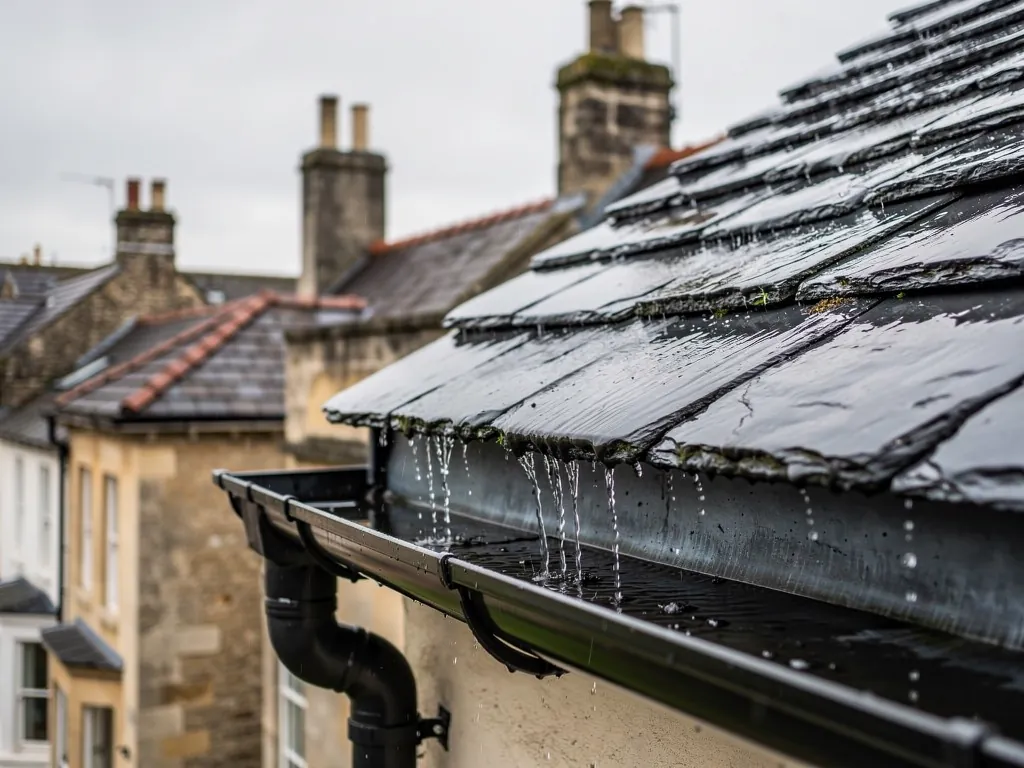
Rainwater running off slates into a black gutter and downpipe
Blocked gutter full of leaves overflowing down a brick wall

The short answer

On large old roofs the weak points are rarely the covering itself. Valley gutters, parapet gutters, outlets, lead flashings and rooflight surrounds funnel water to a handful of small places, and when one fails the water arrives fast. We start there and work outwards.

Thrupp's mills grew up beside the river, the canal and the road, and their roofs show it. They were built to cover wide floors, so a roof is often a pair of long slopes meeting in a valley, or a run of identical pitches side by side. Each junction where two slopes meet is a gutter in waiting, and a gutter is only as good as its outlet.

Why do valley gutters fail first?

A valley is a channel lined with lead or another metal, and it carries rain from two slopes at once. Leaves, moss and silt settle in it, and the lining beneath is seldom seen by anyone. Lead that has stretched and shrunk through many winters can split along its folds, and a patch over a split is only as good as the metal under it. Where the lining is sound we clear it and dress it back into shape, then check the laps and the clips that hold it. Where it has gone, a newly lined valley is the lasting answer.

What about parapet gutters and flashings?

A parapet gutter runs tucked behind a short wall along the eave, and its outlet may be no wider than a drainpipe. When that outlet clogs, the gutter fills until water finds the weakest joint. We check that the outlet runs clear, that the gutter has a proper fall, and that the flashing is tucked into a cut in the wall rather than smeared over the surface with sealant. Our commercial roofing page explains how larger buildings are surveyed and quoted.

Do old rooflights need replacing too?

Many mill roofs carry rooflights in tired frames. Where the glass is sound and the trouble is at the kerb, the repair belongs at the kerb, not in new glazing. Where a rooflight is being replaced, the new unit has to meet current thermal limits, and our written price says so plainly. Photographs of each valley, outlet and flashing come with it, and the defect is laid out on screen or paper well before you choose a course of action.


Q2

How do roofers work on Thrupp's steep valley plots?

The answer

With a plan made at the survey. We note how the ground falls, where scaffold can stand, whether a lorry can reach the door and how materials get up to the roof. Access on a hillside decides a large part of the cost, so it is settled before any price is written down.

The Frome Valley squeezes road, river and houses into a narrow floor, and the houses climb away from it. That shapes how a roofing job is run just as much as it shapes the roof.

Where does the scaffold stand?

On a level street, scaffold is a standard frame at the front wall. On a bank, a terrace or a house set back along a steep lane, the ground may need levelling with sole boards, or the frame may need longer legs. Scaffolding on a neighbour's land needs their agreement, and one on the pavement may need a licence from the highway authority. If a quotation you receive never mentions scaffolding, ask whether it is included, and whether VAT is.

How do slates and tiles reach the roof?

A lorry that cannot climb a narrow lane unloads at the bottom, and the pallets come up in smaller loads, by hand or by hoist. That takes more hours, and hours are what move a price. A job that needs three trips up a bank is not the same job as one with a skip outside the front gate. We plan deliveries so the materials arrive when there is room to receive them, not when the road is blocked.

What if the next house shares the roof line?

Terraces and semi-detached pairs on a slope often share a ridge or a chimney stack. Work along the party wall is planned with the neighbour in mind, and where a party wall notice is needed we raise it early rather than on the morning scaffold goes up.

When the job is finished, offcuts, old tiles and packaging leave with us, however long the carry from the roof to the road. The guarantee on our workmanship lasts ten years, in writing.

Access sets the price

On a steep Thrupp plot, getting materials to the roof can cost as much as the materials themselves.

Q3

Who signs off a roof job in Thrupp?

Rolled lead roof covering over a bay above white windows
Long flat roof on a 1960s brick building being re-covered

The short answer

Planning here belongs to Stroud District Council. Building control sits with the council team or with a registered approver. Most repairs need neither, though anything touching a listed building should be put to the council before a single tile moves.

Plenty of roof work in Thrupp is plain upkeep. Refixing a loose tile, patching a flashing or tidying a ridge with like materials asks nothing of the planners. Three situations deserve a conversation before any scaffold goes up.

At what point does a Thrupp re-roof need approval?

The Planning Portal sets two tests for a re-cover. Stay under 25 per cent of the total building envelope and under 50 per cent of the roof, and building control is not normally involved. Go past either figure and approval applies, with insulation brought up to date. Moving to a covering 15 per cent or more heavier would trigger approval too. When your job crosses a line, we walk you through it and take care of the Building Regulations notification.

Is my Thrupp house listed, or close to a protected one?

Burleigh Court, just over the boundary in Minchinhampton parish, is listed Grade II, and other buildings around Thrupp may be listed too. Work that affects such a building's special character needs listed building consent. Whether your address sits inside a conservation area is a question for Stroud District Council, and the council's reply is worth hearing before you settle on a different material or add a roof window.

What about a mill conversion or a managed building?

Converted mill buildings often sit under a managing agent or a freeholder, and a roof repair may need their agreement as well as the council's. Check your lease or title before the survey and send us the paperwork if you have it.

Our roof repairs page shows how a repair is scoped. The paperwork you receive afterwards is a written quote based on the photographs.

MythA house beside a listed manor always needs a planning application for roof work.

FactOnly the listed building itself, or a property in a protected area, calls for consent. A neighbour's listing does not bind your repair.

Questions from Thrupp and Brimscombe

Why does water come through Thrupp's older roofs at the joints, not the middle?

Because joints are where a roof is most complicated. Chimney flashings, valleys over extensions and the line where a roof meets a neighbour's wall all depend on metal and sealing that ages faster than the tiles around them. On a damp valley floor, moss and slow drying make it worse. We trace the leak to its source first, and a repair at the joint is often all that is needed.

Can you survey a flat-roofed mill unit or workshop in Thrupp?

Yes. Flat and low-pitched commercial roofs are surveyed in the same way as houses, with every outlet and slope photographed, the falls checked and the fault explained. A written quote follows, and the 10-year workmanship guarantee is in writing.

Do you work in Brimscombe and the lanes above the Frome?

Yes. Brimscombe sits in the same parish as Thrupp, and the hillsides and hamlets around Stroud fall inside our 30-mile radius by road. For an address near the boundary, check the full list on the areas page.

Does a Thrupp ridge held on mortar alone need extra fixings?

Usually, yes. Since BS 5534:2014 the standard stopped trusting mortar as the only hold on ridge and hip tiles, so each ridge we re-bed is pinned down with mechanical fixings or finished in a tested dry-fix system. A valley that funnels wind along its length makes that a sensible upgrade whatever the age of the house.

Ask us about your roof

Tell us what’s happening and we’ll call you back.

  • Photos of what we find
  • A written quote
  • 10-year workmanship guarantee

Or call 01793 626096

Call Get a quote