Concrete tiled estate rooftops towards green hills

Roofers in Minchinhampton

Roof repairs, relaying and replacement in Minchinhampton, covering the old centre around the Market House and Holy Trinity as well as the newer houses higher on the hill beside the Common.

Minchinhampton's roofs, from the square to the Common

Stone market building beside a church tower
Around the Market House and Holy Trinity

Minchinhampton appears in the Domesday Book, and its name recalls the Caen nunnery that once held the manor. The main square keeps a 17th-century Market House and a war memorial, while Holy Trinity, the Anglican parish church, lost its spire in 1563 and was finished with a coronet structure. Buildings of that age have been reroofed and patched through several centuries. Where a roof here is natural stone, repair follows stone-roofing practice, and any lead in valleys, gutters or tower flashings gets close attention. We read what the roof has been through before choosing how to mend it, and the survey photographs separate original work from later repair.

Stone tiles in graded courses
Cotswold stone roofs where they survive

A traditional Cotswold stone roof is graded: large stones low down, small ones near the top, each hung on a wooden peg hooked over a batten. Pegs and battens often fail well ahead of the stone, so a slipping roof is not always a worn-out one. Stone is also heavy, around 1000 kg for every 10 sq m according to Cotswold District Council's 2000 guidance, so the timbers beneath are examined before anything else is decided. Stone lifted from the roof itself is laid back on that roof wherever it can be, and taking it from a neighbouring building is not how we like to source it. Not every roof in the town is stone, and we tell you which yours is once we have been up on it. Where it is stone, nothing is ordered until the survey has shown which stones can stay, how many pegs have gone and what the battens look like underneath.

Tiled houses on a hillside street
Hillside houses and newer building

The town stands on a hilltop beside the 580-acre Minchinhampton Common, a Site of Special Scientific Interest, and roofs on open ground take the weather with little cover. Alongside the old centre are twentieth-century houses with concrete or clay tiles, bungalows, garages and extensions with flat roofs. Reconstituted stone slates are concrete products. They suit a modern house, but English Heritage policy, as reproduced by Cotswold District Council, calls such substitutes inappropriate for historic buildings. On the newer roofs we meet loose ridge tiles, tired valleys, failed felt and flat roofs that hold water, and the cure is usually modest.

From Swindon up to the hilltop

Map showing Minchinhampton and central Swindon. 26 road miles west-north-west of central Swindon.

Distance
26 road miles west-north-west of central Swindon
Council
Stroud District Council
Council
Stroud District Council
Conservation area
Minchinhampton
National Landscape
Cotswolds National Landscape

Minchinhampton roof questions

Does the Cotswolds National Landscape affect a roof window here?

Different rules apply to roof windows and dormers in protected areas. The council decides, not the National Landscape body, and our roof window planning page sets out the detail.

Can you refix slipped stone tiles instead of replacing them?

Often yes. Pegs and battens tend to fail ahead of the stone, so sound stones can be hung again, with matching stock making up any that have broken.

How do roofs beside Minchinhampton Common cope with the wind?

Open ground gives them little shelter, so ridges, verges and chimney flashings work hardest and are checked first. The quality of the fixings matters more than the covering underneath them, and we plan the visit around that.

Q1

How are stone roofs near the Market House repaired?

Brick and limestone cottages around a small village green
Reclaimed Cotswold stone slates sorted by length beside a limestone wall

The short answer

By working with the stone. Slipped stones are hung again, rotted pegs and battens renewed, and broken stones replaced with matching ones. A whole slope is relaid only when its fixings have gone, and the stones return in their original order.

If a roof around the Market House is natural stone, it belongs to a craft centuries old, and the repair should respect that. Not every Minchinhampton roof is stone, and we confirm what yours is at survey, but where it is, a few terms are worth knowing.

What are diminishing courses?

Stone splits into many small pieces and few big ones, so the roof starts with the biggest stones on the lowest courses, doubled along the eaves, and finishes with the smallest beside the ridge. The slope seems to tighten as it climbs. Fitting a stone of the wrong size breaks that pattern and can open a path for water, which is why a careful match beats a quick one. Our Cotswold stone roofing page goes through the vocabulary.

Why do the pegs matter?

Each stone traditionally hangs by a peg, often cleft oak, pierced near its head so that it can hook over a batten. Let the peg rot or the batten go soft and the stone drops, although it is perfectly sound. That is why a stone roof can look finished when all it needs is new fixings, and why hanging the same stones again is often wiser than buying more. The repair is slow work, done stone by stone from a crawling board so that nobody stands on the courses.

How heavy is the roof, and does that change the repair?

Very heavy. The 2000 Cotswold District Council guide gives stone slate as about 1000 kg per 10 sq m. Timbers beneath have carried that for generations, and a lighter or a heavier covering shifts the loading, so any change of material begins with a look at the structure. Our roof repairs page explains how a repair is planned.

Q2

Who decides roof work in Minchinhampton?

The answer

Stroud District Council decides planning matters, listed buildings and the conservation area included, while the Cotswolds National Landscape body only advises. Bigger re-roofs go through your council's building control or a registered approver, and Church of England churches follow the faculty system.

A conservation area, listed buildings and the Cotswolds National Landscape all touch Minchinhampton, so people expect a thicket of rules. The reality is narrower.

Does a conservation area stop me re-roofing?

No. Maintenance, or re-roofing in the same material, rarely needs a planning application, because the roofline looks no different when we leave. The council starts to care when something changes: another material, a new roof window facing the street, or work on a listed building, which needs listed building consent. Ask Stroud District Council whether your address sits inside the boundary.

What does the National Landscape change?

Less than most people expect. The body behind the designation makes no planning decisions; it advises, and the council decides. A straight re-roof is untouched. Roof windows and dormers follow their own rules, which our roof window planning guide sets out.

Is the parish church treated like other listed buildings?

Not quite. Anglican churches in regular use are exempt from listed building consent, with the faculty system taking its place, though planning rules for the exterior can still apply. Holy Trinity's roofs are a matter for the parish, not for a private homeowner.

Will a Minchinhampton re-roof need building control?

The Planning Portal draws its line at 25 per cent of the building envelope and 50 per cent of the roof: an ordinary re-cover that remains under both figures needs no application in the normal run of things. Go over either, or choose a covering 15 per cent or more heavier, and building control approval is then required. Where work is notifiable we look after the notification and tell you which route fits.

If your plans touch the front of the house, a short chat with the council before pricing the job saves rework later.


MythBeing in a National Landscape means I cannot change my roof.

FactThe National Landscape body only advises; the council decides, and a straight swap of roof covering proceeds as it would anywhere.

Q3

Should a stone roof be relaid or replaced?

Gloved hands fitting a weathered Cotswold stone slate
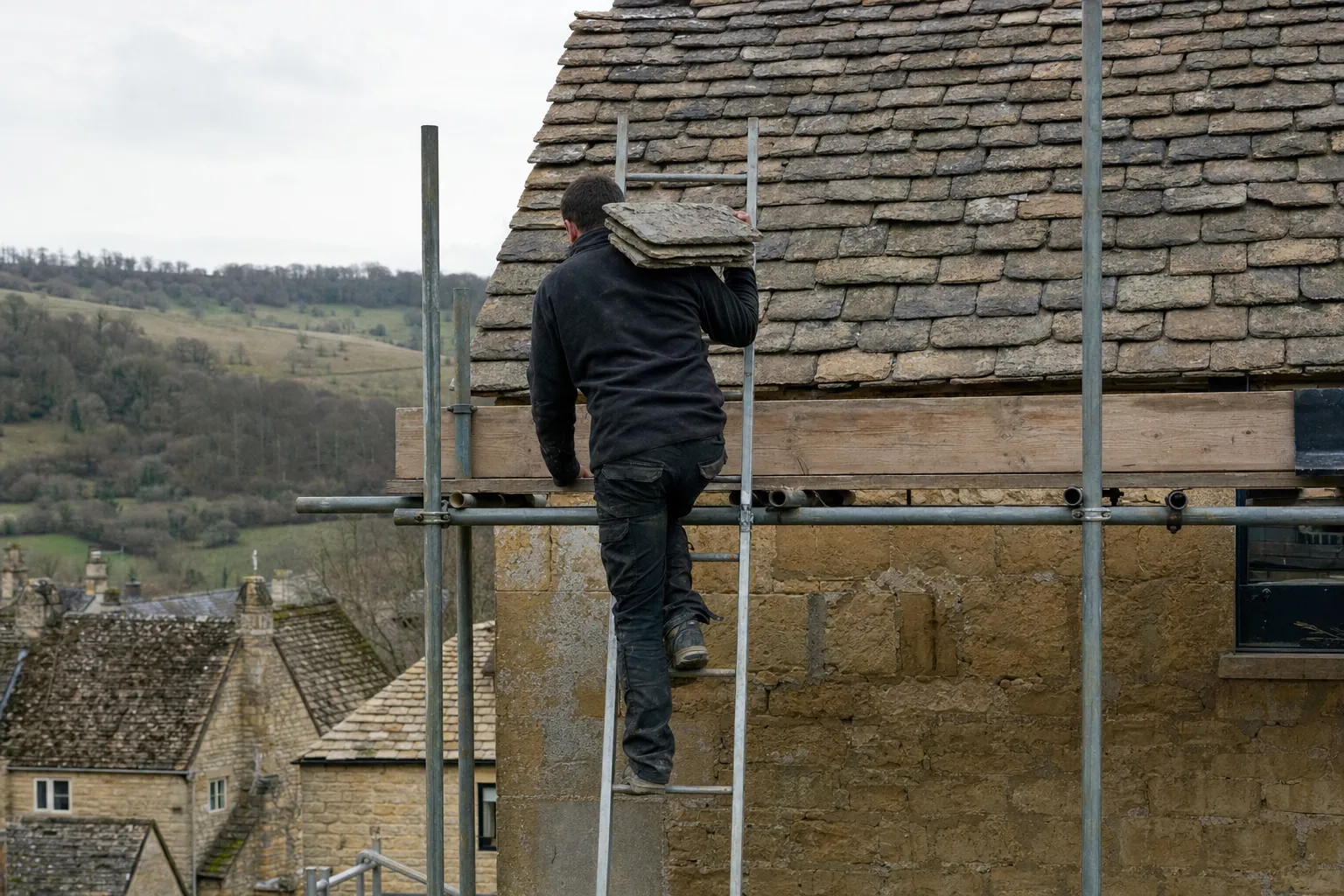
Roofer carrying stone slates up a ladder on scaffolding

The short answer

Relay when the stone is sound and its fixings have failed; replace only when the stone itself is perishing. Labour and access make up much of the bill, not the stone, so keeping good stone is usually better value as well as a better match.

Stone roofs are costly to strip and costly to rebuild, so the first question is how much stone is still sound. Cotswold District Council's technical guidance records that about half the stones may have perished when a roof finally comes off, so the answer is rarely all or nothing.

Is reclaimed stone better than new?

Not necessarily. The English Heritage policy it quotes favours new stone over second-hand, and wants reclaimed stone to stay with the very building it was lifted from, because robbing other roofs can leave them bare. Stone from the roof being relaid is the best match because it already belongs there. Our stone roofing pages cover sourcing in depth.

Can a concrete or reconstituted tile replace it?

On a modern house, yes. On a historic building the policy treats such substitutes as unsuitable, and sandstone and limestone are not to be combined on a single slope. A listed stone roof could not be swapped without consent in any case, so the discussion with the council comes before the discussion about price.

What do stone and slate roofs cost?

Checkatrade's slate-per-m² guide (last updated September 2026) gives around £160 to £210 per m² for an average stone slate roof, and that figure is not Cotswold-specific. MyBuilder (updated 21/08/2026) gives £100 to £180 for natural slate. Access, the timbers beneath and how much stone can be reused set a real price. Ours comes in writing after the survey; ask any firm whether VAT and scaffolding are in theirs.

What it typically costs

  • Stone slate roof£160 to £210 per m²
  • Natural slate re-roof£100 to £180 per m²
  • Welsh slate£140 to £180 per m²
  • Reclaimed slate£110 to £150 per m²
National typical figures, not specific to the Cotswolds; the survey sets the real price. Checkatrade slate roof cost per m² (September 2026) and MyBuilder slate roof cost (updated 21/08/2026).

Questions from the square and the Common edge

Why do some stone roofs in Minchinhampton ripple along the ridge?

Stone is heavy and old timbers move, so a gently rolling roofline is common and generally harmless. What we check is whether it has changed lately, whether stones have slipped at the dip, and whether the pegs and battens beneath are sound. We follow the existing line in a repair; we do not try to straighten it.

Can you quote for a church or village hall roof near Holy Trinity?

Yes, once the right permission route is settled. An Anglican church in use follows the faculty system, whereas other listed buildings need listed building consent. Larger roofs are surveyed and photographed just as a house is, and our written quote carries a 10-year workmanship guarantee in writing. We agree access with whoever looks after the building, and allow for scaffold when the roof is high or the churchyard is awkward.

Do you cover Bussage, Brimscombe and the villages around Stroud?

Yes. Minchinhampton is inside the 30-mile area we work in from Swindon, and the Frome valley villages below the hill are within reach too. The areas page names your village, and a call to 01793 626096 settles any doubt before a survey is booked.

Does a hilltop position matter for chimneys and ridges?

It does. Chimneys, ridges and verges stand highest on any roof, and on a hill they take the wind first. Flashings lift, pointing wears and ridge tiles loosen. Since BS 5534 was revised in 2014, ridge and hip tiles have been fixed mechanically as well as bedded, which is worth doing on an open site.

Ask us about your roof

Tell us what’s happening and we’ll call you back.

  • Photos of what we find
  • A written quote
  • 10-year workmanship guarantee

Or call 01793 626096

Call Get a quote