Street of 1960s brick bungalows with concrete tile roofs

Roofers in Avening

Roof repairs, stone slate work, chimneys and surveys for the cottages stepped up the Avening valley, from the lanes beneath Holy Cross to the newer homes tucked in among the dry-stone walls.

Roofs that follow the valley sides

Steep stone slate roofs on old cottages
Stone slate cottages beside the stream

Avening grew as a cloth village, with its stream turning a number of mills, and the cottages that housed that trade still crowd the valley floor. The council's conservation area statement describes a jumbled roofscape of steeply pitched stone slate roofs that follow the contours of the valley. A steep pitch sheds water briskly, yet it leaves every slate carrying its own weight on a peg or a nail for decades. On these cottages the usual faults are slipped slates where a peg has rotted, worn bedding at the gable edges, and valleys where two steep slopes meet over lead that has aged. Repairs are most often a matter of refixing what is sound and replacing only what has perished.

Stone outbuilding roof beside a garden wall
Walls, gardens and outbuildings

The statement paints a village of dry-stone walls and natural stone cottages, with fields and woodland pressing close around the edge. That setting has a practical side for anyone with a roof to look after. Trees overhang many of the slopes, so leaf litter gathers in valleys and behind chimneys, and damp shade keeps moss alive on the cooler faces. Stone outbuildings, garden stores and barn conversions often carry smaller stone slate roofs of their own, and these get looked at far less often than the house. A low roof beside a garden wall is easy to reach from the wrong side, so every visit starts by working out how to reach each slope safely and with least damage to the garden.

Newer stone-look homes with pitched roofs
Newer homes within the old pattern

The statement says more recent infill generally keeps to the theme of the older roofs, so newer houses in Avening often borrow the steep pitch and the stone look instead of breaking from it. Some are covered in natural stone, others in a reconstituted stone or a concrete tile made to resemble it. The two behave differently. Natural stone weighs a great deal and is hooked over battens on pegs or nails, whereas the concrete look-alikes are lighter and secured with clips and nails, so a mixed repair is never a simple swap. A repair therefore starts with identifying which covering is on the roof, because the right slate, the right fixings and the right ridge detail all follow from that.

Reaching the Avening valley

Map showing Avening and central Swindon. 25 road miles west-north-west of central Swindon.

Distance
25 road miles west-north-west of central Swindon
Council
Cotswold District Council
Conservation area
Avening, first designated in 1989 and altered in 1998
Landscape
Cotswolds National Landscape, in a wooded valley
Council
Cotswold District Council

Avening roof questions

Can a steep Avening stone slate roof be patched without a full strip?

In many cases, yes. If slipped slates, rotted pegs or a tired valley lie behind the leak, the work can stay on that spot and leave the slates around it undisturbed.

Does roof work inside Avening's conservation area need consent?

Straight like-for-like mending seldom does. A direction covers part of the area and the church is Grade I, so Cotswold District Council is the place to check before a roof's appearance changes.

Why do Avening cottages need their valleys checked?

Steep slopes pour a lot of water into each valley. Aged lead or a blocked channel there is a classic place for a damp stain to begin on the ceiling below.

Q1

What are Avening's stone roofs made of?

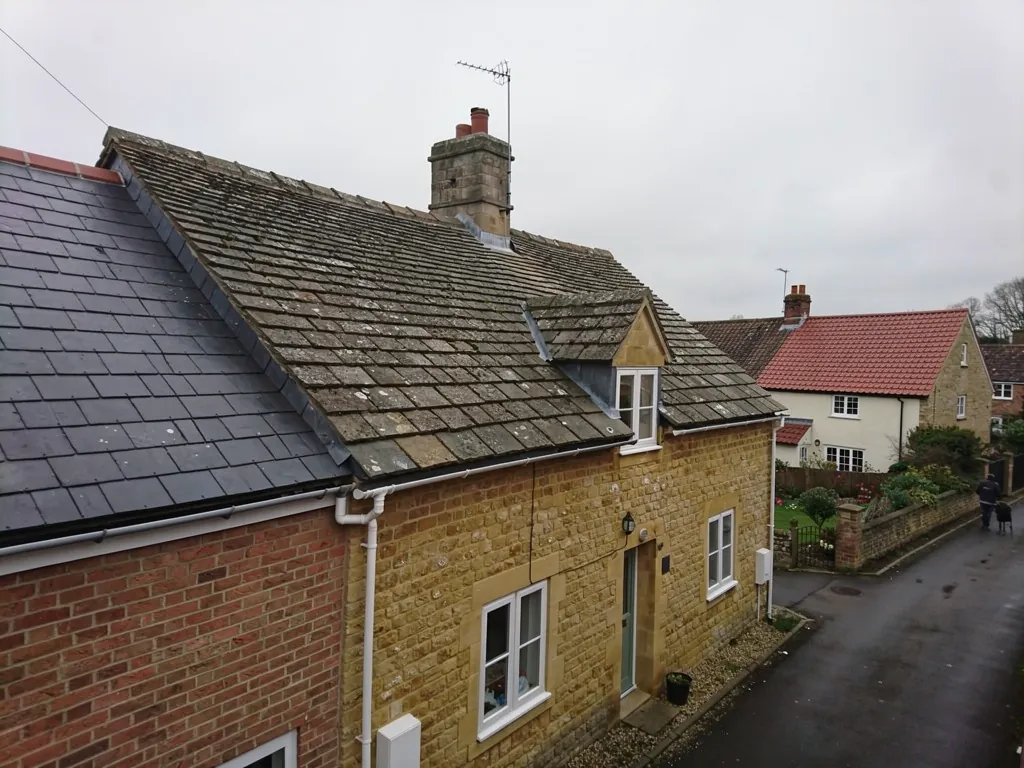
Cotswold stone cottage with a steep stone slate roof
Brick and limestone cottages around a small village green

The short answer

The conservation area statement describes steeply pitched stone slate roofs. Cotswold stone slates are limestone, split from the ground and hung in graduated rows, the longest along the bottom and shrinking steadily towards the top. They are heavy and durable, and each one is fixed individually with a peg or nail.

Walking the lanes beneath Holy Cross, you see stone slate on cottage after cottage, each roof climbing a steep line to its ridge. The material comes from the limestone beds the Cotswolds are known for. The council's technical guidance on the subject names two stones used for slates: Forest Marble, which is hand-split soon after it leaves the ground, and Stonesfield Slate, which is frost-split.

Why are the slates all different sizes?

The rock splits into many short pieces for every long one, which is why a roof is built from graduated rows. Diminishing courses is the trade name for the pattern: the longest slates, about 600 mm and sometimes longer, form a double row along the eaves, and every row above is a little shorter than the last, ending with the smallest pieces just under the ridge. It is what gives a stone roof its soft, textured surface.

How is each slate held on?

In the old method a small hole was made near the head of each slate, a hardwood peg went through it, and the peg caught on the batten; the council's guidance says cleft oak was the usual wood. Pegs rot with age, and a slate that loses its peg slides down. That is the commonest reason a stone roof starts to leak long before the stone itself is finished.

Weight matters here too. The same guidance gives roughly 1000 kg for each 10 square metres of finished stone slate roof, so any talk of a different covering has to begin with what the rafters can carry. Our page on Cotswold stone roofing goes through the material in more detail.

Because Avening's houses climb the slope at different heights and angles, we note the condition of each slope separately, never assuming one verdict for a whole row of cottages.

Q2

Is an old Avening cottage roof worth saving?

The answer

In most cases, yes. The stone often stays sound long after the pegs and battens beneath it have given up. Refixing slipped slates and renewing the fixings keeps the original covering and the look of the lane. A full strip is for the slopes where the whole run has failed.

When a stone slate roof leaks, the slate itself seldom fails first. Pegs go, battens soften where water has crept in, and the lead in valleys and around chimneys grows tired. None of this means the covering has to go, and the council's old guidance suggests a Cotswold roof given regular care can comfortably pass 100 years.

When does a roof need stripping?

Sometimes a whole slope has shifted, or the battens are failing across a wide area. Then the sensible job is to take the roof off carefully, sort the slates by length, fit new battens and underlay, and hang the sound stone back in its rows. That guidance records that about half the slates had perished by the time a roof came to be stripped, so the supply of matching stone shapes both the budget and the finished look.

Where should replacement stone come from?

Where replacement stone is needed, English Heritage's policy, reproduced in the council's guidance, favours freshly cut slates over second-hand ones, and adds that salvaged slates should return solely to the building that gave them up. Lifting slates off one old building to patch another just moves the damage. Sandstone and limestone must not be combined on a single roof either. We would rather tell you where the stone is coming from than leave it vague, and on a steep roof like these the match in colour and thickness shows from the lane.

Once the survey is done, you receive a written quote together with pictures taken on your roof, so you can see the areas we mean. Our roof repairs page covers the point where a patch stops being the right answer.

On old stone we choose the smallest repair that keeps the rain out, which usually means mending first and re-laying a slope only where the survey demands it. A tidy repair leaves the neighbouring slates exactly as the masons set them. Where a slope is beyond repair, the photographs will make that plain.


Our view

Keep the sound stone, renew the pegs and battens beneath it, and re-lay in the old rows.

Q3

Who decides on roof work in Avening's conservation area?

Long flat roof on a 1960s brick building being re-covered
Reclaimed Cotswold stone slates sorted by length beside a limestone wall

The short answer

Cotswold District Council is both planning and building control authority for Avening. Matching repairs rarely need planning consent. Even so, a direction covers part of the conservation area, the parish church has a Grade I listing and several cottages are listed too, so put any change of appearance to the council first.

Avening's conservation area was first designated in 1989, and its boundary was altered in 1998. Avening sits inside the Cotswolds National Landscape, which advises while the council decides. Most everyday roof work is maintenance and needs no application at all, but three situations deserve a check first.

What does the Article 4 direction mean for me?

The statement records a direction removing certain permitted development rights over part of the conservation area. It lists the unlisted houses it covers, and on those a change of roofing material or a new rooflight on the front slope needs planning permission. Not sure about your own house? Put the question to Cotswold District Council before any quote is prepared, and we can go through the reply with you. Matching materials keep most repairs well clear of trouble.

Which Avening buildings are listed, and what about Holy Cross?

Holy Cross church holds a Grade I listing and Old Quarries a Grade II one. On a listed house even a change of roof material counts as an alteration to its character, and that needs listed building consent. The church itself is in Church of England use, so permission for its roof comes through the faculty system run by the diocese.

Does a re-roof involve Building Regulations?

It can. Building control approval is normally not required while the work touches less than 25 per cent of the total building envelope and less than 50 per cent of the roof. If either limit is passed, approval is needed, and the insulation in the roof may then need upgrading to the current standard. Heavier coverings need approval too: the Planning Portal's figure is 15 per cent or more. Cotswold District Council runs its own building control, and we do the notification where work is notifiable.

MythLiving inside a conservation area puts every slipped slate in front of a planning officer.

FactPutting back like for like is ordinary maintenance; the council looks harder when the appearance changes.

Asked along the Avening valley

Why does an Avening stone slate roof leak when the stone looks sound?

Usually the fixings or battens beneath have failed, not the stone. Pegs rot and slates slip, or valley lead wears through. Water then runs under perfectly good slates, which is why we look underneath and photograph the fault before suggesting a fix.

Do you work on roofs among the trees and narrow lanes of Avening?

Yes. Tight lanes and overhanging branches affect where ladders, scaffold and a skip can stand, so we check access at the survey and plan it before the day. The site is cleared afterwards and the waste taken away.

Can an Avening stone slate roof take a different covering?

Only with care. Stone is heavy, so swapping the covering changes what the rafters carry, and substitutes for real stone are not suitable on historic buildings. In the conservation area a change of material is also one to raise with the council first.

How is the ridge of a steep Avening roof fixed properly?

Ridges on these roofs were traditionally simple angled pieces of dressed stone. Where one needs re-bedding, we fix it mechanically as well as with mortar, because BS 5534 stopped treating mortar alone as adequate, and a steep, exposed ridge takes the weather.

Ask us about your roof

Tell us what’s happening and we’ll call you back.

  • Photos of what we find
  • A written quote
  • 10-year workmanship guarantee

Or call 01793 626096

Call Get a quote