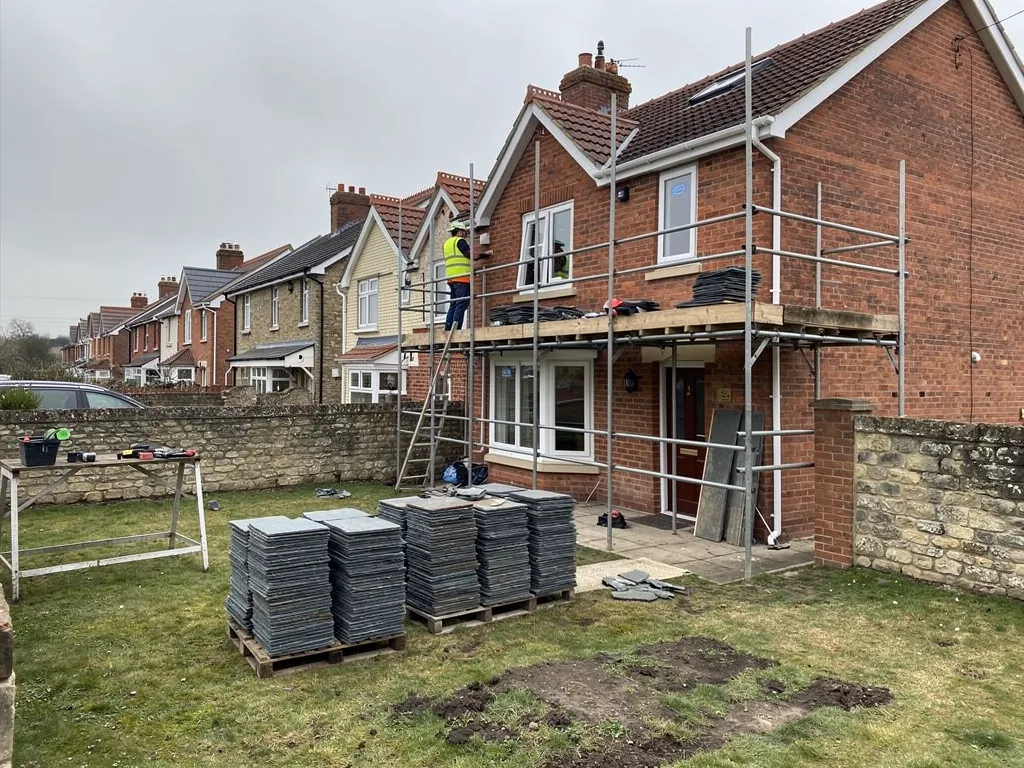
Brick end-of-terrace gable beside a limestone house, slate roofs

Roofers in Tetbury

Leaks, slipped stone, split lead and tired tiles dealt with in Tetbury, from the pillared Market House and the listed streets around it to the modern homes beyond the old wool-market core.

Roofs around the Market House and beyond

Old limestone houses around a market square
The wool-market centre

Tetbury grew wealthy as a market for Cotswold wool and yarn, and the buildings around the Market House show where that money went. The Market House dates from 1655, was restored in 1817, and is a Grade I listed Cotswold pillared market hall. The conservation area holds more than two hundred listed buildings, and the Market House and the parish church are both Grade I. On buildings of that age a roof job is a conservation job as much as a repair, because the covering, the pitch, the ridge and the verge are all part of what a listing protects. Where a roof here does carry Cotswold stone slate, the stones graduate in size from eaves to ridge, and the person repairing it needs to understand that pattern before lifting a single one.

Chimney stacks and gables beside a church tower
Churchyard and lanes

Tetbury's church of St Mary the Virgin is a Gothic revival building, completed in 1781 on the site of the medieval church, and its tower sets the tone for the lanes around it. Houses close to a large church share some of its roofing troubles: tall exposed gables, high stacks, and lead gutters and valleys gathering rain off a long slope. A flashing that has curled away from a stack, or a lead fold that has cracked after years of heating and cooling, is a frequent reason for a brown stain on a ceiling. We trace where the water is entering before anybody discusses stripping a slope. In a terrace, party walls and shared stacks also mean one neighbour's loose flashing can be the cause of the other's leak.

Tiled roofs on a newer residential street
Newer streets and outbuildings

Tetbury has spread beyond its historic core, and the newer streets bring a different set of roofs: interlocking concrete tiles on twentieth century houses, flat or shallow garage and extension roofs, and the odd conservatory with an ageing polycarbonate top. These are simple to repair or renew, and re-covering an unlisted house in the same material rarely needs any planning application. The useful dividing line is the conservation area boundary. Inside it, switching material or adding a roof window is something to raise with Cotswold District Council before any figure is agreed. Outside it, the faults are the everyday ones: ridge tiles relying on old mortar, perished felt, clogged valleys, and gutters sagging off tired brackets. The survey tells you which side of that line your own roof falls on.

From Swindon into the Cotswolds

Map showing Tetbury and central Swindon. 22 road miles west-north-west of central Swindon.

Distance
22 road miles west-north-west of central Swindon
Council
Cotswold District Council
Conservation area
Tetbury, designated 24 March 1971, reviewed 14 July 1993
Council
Cotswold District Council
Landscape
Cotswolds National Landscape

Tetbury roof questions

Is a house near Tetbury's Market House likely to be listed?

Plenty around it are, since the conservation area holds more than two hundred listed buildings, so confirm your own status with Cotswold District Council before changing any material.

Can slipped Cotswold stone slates be fixed on an old Tetbury house?

Yes. We rehang the stones that have dropped, renew rotted pegs and battens beneath them, and keep to the existing coursing so the repair blends in rather than showing.

Why does lead fail around Tetbury chimney stacks?

Usually movement and age. Lead lifts at a fold or cracks where stack and roof shift against each other, and a smear of sealant rarely lasts. We look for the cause first.

Q1

What shapes roofing in Tetbury's conservation area?

Roofer repointing a stone chimney stack above lead flashing
Roofers on a slate roof along a limestone village street

The short answer

Age and protection. Tetbury Conservation Area was designated in 1971 and reviewed in 1993, and it holds more than two hundred listed buildings. Repairs made in like materials rarely need an application, yet a new type of covering, extra roof windows or altered stacks deserve a call to Cotswold District Council before pricing starts.

Tetbury sits on the site of an ancient hill fort, and the town's character comes from its centuries as a wool market. That history explains why so much of the old centre is protected. The council's conservation area map records designation on 24 March 1971 and a review on 14 July 1993, and the boundary takes in the Market House, the church and the lanes between them.

Does a matching repair near the Market House need consent?

Repair in kind is maintenance. Putting back stones that match, re-bedding a ridge, renewing a flashing in the same metal or refixing a loose verge leaves a building looking the way it did, which is why planning permission is rarely in question. Swapping one covering for another is a different matter, because it alters how the whole street reads. If the house is listed, any work that touches its special character needs listed building consent, and the covering you see from the street is part of it.

How do I check whether my Tetbury house is listed?

Cotswold District Council can confirm the status of your own house. Give the council your address, ask whether it is listed and whether it lies inside the boundary, and ask what they would expect to see in a repair. We go through that guidance with you before pricing, and the agreed approach is set out in the written quote.

Our Cotswold stone roofing page explains how traditional stone slate is put together and mended, and it is the best starting point if your Tetbury roof is an old one.

The order of events matters in a protected area. We survey, photograph the roof and its details, settle on the narrowest repair that cures the fault, and only then ask whether any consent is involved. That sequence stops a small repair growing into a large job.

Q2

How do Cotswold stone slates behave on a Tetbury roof?

The answer

They are heavy and durable, and they run from large stones at the eaves to small ones near the ridge. The stones frequently outlive the oak pegs and battens holding them, so a sound repair usually renews those fixings and rehangs the same stone rather than discarding the covering.

Cotswold District Council's technical guidance on stone slate roofing names two limestones used for the purpose, Forest Marble and Stonesfield Slate, and observes that the rock breaks into many more small pieces than big ones. That is the reason for the graded pattern on a traditional roof: the longest stones, normally about 600 mm, form a double course along the eaves, and the shortest, which can be about 15 cm, sit just below the ridge.

What holds a Tetbury stone slate in place?

Every slate is hung from a batten by a peg of wood passing through a hole drilled close to its head. The guidance mentions oak, and when a peg rots the slate slides. A stone roof is also very heavy, roughly 1000 kg for every 10 square metres in the council's figure, so the timbers underneath must be sound before anyone relays the covering. During the survey we check rafters, purlins and bearing points, and we report what we find.

Can a stone valley or ridge in Tetbury be kept?

Traditional stone roofs often have valleys formed from specially cut slates that curve round in a gentle sweep, and ridges made from dressed stone sections. Replacing a swept valley with a plain lead trough alters both the appearance and the way water runs off. Where the existing valley can be kept, we keep it.

A stone-slated outbuilding or barn conversion in the countryside around Tetbury follows the same logic. The roof was built to flex a little, shed rain quickly and last for generations, and a good repair respects all three.

Upkeep counts too. The council's guidance claims that scraping a stone roof clean each year can double how long it lasts, which in practice means clearing moss and debris before it holds damp against the stone. A short visit to rehang the odd slipped slate can spare you a far bigger bill later.


Q3

Who decides on roof work for a Tetbury listed building?

Reclaimed Cotswold stone slates sorted by length beside a limestone wall
Pallets of new slates in a garden beside a scaffolded house

The short answer

For Tetbury the council is Cotswold District, which handles planning and building control alike. Listed status brings a consent requirement for any alteration that affects the building's character. We explain which route your roof needs and sort out the Building Regulations notification when the job is notifiable.

Tetbury lies in the Cotswold District, so the council that matters is Cotswold District Council. It deals with planning, listed building consent and conservation questions, and it runs its own building control service from Trinity Road in Cirencester.

When is consent needed for a Tetbury listed roof?

A matching repair rarely needs planning permission. A listed building calls for more care: the law requires consent for alterations that would affect its character, and carrying them out without consent is an offence. For a Grade I building like the Market House, even modest changes deserve a conversation before anyone climbs a ladder. Churches differ: where a Church of England congregation uses the building, the faculty system stands in for listed building consent and the parish follows that route, not the council's.

Which Tetbury re-roofs fall under Building Regulations?

A bigger re-roof can bring Building Regulations into play. On the Planning Portal's test, no building control application is normally needed where less than 25 per cent of the total building envelope and less than 50 per cent of the roof is affected; once either figure is passed, approval is needed and better insulation may follow. Under Building Regulations, approval is also required if the new covering is 15 per cent or more heavier, and that matters if stone is replaced by something different. Cotswold District Council says a building notice lets work start 48 hours after submission. We tell you which of these your job triggers and arrange the notification where it is required.

Does the Cotswolds National Landscape decide Tetbury roofs?

Tetbury is in the Cotswolds National Landscape. That designation advises rather than decides, because the council remains the planning authority. For us it is another reason to keep a repair matched to the building around it.

Our roof repairs page shows how we deal with a small fault before any larger job is put forward.

MythA Grade I building cannot have its roof touched.

FactCareful matching repair is routine; it is a change of character that needs consent.

Questions from around the Market House

What usually lets water into an old Tetbury roof first?

On stone and slate, rarely the covering itself. Rotted pegs, softened battens, split lead at stacks and valleys, and blocked gutters admit water long before the stones give up. We follow the leak back to its origin and photograph it, so the repair cures the cause and the written quote reflects only what the roof needs.

Do you work on traditional stone roofs like the Market House type?

We handle traditional stone and slate roofs across the Cotswold edge, and on listed buildings we agree a matching approach with you before starting. For a civic building the owner or custodian and the council set the framework, and we work within it using identical material, fixed in the identical manner.

Does Tetbury have an Article 4 direction on roofs?

There is no town-wide one, but an Article 4 direction does cover land at Bath Road, so ask Cotswold District Council whether one touches your property. Conservation area rules and listed building status apply either way, so also ask Cotswold District Council about your address before changing a covering or adding a roof window.

What comes with a roofing quote for a Tetbury home?

Survey pictures of your own roof come first, followed by a written quote as a single total price. Our work carries a 10-year workmanship guarantee in writing. When we finish, the site is swept and our rubbish is gone, and any consent is explained before work begins.

Ask us about your roof

Tell us what’s happening and we’ll call you back.

  • Photos of what we find
  • A written quote
  • 10-year workmanship guarantee

Or call 01793 626096

Call Get a quote