Edwardian brick villas with clay tile roofs and decorative ridges

Roofers in North Woodchester

North Woodchester lies in a side valley off the Nailsworth Valley, and its roofs follow the slope. We repair, replace and maintain them, from pitched stone and tile to the small flat roofs over extensions and outbuildings.

North Woodchester's roofs, up the side valley

Stone houses on a village lane
Houses around the Royal Oak

North Woodchester has the Royal Oak and a post office with a shop, set in the side valley that divides it from South Woodchester, and the older houses around them each deserve a separate look. Buildings of that age often carry steeply pitched roofs with gable ends, chimney stacks at the ridge or the ends, and flashings that have seen several rounds of patching. We begin with the gutters and the lead around each stack, because on a valley slope the water leaving one roof frequently lands on the one below. Old walls underneath are the reason those details deserve care: once water gets behind a stack, the damage shows up indoors, far from the cause.

A stone gable with a steep roof
Near Woodchester Mansion

Woodchester Mansion, a Grade I listed Gothic Revival house, was begun in 1858 for William Leigh to designs by Benjamin Bucknall, and building stopped in 1873. It stands on the Woodchester Park estate at Nympsfield, so it is context for the village rather than part of it, though the estate once owned much of the village. The mansion is built of Cotswold stone, and the stone-slate roofing tradition belongs to the same limestone country. If you own an older house here and wonder what to do with its roof, the first question is what the covering is and whether it can be saved, because matching it later costs far more than keeping it now.

A low flat roof over a garage
Later homes, extensions and outbuildings

Beyond the old lanes sit homes of later years, many with a garage, porch, conservatory or rear extension added. These bring different problems from the older houses. A concrete or clay tile roof suffers cracked tiles, failing ridge bedding and tired underlay, while a flat roof over an extension or garage suffers ponding water, split joints and blocked outlets. A low-pitched roof is often the first on a property to leak, simply because water leaves it slowly. We survey the whole roofline in one visit, so a repair on the extension is not followed by a second callout on the main roof a season later.

From Swindon to the Woodchester valley

Map showing North Woodchester and central Swindon. 29 road miles west-north-west of central Swindon.

Distance
29 road miles west-north-west of central Swindon
Council
Stroud District Council
Council
Stroud District Council
Setting
A side valley of the Nailsworth (Woodchester) Valley, South Cotswolds
Nearby
Woodchester Mansion, Grade I listed, on the Woodchester Park estate

Roofing worries in North Woodchester, answered

Which council decides roof questions in North Woodchester?

The planning authority here is Stroud District Council. Put your postcode to it if you are weighing up new roof windows, a switch of material or any work on a listed home, so you know whether a designation applies.

Does the side valley make a roof harder to repair?

Sometimes. A sloping plot can complicate scaffolding and deliveries, so access is studied at the survey and the job is planned around it instead of being discovered on the day.

Will you repair a roof near the Woodchester Park estate?

Yes. Whatever the age of your house, the repair uses sympathetic materials, and a listing or designation comes up in conversation well before a price is agreed.

Q1

What are the roofs of North Woodchester made of?

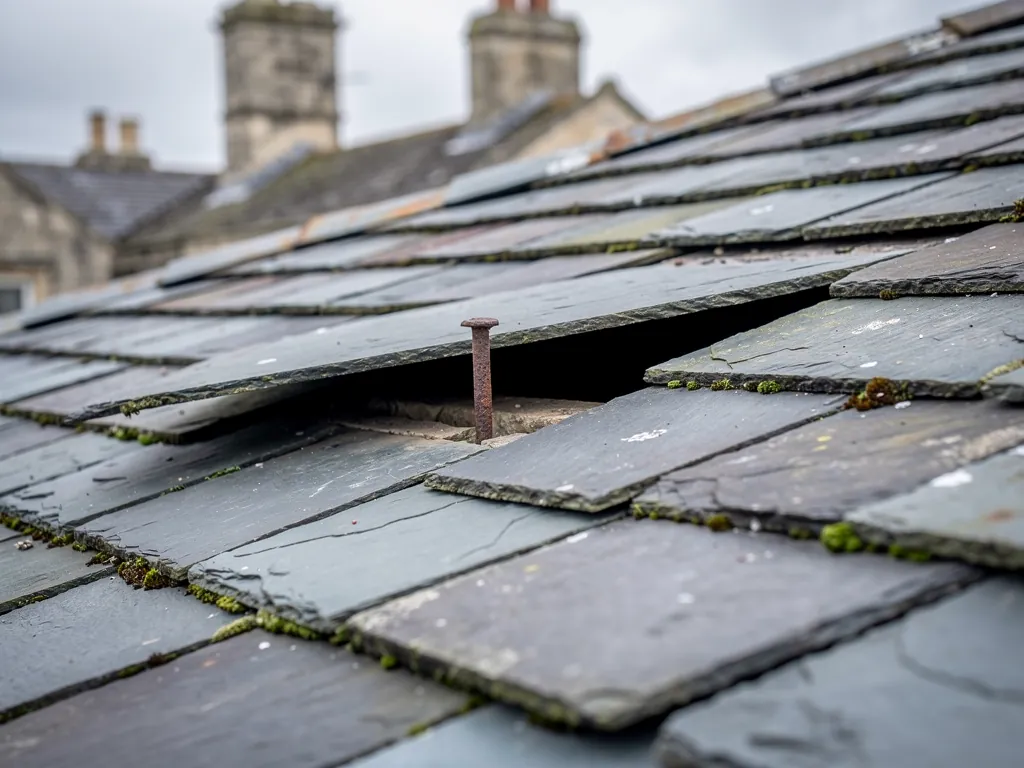
Slipped natural slate with an exposed nail on a weathered roof
Torch showing a water-stained rafter beneath slates in a loft

The short answer

There is no single answer for the village. Woodchester Mansion nearby is built of Cotswold stone, but houses here vary with their age and with the repairs made over the years. Each roof is identified at the survey, which is why photographs of your own covering come with the quote.

North Woodchester is half of a village split by a side valley, with South Woodchester on the far side. The Nailsworth or Woodchester Valley, running south from Stroud along the A46, shapes the setting more than any single building. What sits on a roof depends on when the house was built and what has been done to it since.

How can you tell what an old covering is?

By looking closely. Natural stone shows thick, uneven pieces with a rough face and pegs or nails near the top. Slate is thin, flat and regular. Clay and concrete tiles show a moulded profile and a nib on the underside. The loft often says more than the outside, since stone slates leave a rough texture underneath and pegs can be seen through the battens.

Why does the material set the repair?

No two coverings give out in the same manner. Stone needs its pegs, battens and courses looked after. Slate fails at the nail, so a slipped slate is a symptom, not the fault. Tiles fail at the ridge and verge, and in the underlay beneath them. Our pitched roofing page shows how we treat each one.

What if an earlier patch used something different?

It happens on many older houses, and a mismatched patch may hold for a few winters while leaving a weak junction where the two materials meet. Water finds that join first. We note where earlier repairs sit and say whether to keep, redo or blend them in.

Everything we find is photographed, so you see the covering as we do. A clear picture of what you own is the best protection against paying for the wrong repair, and it gives any later roofer a record to work from.

How common coverings tend to fail
CoveringWhere it fails firstUsual repair
Natural stonePegs, battens and ridgeRenew fixings, re-hang stones
SlateNails and flashingsRefix or replace single slates
Clay or concrete tileRidge bedding and cracked tilesRe-bed, mechanically fix, replace
Flat roofJoints, outlets and edgesPatch or re-cover after survey
Q2

Is a Cotswold stone roof worth keeping near Woodchester?

The answer

Yes, where the roof is sound enough to save. Traditional stone roofs are heavy, long-lived and hard to match once lost, and what usually fails is the pegs, battens and fixings. Renewing those and re-laying the same stones normally beats replacing the covering altogether.

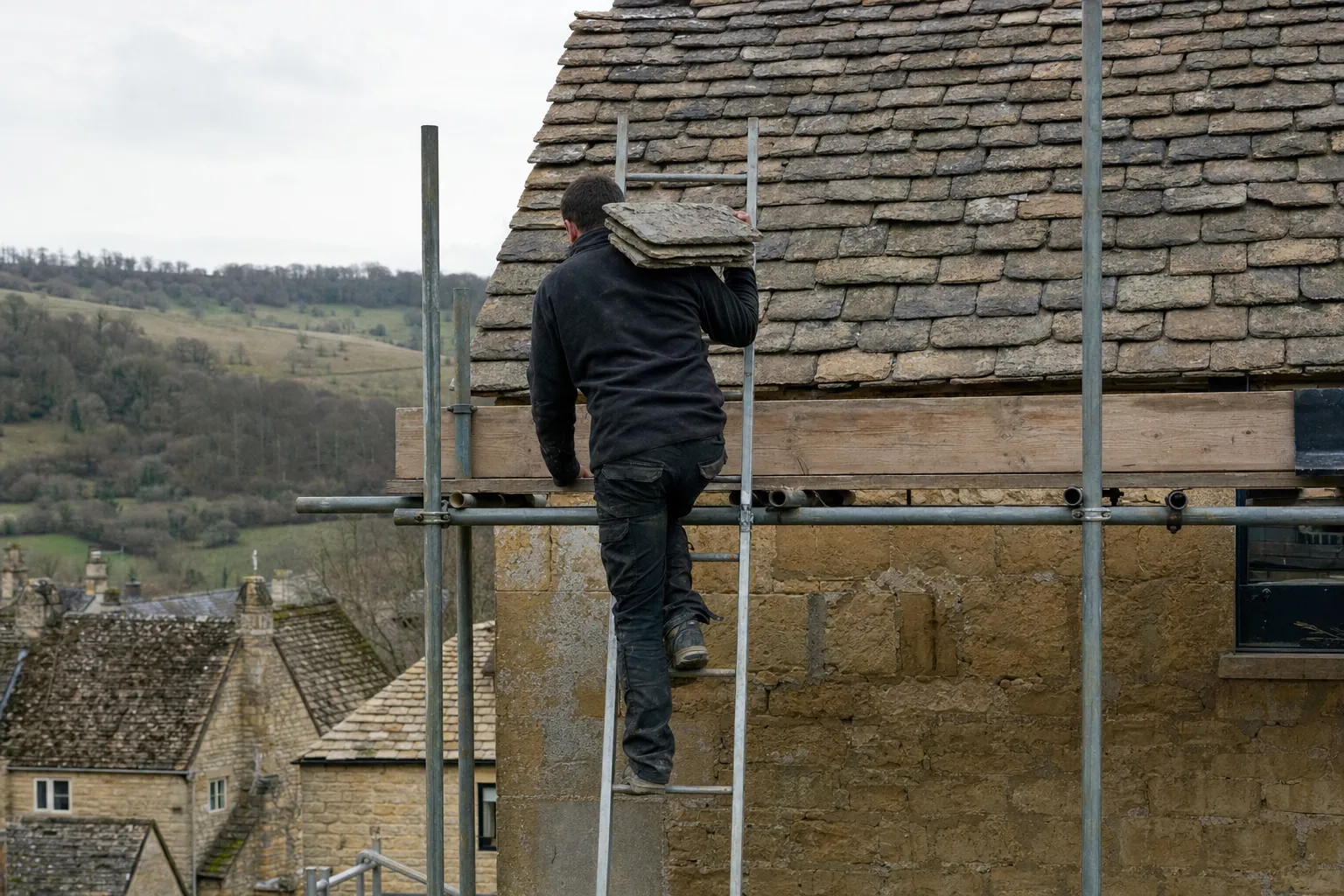
Woodchester Mansion is built in Cotswold stone, and the stone-slate tradition belongs to the same limestone country. Stone slates are laid with the weightiest pieces forming the lowest rows and the thinnest near the top, so the roof tapers as it climbs. Roofers call that pattern diminishing courses.

What do stone roofs need to last?

Attention before they fail. The Cotswold District Council guidance of 2000 says regular yearly scraping of a stone roof could double its life, and that about half the slates were frequently found decayed when a roof was finally stripped. Pegs, usually oak, rot and let stones slip. Moss holds water against the stone, and a blocked gutter feeds it. A yearly look from the ground with binoculars costs nothing and finds the first slipped stone.

Can stone be swapped for a modern lookalike?

Policy from English Heritage, set out in that Cotswold District booklet, treats concrete and reconstituted copies as unsuited to historic buildings, and on a listed house the loss of natural roofing can be refused outright. Even where nothing is listed, a lookalike weighs less, sits differently and ages differently. Our Cotswold stone roofing page covers the choices.

What does repair look like in practice?

The roof is photographed and the stones are sorted by size as they come off. Rotten pegs and battens are replaced, the same stones go back in the same order, and broken ones are made up with matching stone. Swept valleys, where specially cut slates curve through the angle, are rebuilt in the same way instead of being replaced with a plain lead trough.

It takes longer than patching, but the roof then carries on for decades, and it still looks like the roof your house was built with. That is worth having on a lane where the stone is what people notice.

Q3

Who should I ask before re-roofing in North Woodchester?

Roofer carrying stone slates up a ladder on scaffolding
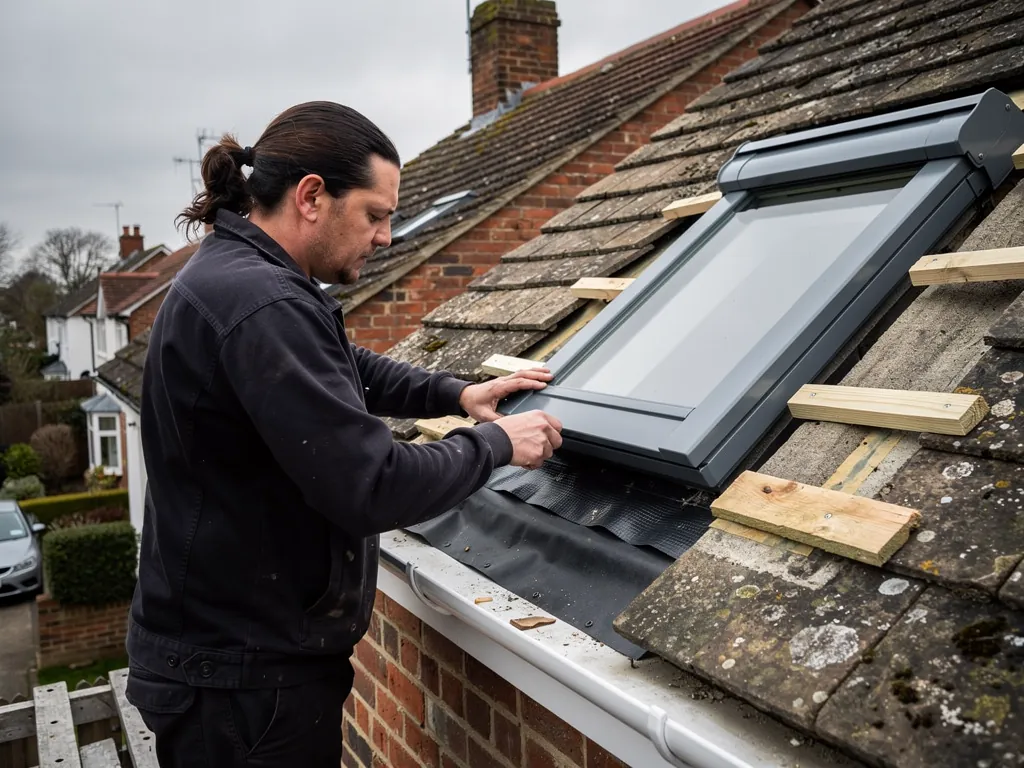
Roofer fitting a roof window frame into a tiled roof opening

The short answer

Start with Stroud District Council's planning team, who can say whether a listing, conservation area or other designation affects your house. Bigger re-roofs also involve Building Regulations through your building control body. We explain which applies at the survey and prepare the notification when work is notifiable.

Designations differ from house to house. Stroud District Council lists South Woodchester as conservation area no. 10; whether any designation touches your own street in North Woodchester is something Stroud District Council can confirm, and it is worth asking before a plan is settled.

Does a like-for-like repair need permission?

Generally not. Replacing cracked tiles, re-bedding a ridge or fitting new flashings in the same materials is ordinary upkeep. A listed building is the exception: a change touching its special interest needs listed building consent, and the roofing is part of what is protected.

When do Building Regulations come into it?

Building control approval is normally unnecessary while the work touches under 25 per cent of the total building envelope and under 50 per cent of the roof. Past both of those limits, approval applies, and better insulation may be required. A heavier covering, 15 per cent or more, needs the structure checked as well. You can use the council's own service or a registered building control approver.

What about roof windows and dormers?

Those carry their own planning conditions, set out on our skylights page, and they are worth checking before you commit to a loft conversion. Bats and nesting birds have protection in law, so a roof is checked for them as it is opened.

What do I get from you before work is booked?

Photographs from a survey of your roof, then a written quote. That settles what the fault is, what fixes it and who needs to be told, so nothing about consent is left to chance once scaffolding is up and the weather is turning. If the survey finds that a small repair will do, that is what the quote says.

Before you start

Ask Stroud District Council about designations first, then price the work.

Roofing services in North Woodchester

Questions from the Royal Oak and the valley lanes

Is North Woodchester treated differently from South Woodchester?

Only on paper. The village is split in two with a side valley between the halves, and we work in both. What matters for the job is the age and covering of your own house, plus any designation Stroud District Council can confirm for your own property.

Do you work on roofs on steep plots in the valley?

Yes. A sloping plot affects scaffolding, deliveries and where materials can be stored, so we look at access at the survey and plan around it. Narrow lanes are noted too, so a lorry delivery is timed so as not to block your neighbours, and we clear everything away at the end.

Does the mansion's stone mean my roof should be stone too?

No. Woodchester Mansion is a grand nearby building, not a rule for the village. A like-for-like repair is the sensible default: if your roof is natural stone we keep it in stone, and if it is tile or slate we keep it that way unless you ask for a change.

Do you cover other villages along the Woodchester valley?

Yes. North Woodchester sits inside our working area from Swindon, as do the neighbouring valley villages. Ring or message us with your postcode if you are unsure, or look through the areas page.

Ask us about your roof

Tell us what’s happening and we’ll call you back.

  • Photos of what we find
  • A written quote
  • 10-year workmanship guarantee

Or call 01793 626096

Call Get a quote