
Councils designate a conservation area when the look of a place is worth keeping or improving. Roofs carry much of that look, so tile colour, texture and shape count for more on a protected street than on an ordinary one. Owners are not stuck, though, because the law does not freeze every roof. Relaying what was there before is generally maintenance rather than development.
The difficulty is that the line between the same and different is narrower than it sounds. Clay swapped for concrete, a plain tile swapped for a large interlocking one, a natural slate swapped for a tile that looks like slate: any of these can change the look of the building enough to need permission, and listed buildings and streets covered by an Article 4 direction have tighter rules again. This guide explains how the system works, what matching means in practice and how to ask in Swindon. Treat it as background, not legal advice: the council decides what applies to your address.
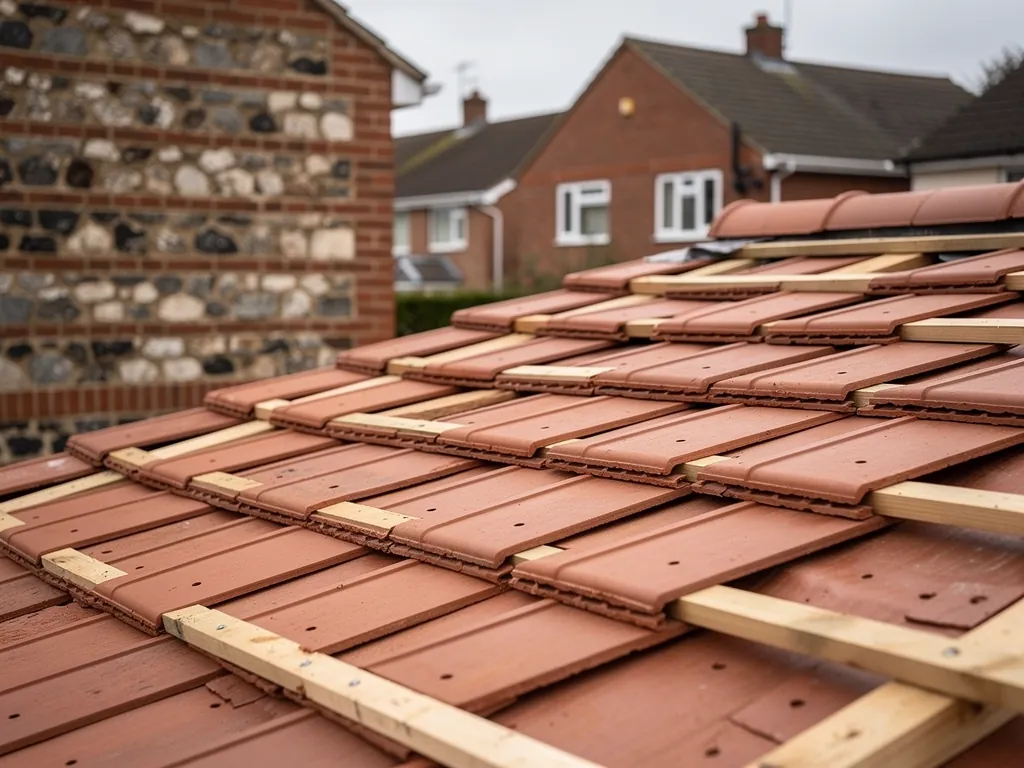
Does replacing roof tiles need planning permission at all?
The Town and Country Planning Act 1990 (section 55) leaves out upkeep and minor alterations from the definition of development, provided the exterior is not materially affected. That is why a straight swap for an identical covering usually needs no planning permission, in a conservation area or outside one. Same tile, same colour, same pattern, same ridge: no application.
Two caveats apply. A listed building has a separate consent regime, listed building consent, for any work touching its special interest, and a changed roof covering can do exactly that. If your street is covered by an Article 4 direction, the council has taken away certain permitted development rights for a mapped area, and that can pull ordinary-looking work back under planning control. The government's planning guidance adds that rights can also be taken away by a condition attached to an earlier planning permission.
What counts as materially different?
That is a judgement for the council, but the common triggers are easy to list: changing material, changing the tile profile, changing the colour range markedly, adding rooflights or dormers to a front slope, or altering the ridge, verge or eaves detail. A new tile in a slightly different shade of red may be accepted. A move from handmade clay to flat grey concrete probably will not be.
What a conservation area changes
Designation brings its own controls, set by statute and listed in the council's notices. Swindon Borough Council's 2021 statutory notice for the railway area lists them: consent to demolish, special publicity for planning applications, and six weeks' notice before tree work. Roofing is not on that list, so a repair is not a conservation matter in itself.
What designation does is raise the stakes on appearance. Councils judge applications on whether they keep or improve local character, and few things on a street show as much as a roof. Dormers are a good example. Class B permitted development for roof additions is not available in a conservation area, because the land counts as article 2(3) land, so a dormer needs a planning application. Roof windows under Class C can remain permitted development, with conditions, and our guide to dormer roofs sets out the difference.
Does a National Landscape change the answer?
Only for additions. Two large protected areas touch this part of the country, the North Wessex Downs and the Cotswolds, and both are called National Landscapes since 22 November 2023. They are also article 2(3) land, so the dormer rule applies there too, but like-for-like re-covering is unaffected. The National Landscape bodies advise; the council decides planning. If your house sits in both a village conservation area and a National Landscape, the council handles both.
The Swindon route: who to ask and what to send
Swindon Borough Council names 27 areas on its conservation page, among them the Old Town, Highworth, Wroughton, Chiseldon and Liddington, as well as the railway area. Two carry Article 4 directions: Bishopstone and the railway village. If you live in any of them, ask before ordering tiles.
For general advice the council's conservation team has an email address on its page, and its planning pages recommend pre-application advice. A short enquiry saves time. Give the address, the existing roof covering, the covering you intend and whether the building is listed. Photographs of the roof from the street, and a close-up of a tile, help the officer more than a long description.
What about the Railway Village?
It is a special case. The Railway Village became a conservation area in 1975 and sits inside the larger Swindon's Railway Conservation Area, created in 2020 to 2021. The cottages were listed in 1970, and an Article 4 direction was adopted in 1980. In the council's own appraisal, the roofs of the village are described as generally slate, and it resists dishes on roofs and chimneys. Most properties there are listed, so changes to a covering usually need listed building consent. Treat any work to a roof in that area as a question for the council first.
The council's own pages are the place to check your address: Swindon's conservation areas page lists the areas and the directions. Outside Swindon, the same logic applies with a different council: Vale of White Horse, Cotswold District and West Berkshire each run their own planning and conservation teams.

Matching clay tiles to the street
Clay tiles are the traditional covering on many older streets, and they are made in a range of colours that come from the clay and the firing. Handmade tiles are slightly irregular, with a gentle camber and a variation of tone across a slope. Machine-made clay is more uniform. Plain tiles are small and lap one course over the next, giving the fine grain people notice from the pavement.
A good match begins with knowing exactly what is up there. Is the tile plain or a pantile? Is it handmade? What size is it, and how is it laid? On most roofs these questions can be answered from the loft by looking at the back of a tile, and from the pavement with binoculars. Our guide to roof tile types helps with the vocabulary.
Can I reuse the old tiles?
Often, and it is the best match there is. Sound tiles from the back or a hidden slope can be used on the front, with the more worn ones used where they are least visible. That is a common approach on conservation roofs, and a council officer will usually favour it. The test is whether the tiles are cracked, laminated or weathered thin; a tile that rings when tapped is generally sound.
New clay in the same size and profile will weather towards the old over a few years. Mixing a little new with old, spread across the slope, blends better than a patch of new tiles in one corner.
Concrete tiles, slate-look tiles and the weight question
Concrete tiles are the standard covering on postwar and later houses, and many conservation areas include those streets as well as the old centres. In such streets, matching is mostly a matter of profile and colour. Interlocking tiles come in several profiles, and plain concrete tiles imitate clay. Our answer on plain and interlocking tiles explains the difference.
Where concrete is not like for like is on older roofs. A concrete tile put on a clay roof changes the texture, and a council officer will see it from the road. The same goes for slate-look tiles over a slate roof, which is what our answer on changing tile to slate looks at from the other direction.
Does a heavier tile need approval as well?
Possibly, through Building Regulations rather than planning. The Planning Portal says a covering that makes the roof 15 per cent heavier or more needs approval, and Approved Document A uses more than 15%. Marley gives its concrete plain tile at 73.8 kg/m² laid at a 100 mm gauge, which gives an idea of the load. Moving from clay to a heavier concrete product on an old roof can cross that line. Check with your building control body. We raise the question at the survey and explain the route.
Planning permission and Building Regulations are separate. A tile can be acceptable to the conservation officer and still need a structural check, or the other way round.
Stone, listed buildings and when the rules are firmer
Listed building consent is the strictest tier. Under section 7 of the 1990 Act, unauthorised works that change a listed building's special character are barred, and section 9 makes doing them an offence. Its covering forms part of the architecture. Swapping tiles for another material is likely to need consent. Like-for-like repair may not, but ask first.
Natural stone roofing sets its own rules. Cotswold District Council's technical guidance, dated 2000, reproduces English Heritage thinking. Fresh stone slates are preferred over second-hand ones, any reclaimed slates should go back only where they came from, and concrete tiles or reconstituted stone are unsuitable for historic buildings. Limestone and sandstone should not be mixed. Our page on Cotswold stone roofing covers the detail, and the same instinct applies to tiles: match the material, do not imitate it.
What about churches and chapels?
Places of worship can fall under a separate ecclesiastical exemption, which swaps the council's consent for the denomination's own process while the building is in use. Not every faith has it, and it ends when a building closes. If you look after a chapel or church, speak to the denomination and the council before ordering materials.
How we handle a conservation-area re-tile
At the survey we identify the tile, the gauge, the headlap and the state of the battens, then photograph the roof from the road and in close-up. If the address is in a conservation area, we tell you which of the questions above apply and what to ask the council. The written quote follows, based on the roof as it stands, and the choice of tile is yours with that information.
Most conservation re-tiles are straightforward: lift the tiles, sort them, renew battens and underlay where needed and lay the sound tiles back with new ones making up the difference. Ridge tiles and valleys are the details that tend to catch attention, because new fixings and linings differ from the old, so our guide to roof valley types is worth a read. Rot in old battens is the common surprise once the covering is off, and our answer on rotten roof battens explains why it is better found early.
Winter timing matters on exposed slopes, so the guide to tiled roofs in winter covers what can wait for better weather. For the wider pitched work we do, see our pitched roofing page. Our workmanship guarantee is written and runs for 10 years; we clear the site and take waste away.