
A tiled roof in Britain usually comes down to one of four things: clay plain tiles, concrete plain tiles, clay pantiles or interlocking concrete tiles. Each has a different shape, a different weight and a different lower limit on how shallow the roof can be before water starts to creep up under the laps. Choosing between them is partly taste and partly arithmetic, and the arithmetic matters more than most people expect.
This guide sets the four side by side. It deals with tile choice only. If you want the wider picture of gables, hips and mansards, start with pitched roof types, and for what a repair might cost, see tiled roof repair cost. Where we quote a figure, we name who published it and when we read it.
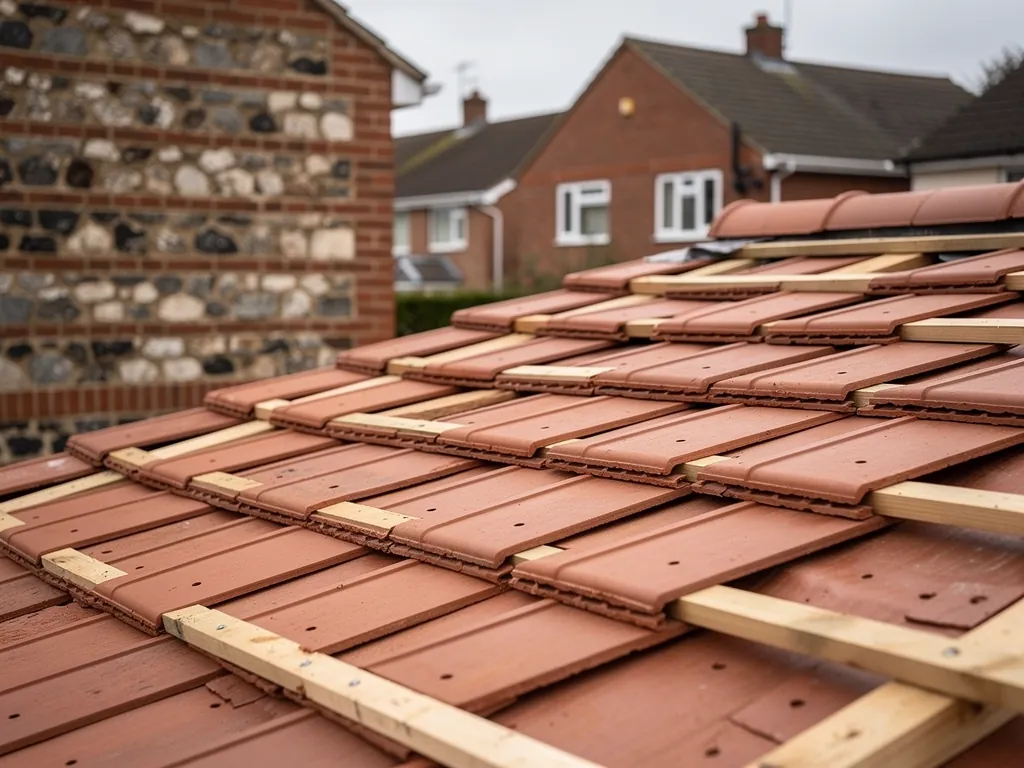
The four families of roof tile
A plain tile is small, flat and slightly curved across its length, and it is laid in overlapping courses so that every part of the roof is covered by at least two thicknesses. Plain tiles come in clay and in concrete. They are fixed with nibs that hang over the batten, with nails in some courses, and they make the fine, busy texture you see on older terraces and village cottages.
An interlocking tile is bigger, with grooves along its sides that lock into the neighbouring tile. Fewer tiles are needed per square metre, so the roof goes down faster and the surface looks calmer. Interlocking tiles are usually concrete. They include profiled styles with a pronounced roll and flatter ones, often called smooth or low-profile. Pantiles are a clay interlocking tile with an S-shaped section, and Marley lists its Lincoln clay pantile at a 15° minimum, far shallower than any clay plain tile.
What is a headlap, and why does it matter?
The headlap is the amount by which a tile reaches over the course two rows beneath it. A bigger headlap keeps wind-driven water out but means more tile to the square metre and a heavier roof. Tiles used at a shallow pitch need a bigger headlap, which is one reason the pitch table below differs from tile to tile.
How long clay and concrete tiles last
Published lifespans vary, and the spread is wide enough that anyone quoting a single number should be treated with caution. Marley, a tile manufacturer, says the BRE set a minimum life expectancy of 60 years for clay roof tiles in its environmental profiling scheme. MyBuilder's slate roof cost guide, updated 21 August 2026, gives 40 to 60 years before clay tiles need replacing, while the CORC roofing materials page says well-maintained clay can last more than a century. Boniface and Redman, writing in the Building Conservation Directory, observe that some roofs hung with clay peg tiles have stood for centuries, so 60 years is no ceiling for clay.
Concrete tiles sit lower on most lists. MyBuilder suggests 30 to 50 years before replacement, Marley expects its tiles to last around 60 years while adding that this is no guarantee, and CORC puts concrete at more than 50 years. A sensible reading is that concrete often lasts 30 to 60 years and clay often lasts longer, with good maintenance moving a roof towards the upper end of either range.
What shortens the life of a tile?
Frost damage in poorly fired or porous tiles, loss of the surface coat on concrete, nail fixings that corrode, battens that rot and moss held against the surface all do it. The tile is often not the first part of the roof to fail. Underlay, battens and flashings tend to give up before sound tiles do, which is why a roof that looks tired can sometimes be repaired and relaid with its own tiles rather than stripped entirely.
A manufacturer's warranty and a tile's lifespan are two different things. One is a commercial promise about defects, the other is how long the material usually lasts in service.
Weight and what your roof structure can carry
Weight is the reason tile choice cannot be done from a catalogue. Marley gives its concrete plain tile at 73.8 kg per square metre when laid at a 100 mm gauge. A reconstructed Cotswold-style slate from Bradstone is quoted at approximately 84 kg per square metre at an 80 mm headlap. Natural Cotswold stone slate is heavier again, at about 1000 kg per 10 sq m according to Cotswold District Council's technical guidance. Weights between products differ, so the data sheet for the tile you are considering is the authority, not a rule of thumb.
Weight matters because the frame was sized for the covering that was on the house when it was built. Changing from a lighter covering to a heavier one adds load to rafters, purlins and the walls beneath. The Planning Portal says that a new covering which increases the roof's weight by 15 per cent or more needs building control approval, and Approved Document A describes a rise of over 15% in roof loading as significant. Both point to checking the structure before ordering tiles.
Can I replace concrete tiles with clay, or the other way round?
Often, yes, but it is a decision with several parts: the weight, the batten gauge the new tile needs, the minimum pitch of the new product and, in a conservation area, how far the look has changed. We check the loading during the survey. For signs of a frame that has already been pushed too hard, see our guide to roof spread.

Minimum pitch: the Marley table
A tile that is laid too shallow lets rain blow or creep up under the laps. Every product has a published minimum pitch, and that figure is a limit, not a target. The table below is taken from Marley's own minimum pitch page, which we read on 14 October 2026. It covers only Marley products and is a guide, because a different make of the same style can have a different limit. Always check the data sheet for the product and the exposure of the site.
| Tile | Type | Minimum pitch |
|---|---|---|
| Canterbury | Clay plain | 40° |
| Ashdowne | Clay plain | 35° |
| Hawkins and Acme Single Camber | Clay plain | 30° |
| Lincoln | Clay pantile | 15° |
| Concrete plain | Concrete plain | 35° |
| Mendip (smooth) and Wessex | Concrete interlocking | 15° |
| Edgemere and Modern/Duo (smooth) | Concrete interlocking | 17.5° |
| Double Roman, Ludlow Plus, Ashmore | Concrete interlocking | 22.5° |
| Anglia (smooth) | Concrete interlocking | 25° |
The pattern is easy to see. Plain tiles need a steeper roof, and interlocking tiles can go much lower. Our guides to the most economical roof pitch and to changing a roof pitch look at what that means when you are planning a new roof or an extension.
What each tile costs to repair or replace
There is no single price for a clay or concrete roof, so treat the figures below as national guides to the size of the gap, not as what we would charge. Checkatrade's roof repair cost guide, whose table was last updated in June 2026, lists clay tile repair at £110 to £160 per m² and concrete tile repair at £90 to £120 per m². Those figures exclude VAT and access equipment. Clay costs more per square metre because the tile itself costs more and because matching an old clay tile can mean a search for reclaimed stock.
For full replacement, the national figures cover roofs in general rather than tile types. MyBuilder's new roof guide, updated 21 August 2026, gives semi-detached roofs of 50 to 80 m² at £5,000 to £8,000 for a gable and £8,000 to £12,000 for a hipped roof. Roof shape, access, scaffolding and the state of the battens all move the number more than the choice between two tile types does.
Does a clay roof always cost more?
On materials, usually. Over the life of the building, not necessarily. A roof expected to last longer, and to be relaid with its own tiles when repairs are needed, can come out level with a cheaper tile that has to be replaced sooner. Your own price comes with the written quote once we have surveyed, and if you hold several quotes, ask whether VAT and scaffolding are inside each total.
Quotes from us cover the whole job at one total price. We tell you what drives it and why, so you can judge whether a cheaper tile is a saving or a short-term one.
Looks, streets and conservation areas
Colour is where clay and concrete differ most to the eye. A clay tile takes its colour from the clay and the firing, so it weathers evenly and shows small variations across the roof. Concrete tiles are coloured with pigment and often a surface finish, which can wear or fade, and moss tends to settle on the rougher faces. Neither is better in the abstract. A mixed roof of new and old clay settles into a single colour over a few winters, while a replacement run of concrete tiles on a clay roof can stand out for years.
The surroundings matter. Swindon's Railway Conservation Area appraisal says the roofs of the Railway Village are generally slate, so a clay or concrete tile there would be a conspicuous change. In a village with a mixture of coverings, the story is different. What counts is what the roof was built with and what the neighbours have.
Will I need permission to change tile type?
Planning rules rarely bite on a plain re-roof in the same material, yet a different covering can change how a building looks. If the house is listed, sits inside a conservation area or falls under an Article 4 direction, speak to your local council's planners before ordering tiles. Our guide to pitched roof types shows how roof shape affects what looks right.
Choosing between them
Four questions settle most cases. What is the pitch? If the roof sits below 30° on a plain-tile house, a plain tile will not work, however pretty. How heavy can the roof go? If the frame is marginal, the lighter product wins. What is on the street? A clay roof in a street of clay suits the neighbours and may be a condition of consent. How long are you staying? Someone selling in five years will weigh up cost and kerb appeal differently from someone who intends to leave the house to their children.
- Choose clay plain tiles where the pitch is steep, the street is historic and the budget allows for a long-lived roof.
- Choose concrete plain tiles where you want the plain-tile look on a tighter budget and the frame can take the weight.
- Choose a clay pantile where the pitch is shallow and the house suits the profile.
- Choose interlocking concrete where the pitch is low or the roof is large and simple, and the roof structure is sound.
Whatever you pick, the underlay, battens and flashings beneath it decide how well the tiles perform. We recommend the tile that suits your roof, not the dearest one. Our survey brings pictures of your tiles and a written quote, and we give a 10-year workmanship guarantee in writing. Ring 01793 626096, message us on WhatsApp, or send the enquiry form. More tiled-roof guides sit in our pitched roofing section.