
Tiled roofs are the most common kind on British houses, and a tile repair can be anything from replacing one cracked tile to relaying a whole slope. The price swings accordingly, which is why a flat answer to this question is rarely much use. What can be said is where the typical ranges sit, what is usually left out of them and which decisions on your roof push the figure up or down.
Every figure here is a national typical range taken from a named, dated cost guide. None is a Skyline price. Your own number is set down in writing after a visit to your roof. This page covers tiled repairs only; for other coverings, see the wider guide to roof repair costs, and for the bigger picture on tiled houses visit our pitched roofing page. If you want to know which tile you have before reading on, our guide to roof tile types shows the differences.

Clay and concrete tile repair rates per square metre
Checkatrade's repair cost guide, updated October 2026 with its rate table last revised in June 2026, gives repair costs by covering. For tiles it lists clay at £110 to £160 per m² and concrete at £90 to £120 per m². Those rates are exclusive of VAT and exclude access equipment such as scaffold. The same guide gives roofers' labour at £35 to £45 per hour, or £280 to £360 per day.
| Covering | Typical repair rate |
|---|---|
| Clay tiles | £110 to £160 per m² |
| Concrete tiles | £90 to £120 per m² |
Why is clay dearer? Clay tiles cost more to buy, many are made in particular sizes and colours, and plain tiles are laid in many small units, each nailed at a narrow gauge. Concrete interlocking tiles are bigger, so each covers more roof and goes down quicker.
Does a per m² rate apply to every repair?
Only to repairs that cover an area, such as re-laying a patch of slope where tiles have slipped or battens beneath have failed. Small repairs do not scale that way. A roofer attending to replace a few tiles has a minimum charge for the visit, the ladder or tower, and the travel, however small the patch. That is why a ten-tile job rarely costs a tenth of a hundred-tile job.
Ask whether any price put to you covers VAT and scaffold. The published rates above leave both out.
Single-tile and small repairs
MyBuilder's roof repair guide, updated 21 August 2026, puts roof repairs overall between £150 and £1,500, with minor repairs at £100 to £300, moderate repairs at £500 to £1,000 and major repairs at £2,500 or more. A few slipped or cracked tiles on a reachable slope sit in the minor group. A section of lifted tiles with damaged battens beneath belongs in the moderate group.
| Size of tiled repair | MyBuilder typical range |
|---|---|
| Minor | £100 to £300 |
| Moderate | £500 to £1,000 |
| Major | £2,500 or more |
What does a single-tile repair involve?
Lifting the tiles above, freeing the damaged one, sliding in a replacement and checking that the nibs, clips and nails hold. On a clay roof, a matching tile can be the harder part, because old tiles fade in the weather, so a fresh tile may look odd for a while. At the survey we look for spare tiles already on the roof, sometimes on the back slope, so the visible side stays uniform.
Roofers sometimes suggest a single-tile fix when the whole course is failing. If the cause is rusted nails, perished battens or an old underlay, one new tile does not fix it. Our answers on cracked roof tiles and slipped roof tiles explain how to tell which you have. We quote the smaller job whenever it will cure the cause.
Ridge, hip and verge repairs on a tiled roof
The top of a tiled roof is where wind does the most damage, and the ridge is a repair in its own right. MyBuilder's slate roof guide, updated 21 August 2026, prices ridge tile re-bedding or replacement at £300 to £600 and repointing a ridge or hip at £200 to £400. For dry-fix, Checkatrade gives dry ridge at £50 to £70 per metre and dry hip at £70 to £100 per metre, excluding VAT, while MyBuilder's dry ridge guide shows a typical job at £500 to £1,000.
BS 5534:2014 changed the rules on fixing: ridge and hip tiles now get mechanical fixings as well as mortar. An older ridge re-bedded today therefore gets fixings, and a dry-fix system is often the tidier answer. Our page on ridge, verge and dry-fix work sets out the choice.
Is it worth repairing a ridge on its own?
Usually, yes. A ridge is one linear job, and it can be repaired without disturbing the slopes either side, provided the tiles beneath are sound. The exception is a ridge that fails alongside a long line of slipped tiles, which can point to a failing batten or underlay along the top of the slope. There the repair that lasts is a wider one, and the quote spells that out.
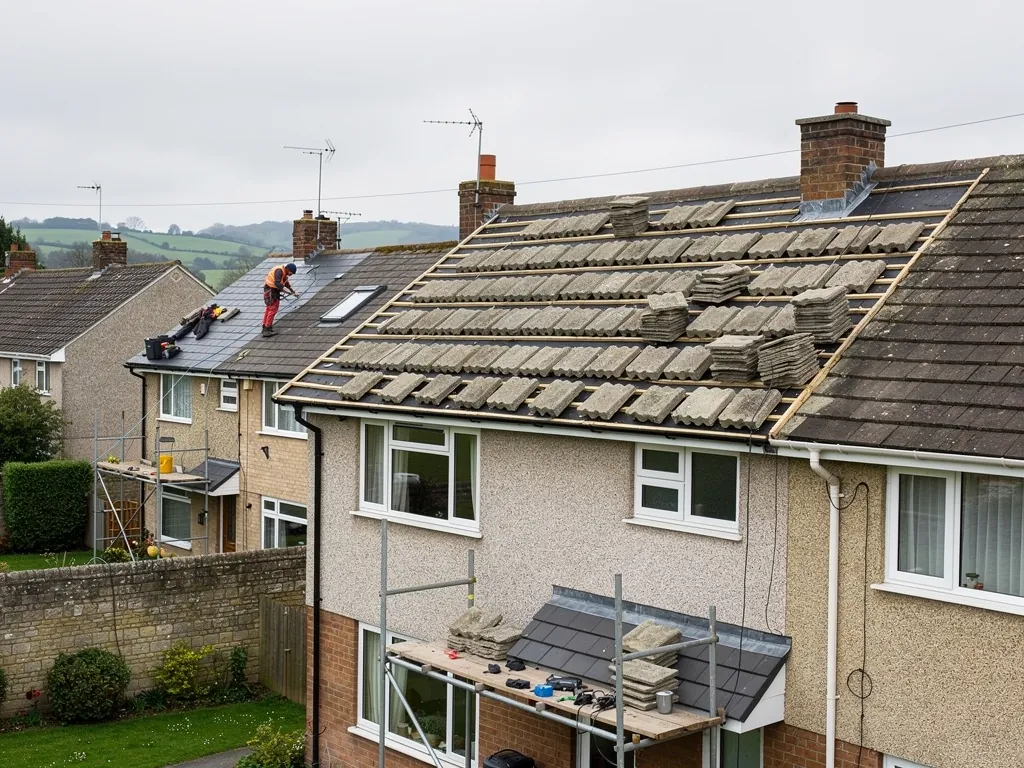
Scaffold and access: the part that surprises people
Access can cost more than the repair itself. MyBuilder's scaffolding guide, updated 21 August 2026, gives around £850 to £1,200 as the usual figure for a two-storey house. Checkatrade's roof replacement guide, updated October 2026, gives scaffold at £700 to £1,300. MyBuilder puts high-level chimney scaffold at £400 to £900.
Not every repair needs a scaffold. A handful of tiles on a low single-storey slope can often be tackled from a ladder or a low tower, and a minor job on a two-storey house usually does not need the full set-up. Longer jobs, or ones on the front of a tall terrace, do, because roofers need a safe platform and a way to pass materials up.
Can you avoid paying for scaffolding?
Sometimes, with the right equipment. Mobile access towers, cherry pickers and ladders with stand-offs all appear in the trade, and the choice depends on the height, the pavement and how long the work takes. Our answer on roof work without scaffolding explains when that holds and when it does not.
One rule we keep to is simple: if work at height cannot be done safely from the proposed access, the access changes, not the safety. Pavement scaffolds need a licence from the council, which MyBuilder's guide puts at £50 to £200, and a licence adds lead time. Any quote you receive should say whether it includes scaffold and VAT.
What changes a Swindon price
A quote that works for a railway terrace may be wrong for a 1980s estate house, and the reasons are mostly physical. Roof height decides the access. Roof pitch decides how safe it is to work from ladders. Tile type decides the material, and whether a match is easy to find. The condition of the battens and underlay beneath decides whether the repair is a replacement tile or a relaid area. Access to the back of a house, narrow side passages and parked cars along the street all affect how materials get up.
Complicated roofs cost more per square metre because cutting and flashing take time. Several valleys, dormers, hips or a stepped chimney mean more joints to seal than a plain gable has. Our guide to pitched roof types shows the shapes involved.
How do the roof's age and lifespan come into it?
Older roofs make repair decisions harder. If tiles are near the end of their typical life, repeated repairs add cost without extending it. The tile maker Marley expects its concrete tiles to last around 60 years, while stressing that is no guarantee, and MyBuilder puts replacement of clay at 40 to 60 years. Our answer on how long a pitched roof lasts sets those ranges against real-world wear. When repairs begin to outrun their value, the survey photographs show it and the quote tells you.
Battens, underlay and reused tiles: where repair money goes
The tile is the part you can see, but the repair is often decided by what lies under it. Tiles hang on timber battens, and the battens sit on an underlay that carries any water that gets past the covering. If the underlay has perished or the timber has softened, a new tile has nothing sound to hang on. The repair becomes a stripped-back patch: tiles lifted and stacked, battens cut out and replaced, underlay renewed, then the tiles laid again with fresh nails or clips.
That costs more than a tile swap, but it is the version that holds. Skimping here is the classic way a roof leaks again within a season. Our answer on rotten roof battens explains how we test for them from the loft, and the one on torn roof felt covers the underlay.
Can old tiles be reused in a repair?
Often, yes, and it keeps the price down. Sound clay tiles lifted from a patch can usually go back, provided they are not cracked, laminated or worn thin. Concrete tiles reuse less well, because the surface coating weathers and the nibs that hold them to the batten can break. We count the tiles that survive when we lift them, and order only the shortfall. Finding a colour match is easier with a recent concrete tile than on an old hand-made clay one, which is why heritage-style roofs sometimes need reclaimed stock.
Fixings are part of the same decision. Tiles on an older roof may be held by one nail every few courses, which is fine in a sheltered spot and thin on an exposed gable. The patch you repair is the right moment to bring the fixings up to date.
Loft conversions, solar and other extras
Roof repairs on a house that has been converted, or has had panels fitted, can cost more. A converted loft puts a lived-in room right under the covering, so a leak shows up faster and the repair has to protect finishes beneath. Dormer cheeks, roof windows and flat sections all add junctions. Our guide to loft conversion roofs covers what is different about them.
Panels mean the tiles under the array must be reached from the roof, and the array may need removing and refitting by the panel installer before a repair, which is a separate cost. We say at the survey whether panels affect the job.
What helps before you ask for a quote?
Photograph the ceiling stain or the damaged area from the ground, note the date it appeared and whether rain or wind came with it, and look into the loft with a torch for daylight or damp. Send that to us with the address, and the survey will fill in the rest. The figure follows the survey in writing, and we keep our prices good and fair. Workmanship is covered by a written 10-year guarantee, and the site is left clear.
A repair often costs less than people fear, and a replacement often costs more. Weigh the photographs and the quote against each other, check what VAT and access are doing in the total, and decide with the roof in front of you.