
A roof repair has no single price, because "a repair" can mean one slate, a length of lead or half a valley. The national cost guides can offer a spread, nothing tighter. MyBuilder, in a guide updated on 21 August 2026, puts roof repairs at around £150 to £1,500, with the rare large job costing a good deal more. Checkatrade publishes a separate set of figures per square metre for each covering.
The sections below take those figures in turn, cover why they swing so widely, and show how to read a quote once it lands. All of them are typical UK ranges taken from third-party guides, and none is a Skyline price. Our own price comes as a written quote after the survey. If water is coming in tonight, the costs for urgent work are set out under emergency roof repair cost, and this guide stays with planned jobs.

Minor, moderate and major: the three bands
MyBuilder divides repairs by scale. Its figures, from the guide updated on 21 August 2026, are a minor repair at £100 to £300, a moderate repair at £500 to £1,000, and a major repair at £2,500 or more. The overall spread it quotes for roof repairs is £150 to £1,500.
| Band | Typical range | What it usually looks like |
|---|---|---|
| Minor | £100 to £300 | A few slipped or cracked tiles, a short length of ridge or a small flashing fault |
| Moderate | £500 to £1,000 | A valley, a chimney flashing, a section of lead or a patch of felt on a flat roof |
| Major | £2,500 or more | Rebuilding a roof edge, replacing timbers or re-covering a slope |
The third column is our own reading of those bands, based on what each size of job tends to involve, and not part of the MyBuilder figures.
Why do the bands overlap so much?
Because a roof is never priced by the repair alone. The same cracked tile costs one amount to swap from a ladder on a bungalow and a good deal more on a three-storey house where scaffolding must go up first. The bands describe the work, while the age of the roof and the way in to it shift the figure within each band.
The top band deserves one comment. Once a repair runs to thousands, it is worth asking whether a partial re-covering would do better. The survey will tell us if so, and we tell you, and the page on whether a repair is worth it sets out how we weigh that.
Cost per square metre by roof covering
Checkatrade publishes repair costs per square metre of roof for each material. Its table, last updated in June 2026, gives these figures, all exclusive of VAT and excluding access equipment such as scaffolding.
| Covering | Repair cost per m2 |
|---|---|
| Clay tiles | £110 to £160 |
| Concrete tiles | £90 to £120 |
| Natural slate (Spanish) | £150 to £220 |
| Bitumen flat roof | £100 to £140 |
| EPDM flat roof | £120 to £170 |
| GRP flat roof | £130 to £180 |
Two lessons come out of the table. Natural slate costs more to repair than concrete tile, because slate is dearer, takes longer to dress and needs more care to avoid cracking its neighbours. And the flat roof membranes sit in a similar band to pitched coverings, which surprises people who expect a flat roof to be the cheap option.
What does "per m2" mean on a small job?
It means the guide has priced the area of roof that is repaired, not the whole roof. A one-square-metre patch is not charged like a ten-square-metre one: the first carries more fixed effort (getting up, setting up, getting down) than its area suggests. That is why very small repairs often come out above the per-metre rate and why a minimum charge is common across the trade.
Per-metre rates are a guide to the order of magnitude. A real quote comes from a survey of your roof, because the same square metre can be a ten-minute job or a half-day one.
Day rates and what a roofer's time buys
Time is the second half of most repair prices. MyBuilder's new-roof guide gives a typical roofer day rate of £250 to £300. Checkatrade's repair guide puts roofers at £35 to £45 an hour, or £280 to £360 a day. The two sources differ, so treat the overlap, around £280 to £300, as the rough centre.
A day rate is a poor guide to a total, because jobs differ in how many people are needed and how much of the day is spent on setting up. A two-person team doing a valley takes longer to arrive and leave than to work, and a lone roofer replacing a few tiles may finish within a morning. For how long the common repairs take, see how long a roof repair takes.
Does the weather add to the cost?
It can. Mortar and sealants have temperature limits, short winter days cut the working hours, and a job may need two visits where one would do in summer. We cover which repairs can and cannot wait in roof repairs in winter.
Are materials a big part of a small repair?
Rarely. On a minor repair the roofer's time, travel and access usually outweigh the cost of the tiles or lead. On a larger job, with new timber, lead or a membrane, materials become a more visible share. The written quote covers both, as one total price, so you are not left adding up parts.
Access, scaffolding and the cost nobody mentions
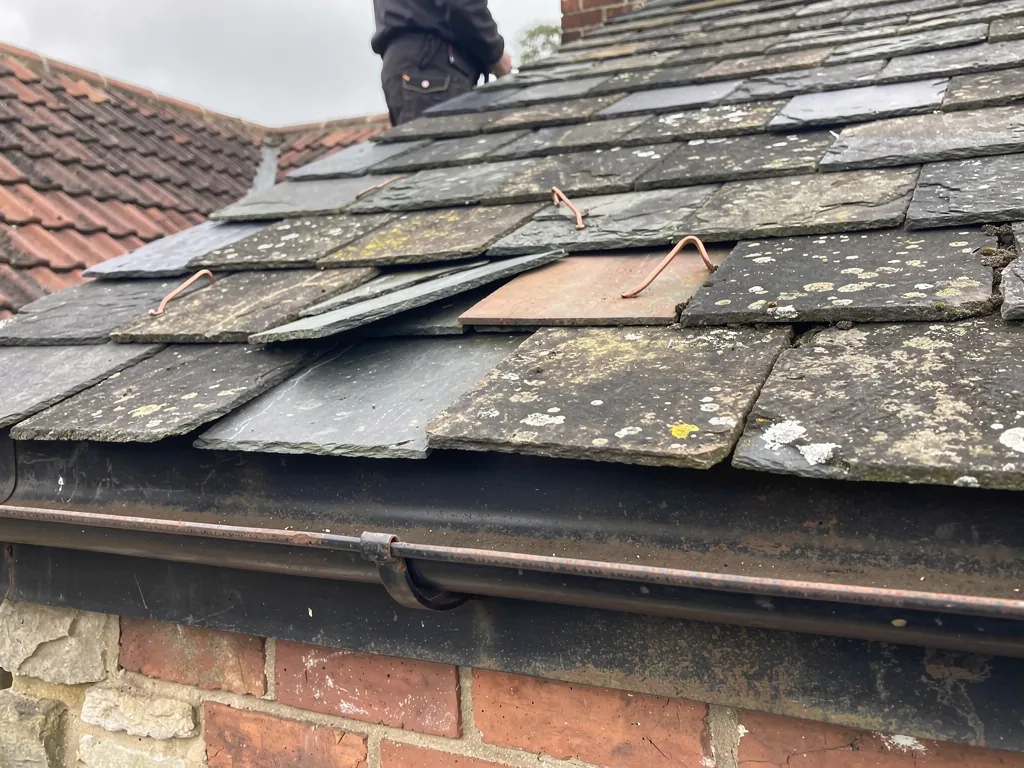
Access is where repair quotes surprise people. A roof you can reach with a ladder and a roof you cannot are priced very differently, and the difference can exceed the cost of the repair itself.
MyBuilder's scaffolding guide, updated 21 August 2026, quotes around £850 to £1,200 for a normal setup on a two-storey house, and scaffold for a chimney at high level at £400 to £900. Checkatrade, in a February 2026 guide, gives about £875 per month for a semi, and £660 a week for chimney scaffolding. Which figure applies depends on how long the scaffold stays up, which in turn depends on the weather and the size of the job.
Could a ladder or a tower do instead?
Sometimes. On a single-storey repair, a porch or a low extension roof, a ladder or small tower may be enough, and that costs far less. A job on a ridge or a chimney stack is another matter: working at that height without a platform raises both the risk and the chance of cracking the slates around your feet. We tell you which access we have allowed for in the written quote, and our answer on roof work without scaffolding says when it is and is not sensible.
Ask each quote whether the figure covers VAT and scaffolding. A smaller number that omits both can end up larger than one that includes them.
What common repairs cost on their own
Some repairs have their own published ranges, which help when your fault is a single item.
- Ridge tiles. MyBuilder puts a ridge tile re-bed or replacement at £300 to £600, and £200 to £400 to repoint a ridge or hip.
- Lead flashing. Checkatrade gives £50 to £70 a metre for a code 5 flashing not exceeding 150 mm, and £80 to £120 a metre for stepped flashing, with VAT on top.
- Chimney leadwork. MyJobQuote, in a guide dated 22 September 2026, gives £150 to £250 for a patch repair and £350 to £460 for full replacement without scaffold, about £700 to £920 with it.
- Valleys. The cost of repairing one depends on the lining, and is covered in roof valley repair cost.
- Sagging sections. These involve timber, and are set out in the cost of repairing a sagging roof.
Lead codes are the weight grades of sheet lead, and a higher code is thicker and costs more. Leadworx calls code 4 its standard pick for everyday flashing, while code 5 is the next weight up.
These are national figures. A roof in Swindon, Marlborough or Cirencester may price a little above or below them depending on access and the covering, and the cause of the fault. To know what the cause is, see our guide to the usual causes of roof leaks.
What pushes a repair to the top of its band?
Four things do most of the pushing, and none of them shows from the ground.
Is the roof old enough to hide surprises?
Older roofs often have no underlay, or one that has perished, so a repair that looks simple from outside can expose battens that crumble when touched. Replacing those is cheap per piece but adds time. When a handful of tiles lift and the timber under them is soft, the repair grows from a patch into a section, and the quote reflects what the survey photographs show.
Can the covering be matched?
Concrete tiles from an estate house are easy to match. Hand-made clay, old peg tiles, Welsh slate and stone slate are not, and a repair that needs the right material takes longer to source. Matching can also mean taking sound pieces from a less visible slope, which is skilled work.
Is the fault shared?
On terraces the chimney, valley or party wall detail may belong in part to a neighbour, which adds a conversation and sometimes a split bill. Our page on terraced house roof repairs covers how that usually works.
Has the repair been left?
A small defect left through a winter often turns into wet insulation, stained plaster and rotted timber, and the bill then covers all of it. That is why we suggest booking a survey when a fault first appears, even when it looks minor. Our page on the roof repairs service lays out how we handle the visit.
Making sense of the written quote
When the survey is finished, a written quote arrives together with photographs of your own roof. The figure is one total, and we think a fair one. The photographs show what the figure is for, so you can see the slipped slates, the cracked lead or the lifted ridge for yourself and decide whether the fix makes sense.
When you read any roofing quote, a few checks save trouble.
What should a quote say it includes?
Look for whether VAT is in the figure, whether scaffolding or other access is covered, whether waste is taken away and whether the work carries a guarantee in writing. Ours carries a written 10-year workmanship guarantee, and the site is left tidy, waste gone.
What if the survey finds more than you booked?
Then we tell you before anything else happens, with the photograph, and the advice is to do only what properly fixes the fault. A bigger job is offered only when a smaller one would fail, and we explain why. That is the same approach covered in what happens during a roof repair.
If the numbers above look high for the fault you have, send us a photograph and a short description. The price depends on what the survey finds, not on a rate card, and we would rather you knew the likely band before a visit than after.