
A roof repair is rarely a mystery once you know the sequence. Somebody looks at the roof, a price is agreed in writing, access is arranged, the fault is fixed and the site is left clean. What differs from house to house is what the looking turns up, and that is the reason the survey is done before any price is set.
Below we walk through each stage as it works with us, explain what you will see on the day, and say where your own decisions come in. Where a stage depends on the building, we say what changes. Still weighing up whether to do the work at all? Our page on repair or replace is a better place to begin. If you want the numbers, see roof repair costs.
Stage one: the first message and what to send
The number is 01793 626096. WhatsApp works too, as does the enquiry form on each page of the site. We ask where the roof is, what you have seen and when it appears. Water on the ceiling after wind and rain from one direction tells us something different from a stain that grows in dry weather, so a few details save a wasted visit.
If you can, send photographs. A picture of the ceiling stain, another of the roof taken from the street or garden, and one of anything odd, such as a slate on the lawn, give us a head start. Keep your feet on the ground to take them: nobody should climb a roof for a photograph. The bundle helps us arrange the right access and the right person for the survey.
What if the roof is leaking right now?
Leaks and storm damage are our priority, and when water is coming in, the roof is made safe first. That means halting the immediate harm with a temporary cover or a holding repair, then planning the permanent fix. A make-safe is a bridge to the proper repair, not a replacement for it, and our guide to temporary roof repairs explains what to expect.
If you are not sure whether what you can see is a leak at all, our pages on water stains on ceilings and leaks that only appear in heavy rain help you describe it.
Stage two: the survey and the photographs
The survey is a visit to look at your roof properly, from its covering down to its timbers. We check the outside from ladders or a safe vantage point, then go into the loft where we can. In the roof space we look for daylight, damp timber, wet insulation and the stains that mark where water has run.
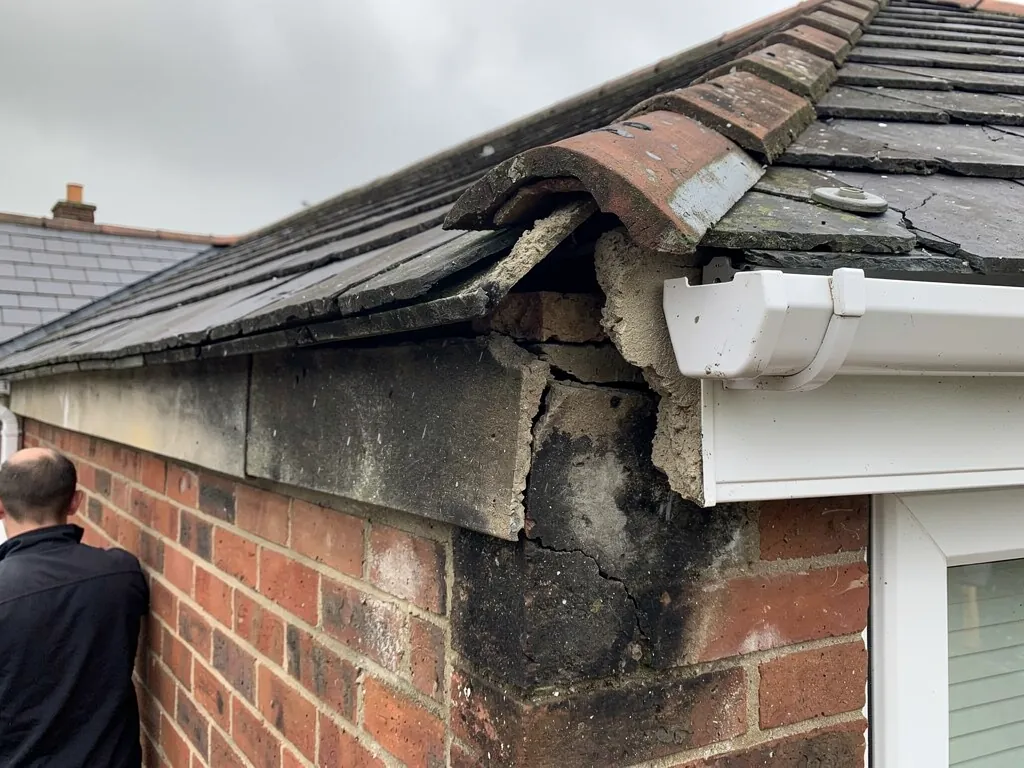
The outside check follows a routine. First the covering, then the ridge and the hips (the sloping corners of a hipped roof), the verges at the gable ends, the valleys, the flashings and the chimney, and last the gutters and fascias around the edge. Each one is a place where roofs fail, and a leak that seems to come from one slate often has its origin at a joint further up the slope.
Why does the loft matter so much to the diagnosis?
Because the roof's underside tells the history. A water track on a rafter shows where water has been entering, old stains show how long it has been going on, and fresh damp shows what is happening now. Without the loft, a roofer is reading only half the evidence.
What do the photographs show?
We photograph the faults and the roof around them, so that the quote talks about your roof and not a roof in general. The photographs come with the quote. They are there so you can follow the reasoning, show a family member or a landlord, and compare the explanation against what you can see for yourself.
Pitched and flat roofs get different treatment. On a pitched roof, the tiles or slates are lifted gently at suspect points to check the battens and fixings beneath. On a flat roof we look for ponding, which is standing water that stays after rain, for blistering and splits in the covering, and for the upstands and outlets where flat roofs most often fail. On an older house with no underlay, the loft side matters more still, because there is no second barrier to hide a fault.
A survey can also find that no repair is needed, or that a different cause lies behind the symptom, such as condensation or a blocked gutter. We say what we found, whatever it is.
Stage three: the written quote and your decision
Next comes the written quote. It is one total price, and it follows the recommendation that the repair should be no bigger than the fault needs. The figure is a fair one, we believe, and the photographs show what the money is for. If you want typical national ranges for context, our repair cost guide sets them out with their sources.
Read the quote for what it covers: the area of roof, the material, the access and the work at each fault, and check whether VAT and scaffolding are part of the figure. If a quote leaves out scaffolding on a two-storey house, ask why.
Can you take time to decide?
Yes. A written quote is not a pressure device, and the repair is yours to accept, change or decline. Questions asked now beat a misunderstanding found halfway up the scaffold.
What are your rights once you agree?
A contract made at your home gives you 14 days to cancel, counted from the day it is made. Work begins within that window only if you have asked us in writing, as a letter or an email. Should you cancel once work has begun, you pay for the part already carried out. The detail is on our page about the cooling-off period.
The quote also names the guarantee: ten years on our workmanship, in writing. It covers the work we do. It is not an insurance-backed policy, and our guarantee page sets out what that means in practice. For the wider picture of repairs across the service, see roof repairs.
Stage four: access, preparation and who needs to be there
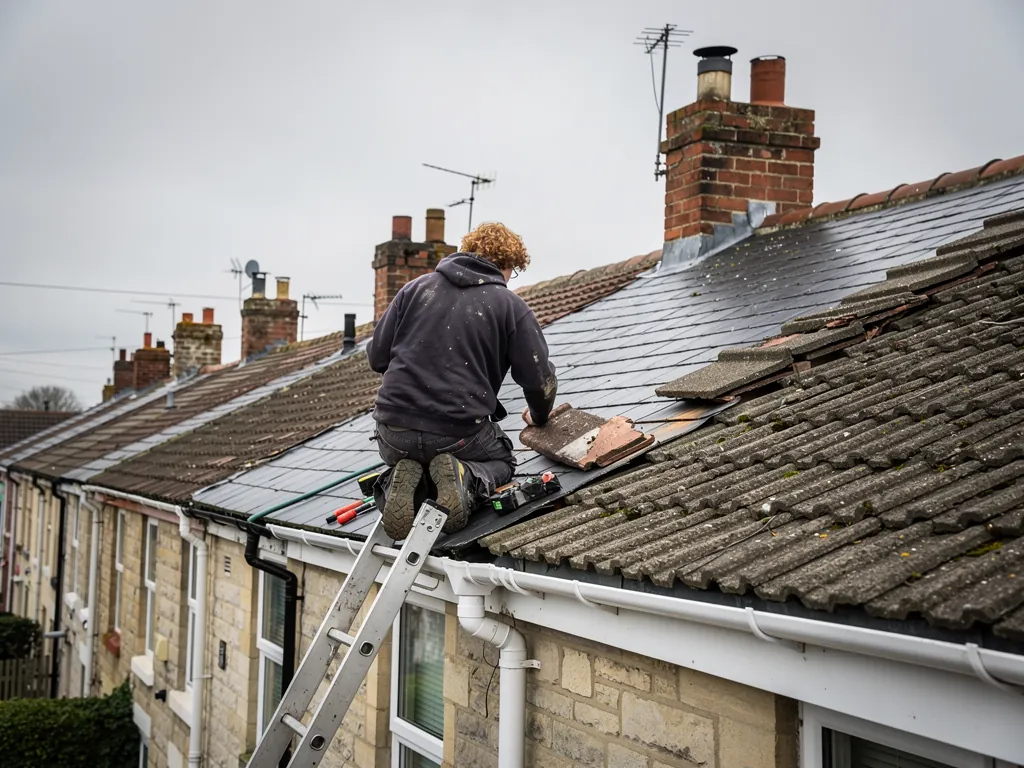
Before the repair, access is organised. For a low roof that may mean a ladder or a small tower. For a ridge, a chimney or a roof over two storeys, scaffolding goes up first, and it should be in place before anyone steps onto the slope. Scaffolding costs money and takes a day to put up and take down, which is why we say clearly in the quote whether it is included.
You need to do very little. A few practical points make the day smoother.
- Move cars from the front or drive if scaffold or materials will go there.
- Clear the way to the loft hatch if the repair needs access from inside.
- Lift fragile items out of rooms directly below the work.
- Tell neighbours on a terrace, because access sometimes crosses their land or the work shares a wall.
Do you need to be at home?
Not for the whole job, but someone should be available at the start to agree where we can work and to answer a question or two. On an occupied house we take care with floors and gardens, and we cover what needs covering.
What if the weather changes?
Rain, high wind and frost can stop a repair, and some materials such as mortar and sealant have temperature limits. If the forecast turns, we protect the roof and rebook the visit rather than risk a poor repair. Our guide to roof repairs in winter covers what can wait.
Stage five: the repair itself
What happens on the roof depends on the fault, but the order is broadly the same. We remove what has failed, check what is under it, repair or replace it, and test the result. On a slipped slate that may mean refixing with a tingle, a small strip of metal that holds the slate in place. On a lead flashing it means taking out the failed lead and fitting new, correctly dressed and fixed. On a flat roof it may be cutting out a blistered section and lapping new membrane in.
Matching matters as much as mending. The replacement tile or slate should suit the roof it joins, in size, thickness and colour, and the new lead should be a weight that suits the position. On an estate house with concrete tiles that is straightforward. On older properties it can mean cutting a few sound pieces from a hidden slope so the visible ones match, and that is slower, careful work.
The aim is to fix the cause, not the sign. A tile that keeps slipping may have rusted nails, and refixing the one tile without checking its neighbours only moves the problem. If the survey shows wider failure, the quote reflects it, and we explain how it compares with a larger job. The same logic applies to a roof that sags in places, which is covered in the page on repairing a sagging roof.
Does repair work need Building Regulations approval?
Usually not, when the repair is a small one. Under Planning Portal guidance, repairs or re-covering do not usually need a building control application where less than 25 per cent of the total building envelope and less than 50 per cent of the roof is affected. Where the work does cross those lines, we explain what consent applies and deal with the Building Regulations notification for you.
How do you check the finished work?
We look again at the repaired area and its surroundings before the scaffold comes down, and photograph the result. Where the fault was water ingress, we recommend watching the ceiling through the next heavy rain, since some leaks take a while to dry out and show whether the fix has held.
Stage six: clearing up, paperwork and the guarantee
Once the work is checked, the site is swept down and rubbish leaves in our vehicle. Broken slates, offcuts and packaging leave with us, and the scaffold comes down once the work has been checked. Gutters and paths are left clear, which matters more than it sounds when slate grit has fallen into them.
You receive the paperwork that goes with the job. The key document is the written guarantee on our workmanship, which runs for 10 years. It covers the work we carried out, not unrelated parts of the roof, and the wording makes that difference plain. Our answer on whether roof repairs come with a guarantee explains why a repair guarantee is narrower than a re-roof.
Keep the guarantee and the photographs together with your house papers. They help if you sell, and they show a surveyor that the work was done and recorded.
What if something goes wrong afterwards?
Tell us promptly, with a photograph and the date. If the problem comes from our workmanship, we put it right under the guarantee. If it is a new fault elsewhere, we tell you and quote for it as a separate job. Either way you get a clear answer.
For the typical duration of the common jobs, from a single tile to a valley, see how long a roof repair takes.