
When water is coming through a ceiling, price is the second question on most people's minds, straight after how to stop it. The honest position is that no one can give a trustworthy figure for your roof from a phone call. What can be said is where national guides put typical storm repairs, what lifts a job to the top of that range or drops it to the bottom, and how the money splits when an emergency becomes two pieces of work: a temporary cover now and a lasting repair afterwards.
The figures below come from published third-party guides and are national, not Skyline prices. We survey first, then put the price in writing. If you are still deciding what to do about an active leak, our section on emergency roof repairs sets out the order of play.
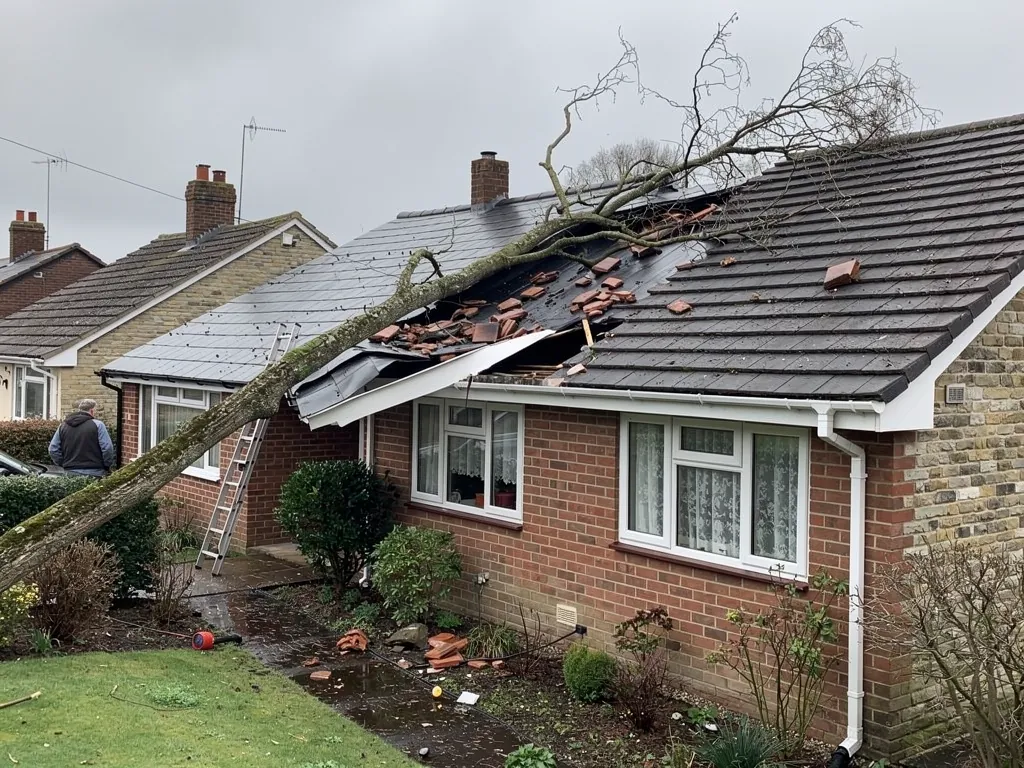
The published range for storm repairs
MyBuilder's roof repair price guide, updated on 21 August 2026, gives a general range of £150 to £1,500 for roof repairs and puts storm fixes at £500 to £1,500. The same guide breaks repairs into bands by seriousness: minor work at £100 to £300, moderate work at £500 to £1,000, and major work at £2,500 or more. Those figures describe a national spread of jobs, not a quotation for any particular house.
| Type of job | MyBuilder range (updated 21/08/2026) |
|---|---|
| Minor repair | £100 to £300 |
| Moderate repair | £500 to £1,000 |
| Storm fixes | £500 to £1,500 |
| Major repair | £2,500 or more |
A storm fix lands at the lower end when the damage is a handful of slipped or missing tiles on an easy slope that can be reached from a short ladder or a low scaffold. It moves higher when the fault is in a ridge or hip, when lead has been torn from a chimney, when a section of battens and underlay has to be replaced, or when the damage spreads across more than one slope.
Why is the spread so wide?
Because roofs differ so much. A concrete-tiled semi with a front slope at head height is a different job from a clay-tiled terrace with a rear lean-to over a kitchen, and both differ from a slated gable with a stack in the middle. Material availability matters too. Matching an old clay tile or a particular slate can take a search, and that search shows in the price.
What scaffold adds
Access is the line that surprises people most. Many storm repairs cannot be done safely from a ladder, especially at height, at an awkward angle or around a chimney, and then the job needs scaffold. MyBuilder's scaffolding guide, also updated on 21 August 2026, gives around £850 to £1,200 for an ordinary two-storey house, with a weekly domestic hire of £300 to £900 and high-level chimney scaffold at £400 to £900. Checkatrade's scaffolding guide, last updated in February 2026, gives roughly £875 a month on a semi and £660 per week for chimney scaffolding.
These figures are not additions to a small job by default. A repair done from a ladder or a low roof avoids them, and a repair that needs a tower for a chimney only pays for a tower. The point to keep in mind is that scaffold can be larger than the repair itself. A £400 repair on a tall house with scaffold is a different total from the same repair on a bungalow.
Should the scaffold be left up after the repair?
Only if the permanent work follows soon. If a temporary cover goes on now and the lasting repair is a week or two away, leaving a scaffold in place can cost less than taking it down and putting it up again. If the permanent repair is weeks off, taking it down is usually the better route. That is a question for the survey, since it depends on the property and the work.
When you compare quotes from any firm, check whether each includes VAT and whether scaffold is included in the total or added to it. A lower figure that leaves both out is not the cheaper job.
Temporary protection and the permanent repair are two jobs
An emergency repair often runs in two stages. The first stage makes the roof safe: stopping the water, covering the opening and protecting the building from the next shower. The second stage fixes the cause properly, with the right tiles, lead, battens or timber, once the weather and access allow. Treating them as one job hides what you are paying for, and mixing them up leads to disappointment when the temporary cover is not the end of the story.
The temporary stage is about speed and safety, and the cost depends on how much roof has to be covered, how high it is, and whether the cover can be fixed without access equipment. We do not have a sourced national figure for the temporary stage, so we do not quote one here. Our page on temporary roof repairs describes the cover itself, and the written quote after survey fixes the price for your roof.
The permanent stage is priced as ordinary roofing work, using the ranges above. Where a tarpaulin has been used, our guide to the roof tarpaulin explains why it is a stopgap, how it is fixed, and how long it can reasonably stay in place.
Does paying for the temporary cover mean the repair costs less?
Not directly. A temporary cover makes the building safe and buys time. The permanent job still needs to be scoped and priced on its own. What it can do is stop damage spreading, which keeps the permanent job smaller. Water left running into insulation and plasterboard turns a roofing problem into a roofing and decorating problem.
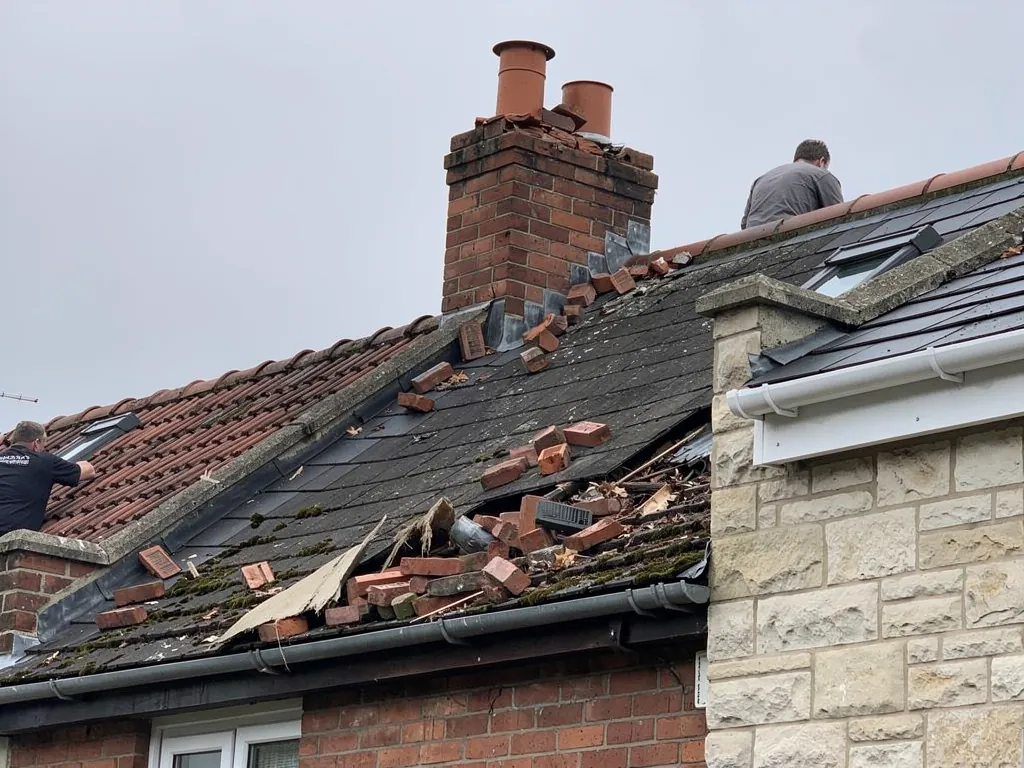
What moves the price of a storm repair
Four things matter most: where the damage is, what the covering is, how much of it has been hurt, and how the roof is reached. A fault at the eaves of a bungalow is cheaper than the same fault at a gable apex on a three-storey house, and a repair near the ridge costs more than one near the gutter because of the reach and the risk.
Covering matters because it dictates materials and skill. Natural slate, clay peg tiles and stone slate are slower to repair than machine-made concrete tiles, and the tiles themselves may be harder to source. Lead flashings need the right code of lead and someone competent to dress it. Flat roof coverings, such as felt, EPDM (a synthetic rubber membrane) and GRP (glass-reinforced plastic), each have their own repair methods and their own limits, and a patch that works on one may be wrong for another.
The amount of damage matters because labour and materials scale with it, but not in a straight line. The first slate on a roof costs the most to replace, because the work includes the access, the setting up and the checking of the surrounding area. Each further slate adds less. That is why, on a roof with six cracked slates, replacing all six is often only a small step up from replacing one. It is also why a firm that quotes a very low figure for a single tile may be counting on finding more work once it is up there, so ask what the survey photographs show.
Does a large storm push prices up?
After a widespread storm, demand for roofers rises across a whole area, and waiting times lengthen. Whether a particular firm changes its prices is a matter for that firm. What you can do is ask for a written quote, ask what it covers, and decline pressure to agree on the spot.
Reading a quote, and spotting a bad one
A sound quote tells you what is being done, to which part of the roof, with what materials, whether it includes access and VAT, and what guarantee applies. Ours arrives in writing after the survey, with pictures of the fault on your roof that you can look at yourself. The price is a single total, and we explain what drives it so you are not left guessing.
Treat a few things with caution. A demand for full payment before any work begins is one. Another is a flat claim that the whole roof is finished, made from the ground, without any photographs. A third is a fixed price offered by phone for a roof nobody has looked at. Pressure to decide that day, on the grounds that the price will rise tomorrow, is also a reason to stop and ask for the quote in writing. Our guide on storm damage claims covers the paperwork side of a bad night.
Can I cancel if I agree on my doorstep?
Under the Consumer Contracts Regulations 2013, a contract made at your home generally carries a 14-day cancellation period. Work can begin inside that window only where you have expressly asked for it in writing, by letter or email, and a cancellation after that point means paying for what has been done. Some emergency work is started at once for good reason, and a firm should be clear with you about this in writing.
Insurance, snow and other things that change the sums
Insurance can change who pays but not what the work costs. If you intend to claim, speak to your insurer early, and before agreeing anything larger than a temporary cover. ABI advice issued for Storm Eunice in 2022 said to arrange only the emergency repairs needed to stop damage getting worse, to speak to the insurer first, and to keep receipts. Whether a policy pays depends on its wording and on the cause, and Which? has reported that insurers often rely on a storm definition that includes wind gusts of at least 55mph. Nobody can promise in advance that a given claim will succeed.
Snow and ice follow similar logic. Weight on a roof can push tiles out of line or stress a flat roof deck, and the cost of repair depends on what actually failed, which only a survey shows. Our page on snow damage to a roof covers the signs.
How do I keep costs down in an emergency?
Photograph the damage, keep the area clear for access, and give the roofer clear information. Resist the urge to paint, seal or patch over the evidence first. Ask for a repair that deals with the fault properly, not with the whole roof, unless the survey shows the covering is worn out across the board. We lean towards the modest repair, and if one will not hold, you will be told why a bigger job is the better spend.
Finished work is backed by a written guarantee of ten years on the workmanship, and the waste leaves with us.