
Most of the year a tiled roof sheds water without anyone giving it a thought. Winter changes the conditions rather than the roof. Water that has soaked into a tile freezes and expands. Wind that was a stiff breeze in summer arrives as a sustained gale and pulls at the edges of a slope. Snow adds weight and, when it melts, finds routes that rain never takes.
None of those forces will harm a sound, well-fixed roof. They show up the weak points: a tile with a hairline crack, a nail that has rusted, a ridge bedded on tired mortar, an underlay that was torn years ago. That is the useful way to think about this season. It is a check on what has already gone wrong, and the aim of this guide is to help you notice problems early, tell the urgent from the patient, and know what work needs better weather. For a wider look at the cost side of repairs, see our guide to tiled roof repair costs.

How frost gets into clay and concrete tiles
Every roof tile is slightly porous. Clay and concrete both take up a little moisture in wet weather, and a tile that is wet through in a hard freeze has water in its pores that turns to ice. Ice takes up more room than water, and in a weak tile the pressure splits the surface. Over repeated winters the damage shows as flaking faces, thin layers peeling away, or a crack that was invisible in autumn running across the tile.
Tiles differ in how well they resist this. Good-quality clay is fired hard and takes up little water, which is part of why some clay roofs last for generations. Older handmade tiles, fired at lower temperatures, can be softer and more open. Concrete tiles carry a surface coat and are generally hard-wearing, but the coat wears thin on exposed slopes and the tile beneath then takes up more water.
Which tiles are most at risk?
Tiles on the exposed side of a house, those that stay shaded and damp, and those with existing cracks. Moss keeps a damp film on the face of a tile, so a mossy north slope is a likelier place for frost damage than a sunny south one. A cracked tile is a particular worry because the crack fills with water, freezes, widens, and repeats the cycle all winter.
What to check from the ground after a cold snap
Stay on the ground. Most winter damage shows from the garden or the pavement if you know where to look, ideally on a bright day with binoculars. Walk round the house and compare slope with slope.
- Fragments of tile or small flakes of clay on paths, lawns or flower beds beneath the eaves.
- Dark patches on a slope where a tile face has come away and exposed the unglazed body.
- A tile sitting lower than the ones beside it, or tilted, which means it has slipped.
- Gaps or missing tiles near the ridge, at the verge or around the chimney.
- Gutters full of grit, with a gritty orange or grey deposit in the outlet, which is tile surface being washed off.
Indoors, the loft tells the rest. Check for daylight, for damp patches on the underlay, for a drip or a stain on insulation, and for frost on the underside of the roof in a very cold spell. Frost on nail points or timber is condensation freezing, and our guide to roof ventilation explains why it forms.
What if I can see a problem?
Photograph it from the ground, note the date and the weather, and send it to us. A loose tile hanging over a path or a front door is worth acting on quickly, because it can fall; a roof that is actively letting water in is dealt with first, and made safe before it is repaired. Anything else can wait for a proper look. Our guide to checks after a storm follows the same approach for wind damage.
Wind uplift and why fixings matter
Wind does not just push on a roof; it lifts. Air crossing a pitched roof creates suction on the sheltered side and along the edges, and a tile that is only held by its own weight and a nail or two can be pulled up and thrown. The most exposed spots are the ridge, hips, verges and eaves, so that is where fixings matter most.
Standards have moved on. BS 5534 was revised in 2014 so that mortar by itself no longer holds ridge and hip tiles; they are fixed mechanically too. Dry-fix systems are tested against BS 8612. Older roofs, built when mortar bedding on its own was commonly accepted, are the ones where ridge tiles rock and lift first in a gale. Our page on ridge, verge and dry-fix work explains the options.
Do roof tiles need clips?
On many roofs, yes. Tiles can be secured with nails, clips or both, depending on the tile, the pitch and the exposure. Interlocking tiles often have a nib that hooks onto the batten, but in a strong wind a nib alone may not be enough. Our answer on whether roof tiles need clips sets out how that is decided, and the one on tiles lifting in the wind covers what the first signs look like.
Wind-driven rain adds to the problem. It is pushed up under the laps of tiles and over the top of the headlap, so a roof that seems watertight in ordinary rain can leak in a gale. So a slightly lifted old slope can stain a bedroom ceiling only when the gale blows from a particular quarter.
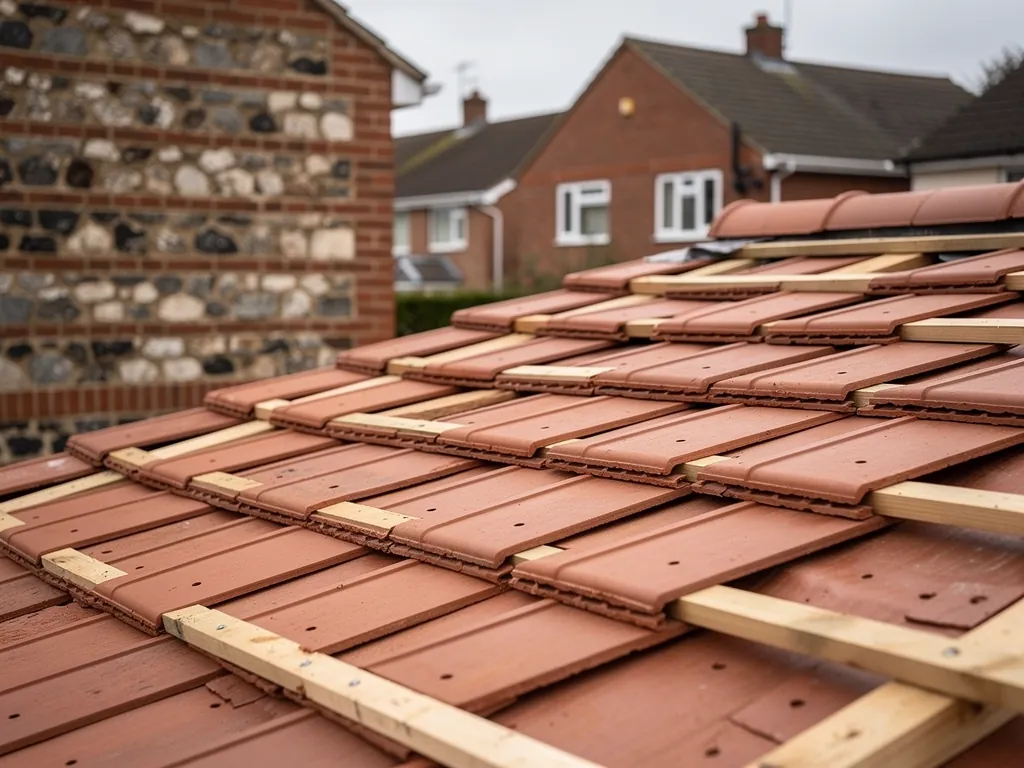
Snow load, powder snow and the thaw
Snow is weight, and then it is water. A roof with a sound structure carries snow without complaint, but an older roof with sagging rafters, a spreading ridge or rotten timbers can be pushed further. Tiles are heavy in themselves; Marley gives its concrete plain tile at 73.8 kg/m² laid at a 100 mm gauge, so an old roof already works for a living. If you see a roofline dipping, a ceiling cracking or a door sticking after snow, stop and have it looked at. Our guide to roof spread explains what to look for.
Powder snow is a quieter hazard. Fine snow is blown under the laps of the tiles and settles on the underlay, then melts into the loft when the weather turns. The tiles look intact; a damp patch or a drip on a milder day is the only clue. A sound underlay catches that water and sends it to the gutter, which is the job it is there for. Where the underlay is torn or missing, the meltwater runs straight onto insulation.
Should I clear snow from the roof?
Generally no. Raking snow off a tiled roof from the ground risks pulling tiles loose, and climbing up in icy conditions is dangerous. Snow sliding off in sheets can take gutters with it, so keep clear of the eaves. The practical work is to look for damage after the thaw. Our guide to snow damage to roofs sets out what to look for.
Never walk on a tiled roof in frost or snow. A cracked tile you did not see will not hold your weight, and the surface can be slick.
Valleys, flashings and the details that fail first
Tiles themselves are only part of the story. In winter the joints between them and the structure take the strain. Valleys carry the water from two slopes and freeze solid in a cold night, which can crack a brittle liner or push debris against its edges. Lead flashings against walls and chimneys move with the temperature, and old, hard lead splits where it has been bent too often. Flaunching around chimney pots cracks and lets water in, and the frost then lifts it.
Gutters matter as well. A gutter blocked with leaves holds water, and in a freeze the weight of ice can pull a bracket or crack a joint. When the thaw comes, water overflows behind the fascia and shows up as damp at the wall head, not the roof. Our guide to roof valley types explains how each kind of valley behaves in hard weather.
Does a dormer or loft conversion change the picture?
Yes, because there are more junctions. A dormer has cheeks, a roof of its own and flashings on three sides, and each one is a place for frost, wind and meltwater to work on. A converted loft also has a bedroom or study directly beneath the covering, so a failure shows sooner and does more harm. Our guides to dormer roofs and loft conversion roofs go into those junctions.
Which tile jobs can wait for better weather
Not every repair needs doing in a cold snap, and some are better done later. The rule we work to is simple: make it safe now, repair properly when conditions allow. A leak that is damaging a ceiling, a tile that could fall, and a gap that lets wind and water into the loft are the first to be dealt with. A temporary cover, a re-fixed tile or a patch can hold until the proper repair.
Mortar is the main constraint. Mortar for ridges, verges and flaunching has to cure, and frost in that window can ruin it. Mortar work is therefore usually better scheduled for milder weather, unless the situation is urgent. Dry-fix systems and mechanical fixings have fewer such limits, which is another reason they are used on winter repairs. Our guide to ridge repairs in winter deals with that choice.
Can a whole slope be relaid in winter?
It can, but it is a matter of weather windows. Stripping a slope opens the roof, so the work has to be planned around a dry spell, with the covering and underlay renewed before the weather turns. Short, bright, dry days are workable. Wet, windy or icy days are not. On a larger job the survey comes first, then the written quote, and then we agree timing with you. Typical costs for the smaller repairs are in our guide to tiled roof repair costs.
Planning a job for spring is often kinder to your budget and to the roof. A scheduled repair costs less than an emergency one, and the survey photographs show whether anything is deteriorating in the meantime. Workmanship is guaranteed for 10 years, and the site is left tidy. For the wider range of work, visit the pitched roofing page.