
Ridge tiles tend to announce themselves in the worst months. A gale lifts one, a frost cracks a bed that has been weakening for years, and the first sign is a cracked tile on the path or brown staining above a bedroom window. Then comes the practical question: can anyone bed new mortar on a roof in January?
The honest answer is that it depends on the day, and on the night that follows it. Mortar hardens by a chemical reaction that needs water and a reasonable temperature, and it is at its weakest in the first hours. Frost or heavy rain in that window can ruin a bed that looked perfect when the roofer came down the ladder. This guide explains where the limits lie, what a careful roofer does to work around them, and why a dry-fix system, which has no mortar to cure, often suits the colder part of the year. For the wider picture of methods, start with our ridge, verge and dry-fix section.
Can ridge tiles be rebedded in winter?
Yes, on the right days. Winter does not stop mortar work; it narrows the windows in which good work is possible. A roofer looks for a day that is dry, above freezing, and with a forecast that keeps the night above freezing too, because a bed that freezes before it has gained strength is the one that fails.
Each bag of mortar and each bedding compound has a manufacturer data sheet giving the lowest air temperature for laying it and the conditions it needs while it hardens. That sheet governs the product on your roof, so the limit is read off the packaging, not remembered. When the forecast drops below it, the sensible decision is to leave the ridge alone for a few days.
What happens if the weather turns after the work?
Rain is the other hazard. Heavy rain landing on a fresh bed can wash cement out of the mix and leave a weak, sandy joint. Light cover over the work and a dry forecast for the rest of the day keep that risk small. Where cover cannot be rigged safely in the wind, the job waits.
Does the temperature of the tiles matter?
It does. Tiles that are frozen or soaked pull water from a mortar bed unevenly, and a joint that dries too fast or too slowly bonds badly. Experienced roofers read the surface of the tile and the air together, which is why a winter rebed done on a mild, dry day often outlasts a summer job done in a rush.
Why does frost damage fresh mortar?
Mortar starts out wet. The water in the mix is what lets the cement and sand set, and until the bed has hardened, some of it is still free inside. When that water freezes it expands, forces the grains apart and breaks the bond that was only beginning to form. The bed may look intact for weeks. Then the first heavy rain finds the tiny cracks and a section of pointing falls out.
This is why a rebed laid in a cold snap often fails in a pattern: the pointing along the sunless side of the roof goes first, or the joints at the exposed gable end. The same bed laid on a mild morning on the south slope may be fine. The failure was set up on the day of the work, not by anything the weather did later in the year.
Do additives help?
Some products contain admixtures that speed setting or protect against early frost, and a few ready-mixed bedding compounds are formulated for colder working. They widen the window; they do not remove it, and each has its own minimum temperature on the data sheet. Roofers also use insulating covers over finished work when a freeze is forecast. None of this rescues a bed laid in a hard frost.
What does failed winter mortar look like?
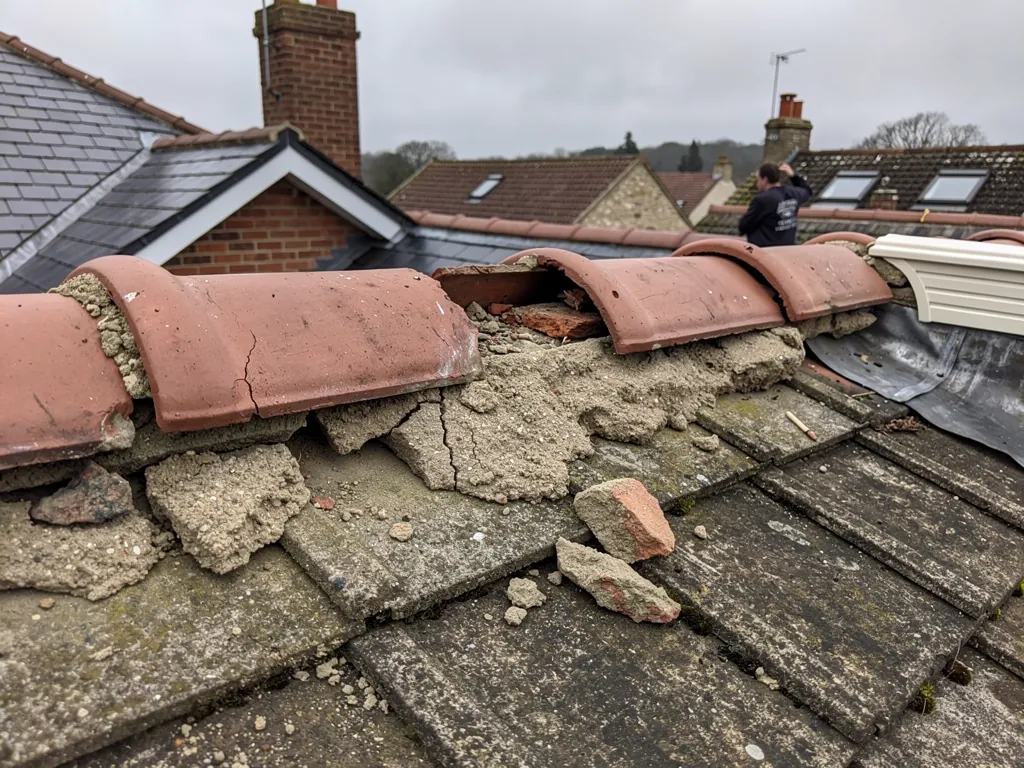
Sandy, crumbling pointing that rubs off under a finger, joints that look pale and powdery, and tiles that rock when pressed. If your ridge was done in the cold months and looks like this a season later, tell whoever carried out the work. A separate question is whether the bed was ever the only thing holding the tiles on: since BS 5534:2014, ridge and hip tiles are meant to be mechanically fixed as well as bedded, as our guide to the BS 5534 and BS 8612 fixing rules explains.
When is dry-fix the winter answer?
In a dry ridge, a batten, clips or screws, a cap and an edge seal do the work that a bed of mortar used to do. There is nothing wet in the system, so there is nothing to freeze before it has set. That is the heart of the argument for dry-fix in the colder months. The fixings go in the same on a frosty day as on a warm one.
Products are tested against BS 8612:2018, and only those that pass can claim compliance with it. The tiles are held by their fixings and not by the strength of a mortar joint, which is why the failure shown on the sunless slope in the last section does not arise.
Is dry-fix always possible in winter?
No, and it would be wrong to pretend so. A roofer still cannot work on an icy slope or in a high wind, and a dry-fix job on a wet, frosted ridge is slower and riskier than the same job on a dry day. Some seals and adhesive strips used under the cap have their own minimum fitting temperatures too, so the data sheet still applies. The gain is a wider range of workable days, not a licence to ignore the weather.
Does dry-fix suit every roof?
It suits most common concrete and clay tile profiles, but not every old or special tile, and not every heritage ridge. Our page on dry ridge and dry hip cost explains what it adds to the total, and the comparison of dry ridge against mortar sets out which roofs lean which way.
What can be done about a loose ridge until the weather improves?
A loose ridge in December is not a reason to panic, but it is a reason to act sooner than you would on a dry July morning. The risk is wind. Loose tiles at the top of a roof are the first to be lifted by a gust, and a falling tile can damage gutters, a car or a person below. If one has come off already, our answer on what to do when a ridge tile has fallen covers the first steps.
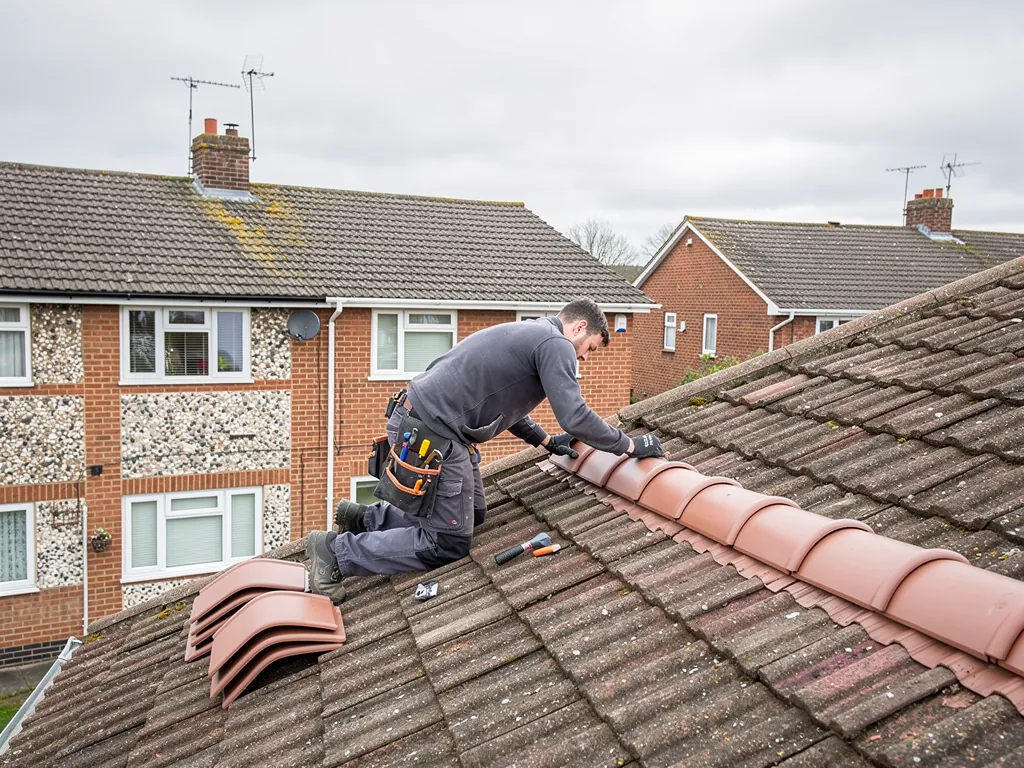
If a ridge is letting water in, we make that safe first, because leaks and storms come ahead of routine jobs in our diary. A temporary measure can be as simple as refixing a few tiles with mechanical fixings and no mortar, or covering an exposed section with a membrane that is properly weighted down. These are stopgaps. They buy time while the weather suits a permanent repair, and the quote we give you after the survey says clearly which part is temporary and which is the finished job.
Never climb onto a frosty or wet roof to inspect a loose ridge. Binoculars used from the garden show missing tiles and gaps in the pointing safely.
From the ground, look for tiles that sit at a different angle to their neighbours, pale lines where the old pointing has dropped away, and bits of mortar in the gutters or on the path below. Those clues, with photographs, give us a good starting point before we get up there.
How does cold weather affect heritage and lime-bedded ridges?
Older roofs often have ridges bedded in lime-based mortar, which is gentler on old clay tiles and lets the roof breathe. Lime mortar generally takes longer to harden than a sand and cement mix, which makes it more exposed to early frost, and a lime bed that has been through a freeze before it has gained strength is soft and open. Lime work is traditionally a warm-season job, and a careful roofer waits for settled weather rather than force it in January.
Where a ridge forms part of a listed building or sits inside a conservation area, the question is wider than temperature. Replacing tiles with matching ones is not normally a planning matter, but listed status brings its own consent rules for anything that touches the building's character. Beyond listing, a conservation area or an Article 4 direction can alter the position again. Swindon has Article 4 directions in the Railway Village and at Bishopstone. Speak to Swindon Borough Council's planning team, or whichever council covers your village, before booking anything. Our page on ridge tiles on listed and conservation-area homes goes through those cases.
Can a heritage ridge wait until spring?
Usually, if it is not letting water in and the tiles are not moving. A survey in winter still helps, because it lets the work be planned and the right tiles and mortar ordered for the first suitable run of dry weather. Where tiles are loose and likely to fall, they are made safe first.
Do verges have the same winter problem?
Yes. A verge is the raking edge of the roof where it meets a gable wall; its tiles usually sit on a mortar bed laid over a strip called the undercloak. Mortar there is exposed to rain from the side and the open sky above, and it freezes harder than mortar in a sheltered valley. A verge repointed in a cold snap suffers the same failure as a ridge, and it is often harder to cover safely.
For that reason, work on verges tends to follow the same rules: pick a dry spell, protect the work, and consider a mechanical dry verge system where the tiles and the building suit it. Our answer on what a verge undercloak is shows what sits under the tiles and why its condition matters before any new bedding goes on.
Should the ridge and verge be done together?
Often it makes sense. Scaffold is the biggest shared cost on a ridge and verge job, so doing both in one visit avoids paying for access twice. The published price guides give the national ranges for the ridge side of that; our guide to ridge tile repair costs lays them out with their dates.
Is it worth waiting for spring?
Sometimes. If the ridge is sound but the pointing is cosmetic, waiting does little harm, and a spring job on a settled week gives the best chance of a long-lasting bed. If tiles are already moving, the cost of waiting is the risk of a fall and a wet roof space, and the dry-fix option or a mechanical refix can sort things out in the cold months without compromising the finish.
Our approach is to choose the smallest repair that settles the problem. In winter that sometimes means a short, safe refix now and the full rebed later, and sometimes a dry ridge that does the whole job at once. You see close-up pictures of the ridge on your house before you decide, and a written quote follows. The work itself comes with a ten-year guarantee on paper. Old mortar and broken tiles go off site with us.